
ACCT 210 Homework Chapter 5, Fall 2012
American University of Beirut · Financial Accounting · 103 pages





Showing the first 10 of 103 pages. Download the PDF to see all of it.
More ACCT 210 files
- Drop Quiz Chapter 7 Quiz Questions · Summer 2017ChapterView
- Drop Quiz Chapter 11 Quiz Questions · Summer 2017ChapterView
- Drop Quiz Chapter 13 Quiz Questions · Summer 2017ChapterView
- Drop Quiz Chapter 2 Quiz Questions · Summer 2017ChapterView
- Drop Quiz Chapter 3 Quiz Questions · Summer 2017ChapterView
- Drop Quiz Chapter 4 Quiz Questions · Summer 2017ChapterView
- Drop Quiz Chapter 5 Quiz Questions · Summer 2017ChapterView
- Drop Quiz Chapter 6 Quiz Questions · Summer 2017ChapterView
Show the text of this chapter
© The McGraw-Hill Companies, Inc., 2010
Overview
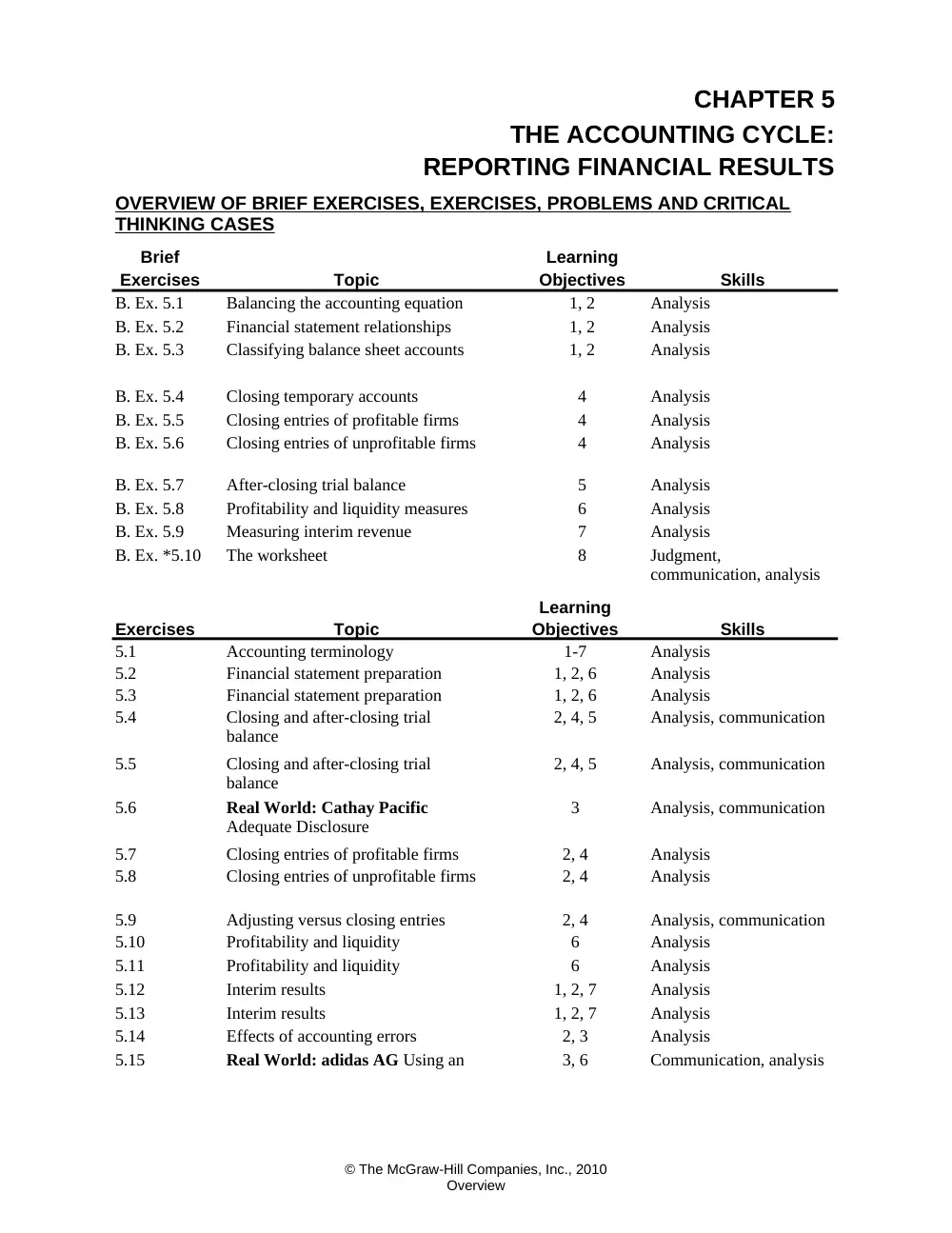
CHAPTER 5
THE ACCOUNTING CYCLE:
REPORTING FINANCIAL RESULTS
Brief
Learning
Exercises
Topic
Objectives
Skills
B. Ex. 5.1
Balancing the accounting equation
1, 2
Analysis
B. Ex. 5.2
Financial statement relationships
1, 2
Analysis
B. Ex. 5.3
Classifying balance sheet accounts
1, 2
Analysis
B. Ex. 5.4
Closing temporary accounts
4
Analysis
B. Ex. 5.5
Closing entries of profitable firms
4
Analysis
B. Ex. 5.6
Closing entries of unprofitable firms
4
Analysis
B. Ex. 5.7
After-closing trial balance
5
Analysis
B. Ex. 5.8
Profitability and liquidity measures
6
Analysis
B. Ex. 5.9
Measuring interim revenue
7
Analysis
B. Ex. *5.10
The worksheet
8
Learning
Exercises
Topic
Objectives
Skills
5.1
Accounting terminology
1-7
Analysis
5.2
Financial statement preparation
1, 2, 6
Analysis
5.3
Financial statement preparation
1, 2, 6
Analysis
5.4
2, 4, 5
Analysis, communication
5.5
2, 4, 5
Analysis, communication
5.6
3
Analysis, communication
5.7
Closing entries of profitable firms
2, 4
Analysis
5.8
Closing entries of unprofitable firms
2, 4
Analysis
5.9
Adjusting versus closing entries
2, 4
Analysis, communication
5.10
6
Analysis
5.11
6
Analysis
5.12
Interim results
1, 2, 7
Analysis
5.13
Interim results
1, 2, 7
Analysis
5.14
Effects of accounting errors
2, 3
Analysis
5.15
3, 6
Communication, analysis
OVERVIEW OF BRIEF EXERCISES, EXERCISES, PROBLEMS AND CRITICAL
THINKING CASES
Judgment,
communication, analysis
Closing and after-closing trial
balance
Closing and after-closing trial
balance
Real World: Cathay Pacific
Adequate Disclosure
Profitability and liquidity
measures
Profitability and liquidity
measures
Real World: adidas AG Using an
annual report
© The McGraw-Hill Companies, Inc., 2010
Overview
Real World: adidas AG Using an
annual report
*Supplemental Topic, "The Worksheet."
© The McGraw-Hill Companies, Inc., 2010
Overview (p.2)
Problems
Learning
Sets A, B
Topic
Objectives
Skills
5.1 A,B
Correcting classification errors
1, 2, 4, 6
Analysis, communication
5.2 A,B
1, 2, 4-6
Analysis, communication
5.3 A,B
1-4, 6
Analysis, communication
5.4 A,B
Interim financial statements
1, 2, 7
Analysis, communication
5.5 A,B
1–4, 6
Analysis, communication
5.6 A,B
1–4, 6
Analysis, communication
*5.7 A,B
8
Analysis, communication
5.8 A,B
6
Analysis, communication
Critical Thinking Cases
5.1
Adequate disclosure
3
Analysis, communication
5.2
Conflicts of interest
1
(Ethics, fraud & corporate governance)
5.3
3
5.4
Real World: Ford Motor Company
3
Annual report disclosures
(Internet)
Statement preparation and closing
process of a profitable firm
Statement preparation and closing
process of an unprofitable firm
Comprehensive problem combining
Chapter 4 and Chapter 5
Comprehensive problem combining
Chapter 4 and Chapter 5
Comprehensive problem combining
Chapter 4 and Chapter 5
Real World: Capcom/Carrefour
Evaluating profitability and liquidity
Communication, judgment,
analysis, research
Sarbanes-Oxley Act: CEO and CFO
personal certifications
Analysis, judgment,
communication
*Supplemental Topic, "The Worksheet."
© The McGraw-Hill Companies, Inc., 2010
Overview Desc.
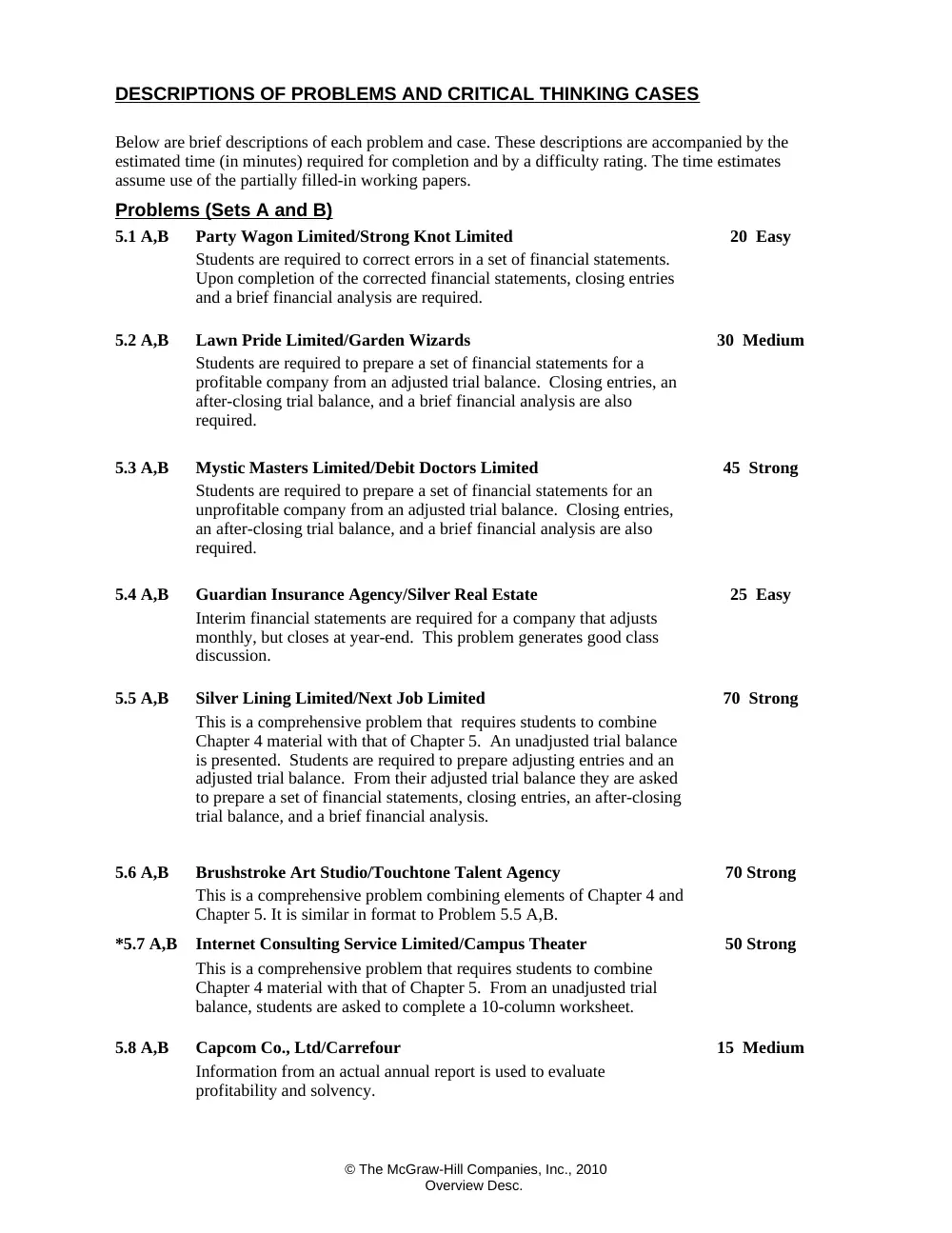
DESCRIPTIONS OF PROBLEMS AND CRITICAL THINKING CASES
Problems (Sets A and B)
5.1 A,B
Party Wagon Limited/Strong Knot Limited
20 Easy
5.2 A,B
Lawn Pride Limited/Garden Wizards
30 Medium
5.3 A,B
Mystic Masters Limited/Debit Doctors Limited
45 Strong
5.4 A,B
Guardian Insurance Agency/Silver Real Estate
25 Easy
5.5 A,B
Silver Lining Limited/Next Job Limited
70 Strong
5.6 A,B
Brushstroke Art Studio/Touchtone Talent Agency
70 Strong
*5.7 A,B
Internet Consulting Service Limited/Campus Theater
50 Strong
5.8 A,B
Capcom Co., Ltd/Carrefour
15 Medium
Below are brief descriptions of each problem and case. These descriptions are accompanied by the
estimated time (in minutes) required for completion and by a difficulty rating. The time estimates
assume use of the partially filled-in working papers.
Students are required to correct errors in a set of financial statements.
Upon completion of the corrected financial statements, closing entries
and a brief financial analysis are required.
Students are required to prepare a set of financial statements for a
profitable company from an adjusted trial balance. Closing entries, an
after-closing trial balance, and a brief financial analysis are also
required.
Students are required to prepare a set of financial statements for an
unprofitable company from an adjusted trial balance. Closing entries,
an after-closing trial balance, and a brief financial analysis are also
required.
Interim financial statements are required for a company that adjusts
monthly, but closes at year-end. This problem generates good class
discussion.
This is a comprehensive problem that requires students to combine
Chapter 4 material with that of Chapter 5. An unadjusted trial balance
is presented. Students are required to prepare adjusting entries and an
adjusted trial balance. From their adjusted trial balance they are asked
to prepare a set of financial statements, closing entries, an after-closing
trial balance, and a brief financial analysis.
This is a comprehensive problem combining elements of Chapter 4 and
Chapter 5. It is similar in format to Problem 5.5 A,B.
This is a comprehensive problem that requires students to combine
Chapter 4 material with that of Chapter 5. From an unadjusted trial
balance, students are asked to complete a 10-column worksheet.
Information from an actual annual report is used to evaluate
profitability and solvency.
© The McGraw-Hill Companies, Inc., 2010
Overview Desc.
*Supplemental Topic, "The Worksheet."
© The McGraw-Hill Companies, Inc., 2010
Desc. of Prob & Cases
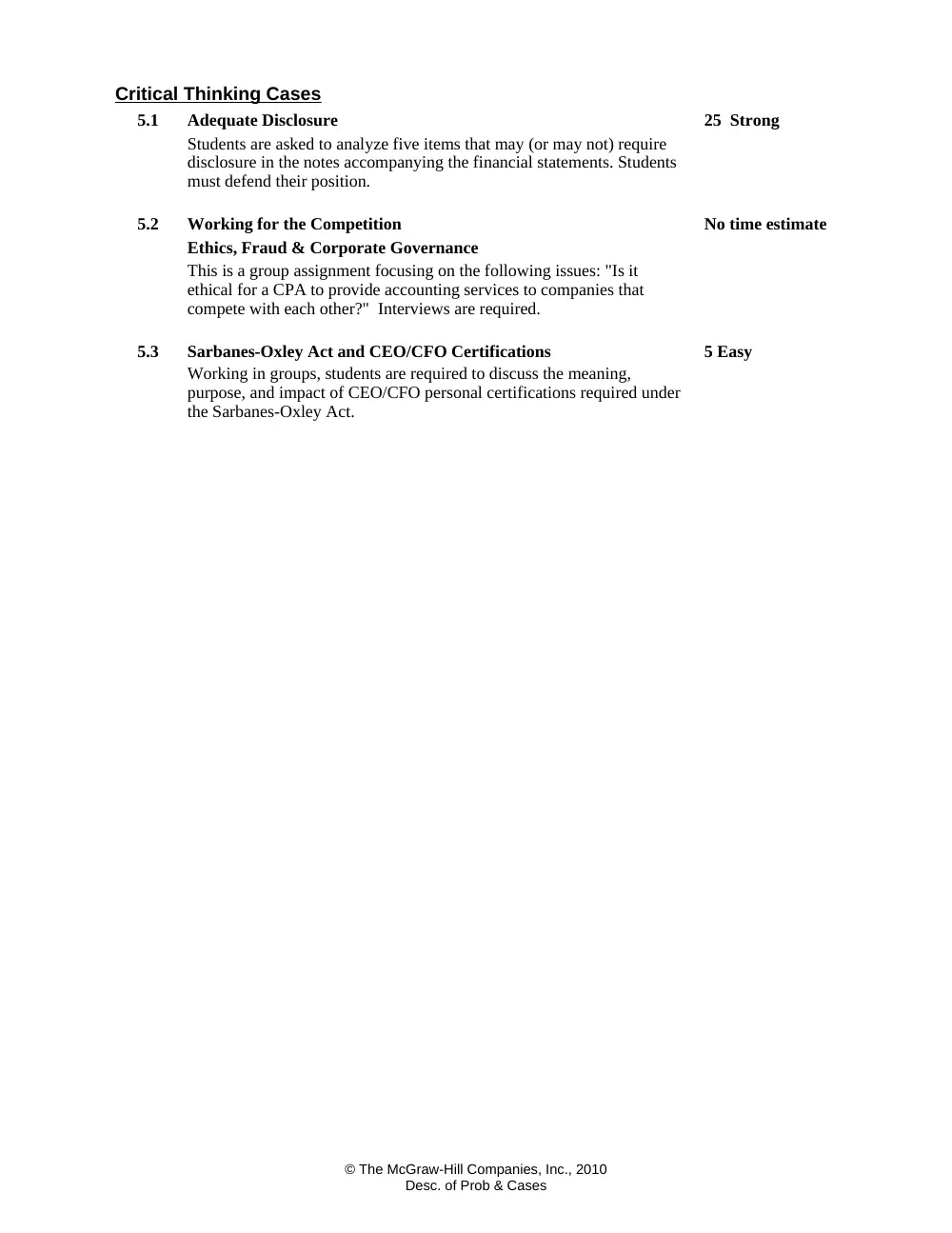
Critical Thinking Cases
5.1
Adequate Disclosure
25 Strong
5.2
Working for the Competition
No time estimate
Ethics, Fraud & Corporate Governance
5.3
Sarbanes-Oxley Act and CEO/CFO Certifications
5 Easy
Students are asked to analyze five items that may (or may not) require
disclosure in the notes accompanying the financial statements. Students
must defend their position.
This is a group assignment focusing on the following issues: "Is it
ethical for a CPA to provide accounting services to companies that
compete with each other?" Interviews are required.
Working in groups, students are required to discuss the meaning,
purpose, and impact of CEO/CFO personal certifications required under
the Sarbanes-Oxley Act.
© The McGraw-Hill Companies, Inc., 2010
Q1-6
SUGGESTED ANSWERS TO DISCUSSION QUESTIONS
1.
2.
3.
4.
5.
6.
An annual report generally includes comparative financial statements, supporting
information about the company’s financial position, its business operations, and a
discussion by management concerning the company’s future prospects. Before the annual
report is issued, the financial statements must be audited by a firm of Certified Public
Accountants (CPAs). Publicly owned companies must file their financial statements and
detailed supporting schedules with the Securities and Exchange Commission (SEC).
The income statement’s measurement of profit is not absolutely accurate or precise due to
various assumptions and estimates involved in the accounting process. For instance, the
amounts shown for depreciation expense are based upon estimates of the useful lives of the
company’s depreciable assets. Also, the income statement includes only those events that
have been evidenced by actual business transactions. For instance, a strong customer base
is an important step toward profitable operations; however the development of a customer
base is not reflected in the income statement because its value cannot be measured
objectively until actual sales transactions take place.
Retained earnings is that portion of shareholders’ equity created by earning income and
retaining all or part of the resources created in the business. Profit is a function of revenue
less expenses. We have learned that cash is not always received at the exact time that
revenue is earned, nor is cash necessarily disbursed at the exact time that an expense is
incurred. Thus, the profit retained by a company is not in the form of cash. Even if a
company’s profit did equal its net cash inflow, the amount retained would not be kept in the
form of cash. As the company grew, the cash would be converted into property, plant,
equipment, and other assets.
Dividends are not part of income. As such, the dividends paid to shareholders are never
reported in the income statement as an expense. Dividends represent a policy decision by a
corporation’s directors to distribute a portion of income to shareholders.
The income statement, statement of changes in equity, and balance sheet are prepared
directly from the amounts shown in the adjusted trial balance. The income statement
reports revenue earned during the period less expenses incurred in generating that revenue.
When revenue exceeds expenses, profit is reported, and an increase in shareholders’ equity
results. When expenses exceed revenue, a net loss is reported, and a decrease in
shareholders’ equity results. The profit (or net loss) from the income statement is added to
the beginning Retained Earnings balance in the statement of changes in equity. Any
dividends declared during the period are subtracted in arriving at the ending Retained
Earnings balance to be reported in the balance sheet at the end of the period.
Items that may require disclosure include, but are not limited to: pending lawsuits,
scheduled plant closings, certain governmental investigations, significant events occurring
after the balance sheet date but before the statements are issued, specific customers that
account for a large portion of the company’s business, names of shareholders that own large
amounts of the company’s shares, any changes in accounting principles having a significant
impact on the company’s financial position, and any unusual conflicts between the company
and its officers.
© The McGraw-Hill Companies, Inc., 2010
Q7-15
7.
8.
9.
10.
11.
12.
13.
14.
15.
Temporary (or nominal) accounts include revenue, expenses, and dividend accounts. These
are the accounts involved in the closing process at the end of the year. Generally speaking, all
income statement accounts (and dividends reported in the statement of changes in equity) are
considered temporary.
Permanent (or real) accounts include assets, liability, and shareholders’ equity accounts. These
accounts are not involved in the closing process at the end of the year. Generally speaking, all
accounts reported in the balance sheet (and in the after-closing trial balance) are considered
permanent.
Dividends paid to shareholders are not considered an expense of the business and, therefore,
are not taken into account in determining profit for the period. Since dividends are not an
expense, the Dividends account is not closed to the Income Summary account. Instead, it is
closed directly to the Retained Earnings account.
After all revenue, expense, and dividend accounts have been closed, the only accounts that
remain are the permanent (or real) accounts appearing in the balance sheet. In comparison to
the adjusted trial balance, the after-closing trial balance contains only balance sheet accounts.
Also, the Retained Earnings account is no longer reported at its beginning balance.
A company can be both profitable and insolvent. For instance, the company’s sales might be
made only on account. If customers delay in paying what they owe, the average number of
days that accounts receivable remain outstanding could be very high (say, 120 days). At the
same time, the company’s creditors may require payment at a much faster rate, say, 30 days.
Thus even though this business might be profitable (i.e., its revenue exceed its expenses), it
may not be able to remain solvent if its accounts receivable fail to convert to cash in time to
settle its accounts payable.
A company may close its accounts annually, but prepare financial reports monthly or
quarterly. These monthly (or quarterly) statements are referred to as interim financial
statements. General ledger accounts to be reported in the interim income statement require
certain computations in order to determine their correct monthly or quarterly amounts.
Computations are not required to ascertain interim balance sheet amounts because the balance
is always based on the account balances at the balance sheet date.
Adequate disclosure means that financial statements should include whatever supplemental
information is necessary for an intelligent user to interpret the statements properly.
The notes accompanying financial statements include whatever disclosures are necessary for
users to interpret the statements properly. Among the facts disclosed in notes are the
accounting methods in use, due dates of major liabilities, significant events occurring after the
balance sheet date, and litigation pending against the company. The notes do not include
disclosure of items that are immaterial, or which do not directly affect the financial position of
the business.
Unlike most other operating expenses, depreciation does not require regular periodic outlays
of cash. Depreciation is merely an estimate of that portion of a depreciable asset’s cost which
is to be matched against revenue earned during the current accounting period.
© The McGraw-Hill Companies, Inc., 2010
Q16-20
16.
17.
18.
19.
*20.
A worksheet (or spreadsheet software):
*
*
*
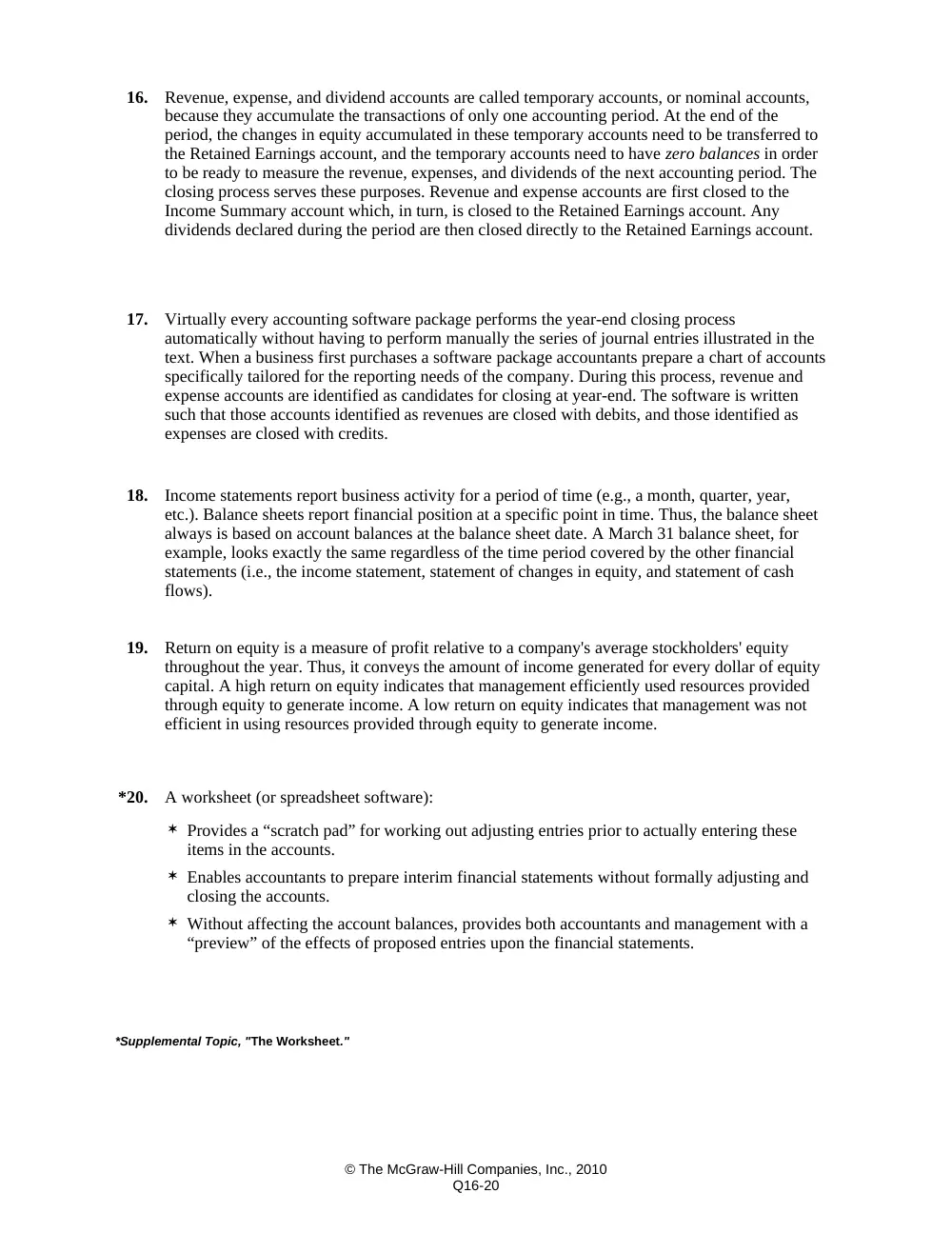
Revenue, expense, and dividend accounts are called temporary accounts, or nominal accounts,
because they accumulate the transactions of only one accounting period. At the end of the
period, the changes in equity accumulated in these temporary accounts need to be transferred to
the Retained Earnings account, and the temporary accounts need to have zero balances in order
to be ready to measure the revenue, expenses, and dividends of the next accounting period. The
closing process serves these purposes. Revenue and expense accounts are first closed to the
Income Summary account which, in turn, is closed to the Retained Earnings account. Any
dividends declared during the period are then closed directly to the Retained Earnings account.
Virtually every accounting software package performs the year-end closing process
automatically without having to perform manually the series of journal entries illustrated in the
text. When a business first purchases a software package accountants prepare a chart of accounts
specifically tailored for the reporting needs of the company. During this process, revenue and
expense accounts are identified as candidates for closing at year-end. The software is written
such that those accounts identified as revenues are closed with debits, and those identified as
expenses are closed with credits.
Income statements report business activity for a period of time (e.g., a month, quarter, year,
etc.). Balance sheets report financial position at a specific point in time. Thus, the balance sheet
always is based on account balances at the balance sheet date. A March 31 balance sheet, for
example, looks exactly the same regardless of the time period covered by the other financial
statements (i.e., the income statement, statement of changes in equity, and statement of cash
flows).
Return on equity is a measure of profit relative to a company's average stockholders' equity
throughout the year. Thus, it conveys the amount of income generated for every dollar of equity
capital. A high return on equity indicates that management efficiently used resources provided
through equity to generate income. A low return on equity indicates that management was not
efficient in using resources provided through equity to generate income.
Provides a “scratch pad” for working out adjusting entries prior to actually entering these
items in the accounts.
Enables accountants to prepare interim financial statements without formally adjusting and
closing the accounts.
Without affecting the account balances, provides both accountants and management with a
“preview” of the effects of proposed entries upon the financial statements.
*Supplemental Topic, "The Worksheet."
© The McGraw-Hill Companies, Inc., 2010
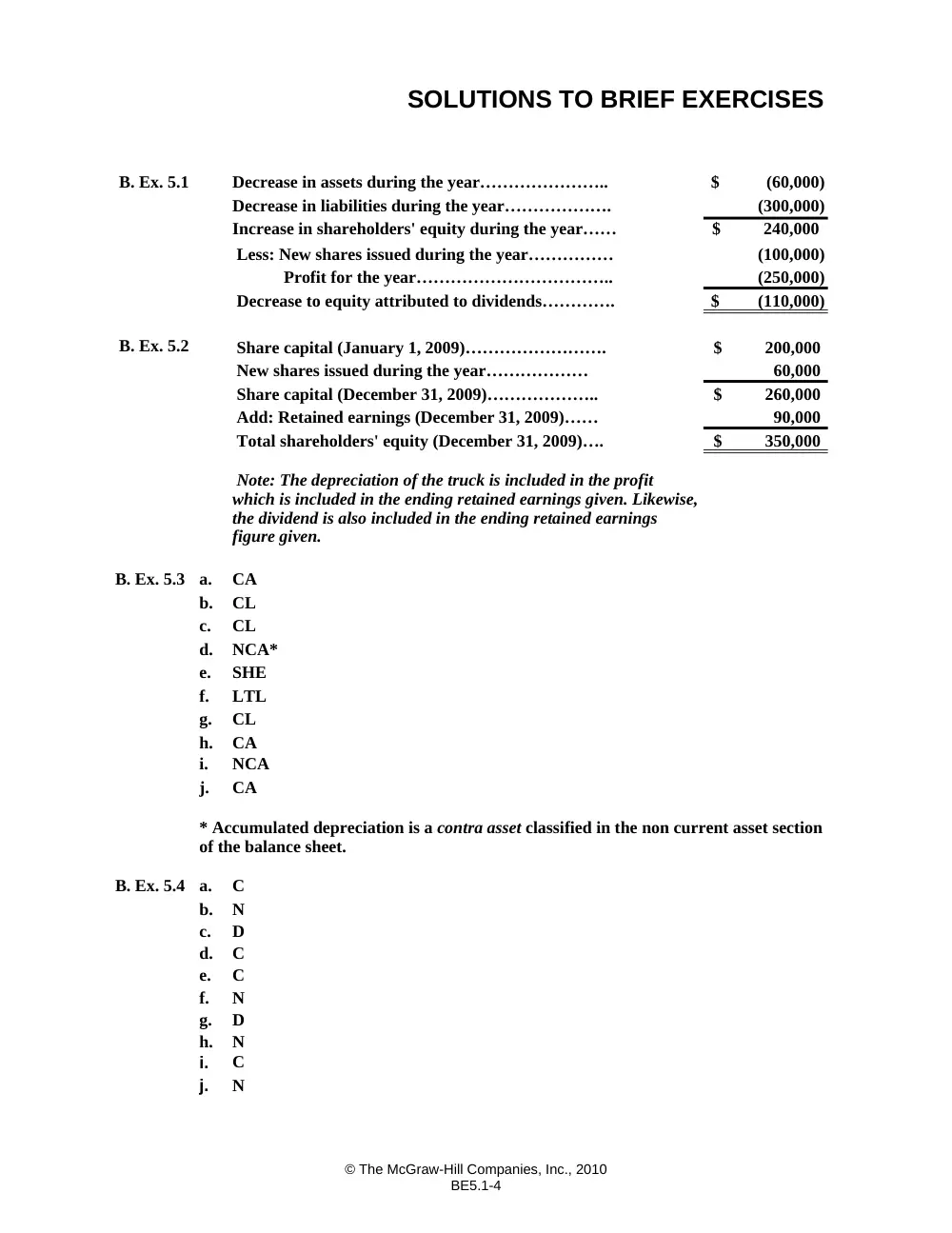
BE5.1-4
SOLUTIONS TO BRIEF EXERCISES
B. Ex. 5.1
Decrease in assets during the year…………………..
$ (60,000)
Decrease in liabilities during the year……………….
(300,000)
Increase in shareholders' equity during the year……
$ 240,000
Less: New shares issued during the year……………
(100,000)
Profit for the year……………………………..
(250,000)
Decrease to equity attributed to dividends………….
$ (110,000)
B. Ex. 5.2
Share capital (January 1, 2009)…………………….
$ 200,000
New shares issued during the year………………
60,000
Share capital (December 31, 2009)………………..
$ 260,000
Add: Retained earnings (December 31, 2009)……
90,000
Total shareholders' equity (December 31, 2009)….
$ 350,000
B. Ex. 5.3
a.
CA
b.
CL
c.
CL
d.
NCA*
e.
SHE
f.
LTL
g.
CL
h.
CA
i.
NCA
j.
CA
B. Ex. 5.4
a.
C
b.
N
c.
D
d.
C
e.
C
f.
N
g.
D
h.
N
i.
C
j.
N
Note: The depreciation of the truck is included in the profit
which is included in the ending retained earnings given. Likewise,
the dividend is also included in the ending retained earnings
figure given.
* Accumulated depreciation is a contra asset classified in the non current asset section
of the balance sheet.
© The McGraw-Hill Companies, Inc., 2010
BE5.1-4
k.
D
l.
C
© The McGraw-Hill Companies, Inc., 2010
BE5.5-6
B. Ex. 5.5
Service Revenue …………………………………………………… 19,800
Income Summary …………………………
19,800
To close revenue to income summary.
Income Summary……………………….……………………..
18,700
Supplies Expense……………………………
525
Rent Expense………………………………
3,660
Depreciation Expense: Equipment………
1,200
Salaries Expense…………………………..
12,700
Income Taxes Expense…………………..
615
To close expense accounts to income summary.
Income Summary…………………………………………….
1,100
Retained Earnings…………………………
1,100
To transfer profit to retained earnings.
Retained Earnings……………………………………………
600
Dividends…………………………………..
600
To close dividends to retained earnings.
B. Ex. 5.6
Consulting Fees Earned…………………………………….
26,000
Interest Revenue……………………………………………
300
Income Summary…………………………..
26,300
To close revenue to income summary.
Income Summary……………………………………………..
34,700
Insurance Expense………………………..
1,900
Rent Expense……………………………..
10,800
Depreciation Expense: Office Equip. …..
5,600
Salaries Expense…………………………..
16,400
To close expense accounts to income summary.
Retained Earnings…………………………………………….
8,400
Income Summary…………………………..
8,400
To transfert loss to income summary.
Retained Earnings…………………………………………..
400
Dividends…………………………………..
400
To close dividends to retained earnings.
© The McGraw-Hill Companies, Inc., 2010
BE5.7-10
B. Ex. 5.7
a.
C
b.
C
c.
D
d.
N
e.
C
f.
N
g.
N
h.
C
i.
D
j.
N
k.
C
l.
C
B. Ex. 5.8
a. Profit ($15,000) ÷ Total Revenue ($60,000)….
25%
b. Profit ($15,000) ÷ Average Equity ($37,500)….
40%
c.
4-to-1
Computations:
Total revenue…………………………………
60,000
Total expenses……………………………….
$ (45,000)
Profit……………………………………
15,000
Shareholders' equity (January 1, 2009)……………
$ 37,000
Shareholders' equity (December 31, 2009)……….
38,000
75,000
÷ 2
Average shareholders' equity in 2009
37,500
B. Ex. 5.9
a.
April through September ($450,000 - $140,000)….
$ 310,000
b.
October through December ($680,000 - $450,000)..
$ 230,000
c.
April through December ($680,000 - $140,000)……
$ 540,000
*B. Ex.5.10a.
Profit ($540,000 - $410,000)…………………
$ 130,000 1
b.
Income statement debits ($380,000 - $130,000)….
$ 250,000 2
1
2
Current Assets ($16,000) ÷ Current Liab. ($4,000)
The amount needed to make the columns of the balance sheet equal is profit
for the period.
The credit column of the income statement represents total revenue whereas
the debit column amount represents total expenses. Thus, total revenue
($380,000 credit column amount) minus profit ($130,000 computed in part a.),
equals total expenses (i.e., the income statement debit column total).
© The McGraw-Hill Companies, Inc., 2010
BE5.7-10
The credit column of the income statement represents total revenue whereas
the debit column amount represents total expenses. Thus, total revenue
($380,000 credit column amount) minus profit ($130,000 computed in part a.),
equals total expenses (i.e., the income statement debit column total).
*Supplemental Topic, "The Worksheet."
© The McGraw-Hill Companies, Inc., 2010
E5.1,2
SOLUTIONS TO EXERCISES
Ex 5.1
a.
Adequate disclosure
b.
Liquidity
c.
Nominal accounts
d.
Real accounts
e.
After-closing trial balance
f.
Dividends
g.
Closing entries
h.
None (This is an example of a "correcting entry.")
Ex. 5.2
a.
TUTORS FOR RENT LIMITED
Income Statement
For the Year Ended December 31, 2009
Revenues:
Tutoring revenue earned
$ 96,000
Expenses:
Salary expense
$ 52,000
Supply expense
1,200
Advertising expense
300
Depreciation expense: equipment
1,000 54,500
Profit before taxes
$ 41,500
Income taxes expense
11,600
Profit
$ 29,900
TUTORS FOR RENT LIMITED
Statement of Changes in Equity
For the Year Ended December 31, 2009
Retained earnings (1/1/09)
$ 45,000
Add: Profit
29,900
Less: Dividends
2,000
Retained earnings (12/31/09)
$ 72,900
© The McGraw-Hill Companies, Inc., 2010
E5.2 (p.2)
Ex. 5.2 (concluded)
TUTORS FOR RENT LIMITED
Balance Sheet
December 31, 2009
Assets
Cash
$ 91,100
Accounts receivable
4,500
Supplies
300
Equipment
$ 12,000
Less: Accumulated depreciation: equipment
5,000
7,000
TOTAL ASSETS
$ 102,900
Liabilities
Accounts payable
$ 1,500
Income taxes payable
3,500
TOTAL LIABILITIES
$ 5,000
Shareholders' Equity
Share capital
$ 25,000
Retained earnings
72,900
TOTAL SHAREHOLDERS' EQUITY
$ 97,900
TOTAL LIABILITIES AND SHAREHOLDERS' EQUITY
$ 102,900
b.
c.
The company appears to be extremely liquid. Cash and accounts receivable comprise 93%
of total assets. Together, these highly liquid assets total $95,600, compared to only $5,000
in liabilities coming due. In other words, the combined total of cash and accounts
receivable are 19 times the obligations coming due in the near future.
The $45,000 credit Retained Earnings balance reported in the company’s adjusted trial
balance is its beginning balance. In order to have retained $45,000 in earnings, the
company must have been profitable in the past.
© The McGraw-Hill Companies, Inc., 2010
E5.3
Ex. 5.3
a.
WILDERNESS GUIDE SERVICES LIMITED
Income Statement
For the Year Ended December 31, 2009
Revenues:
Guide revenue earned
$ 102,000
Expenses:
Salary expense
$ 87,500
Camping supply expense
1,200
Insurance expense
9,600
Depreciation expense: equipment
5,000
Interest expense
1,700
105,000
Loss
$ (3,000)
WILDERNESS GUIDE SERVICES LIMITED
Statement of Changes in Equity
For the Year Ended December 31, 2009
Retained earnings (1/1/09)
$ 15,000
Less: Loss
3,000
Less: Dividends
1,000
Retained earnings (12/31/09)
$ 11,000
© The McGraw-Hill Companies, Inc., 2010
E5.3 (p.2)
Ex. 5.3 (Concluded)
WILDERNESS GUIDE SERVICES LIMITED
Balance Sheet
December 31, 2009
Assets
Cash
$ 12,200
Accounts receivable
31,000
Camping supplies
7,900
Unexpired insurance policies
2,400
Equipment
$ 70,000
Less: Accumulated depreciation: equipment
60,000
10,000
TOTAL ASSETS
$ 63,500
Liabilities
Notes payable (due 4/1/10)
$ 18,000
Accounts payable
9,500
TOTAL LIABILITIES
$ 27,500
Shareholders' Equity
Share capital
$ 25,000
Retained earnings
11,000
TOTAL SHAREHOLDERS' EQUITY
$ 36,000
TOTAL LIABILITIES AND SHAREHOLDERS' EQUITY
$ 63,500
b.
c.
The company appears to be liquid. Cash and accounts receivable comprise 68% of the
company’s total assets. These highly liquid assets total $43,200, in comparison to $27,500
in liabilities coming due in the near future. However, given that its equipment is nearly
fully depreciated, it may have to invest in new equipment shortly.
The company was not profitable in the current period as evidenced by the $3,000 net loss
reported in the income statement. However, the $15,000 credit Retained Earnings balance
reported in the company’s adjusted trial balance is the balance carried forward from prior
years. In order to have retained $15,000 in earnings, the company must have been
profitable in the past.
© The McGraw-Hill Companies, Inc., 2010
E5.4
Ex. 5.4
a.
TUTORS FOR RENT
General Journal
December 31, 2009
(1)
Dec. 31 Tutoring Revenue earned
96,000
Income Summary
96,000
To close Tutoring Revenue Earned
(2)
31 Income Summary
66,100
Salary Expense
52,000
Supply Expense
1,200
Advertising Expense
300
Depreciation Expense: Equipment
1,000
Income Taxes Expense
11,600
To close all expense accounts.
(3)
31 Income Summary
29,900
Retained Earnings
29,900
To transfer profit earned in 2009 to the
Retained Earnings account ($96,000-$66,100 =
$29,900).
(4)
31 Retained Earnings
2,000
Dividends
2,000
To transfer dividends declared in 2009 to the
Retained Earnings account.
© The McGraw-Hill Companies, Inc., 2010
E5.4 (p.2)
Ex. 5.4 (Concluded)
b.
TUTORS FOR RENT LIMITED
After-Closing Trial Balance
December 31, 2009
Cash
$ 91,100
Accounts receivable
4,500
Supplies
300
Equipment
12,000
Less: Accumulated depreciation: equipment
$ 5,000
Accounts payable
1,500
Income taxes payable
3,500
Share capital
25,000
Retained earnings
$ 72,900
Totals
$ 107,900
$ 107,900
c.
The $72,900 Retained Earnings balance reported in the after-closing trial balance is
$27,900 more than the $45,000 balance reported in the unadjusted trial balance. By adding
profit to the Retained Earnings balance in the unadjusted trial balance, and subtracting
dividends, one arrives at the $72,900 reported in the after-closing trial balance ($45,000 +
$29,900 - $2,000 = $72,900).
© The McGraw-Hill Companies, Inc., 2010
E5.5
Ex. 5.5
a.
WILDERNESS GUIDE SERVICES LIMITED
General Journal
December 31, 2009
(1)
Dec. 31 Guide Revenue Earned
102,000
Income Summary
102,000
To close Guide Revenue Earned.
(2)
31 Income Summary
105,000
Salary Expense
87,500
Camping Supply Expense
1,200
Insurance Expense
9,600
Depreciation Expense: Equipment
5,000
Interest Expense
1,700
To close all expense accounts.
(3)
31 Retained Earnings
3,000
Income Summary
3,000
To transfer loss incurred in 2009 to the
Retained Earnings account ($102,000 - $105,000 =
$3,000 loss).
(4)
31 Retained Earnings
1,000
Dividends
1,000
To transfer dividends declared in 2009 to the
Retained Earnings account.
© The McGraw-Hill Companies, Inc., 2010
E5.5 (p.2)
Ex. 5.5 (Concluded)
b.
WILDERNESS GUIDE SERVICES LIMITED
After-Closing Trial Balance
December 31, 2009
Cash
$ 12,200
Accounts receivable
31,000
Camping supplies
7,900
Unexpired insurance policies
2,400
Equipment
70,000
Accumulated depreciation: equipment
$ 60,000
Notes payable (due 4/1/10)
18,000
Accounts payable
9,500
Share capital
25,000
Retained earnings
11,000
Totals
$ 123,500
$ 123,500
c.
The $11,000 Retained Earnings balance reported in the after-closing trial balance is $4,000
less than the $15,000 balance reported in the unadjusted trial balance. By subtracting both
the net loss and dividends from the Retained Earnings balance in the unadjusted trial
balance, one arrives at the $11,000 reported in the after-closing trial balance ($15,000 -
$3,000 - $1,000 = $11,000).
© The McGraw-Hill Companies, Inc., 2010
E5.6
Ex. 5.6
a.
1.
2.
3.
4.
b.
1. Cash………………………………………………
500
Unearned Transportation Revenue……………………
500
To record the sale of a $500 air ticket.
2.
500
Sales (Revenue)………………………
500
To record the redemption of a $500 air ticket.
c.
Cathay Pacific recognizes revenue when the transportation service is provided
to customers. This means that revenue is recorded at the time customers
receive their service.
The earnings process is not complete when the company first receives cash for
gift cards. This is because no services have been delivered. Thus, as gift cards
are sold, the company debits Cash and credits Unearned Transportation
Revenue. As customers use their tickets, the company debits Unearned
Transportation Revenue and credits Revenue (Sales).
The company records replacement and maintenance cost in the period that it
consumes and incurs. Thus, when it pays for maintenance it debits
Maintenance Cost and credits Cash.
The company matches the cost of fixed assets to the periods in which it
contributes to generating revenue. It does so by dividing the cost of fixed assets
by its anticipated life and charging the result to depreciation expense each
period.
Unearned Transportation
Revenue…………………………
Cathay Pacific matches labor cost to revenue in the period that it pays for
wages and salary. The alternative would be to debit Other receivables and
Prepayments when payment is made, and later debit labor cost and credit
Other receivables and Prepayments when labor cost is incurred. Differences in
these two alternatives are not considered material, so Cathay Pacific takes the
simpler approach of expensing labor costs immediately.
© The McGraw-Hill Companies, Inc., 2010
E5,7
Ex. 5.7
a.
Counseling Revenue…………………………………………
225,000
Income Summary……………………………………
225,000
To close counseling revenue earned.
Close all expenses to the Income summary account:
Income Summary……………………………………………… 170,400
Advertising Expense………………………………
1,800
Salaries Expense………………………………………
94,000
Office Supplies Expense…………………………
1,200
Utilities Expense………………………………………
850
Malpractice Insurance Expense……………………
6,000
Office Rent Expense………………………………….
24,000
Continuing Education Expense…………………
2,650
Depreciation Expense: Fixtures……………………
4,500
Miscellaneous Expense……………………………
6,000
Income Taxes Expense……………………………
29,400
To close all expense accounts.
Income Summary…………………………………………
54,600
Retained Earnings…………………………………
54,600
Retained Earnings…………………………………………
6,000
Dividends……………………………………………..
6,000
b. Retained Earnings, January 1, 2009
$ 92,000
Plus: Profit
54,600
$ 146,600
Less: Dividends Declared in 2009
(6,000)
Retained Earnings, December 31, 2009
$ 140,600
To transfer profit earned in 2009 ($225,000 - $170,400)
to Retained Earnings.
To close dividends declared in 2009 to Retained
Earnings.
© The McGraw-Hill Companies, Inc., 2010
E5.8,9
Ex. 5