
ACCT 210 Homework Chapter 7 Solutions, Fall 2012
American University of Beirut · Financial Accounting · 57 pages · Dr. Abdeljalil Ghanem · with solution




Showing the first 10 of 57 pages. Download the PDF to see all of it.
More ACCT 210 files
- Drop Quiz Chapter 7 Quiz Questions · Summer 2017ChapterView
- Drop Quiz Chapter 11 Quiz Questions · Summer 2017ChapterView
- Drop Quiz Chapter 13 Quiz Questions · Summer 2017ChapterView
- Drop Quiz Chapter 2 Quiz Questions · Summer 2017ChapterView
- Drop Quiz Chapter 3 Quiz Questions · Summer 2017ChapterView
- Drop Quiz Chapter 4 Quiz Questions · Summer 2017ChapterView
- Drop Quiz Chapter 5 Quiz Questions · Summer 2017ChapterView
- Drop Quiz Chapter 6 Quiz Questions · Summer 2017ChapterView
Show the text of this chapter
© The McGraw-Hill Companies, Inc., 2010
Overview
CHAPTER 7
FINANCIAL ASSETS
Brief
Learning
Exercises
Topic
Objectives
Skills
B. Ex. 7.1
1, 2
Analysis
B. Ex. 7.2
Bank reconciliations
2, 3
Analysis
B. Ex. 7.3
1, 4
Analysis, communication
B. Ex. 7.4
1, 4
Analysis
B. Ex. 7.5
1, 5
Analysis
B. Ex. 7.6
1, 5
Analysis
B. Ex. 7.7
1, 5, 7
Analysis, judgment, communication
B. Ex. 7.8
Notes receivable and interest
6
Analysis
B. Ex. 7.9
5, 7
Analysis, judgment, communication
B. Ex. 7.10
Analyzing accounts receivable
7
Analysis
Learning
Exercises
Topic
Objectives
Skills
7.1
You as a student
3
Analysis, communication
7.2
1, 2
Analysis
7.3
2
Analysis, judgment
7.4
Protecting liquid assets
2
Analysis, communication
7.5
Bank reconciliation
3
Analysis
7.6
1, 2
Analysis, communication
7.7
1, 4
Analysis, communication
OVERVIEW OF BRIEF EXERCISES, EXERCISES, PROBLEMS, AND CRITICAL
THINKING CASES
Real World: Singapore Airlines
Cash and cash equivalents
Real World: Nestlé Mark-to-
market adjustments
Accounting for investments in
securities
Uncollectible accounts - balance
sheet approach
Uncollectible accounts -
Income statement approach
Real World: Cathay Pacific
Airways and Anheuser-Busch
Companies Limited Analyzing
accounts receivable
Real World: Seven and i
Holdings Co., Ltd and Nippon
Telegraph and Telephone
Corporation. Impairment by
industry
Real World: Foxconn
International Reporting financial
assets
Real World: White Electric
Supply Embezzling cash
Real World: Asian Bank, Bank
of Greater Asia, European Bank,
Pacific Asian Bank Evaluating
cash equivalents
Real World: Assicurazioni
Generali S.p.A. Investment in
Securities
© The McGraw-Hill Companies, Inc., 2010
Overview
7.8
Estimating uncollectible accounts
1, 5
Analysis
Real World: Assicurazioni
Generali S.p.A. Investment in
Securities
© The McGraw-Hill Companies, Inc., 2010
Overview (p.2)
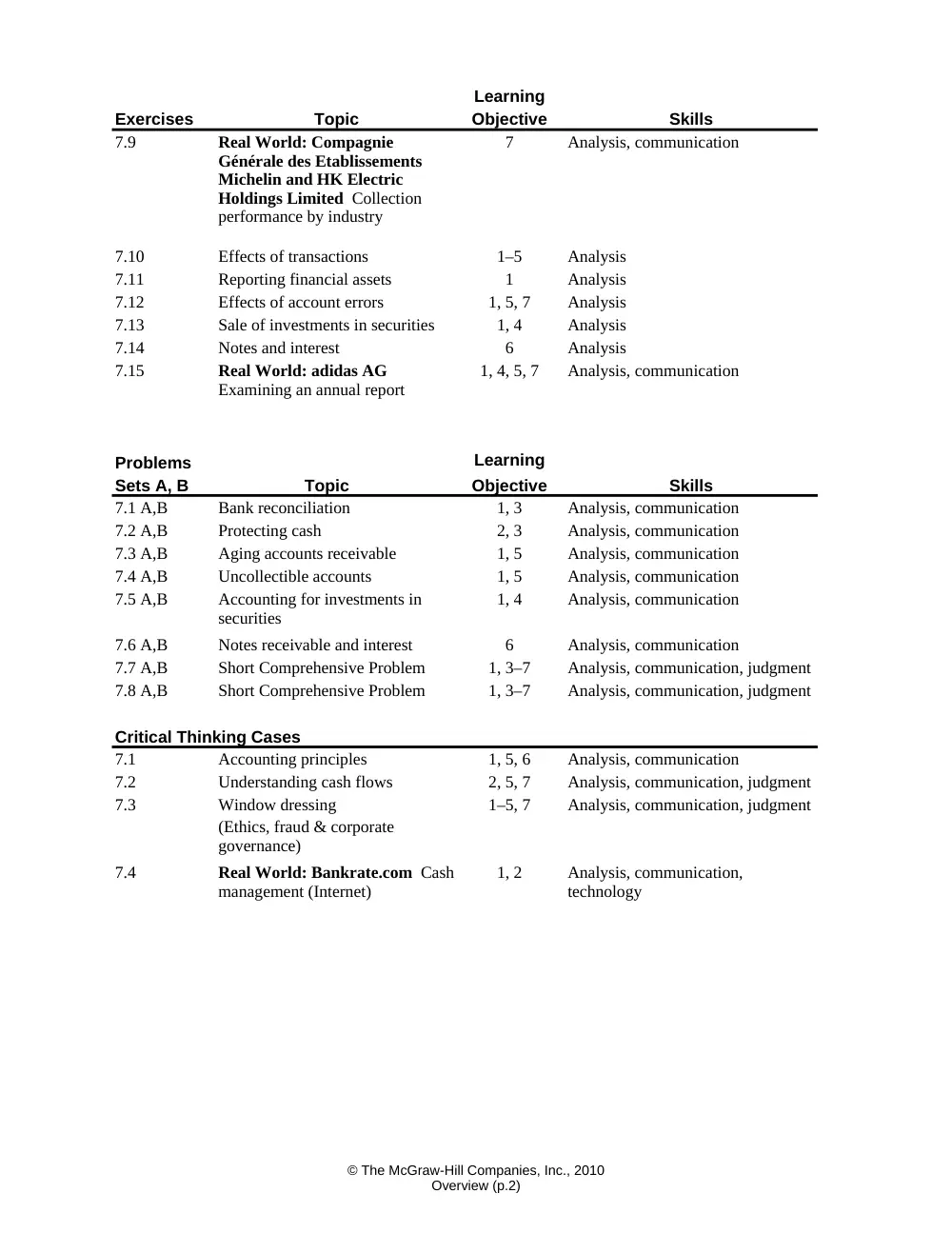
Learning
Exercises
Topic
Skills
7.9
7
Analysis, communication
7.10
Effects of transactions
1–5
Analysis
7.11
Reporting financial assets
1
Analysis
7.12
Effects of account errors
1, 5, 7
Analysis
7.13
Sale of investments in securities
1, 4
Analysis
7.14
Notes and interest
6
Analysis
7.15
1, 4, 5, 7
Analysis, communication
Problems
Learning
Sets A, B
Topic
Skills
7.1 A,B
Bank reconciliation
1, 3
Analysis, communication
7.2 A,B
Protecting cash
2, 3
Analysis, communication
7.3 A,B
Aging accounts receivable
1, 5
Analysis, communication
7.4 A,B
Uncollectible accounts
1, 5
Analysis, communication
7.5 A,B
1, 4
Analysis, communication
7.6 A,B
Notes receivable and interest
6
Analysis, communication
7.7 A,B
Short Comprehensive Problem
1, 3–7
Analysis, communication, judgment
7.8 A,B
Short Comprehensive Problem
1, 3–7
Analysis, communication, judgment
Critical Thinking Cases
7.1
Accounting principles
1, 5, 6
Analysis, communication
7.2
Understanding cash flows
2, 5, 7
Analysis, communication, judgment
7.3
Window dressing
1–5, 7
Analysis, communication, judgment
7.4
1, 2
Objective
s
Real World: Compagnie
Générale des Etablissements
Michelin and HK Electric
Holdings Limited Collection
performance by industry
Real World: adidas AG
Examining an annual report
Objective
s
Accounting for investments in
securities
(Ethics, fraud & corporate
governance)
Real World: Bankrate.com Cash
management (Internet)
Analysis, communication,
technology
© The McGraw-Hill Companies, Inc., 2010
Overview Desc.
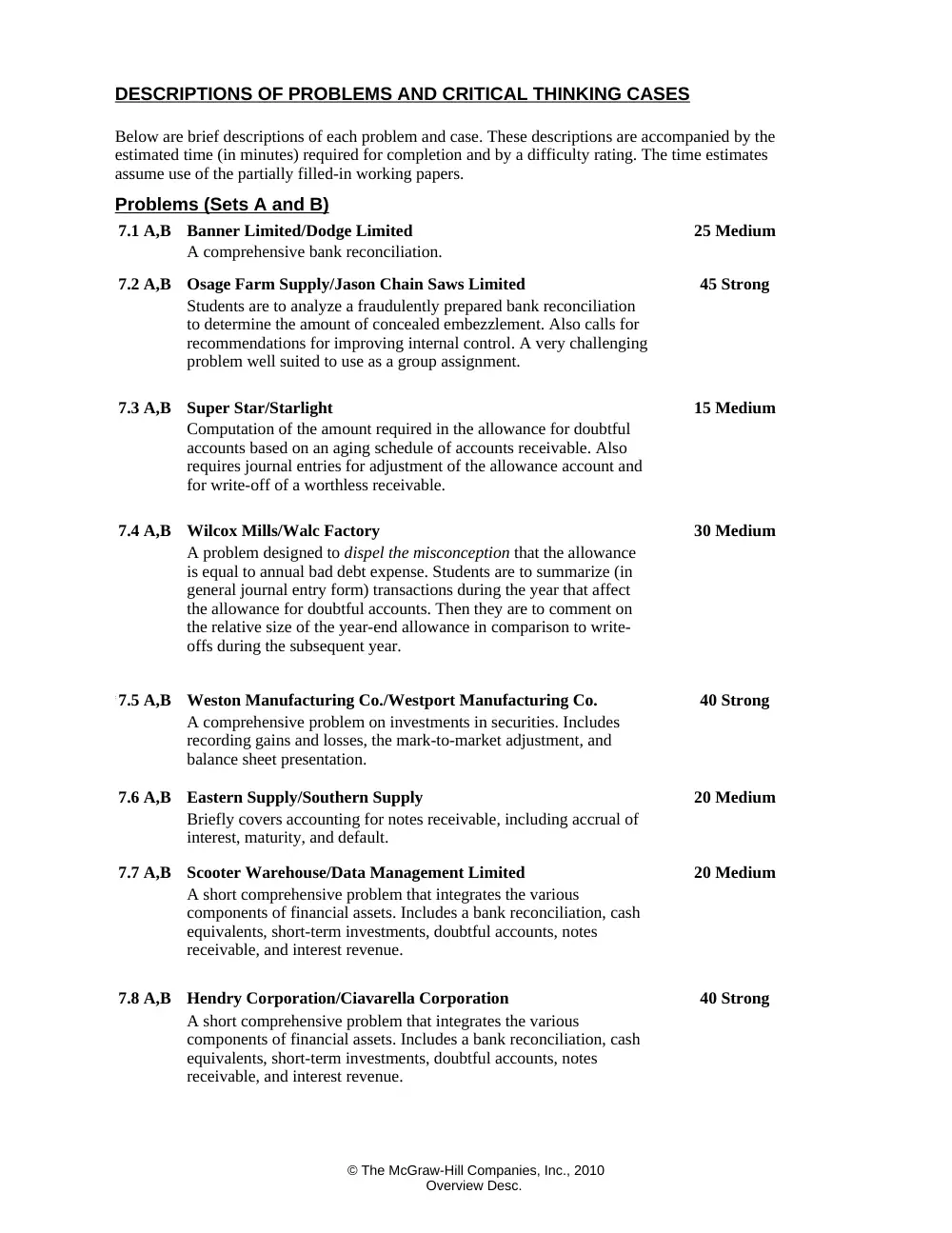
DESCRIPTIONS OF PROBLEMS AND CRITICAL THINKING CASES
Problems (Sets A and B)
7.1 A,B
Banner Limited/Dodge Limited
25 Medium
A comprehensive bank reconciliation.
7.2 A,B
Osage Farm Supply/Jason Chain Saws Limited
45 Strong
7.3 A,B
Super Star/Starlight
15 Medium
7.4 A,B
Wilcox Mills/Walc Factory
30 Medium
7.5 A,B
Weston Manufacturing Co./Westport Manufacturing Co.
40 Strong
7.6 A,B
Eastern Supply/Southern Supply
20 Medium
7.7 A,B
Scooter Warehouse/Data Management Limited
20 Medium
7.8 A,B
Hendry Corporation/Ciavarella Corporation
40 Strong
Below are brief descriptions of each problem and case. These descriptions are accompanied by the
estimated time (in minutes) required for completion and by a difficulty rating. The time estimates
assume use of the partially filled-in working papers.
Students are to analyze a fraudulently prepared bank reconciliation
to determine the amount of concealed embezzlement. Also calls for
recommendations for improving internal control. A very challenging
problem well suited to use as a group assignment.
Computation of the amount required in the allowance for doubtful
accounts based on an aging schedule of accounts receivable. Also
requires journal entries for adjustment of the allowance account and
for write-off of a worthless receivable.
A problem designed to dispel the misconception that the allowance
is equal to annual bad debt expense. Students are to summarize (in
general journal entry form) transactions during the year that affect
the allowance for doubtful accounts. Then they are to comment on
the relative size of the year-end allowance in comparison to write-
offs during the subsequent year.
*
A comprehensive problem on investments in securities. Includes
recording gains and losses, the mark-to-market adjustment, and
balance sheet presentation.
Briefly covers accounting for notes receivable, including accrual of
interest, maturity, and default.
A short comprehensive problem that integrates the various
components of financial assets. Includes a bank reconciliation, cash
equivalents, short-term investments, doubtful accounts, notes
receivable, and interest revenue.
A short comprehensive problem that integrates the various
components of financial assets. Includes a bank reconciliation, cash
equivalents, short-term investments, doubtful accounts, notes
receivable, and interest revenue.
© The McGraw-Hill Companies, Inc., 2010
Desc. of Prob & Cases
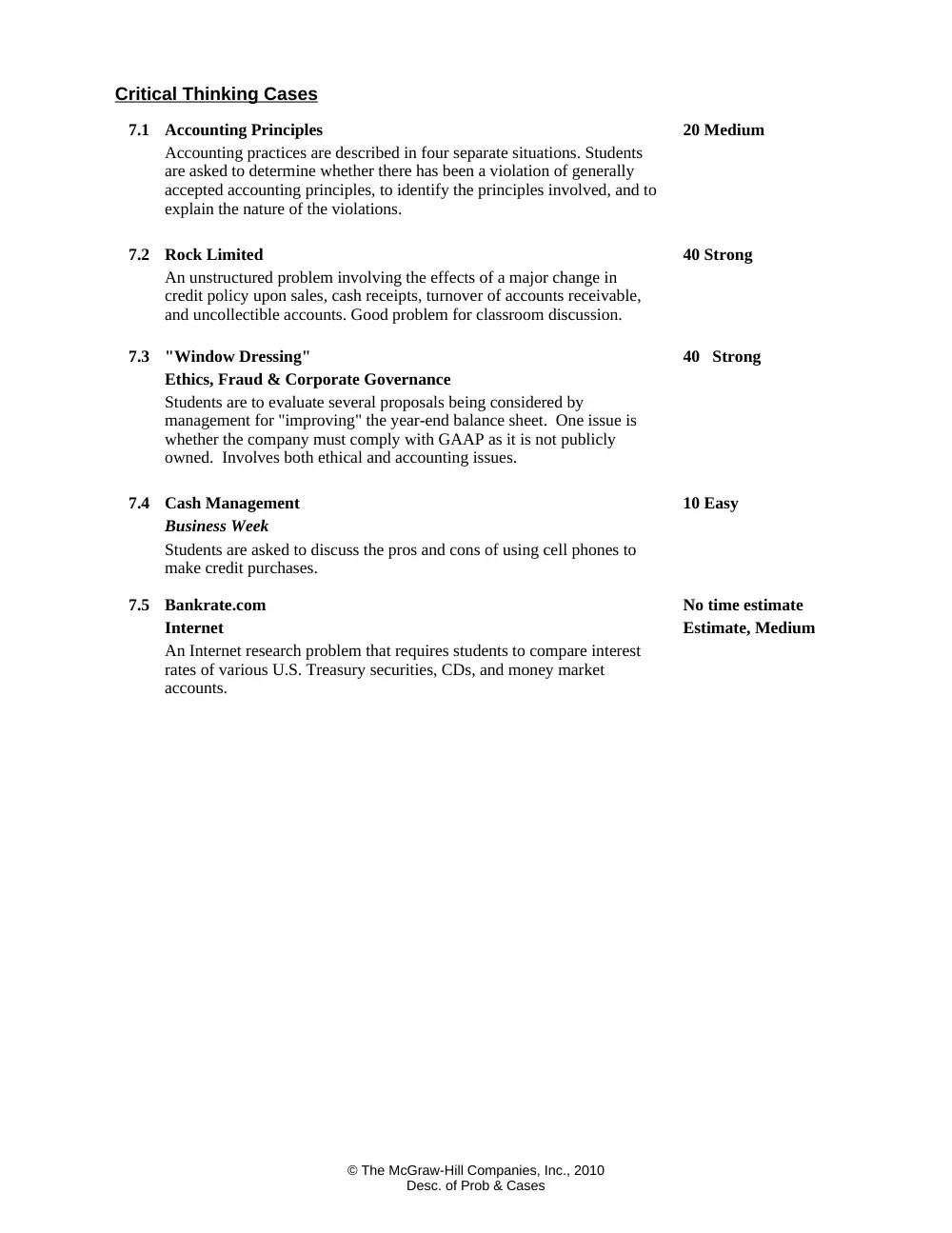
Critical Thinking Cases
7.1
Accounting Principles
20 Medium
7.2
Rock Limited
40 Strong
7.3
"Window Dressing"
40 Strong
Ethics, Fraud & Corporate Governance
7.4
Cash Management
10 Easy
Business Week
7.5
Bankrate.com
No time estimate
Internet
Estimate, Medium
Accounting practices are described in four separate situations. Students
are asked to determine whether there has been a violation of generally
accepted accounting principles, to identify the principles involved, and to
explain the nature of the violations.
An unstructured problem involving the effects of a major change in
credit policy upon sales, cash receipts, turnover of accounts receivable,
and uncollectible accounts. Good problem for classroom discussion.
Students are to evaluate several proposals being considered by
management for "improving" the year-end balance sheet. One issue is
whether the company must comply with GAAP as it is not publicly
owned. Involves both ethical and accounting issues.
Students are asked to discuss the pros and cons of using cell phones to
make credit purchases.
An Internet research problem that requires students to compare interest
rates of various U.S. Treasury securities, CDs, and money market
accounts.
© The McGraw-Hill Companies, Inc., 2010
Q1-9
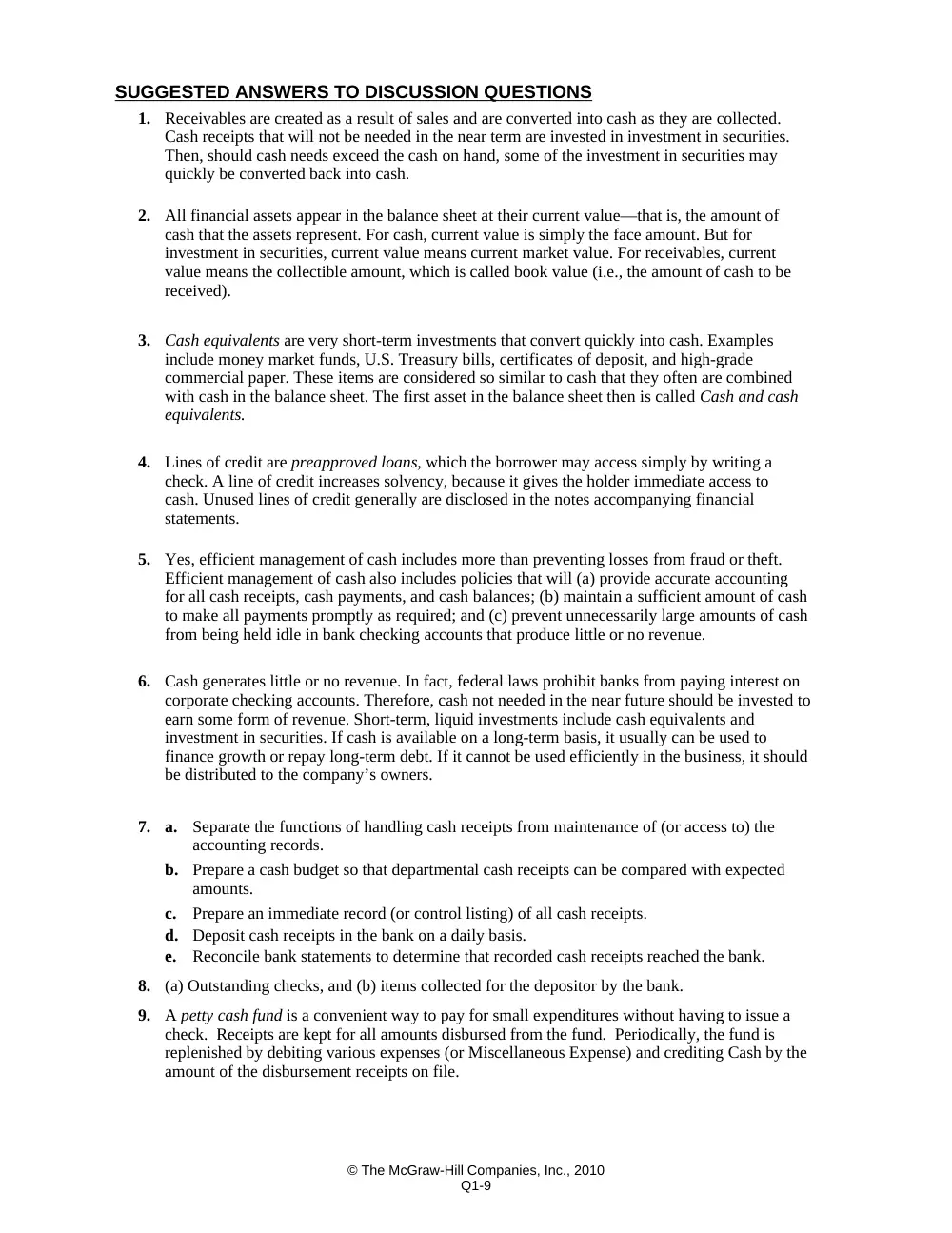
SUGGESTED ANSWERS TO DISCUSSION QUESTIONS
1.
2.
3.
4.
5.
6.
7.
a.
b.
c.
Prepare an immediate record (or control listing) of all cash receipts.
d.
Deposit cash receipts in the bank on a daily basis.
e.
Reconcile bank statements to determine that recorded cash receipts reached the bank.
8.
(a) Outstanding checks, and (b) items collected for the depositor by the bank.
9.
Receivables are created as a result of sales and are converted into cash as they are collected.
Cash receipts that will not be needed in the near term are invested in investment in securities.
Then, should cash needs exceed the cash on hand, some of the investment in securities may
quickly be converted back into cash.
All financial assets appear in the balance sheet at their current value—that is, the amount of
cash that the assets represent. For cash, current value is simply the face amount. But for
investment in securities, current value means current market value. For receivables, current
value means the collectible amount, which is called book value (i.e., the amount of cash to be
received).
Cash equivalents are very short-term investments that convert quickly into cash. Examples
include money market funds, U.S. Treasury bills, certificates of deposit, and high-grade
commercial paper. These items are considered so similar to cash that they often are combined
with cash in the balance sheet. The first asset in the balance sheet then is called Cash and cash
equivalents.
Lines of credit are preapproved loans, which the borrower may access simply by writing a
check. A line of credit increases solvency, because it gives the holder immediate access to
cash. Unused lines of credit generally are disclosed in the notes accompanying financial
statements.
Yes, efficient management of cash includes more than preventing losses from fraud or theft.
Efficient management of cash also includes policies that will (a) provide accurate accounting
for all cash receipts, cash payments, and cash balances; (b) maintain a sufficient amount of cash
to make all payments promptly as required; and (c) prevent unnecessarily large amounts of cash
from being held idle in bank checking accounts that produce little or no revenue.
Cash generates little or no revenue. In fact, federal laws prohibit banks from paying interest on
corporate checking accounts. Therefore, cash not needed in the near future should be invested to
earn some form of revenue. Short-term, liquid investments include cash equivalents and
investment in securities. If cash is available on a long-term basis, it usually can be used to
finance growth or repay long-term debt. If it cannot be used efficiently in the business, it should
be distributed to the company’s owners.
Separate the functions of handling cash receipts from maintenance of (or access to) the
accounting records.
Prepare a cash budget so that departmental cash receipts can be compared with expected
amounts.
A petty cash fund is a convenient way to pay for small expenditures without having to issue a
check. Receipts are kept for all amounts disbursed from the fund. Periodically, the fund is
replenished by debiting various expenses (or Miscellaneous Expense) and crediting Cash by the
amount of the disbursement receipts on file.
© The McGraw-Hill Companies, Inc., 2010
Q10-16
10.
11.
12.
13.
14.
15.
16.
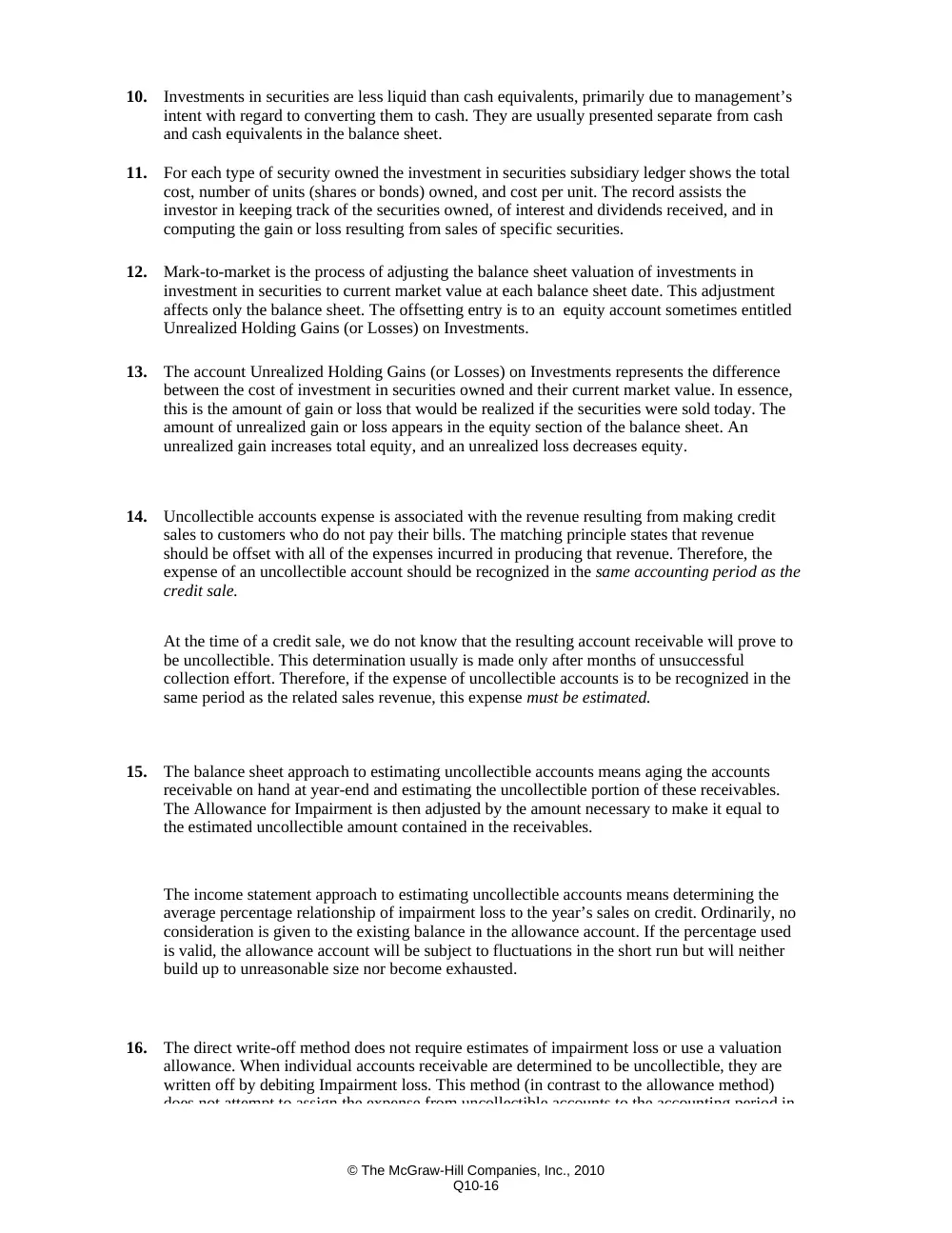
Investments in securities are less liquid than cash equivalents, primarily due to management’s
intent with regard to converting them to cash. They are usually presented separate from cash
and cash equivalents in the balance sheet.
For each type of security owned the investment in securities subsidiary ledger shows the total
cost, number of units (shares or bonds) owned, and cost per unit. The record assists the
investor in keeping track of the securities owned, of interest and dividends received, and in
computing the gain or loss resulting from sales of specific securities.
Mark-to-market is the process of adjusting the balance sheet valuation of investments in
investment in securities to current market value at each balance sheet date. This adjustment
affects only the balance sheet. The offsetting entry is to an equity account sometimes entitled
Unrealized Holding Gains (or Losses) on Investments.
The account Unrealized Holding Gains (or Losses) on Investments represents the difference
between the cost of investment in securities owned and their current market value. In essence,
this is the amount of gain or loss that would be realized if the securities were sold today. The
amount of unrealized gain or loss appears in the equity section of the balance sheet. An
unrealized gain increases total equity, and an unrealized loss decreases equity.
Uncollectible accounts expense is associated with the revenue resulting from making credit
sales to customers who do not pay their bills. The matching principle states that revenue
should be offset with all of the expenses incurred in producing that revenue. Therefore, the
expense of an uncollectible account should be recognized in the same accounting period as the
credit sale.
At the time of a credit sale, we do not know that the resulting account receivable will prove to
be uncollectible. This determination usually is made only after months of unsuccessful
collection effort. Therefore, if the expense of uncollectible accounts is to be recognized in the
same period as the related sales revenue, this expense must be estimated.
The balance sheet approach to estimating uncollectible accounts means aging the accounts
receivable on hand at year-end and estimating the uncollectible portion of these receivables.
The Allowance for Impairment is then adjusted by the amount necessary to make it equal to
the estimated uncollectible amount contained in the receivables.
The income statement approach to estimating uncollectible accounts means determining the
average percentage relationship of impairment loss to the year’s sales on credit. Ordinarily, no
consideration is given to the existing balance in the allowance account. If the percentage used
is valid, the allowance account will be subject to fluctuations in the short run but will neither
build up to unreasonable size nor become exhausted.
The direct write-off method does not require estimates of impairment loss or use a valuation
allowance. When individual accounts receivable are determined to be uncollectible, they are
written off by debiting Impairment loss. This method (in contrast to the allowance method)
does not attempt to assign the expense from uncollectible accounts to the accounting period in
which the uncollectible receivables originated, and therefore does not match related revenue
and expenses.
© The McGraw-Hill Companies, Inc., 2010
Q10-16
The direct write-off method does not require estimates of impairment loss or use a valuation
allowance. When individual accounts receivable are determined to be uncollectible, they are
written off by debiting Impairment loss. This method (in contrast to the allowance method)
does not attempt to assign the expense from uncollectible accounts to the accounting period in
which the uncollectible receivables originated, and therefore does not match related revenue
and expenses.
© The McGraw-Hill Companies, Inc., 2010
Q17-21
17.
18.
19.
20.
21.
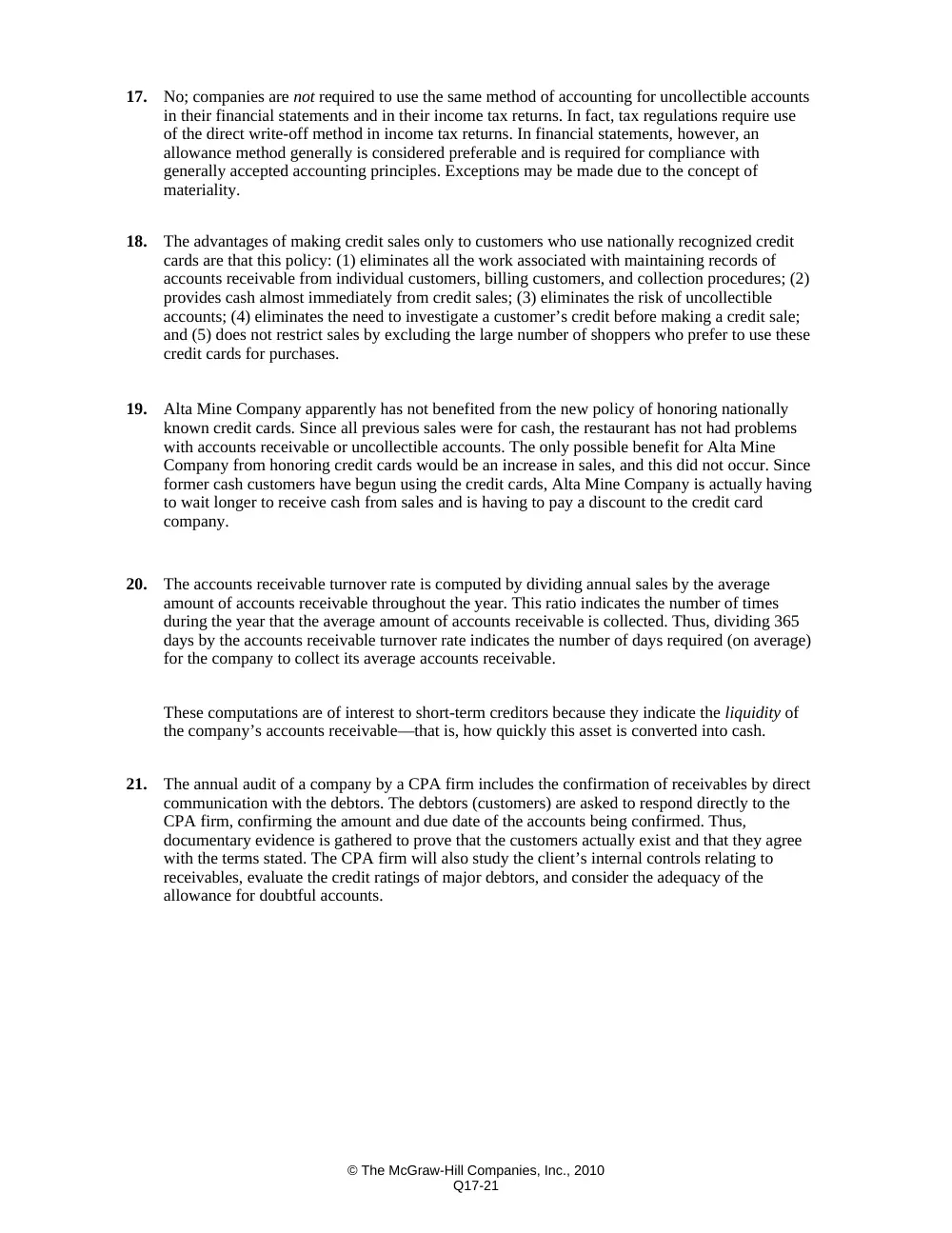
No; companies are not required to use the same method of accounting for uncollectible accounts
in their financial statements and in their income tax returns. In fact, tax regulations require use
of the direct write-off method in income tax returns. In financial statements, however, an
allowance method generally is considered preferable and is required for compliance with
generally accepted accounting principles. Exceptions may be made due to the concept of
materiality.
The advantages of making credit sales only to customers who use nationally recognized credit
cards are that this policy: (1) eliminates all the work associated with maintaining records of
accounts receivable from individual customers, billing customers, and collection procedures; (2)
provides cash almost immediately from credit sales; (3) eliminates the risk of uncollectible
accounts; (4) eliminates the need to investigate a customer’s credit before making a credit sale;
and (5) does not restrict sales by excluding the large number of shoppers who prefer to use these
credit cards for purchases.
Alta Mine Company apparently has not benefited from the new policy of honoring nationally
known credit cards. Since all previous sales were for cash, the restaurant has not had problems
with accounts receivable or uncollectible accounts. The only possible benefit for Alta Mine
Company from honoring credit cards would be an increase in sales, and this did not occur. Since
former cash customers have begun using the credit cards, Alta Mine Company is actually having
to wait longer to receive cash from sales and is having to pay a discount to the credit card
company.
The accounts receivable turnover rate is computed by dividing annual sales by the average
amount of accounts receivable throughout the year. This ratio indicates the number of times
during the year that the average amount of accounts receivable is collected. Thus, dividing 365
days by the accounts receivable turnover rate indicates the number of days required (on average)
for the company to collect its average accounts receivable.
These computations are of interest to short-term creditors because they indicate the liquidity of
the company’s accounts receivable—that is, how quickly this asset is converted into cash.
The annual audit of a company by a CPA firm includes the confirmation of receivables by direct
communication with the debtors. The debtors (customers) are asked to respond directly to the
CPA firm, confirming the amount and due date of the accounts being confirmed. Thus,
documentary evidence is gathered to prove that the customers actually exist and that they agree
with the terms stated. The CPA firm will also study the client’s internal controls relating to
receivables, evaluate the credit ratings of major debtors, and consider the adequacy of the
allowance for doubtful accounts.
© The McGraw-Hill Companies, Inc., 2010
Q22-24
22.
a.
b.
c.
d.
23.
24.
a. Maturity value = $10,900 (interest = $10,000 x .09 x 1 = $900.)
Maturity date = July 1, 2010 (365 days later, but the counting starts on July 2).
b. Maturity value = $20,400 (interest = $20,000 x .08 x 90/360 = $400.)
In a multiple-step income statement, the loss from a sale of investment in securities reduces
profit and is classified as a nonoperating item. In a statement of cash flows, the entire
proceeds from the sale are shown as a cash receipt from investing activities.
The adjusting entry to create or increase the allowance for doubtful accounts involves the
recognition of an expense. This expense (impairment loss) appears as a selling expense in a
multiple-step income statement. But this adjusting entry, like all adjusting entries, involves
no cash receipts or cash payments. Therefore, it has no effect upon cash flows.
Writing off an account receivable against the allowance does not affect income or cash
flows.
The adjusting entry to increase the balance sheet valuation of investment in securities affects
only the balance sheet. No cash flows are involved, and the unrealized gain appears in the
stockholders’ equity section of the balance sheet, not in the income statement.
Changes in the market value of securities owned do not affect the investor's taxable income.
For income tax purposes, gains on investments are recognized only when the investments are
sold.
Maturity date = June 9, (20 days in March, 30 days in April, 31 days in May,
leaves 9 days in June).
© The McGraw-Hill Companies, Inc., 2010
BE7.1,2
SOLUTIONS TO BRIEF EXERCISES
B.Ex.7.1 a.
b.
B.Ex.7.2 a. Cash balance per general ledger………………………………….
$ 21,749
Less: Bank service charge………………….……………………..
(200)
NSF check from Susque Company………………………….
(3,000)
Error corrections, office supplies…………………………..
(549)
Adjusted cash balance, December 31……………………………….
$ 18,000
Cash balance per bank statement…………………………………
$ 22,000
Add: Deposits in transit…………………………………………….
5,000
Less: Outstanding checks………………………………………….
(9,000)
Adjusted cash balance, December 31……………………………..
$ 18,000
b. Adjusted cash balance, December 31 (from part a.)…………..
$ 18,000
Cash equivalents: Money market account…………………….
60,000
Cash and cash equivalents, December 31………………………..
$ 78,000
c. Bank Service Charges………………………………
200
Accounts Receivable………………………………
3,000
Office Supplies……………………………………
549
Cash……………...…………………………
3,749
Cash equivalents are usually short-term debt securities (e.g., U.S. Treasury bills,
high-grade commercial paper, etc.). This appears to be true for Singapore Airlines,
as the footnote specifically mentions that all cash equivalents have a maturity date of
three months or less (equity securities have no maturity date).
The statement referring to the risk of fluctuation in value of company's assets is
low. In short these short term assets will seldom fluctuate in value as a result.
Note: Stocks are never considered cash equivalents and commercial
paper can be considered cash equivalents only when durations are
90 days or less.
To record bank service charges, to reclassify a NSF check as an
account receivable, and to correct an error in the recording of office
supplies.
© The McGraw-Hill Companies, Inc., 2010
BE7.3,4
B.Ex.7.3
a.
b.
c.
d.
B. Ex. 7.4
a. Dec. 4
Investments in Securities……………………. 30,000
Cash………………………………….
30,000
b. Dec. 9
Cash…………………………………………. 10,000
Investments in Securities………………
7,000
Gain on Sale of Investments………..
3,000
c. Dec. 18 Cash…………………………………………
5,000
Loss on Sale of Investments………………
1,000
Investments in Securities………………
6,000
d. Dec. 31 Investments in Securities……………………. 3,000
Unrealized Holding Gain on Investments ...
3,000
Nestlé's unrealized gain on investments is the difference between the cost of these
investments and their current market values. In essence, it is the amount of gain
that would be realized if the investments were sold today. But the term
"unrealized" indicates that this gain has not been finalized through an actual sale
of the investments. Therefore, its amount will change as market values fluctuate.
The $358 million unrealized gain increases the asset amount and also appears in
an account in Nestlé's shareholders' equity section of its balance sheet. The
recognition of this gain does not involve any cash flow.
Nestlé's unrealized gain is not included in the computation of taxable income. For
income tax purposes, losses and gains on investments are reported in the period
in which the investments are sold.
Nestlé's short-term creditors are primarily interested in the company's current
debt-paying ability. From this perspective, mark-to-market should enhance the
usefulness of the balance sheet by showing the amount of liquid resources that
would be available if the investment in securities were sold.
To record the purchase of investment in
securities.
To record the sale of investment in
securities at a gain.
To record the sale of investment in
securities at a loss.
To adjust the balance sheet valuation of
investment in securities from their cost
($30,000 - $7,000 - $6,000 = $17,000) to their
current market value of $20,000.
© The McGraw-Hill Companies, Inc., 2010
BE7.5,6
B.Ex.7.5 a. Impairment loss………………….
12,000
Allowance for Impairment ..........
12,000
b. Impairment loss………………….
15,000
Allowance for Impairment .........
15,000
Computations:
Current $60,000 x 2% = $ 1,200
Past due 1-30 days 40,000 x 4% = 1,600
Past due 31-60 days 25,000 x 16% = 4,000
Past due 61-90 days 12,000 x 40% = 4,800
B.Ex.7.6
Ending book value of accounts receivable…………….
$ 6,000,000
Computations:
Accounts Receivable (beginning balance)……………………….
$ 5,000,000
Add: Credit sales for the period…………………………………….
9,000,000
Less: Accounts receivable written-off……………………………
(100,000)
Accounts receivable collected……………………………
(7,835,000)
Accounts Receivable (ending balance)…………………………..
$ 6,065,000
Allowance for Impairment (beginning balance*)……….
$ 75,000
Add: impairment loss of receivable ($9 million x 1%)………
90,000
Less: Accounts receivable written-off……………………………..
(100,000)
Allowance for Impairment (ending balance)…………….
$ 65,000
Ending book value ($6,065,000 - $65,000)…………….
$ 6,000,000
To record impairment loss of receivable ($13,400 - $1,400 credit
balance = $12,000).
To record impairment loss ($13,400 + $1,600 debit balance =
$15,000).
Past due over 90 days 2,000 x 90% = 1,800
Required allowance for impairment balance $13,400 credit
* $5,000,000 - $4,925,000 = $75,000 beginning balance in the
Allowance for Impairment.
© The McGraw-Hill Companies, Inc., 2010
BE7.7,8
B.Ex. 7.7
a.
b.
c.
B.Ex. 7.8
a.
Sept.
1 Notes Receivable …………………………
22,000
Accounts Receivable ……………
22,000
b.
Dec.
31 Interest Receivable ………………………
880
Interest Revenue …………………
880
To recognize 4 months’ interest on note
c.
May
31 Cash ……………………………………………
23,980
Notes Receivable …………………
22,000
Interest Receivable ………………
880
Interest Revenue …………………
1,100
Accounts receivable turnover rate (sales/average accounts
receivable):
Tesco: £54,327/£1,555 = 34.94 times
Carrefour: €86,967/€3,172 = 27.42 times
Accounts receivable days outstanding (365 days/accounts
receivable turnover rate):
Tesco: 365 days/34.94 times = 10.45 days
Carrefour: 365 days/27.42 times = 13.31 days
Both of these companies have very liquid accounts receivable – that is, their
receivables convert quickly into cash. However, the accounts receivable of Tesco
are even more liquid than those of Carrefour. Tesco, on average, collects on its
outstanding accounts 3 days faster than Cathay Pacific (13 days - 10 days).
To record receipt of a 9-month, 12% note
receivable in settlement of the account
receivable of Herbal Innovations.
from Herbal Innovations ($22,000 x 12% x
4/12 = $880).
To record collection of principal and interest
on 12% note from Herbal Innovations.
Interest revenue is computed as $22,000 x
12% x 5/12.
© The McGraw-Hill Companies, Inc., 2010
BE7.9
B.Ex. 7.9
B.Ex. 7.10
a.
b.
All sales by long distance carriers, such as Nippon Telegraph and Telephone
Corporation, are made on account. In contrast, the majority of sales made by
convenience stores, such as Seven and i Holdings Limited, are cash sales. Thus, one
would expect accounts receivable, expressed as a percentage of sales, to be larger
for Nippon Telegraph and Telephone Corporation than it is for Seven and i
Holdings Limited (18.7% versus 2.3%).
Sales made on account by convenience store are often to institutional customers
(e.g., restaurants, college cafeterias, Boy Scout Camps, etc.). Long distance carriers,
on the other hand, generate a large volume of credit sales from individuals.
Generally speaking, individuals pose a greater credit risk than institutional
customers. Therefore, it is not surprising that the allowance for doubtful accounts,
expressed as a percentage of sales, is nearly 5 times greater for Nippon Telegraph
and Telephone than it is for Seven and i (0.08% versus 0.4%).
$1,500,000 ÷ $125,000 = 12 times
365 days ÷ 12 times turnover rate = 30.4 days
© The McGraw-Hill Companies, Inc., 2010
E7.1,2
SOLUTIONS TO EXERCISES
Ex. 7.1
a.
Balance per bank statement at September 30 ………………………..
$ 3,400
Add: Deposit made by your parents on October 2 …………………..
2,400
$ 5,800
Deduct outstanding checks:
#203 University tuition ………………………………………………..
1,500
#205 University bookstore ……………………………………………
350
#208 Rocco’s pizza …………………………………………………….
25
#210 Stereo purchase ………………………………………………….
425
#211 October apartment rent ………………………………………….
500
Adjusted cash balance ………………………………………………….
$ 3,000
Balance per your checkbook (including $2,400.00 deposit)
$ 3,001
Add: Interest earned in September
4
$ 3,005
Deduct bank’s service charge
5
Adjusted cash balance (as above)
$ 3,000
Ex. 7.2
a.
b.
c.
d.
e.
As shown above, your correct current checkbook balance is $3,000. Prior to
adjusting your records, neither your checkbook nor your bank statement report this
balance because neither contains complete information about your account activity
during the month.
Financial assets are cash and other assets that will convert directly into known
amounts of cash.
Cash and cash equivalents are reported in the balance sheet at face value.
Investments in securities are reported at market value, whereas accounts receivable
are reported at book value. The common goal is to report these assets at their
current value—that is, the amount of cash that each asset represents.
Companies hold investment in securities because these assets, unlike corporate
checking accounts, have the potential to generate income through interest and
capital appreciation. The reason companies hold accounts receivable is different.
Most companies must be willing to make sales on account (as opposed to only cash
sales) in order to maximize their income potential. Thus, they must be willing to hold
some of their resources in the form of accounts receivable.
Bank balances and cash comprise cash held by the Group and short term bank
deposits with an original maturity of three months or less..
Foxconn’s receivable, in total, amount to $1,439.87 million. Of this amount,
however, the company estimates that $1.23 million will not be collected. Thus, the
company reports receivables at a book value of $1,438.64 million in its balance sheet
($1,439.87 million - $1.23 million).
© The McGraw-Hill Companies, Inc., 2010
E7.3
Ex. 7.3
a.
b.
There were several controls lacking at White Electric Supply which made it
possible for the bookkeeper to embezzle nearly $416,000 in less than five years.
First, not only did the bookkeeper prepare the company’s bank reconciliation
each month, but she also had complete control over all cash receipts and
disbursements. These duties must be segregated for adequate protection against
theft. Second, the company had no inventory control system in place. Thus, it
went undetected by management when the check register consistently showed
inventory purchase amounts in excess of actual inventory received. Finally,
because White Electric Supply was not a publicly owned corporation, an
independent audit was not required. As a result, management never considered
conducting an independent review of the company’s financial records and
control systems.
Employee theft is never ethical, even if it is committed to pay for medical bills. It
is also unethical for employees to “borrow” funds from their employers without
formal permission (even if one has the “intent” of eventually paying back the full
amount).
Note to instructor: The White Electric Supply example is one of several “real world” cases
documented in a video entitled, Red Flags: What Every Manager Should Know About Crime. The
video is produced by The Institute for Financial Crime Prevention, 716 West Avenue, Austin, TX
78701.
© The McGraw-Hill Companies, Inc