
ACCT 210 Homework Chapter 8, Fall 2011
American University of Beirut · Financial Accounting · 20 pages




Showing the first 10 of 20 pages. Download the PDF to see all of it.
More ACCT 210 files
- Drop Quiz Chapter 7 Quiz Questions · Summer 2017ChapterView
- Drop Quiz Chapter 11 Quiz Questions · Summer 2017ChapterView
- Drop Quiz Chapter 13 Quiz Questions · Summer 2017ChapterView
- Drop Quiz Chapter 2 Quiz Questions · Summer 2017ChapterView
- Drop Quiz Chapter 3 Quiz Questions · Summer 2017ChapterView
- Drop Quiz Chapter 4 Quiz Questions · Summer 2017ChapterView
- Drop Quiz Chapter 5 Quiz Questions · Summer 2017ChapterView
- Drop Quiz Chapter 6 Quiz Questions · Summer 2017ChapterView
Show the text of this chapter
30 Minutes, Strong
PROBLEM 8.2A
SPEED WORLD CYCLES: PERPETUAL SYSTEM
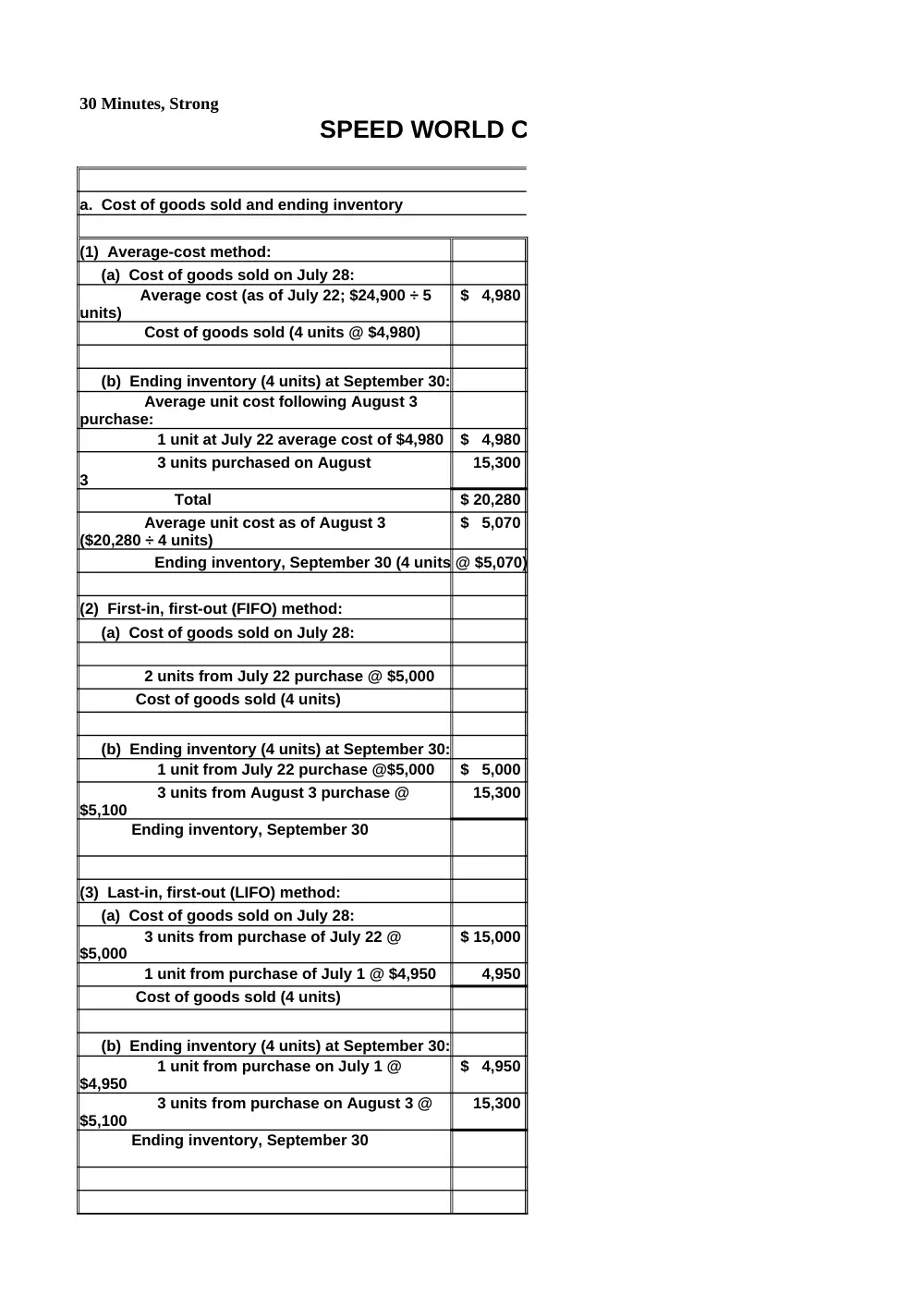
a. Cost of goods sold and ending inventory
(1) Average-cost method:
(a) Cost of goods sold on July 28:
$ 4,980
Cost of goods sold (4 units @ $4,980)
(b) Ending inventory (4 units) at September 30:
1 unit at July 22 average cost of $4,980 $ 4,980
15,300
Total
$ 20,280
$ 5,070
Ending inventory, September 30 (4 units @ $5,070)
(2) First-in, first-out (FIFO) method:
(a) Cost of goods sold on July 28:
2 units from July 22 purchase @ $5,000
Cost of goods sold (4 units)
(b) Ending inventory (4 units) at September 30:
1 unit from July 22 purchase @$5,000
$ 5,000
15,300
(3) Last-in, first-out (LIFO) method:
(a) Cost of goods sold on July 28:
$ 15,000
1 unit from purchase of July 1 @ $4,950
4,950
Cost of goods sold (4 units)
(b) Ending inventory (4 units) at September 30:
$ 4,950
15,300
Average cost (as of July 22; $24,900 ÷ 5
units)
Average unit cost following August 3
purchase:
3 units purchased on August
3
Average unit cost as of August 3
($20,280 ÷ 4 units)
3 units from August 3 purchase @
$5,100
Ending inventory, September 30
3 units from purchase of July 22 @
$5,000
1 unit from purchase on July 1 @
$4,950
3 units from purchase on August 3 @
$5,100
Ending inventory, September 30
PROBLEM 8.2A
ORLD CYCLES: PERPETUAL SYSTEM
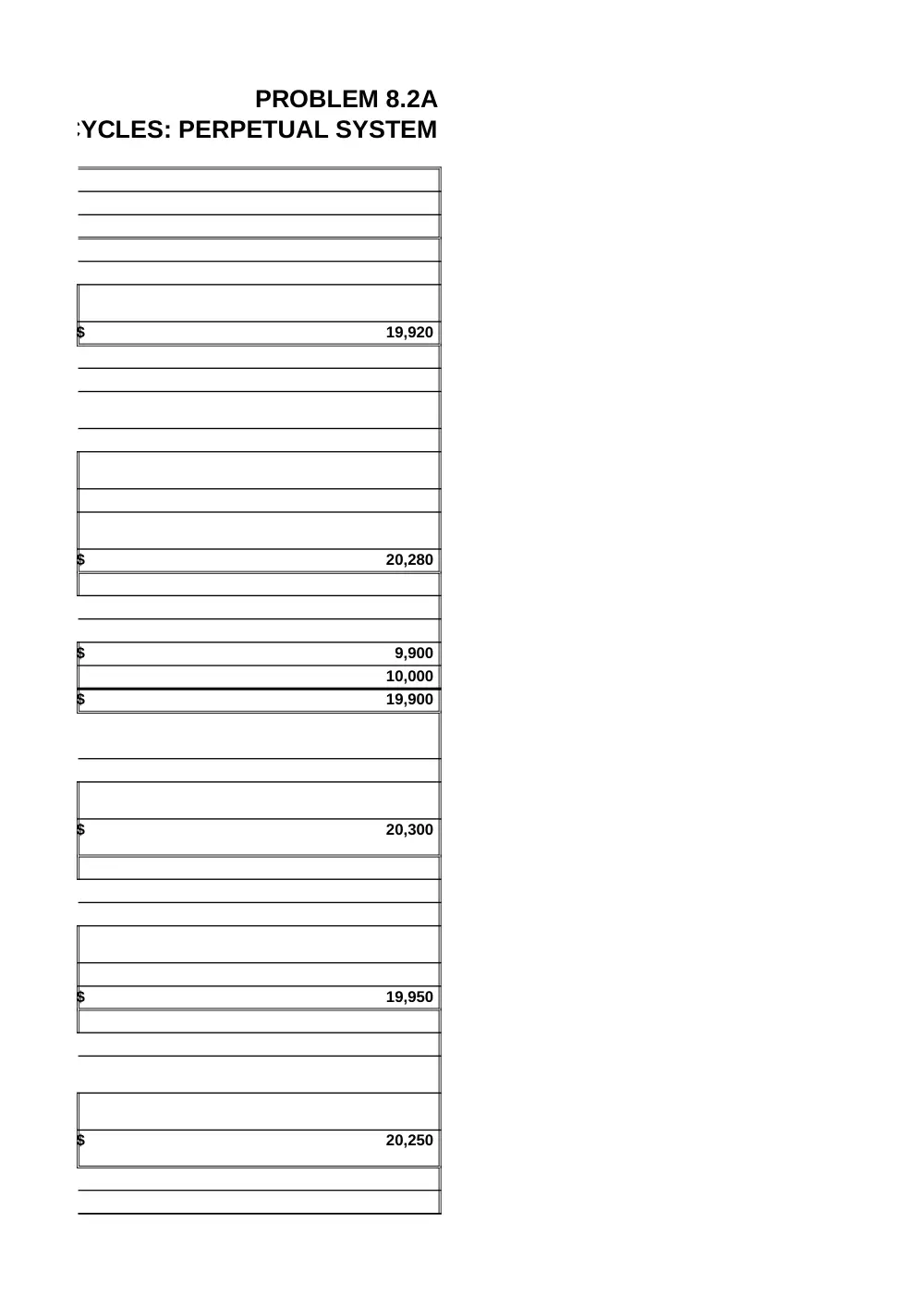
$ 19,920
$ 20,280
$ 9,900
10,000
$ 19,900
$ 20,300
$ 19,950
$ 20,250
Problem 8.2A
SPEED WORLD CYCLES: PERPETUAL SYSTEM (concluded)
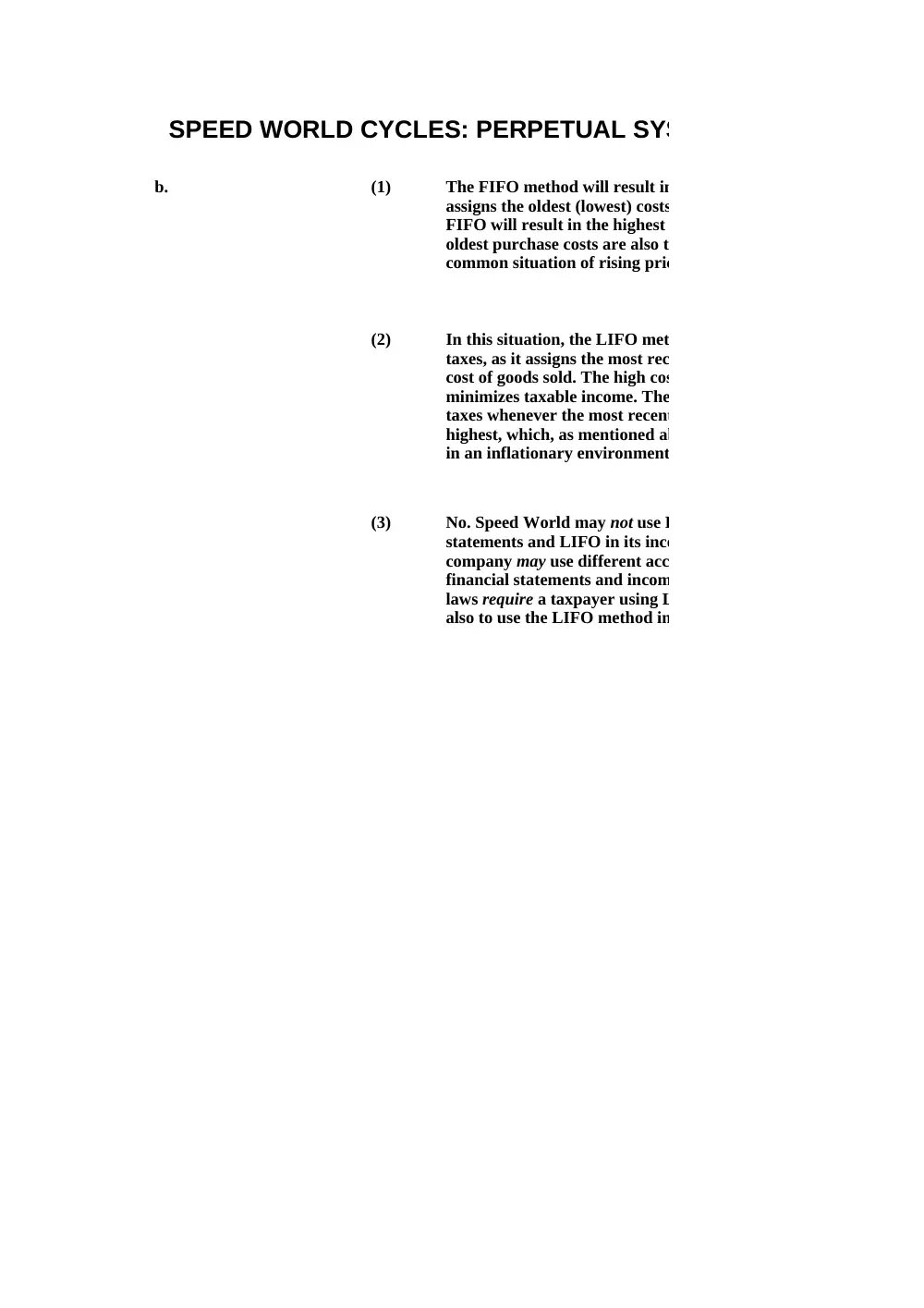
b.
(1)
(2)
(3)
The FIFO method will result in the highest net income, as it
assigns the oldest (lowest) costs to the cost of goods sold.
FIFO will result in the highest net income whenever the
oldest purchase costs are also the lowest—that is, in the
common situation of rising prices.
In this situation, the LIFO method will minimize income
taxes, as it assigns the most recent (and highest) costs to the
cost of goods sold. The high cost of goods sold, in turn,
minimizes taxable income. The LIFO method will minimize
taxes whenever the most recent purchase costs are the
highest, which, as mentioned above, is the normal situation
in an inflationary environment.
No. Speed World may not use FIFO in its financial
statements and LIFO in its income tax returns. Normally a
company may use different accounting methods in its
financial statements and income tax returns. However, tax
laws require a taxpayer using LIFO in its income tax return
also to use the LIFO method in its financial statements.
Problem 8.2A
UAL SYSTEM (concluded)
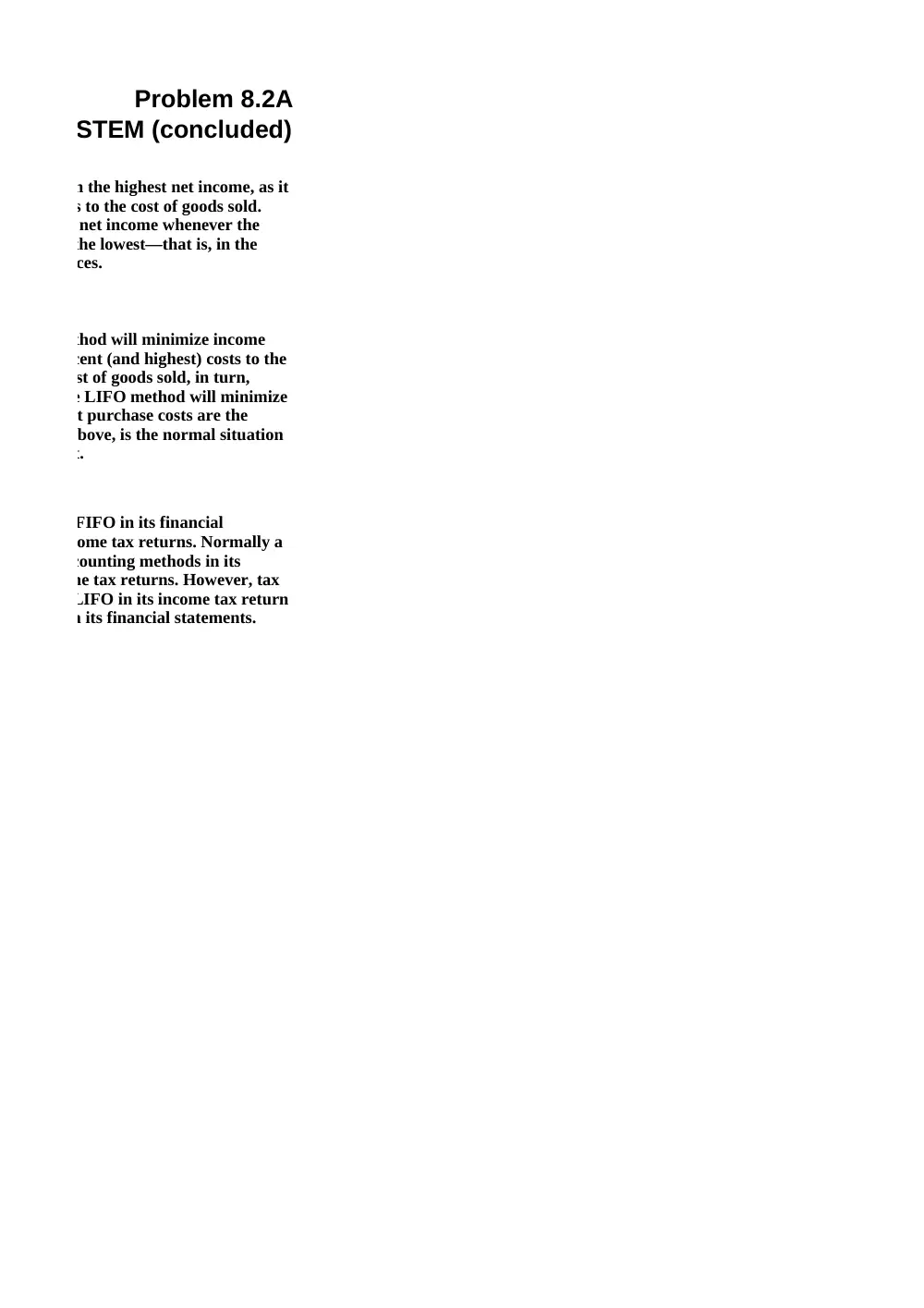
will result in the highest net income, as it
owest) costs to the cost of goods sold.
the highest net income whenever the
ts are also the lowest—that is, in the
f rising prices.
e LIFO method will minimize income
he most recent (and highest) costs to the
The high cost of goods sold, in turn,
ncome. The LIFO method will minimize
most recent purchase costs are the
mentioned above, is the normal situation
nvironment.
ay not use FIFO in its financial
O in its income tax returns. Normally a
ifferent accounting methods in its
s and income tax returns. However, tax
ayer using LIFO in its income tax return
O method in its financial statements.
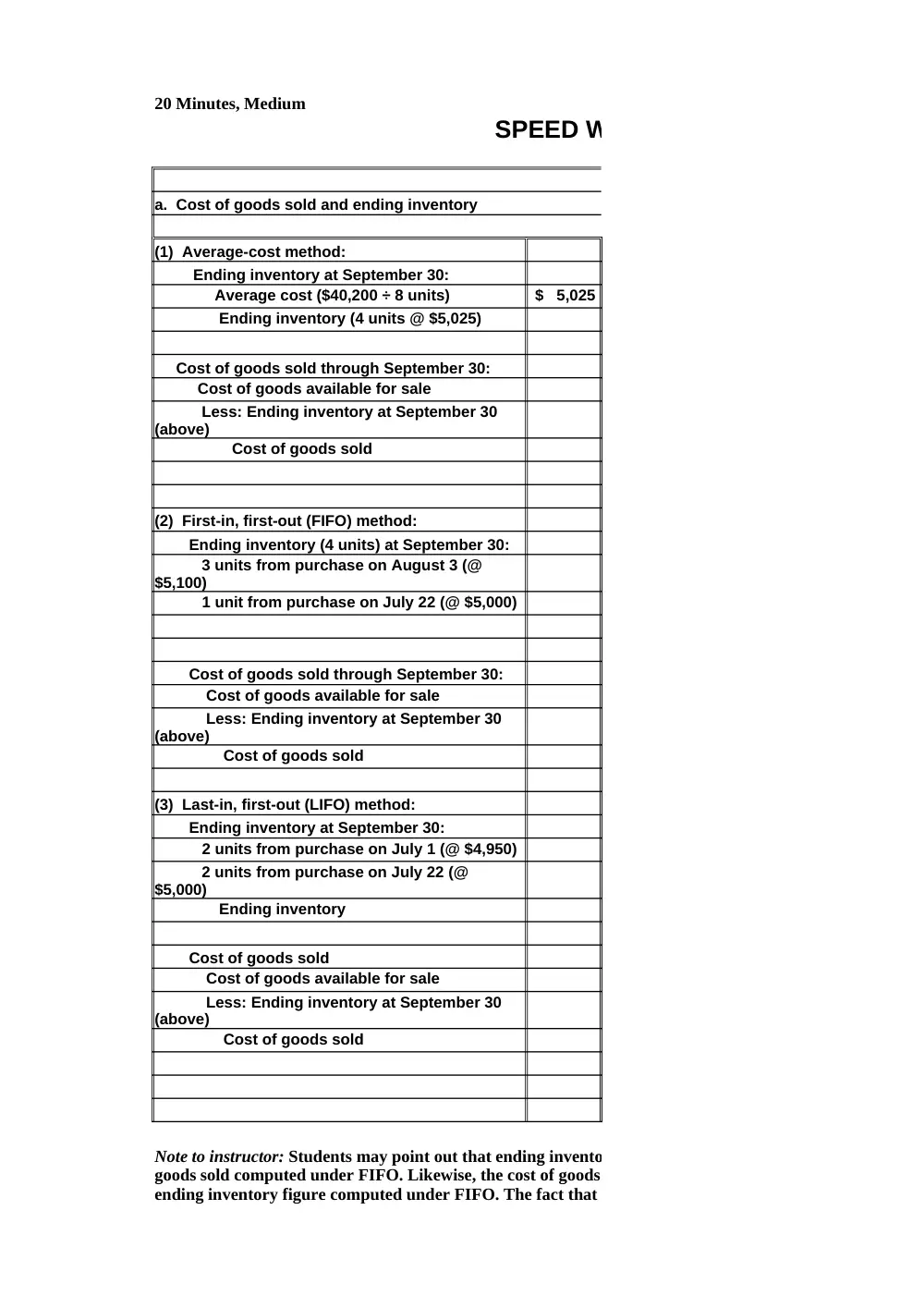
20 Minutes, Medium
PROBL
SPEED WORLD CYCLES: PERIODIC
a. Cost of goods sold and ending inventory
(1) Average-cost method:
Ending inventory at September 30:
$ 5,025
Ending inventory (4 units @ $5,025)
Cost of goods sold through September 30:
Cost of goods available for sale
Cost of goods sold
(2) First-in, first-out (FIFO) method:
Ending inventory (4 units) at September 30:
1 unit from purchase on July 22 (@ $5,000)
Cost of goods sold through September 30:
Cost of goods available for sale
Cost of goods sold
(3) Last-in, first-out (LIFO) method:
Ending inventory at September 30:
2 units from purchase on July 1 (@ $4,950)
Ending inventory
Cost of goods sold
Cost of goods available for sale
Cost of goods sold
Average cost ($40,200 ÷ 8 units)
Less: Ending inventory at September 30
(above)
3 units from purchase on August 3 (@
$5,100)
Less: Ending inventory at September 30
(above)
2 units from purchase on July 22 (@
$5,000)
Less: Ending inventory at September 30
(above)
Note to instructor: Students may point out that ending inventory computed under LIFO is the same figure
goods sold computed under FIFO. Likewise, the cost of goods sold figure computed under LIFO is the sam
ending inventory figure computed under FIFO. The fact that these numbers are the same is merely a coinc
b.
Note to instructor: Students may point out that ending inventory computed under LIFO is the same figure
goods sold computed under FIFO. Likewise, the cost of goods sold figure computed under LIFO is the sam
ending inventory figure computed under FIFO. The fact that these numbers are the same is merely a coinc
Yes. Income tax regulations influence the inventory method used in financial reports only when
method is used for income tax purposes. If the company selects the FIFO method for income tax
is free to choose another method for financial reporting purposes.
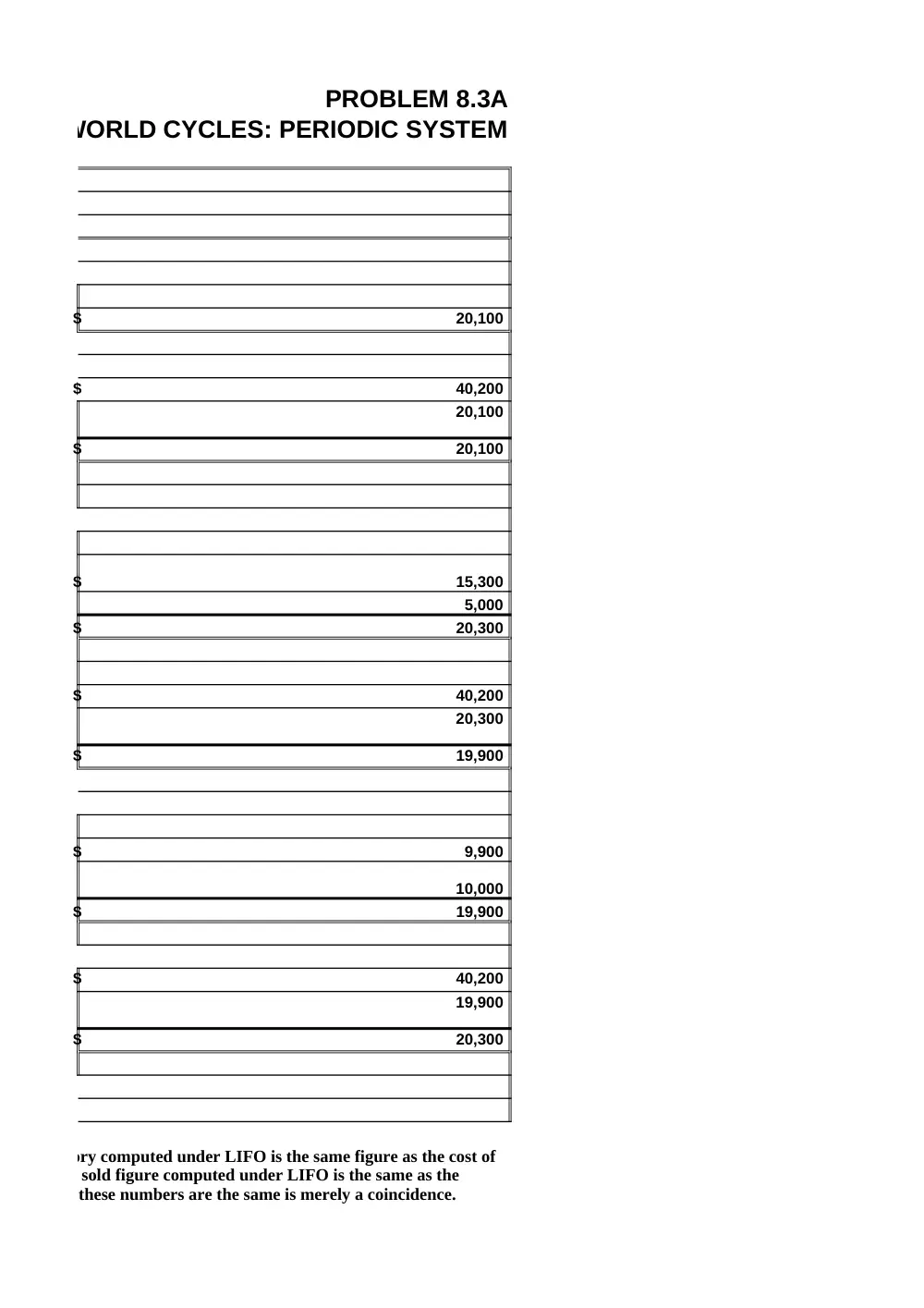
PROBLEM 8.3A
PEED WORLD CYCLES: PERIODIC SYSTEM
$ 20,100
$ 40,200
20,100
$ 20,100
$ 15,300
5,000
$ 20,300
$ 40,200
20,300
$ 19,900
$ 9,900
10,000
$ 19,900
$ 40,200
19,900
$ 20,300
ing inventory computed under LIFO is the same figure as the cost of
st of goods sold figure computed under LIFO is the same as the
he fact that these numbers are the same is merely a coincidence.
ing inventory computed under LIFO is the same figure as the cost of
st of goods sold figure computed under LIFO is the same as the
he fact that these numbers are the same is merely a coincidence.
e inventory method used in financial reports only when the LIFO
If the company selects the FIFO method for income tax reporting, it
ancial reporting purposes.
20 Minutes, Medium
PROBLEM
MARIO'S NURS
a.
Shrinkage loss - 40 trees
(1) Average-cost method:
Cost of Goods Sold
1,208
Inventory
(2) Last-in first-out (LIFO) method:
Cost of Goods Sold
1,560
Inventory
b. Shrinkage loss and LCM adjustment
Cost of Goods Sold
1,000
Inventory
assumption (40 trees @ $25).
(2) Write-down of inventory to the lower-of-cost-or
Cost of Goods Sold
3,370
Inventory
Cost (after shrinkage loss: $10,570 - $1,000)
$ 9,570
Market (310 trees x $20 per tree)
6,200
Loss from write-down to market value
$ 3,370
To record shrinkage loss of 40 trees using
average cost of
$30.20 ($10,570 ÷ 350 trees = $30.20 per tree).
To record shrinkage loss of 40 trees using the
LIFO flow
assumption (40 trees @ $39).
(1) Shrinkage loss, first-in, first-out (FIFO)
method:
To record shrinkage loss of 40 trees using the
FIFO flow
To write down inventory to a market value below
cost:
c.
The only unethical act in this situation was committed by the employee against his employer. Th
nothing unethical about using a hidden security camera to protect one’s assets. The camera was
used to entice (or entrap) the employee. In short, he made a conscious decision to steal trees from
employer and should be held completely responsible for doing so.
PROBLEM 8.4A
MARIO'S NURSERY
1,208
1,560
1,000
3,370
was committed by the employee against his employer. There is
security camera to protect one’s assets. The camera was not
In short, he made a conscious decision to steal trees from his
responsible for doing so.
25 Minutes, Easy
PR
MAC
Units
Unit Cost
a.
Inventory and cost of goods sold:
(1) FIFO:
Inventory:
Fourth pur 19 $ 320
Third purc 2 315
Ending inv 21
Cost of goods sold,
(2) LIFO:
Inventory:
10
$ 299
11 306
Ending inv 21
Cost of goods sold,
(3) Average cost:
Inventory:
Total good
72
72 units)
$ 310.28
Cost of goods
sold:
Cost of
goods
available
for sale
Less:
Ending
inventory
, FIFO
Beginnin
g
inventory
First
purchase
(May 12)
Cost of goods
sold:
Cost of
goods
available
for sale
Less:
Ending
inventory
, LIFO
Average unit cost ($22,340 ÷
average 21 310.28
51
310.28
b.
Ending
inventory
,
weighted
Cost of goods
sold, weighted
$310.28
per unit
average
of
$310.28
per unit
The FIFO method, by assigning the costs of the most recent purchases to inventory, provides the
balance sheet amount for inventory in terms of replacement costs. A weakness in the FIFO meth
the costs assigned to the cost of goods sold are relatively old costs. Because the replacement costs
been rising throughout the year, the FIFO method tends to understate the cost of goods sold in t
actually being incurred by MACH IV to replenish its inventory. The LIFO inventory method as
recent costs to the cost of goods sold and therefore provides a more realistic measure of income,
replacement costs, than does the FIFO method.
PROBLEM 8.5A
MACH IV AUDIO
Total Cost
$ 6,080
630
$ 6,710
$ 22,340
6,710
$ 15,630
$ 2,990
3,366
$ 6,356
$ 22,340
6,356
$ 15,984
$ 22,340
$ 6,516
$ 15,824
s of the most recent purchases to inventory, provides the most realistic
rms of replacement costs. A weakness in the FIFO method, however, is that
ld are relatively old costs. Because the replacement costs of the units has
O method tends to understate the cost of goods sold in terms of the costs
replenish its inventory. The LIFO inventory method assigns the more
therefore provides a more realistic measure of income, in terms of current
method.
20 Minutes, Medium
a.
2011
Net sales
$ 875,000
Cost of goods sold
563,000
Gross profit on sales
$ 312,000
Gross profit percentage
36%
Cost of Goods Sold:
2009:
2010:
2011:
b.
$480,000 - $40,000
= $440,000
$487,200 + $40,000
= $527,200
$481,250 + $81,750
= $563,000
The current owners of this business have no reason to be enthusiastic over the trend of gross pro
inventory errors, it is apparent that both the dollar amount of gross profit and the gross profit p
the last three years.
PROBLEM 8.6A
HEXAGON HEALTH FOODS
2010
2009
$ 840,000
$ 820,000
527,200 $ 440,000
$ 312,800 $ 380,000
37%
46%
son to be enthusiastic over the trend of gross profit or gross profit percentage. After correction of the
lar amount of gross profit and the gross profit percentage have declined, rather than increased, during