
ACCT 210 Midterm, Spring 2003
American University of Beirut · Financial Accounting · 5 pages

More ACCT 210 files
Show the text of this exam
os
ww’ .
os
AMERIC NUNES CHEE
oF
Tam wee ene ono named
April 16,2003
(D# :
Instructor name/section = :__(c i!
Lie ARY | ACCT 210
Midterm II
Spring 2002-2003
. American University of Beirut
- School Of Business
Name : NAVD JATALEDOS NE
. Az DS
e
L- Multiple Choice
II Problems:
Problem 1:Bank Reconciliation
20 15
Problem 2: Accounts Receivable 20 25
Problem 3: Perpetual inventory 20 25
, Problem 4: Periodic inventory 15 25
Problem 5: Lower of cost or market ‘5 10
Total 100 120
Good Luck!
SHOW ALL SUPPORTING COMPUTATIONS
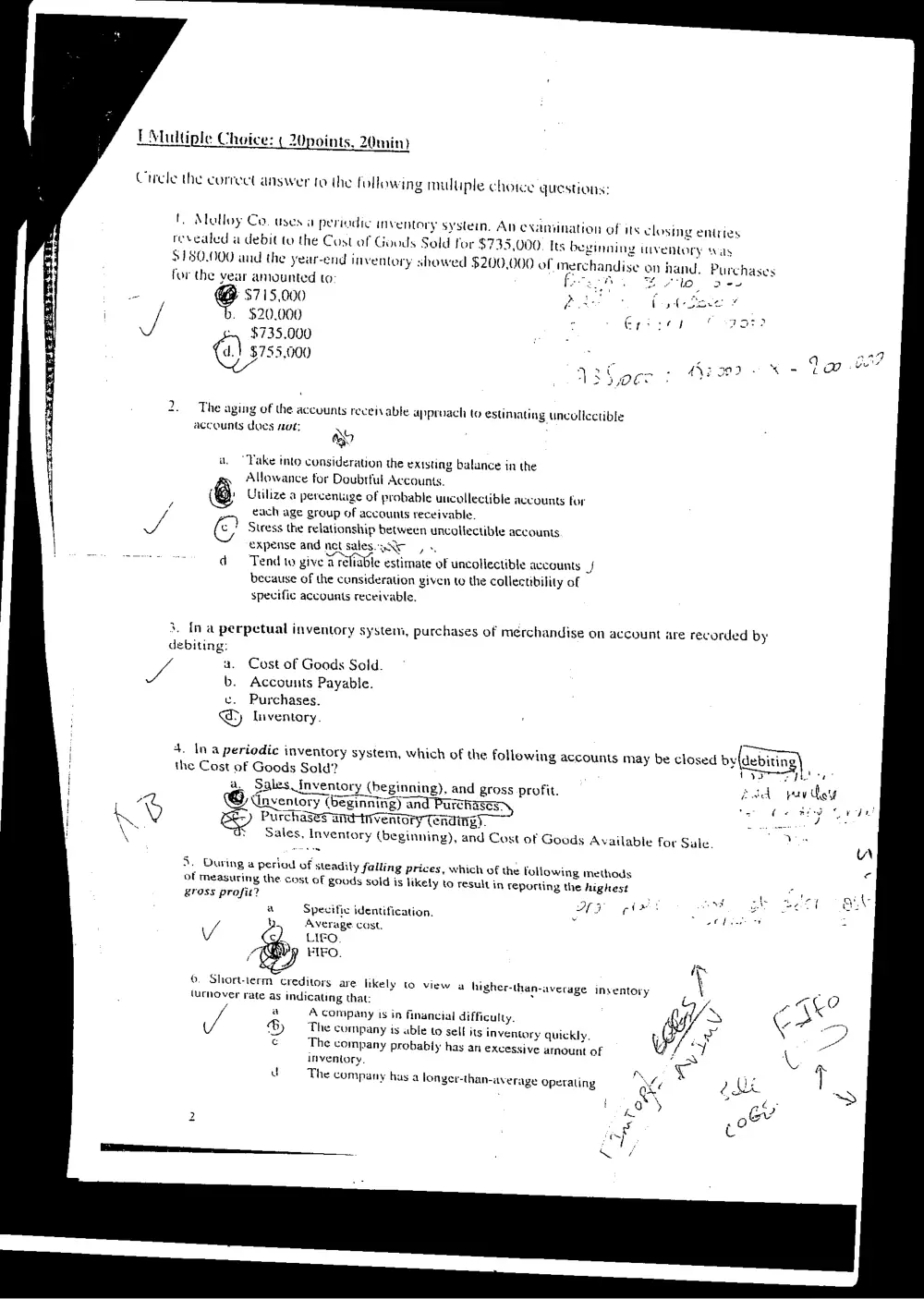
UNtutiple Choice: ( 20points, 20min)
Crrele the correct answer to the following muluple choice questions:
1, Mulloy Co. uses a periadic inventory systein. Anes
revealed a debit to the Cost of Goods Sold for $7
$180.00 aud the year-end inventory showed $2(
for the vear aniounted to:
- $715,000
J $20,000
. $735,000
(a) $155.00
aniination of its closing entries
35,000, Its beginning tiventory
J0,000 of merch
aly
andise en hand. Purchases
The aging of the accounts receivable approach to estimating uncollectible
accounts dues net: .
*
a, “Take into consideration the existing balance in the
Allowance for Doubtful Accounts,
1 Utilize a percentage of probable uncollectible accounts tor
é each age group of accounts receivable.
S ‘Gi Stress the relationship between uncollectible accounts
expense and net sales-yXr, .,
Tend te give ‘Yreliable estimate of uncollectible accounts _/
because of the consideration given to the collectibility of
specific accounts receivable.
sues d
3. In a perpetual inventory system, purchases of merchandise on account are recorded by:
debiting:
a. Cost of Goods Sold.
S b. Accounts Payable.
vc. Purchases.
g Inventory.
4. In a periodic inventory system, which of the following accounts may be closed by(debiing
: . : Peet.
the Cast of Goods Sold? ‘
1yF vt
a. Sales. Inventory (beginning), and gross profit.
j
I asd pa hey
i 2 Unventory (beginnitig) and Purchases, a re oe
I i iv) Purchases andtrventory tending),
ij \ S
4
Sales, Inventory (beginning), and Cost of Goods Available for Sale.
3. During a period of steadily falling prices, which of the following methods
of measuring the cost of goods sold is likely to result in reporting the highest
gross profit?
ym) ey
A Specific identification. ¥ fr r
i; Average cost.
vA cof LIEO.
AOS FIFO,
6. Short-lerm® creditors are Itkely to view a higher-than-average inventory
(ucnover rate as indicating that:
/ a A company is in financial difficulty.
4) The company is able to self its inventory quickly,
c The company probably has an excessive arnount of
inventory.
d
The company has a longer-than-average Operating
Sree
qf me *
4 Senet ty
cmeRICAN OT Wid te
LIBRA ry
oar
_——_—
eycle nell
oe
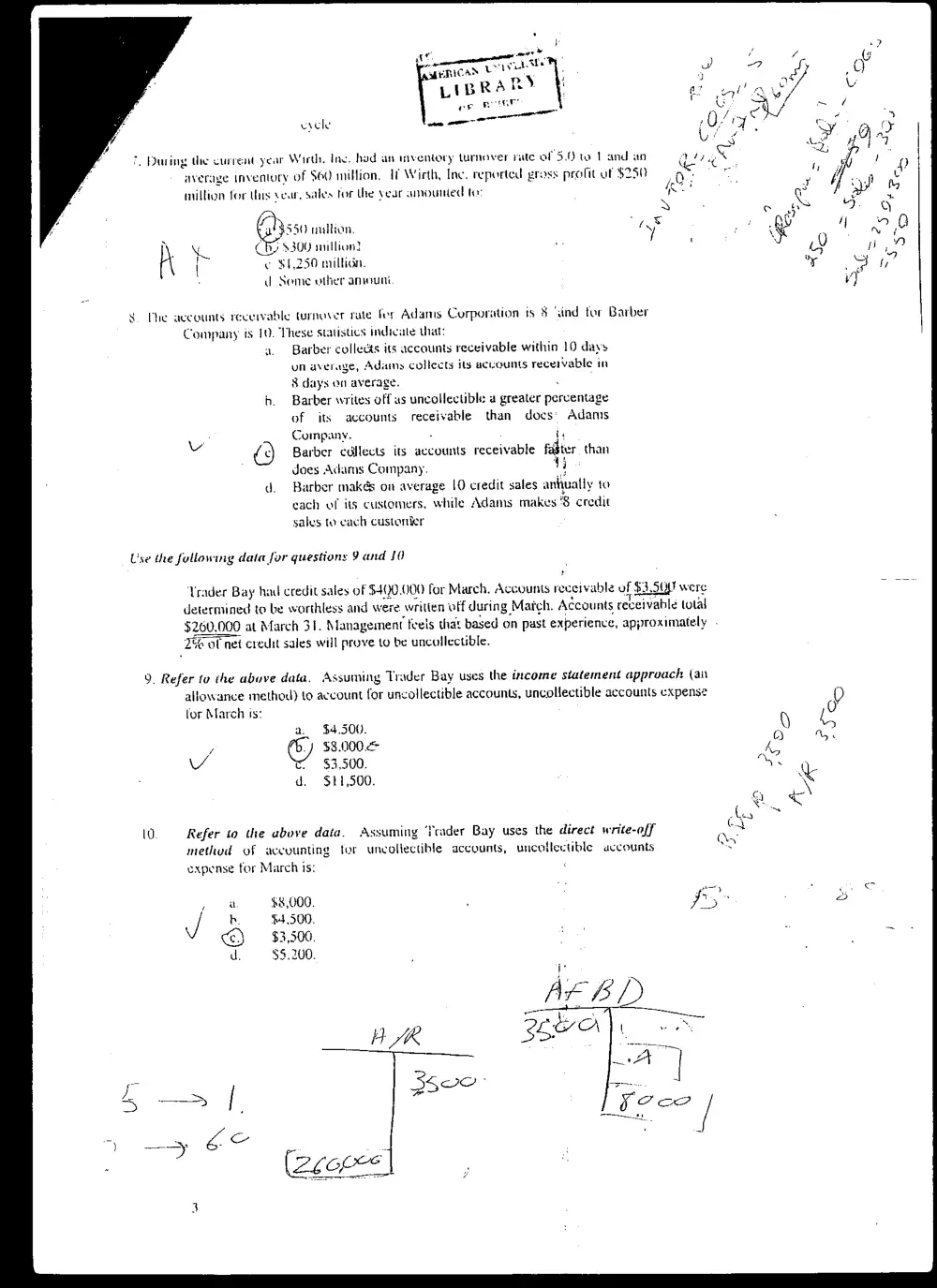
. During the current year Wirth, Ine. had an uiventory turnover rate of 5.0 tw Land an
average inventory of S60 million, IW Wirth, Inc. reported gross profit of $250
million for this sear, sales for the year amoutted to:
iD
¥ 4550 unltion.
Be 5300 million?
¢ $0,250 millian.
d Seme wther amount
¥ Phe accounts receivable turnover rate fer Adams Corporation is 8 “ind for Barber
Company is 10. These Statistics indicule Wat:
a. Barber collects its accounts receivable within 10 days
on average, Adams collects its acuounts receivable in
8 days on average. .
Barber writes off us uncollectible a greater percentage
of its accounts receivable than docs’ Adams
Company. : be
Barber cdlllects its accounts receivable fabter than
does Ackims Company. v4
Barber makés on average 10 credit sales anhually to
each of its customers, while Adams makes % credit
sales to cach custonier
Use the following data for questions 9 and 10
Vrader Bay had credit sales of $4(0.000 for March, Accounts receivable of &: 3.SQ)) were
determined to be worthless and were written off during Match. Accounts receivable total
$260,000 at March 31. Management feeis that based on past experience, approximately
25e of net creuit sales will prove to be uncullectible.
9. Refer to the above data. Assuming Trader Bay uses the income statement approach (ait
allowance method) to account for uncollectible accounts, uncollectible accounts expense
for March ts:
a. 34.500.
/ -) $8.000.
Y $3,500.
d. $11,500.
Refer to the above data. Assuming Trader Bay uses the direct write-off
methud of accounting for uncollectible accounts, uncollectible accounts
expense for March is:
$8,000.
$4,500.
$3,500.
$5,200.
| &
PProblem I N20poiuts, 15 min) “~
POLIS:
7s
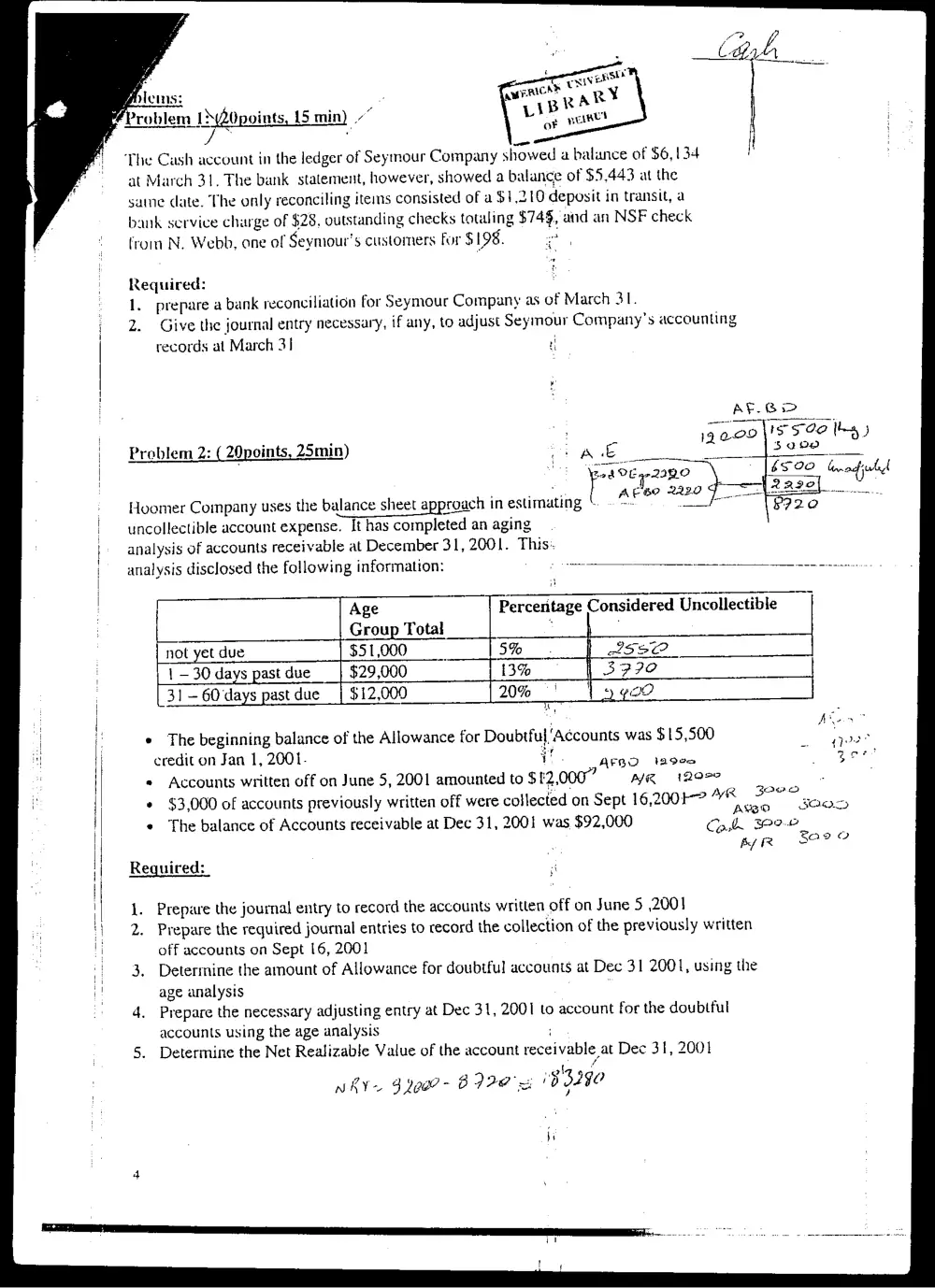
The Cash account in the ledger of Seymour Company showed a balance of $6,134
at March 31. The bank statement, however, showed a balance of $5,443 at the
same date. The only reconciling items consisted of a $1,210 deposit in transit, a
bank service charge of $28, outstanding checks totaling $74§, and an NSF check
from N. Webb, one of Seymour's customers for $198. ou
Required:
1. prepare a bank reconciliation for Seymour Company as of March 31.
2. Give the journal entry necessary, if any, to adjust Seymour Company's accounting
4
records at March 31 i
AF.BD__
5 Is SOO [hy )
5 aon
: . : 19 BOD
Problem 2: ( 20points, 25min) ae -
a Freeze [ESOC bmaefrenlel
Pent 2 RPO}
Abe 2220 J
~ 8720
Hoomer Company uses the balance sheet approach in estimating * - ~
uncollectible account expense. It has completed an aging
analysis of accounts receivable at December 31, 2001. This:.
analysis disclosed the following information: coe — eee niente
Age Perceritage Considered Uncollectible
Group Total : ;
not yet due $51,000 ; 5% _ LSSO
1 — 30 days past due $29,000 13% 3F7O
| 31-60 days past due__| $12,000 20% 19 yoO
: hes
° The beginning balance of the Allowance for Doubtful'Accounts was $15,500 7 ree
credit on Jan 1, 2001- i. AFRO \asee “ge
* Accounts written off on June 5, 2001 amounted to $2,000” AJR 12Ese
¢ $3,000 of accounts previously written off were collected on Sept 16,2001 ue 3o8 © soe
* The balance of Accounts receivable at Dec 31, 2001 was $92,000 Cpe 320 - ;
ae oO
BYR
Required: a
_
Prepare the journal entry to record the accounts written off on June 5 2001!
2. Prepare the required journal entries to record the collection of the previously written
off accounts on Sept 16, 2001
3. Determine the amount of Allowance for doubtful accounts at Dec 31 2001, using the
age analysis
4. Prepare the necessary adjusting entry at Dec 31, 2001 to account for the doubtful
accounts using the age analysis ‘
5. Determine the Net Realizable Value of the account receivable at Dec 31, 2001
NAY ~ 9 206? - BDDe ‘$3290
ji
Problem 3: ( 20points, 25min)
PEcohe | FQ)
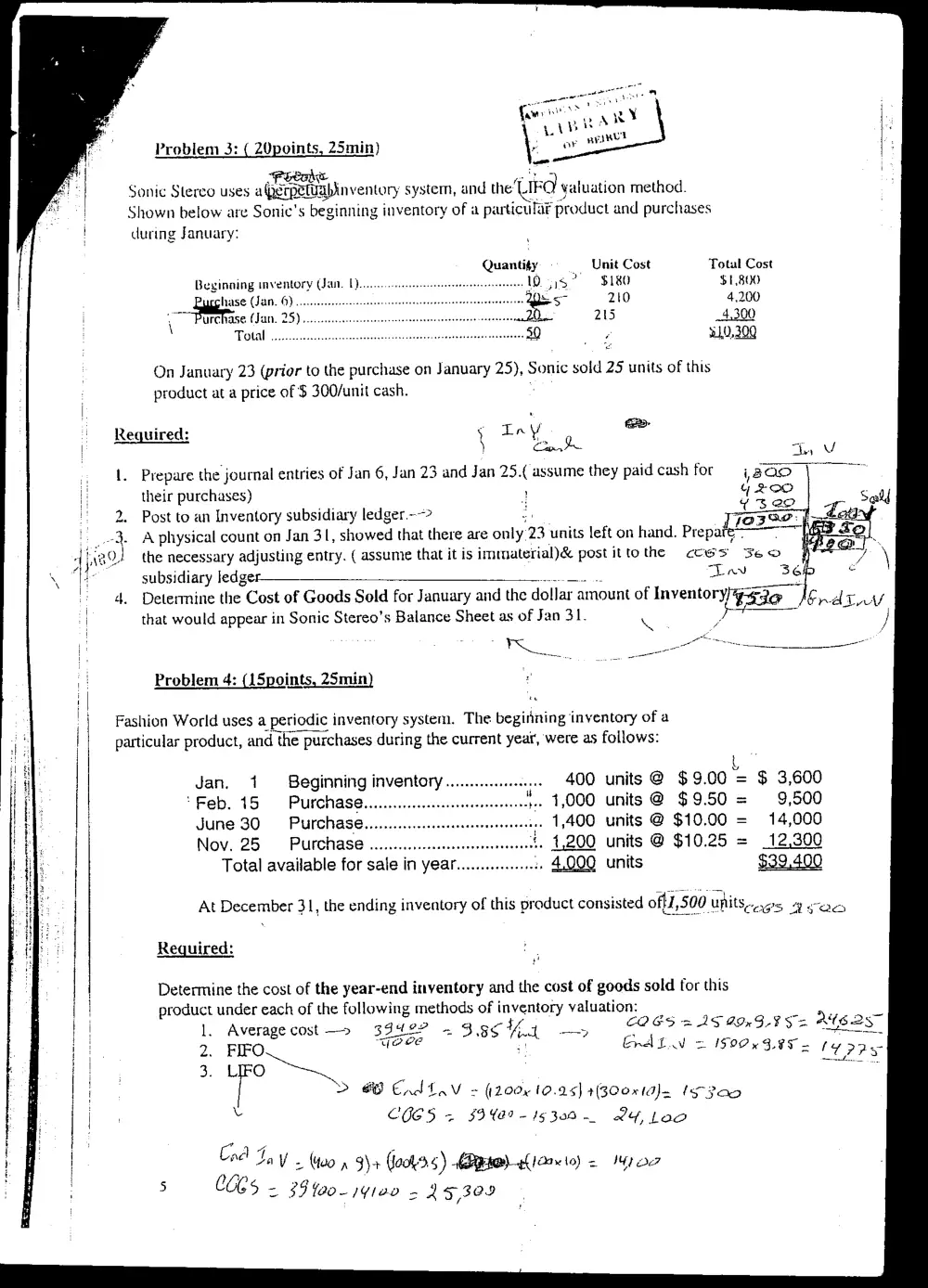
Sonic Slereo uses alpe nventory system, and the UR yaluation method.
Shown below are Sonic’s beginning inventory of a particular product and purchases
during January:
_, Unit Cost Total Cost
Bexginaing mventory Gan. 1) ~ AD 48 $180 $1,800
Sl Gan. 6)... _ 210 4,200
a urchase (Jan. 25).. 215 4,300
210,300
On January 23 (prior to the purchase on January 25), Sonic sold 25 units of this
product at a price of $ 300/unit cash. :
Required: i Tay. all
Cae
Prepare the journal entries of Jan 6, Jan 23 and Jan 25.( assume they paid cash for Xero)
their purchases) : 4 FOO
Post to an Inventory subsidiary ledger.~~? 7
A physical count on Jan 31, showed that there are only 2B units left on hand. Prepate-—"~
the necessary adjusting entry. ( assume that it is immaterial)& post ittothe ccwes Bea
subsidiary ledger. Tia 36
Determine the Cost of Goods Sold for January and the dollar amount of Inventory ¥F3q
that would appear in Sonic Stereo’s Balance Sheet as of Jan 31.
Problem 4: (L5points, 25min)
Fashion World uses a periodic inventory system. The begitining inventory of a
particular product, and the purchases during the current year, were as follows:
L
Jan. 1 Beginning inventory 400 units @ $9.00 = $ 3,600
‘Feb. 15 Purchase .. 1,000 units @ $9.50 9,500
June 30 Purchase 1,400 units @ $10.00 14,000
Nov. 25 Purchase 1,200 units @ $10.25 12,300
Total available for sale in year. : $39,400
At December 31, the ending inventory of this product consisted off 1,500 URIS e505 Ageo
Required:
Determine the cost of the year-end inventory and the cost of goods sold for this
product under each of the following pene’ of inventory valuation:
1. Average cost» 39429? + as ha — COES a AS AGS AUS 2S-
2. FIFO GO Oe Crd Lv 2 1900 Kn 3.9 F = (9299
3. Li Oo
r > AI Crd LaV = (100% 10.95) +B00rtI= IS F00
COE5 + $9409- 15306 24, Lao
Cod Ja V 5 (oo » 9)+ Gooks) AB BHO) klar) = Nyro
COC5 = 39 400- jy10 = 25,309