
AGSC 212 Final + Solution, Fall 2018
American University of Beirut · Agricultural Economic Principles and Policy · 9 pages · with solution





More AGSC 212 files
Show the text of this final exam
Name:
Fall 2012-2013 - Final Exam
AGSC 212.1
Instructions:
• Do not turn to the next page before you are instructed to do so
• Write your name before you start the Exam
• Exam duration is 60 minutes
• You have 40 multiple choice questions
• Each question has exactly ONE correct answer
• Grades are equally distributed among the di↵erent questions
• There is no penalty, answer ALL questions
• If a question is not clear raise your hand and I will come asap to clarify it
• Cheating will be severely punished. DO NOT attempt to cheat
• When you finish the exam raise your hand, a proctor will come take your exam paper and
then you will be allowed to leave
Good Luck!
1
Name:
Fall 2012-2013 - Final Exam
AGSC 212.1
1. Good A and Good B cost $3 and $4, respectively. Sarah, spending all of her income, buys
4 units of Good A and 3 units of Good B. The final unit of each good gives her 12 units of
utility.
(a) Sarah is maximizing her utility.
(b) Sarah should buy more of Good A and less of Good B to maximize utility.
(c) Sarah should buy less of Good A and more of Good B to maximize utility.
(d) Sarah should buy less of both goods to maximize utility.
2. If all prices double and income doubles, the budget constraint will
(a) double.
(b) more inward.
(c) move outward by 50%.
(d) not shift position.
3. The wage rate rises. If the quantity of labor supplied falls, the most likely explanation is that
the substitution e↵ect
(a) is negative and it dominates the income e↵ect.
(b) is negative and it is dominated by the income e↵ect.
(c) is positive and it dominates the income e↵ect.
(d) is positive and it is dominated by the income e↵ect.
4. Jamil has had 4 hamburgers and 2 hot dogs this week and is now indi↵erent between them.
Hamburgers cost $2 and hot dogs cost $1. Currently
(a) Jamil’s marginal utility per unit of hamburgers is twice that of hot dogs.
(b) Jamil’s total utility of hamburgers equals that of hot dogs.
(c) Jamil’s total utility of hamburgers is twice that of hot dogs.
(d) Jamil’s marginal utility per unit of hamburgers equals that of hot dogs.
5. The wage rate can be seen as a measure of the opportunity cost of
(a) work.
(b) saving.
(c) leisure.
(d) future consumption.
6. Lynn can buy two goods, Good X and Good Y. Good X is represented on the horizontal axis.
Which of the following will cause the budget constraint to increase its slope?
(a) An increase in the price of Good X.
(b) An equal increase in the price of both goods.
(c) An increase in Lynn’s income.
(d) An increase in the price of Good Y.
2
Name:
Fall 2012-2013 - Final Exam
AGSC 212.1
Use the following information for the next two questions. Hassan’s income is $100; the price
of apples is $5 per unit; the price of oranges is $10 per unit. Assume a consumer choice
diagram with apples on the vertical axis and oranges on the horizontal axis.
7. If Hassan’s income falls to $75, but the prices of apples and oranges remain unchanged, there
will be
(a) a parallel shift inwards of the indi↵erence curves.
(b) a parallel shift outwards of the budget line.
(c) a parallel shift inwards of the budget line.
(d) a decrease in Hassan’s consumption of both apples and oranges.
8. If the price of apples increases to $10 per unit,
(a) the budget line will rotate clockwise around the intersection of the budget line and the
vertical axis.
(b) the budget line will rotate counterclockwise around the intersection of the budget line
and the horizontal axis.
(c) Hassan will be on the same indi↵erence curve, but fewer apples will be consumed.
(d) Hassan’s consumption of apples will decrease.
9. Four workers produce 160 units of output and five workers produce 180. The marginal product
of the fifth worker is
(a) 32 units of output.
(b) 4 units of output.
(c) 20 units of output.
(d) 36 units of output.
10. The return on investment that is just sufficient to satisfy the owners of a business is called
(a) normal profit.
(b) marginal profit.
(c) economic profit.
(d) excess profit.
11. Omar increases the amount of capital his workers use. The average product of labor will
and the marginal product of labor will
.
(a) increase; increase
(b) decrease; decrease
(c) increase; decrease
(d) decrease; increase
3
Name:
Fall 2012-2013 - Final Exam
AGSC 212.1
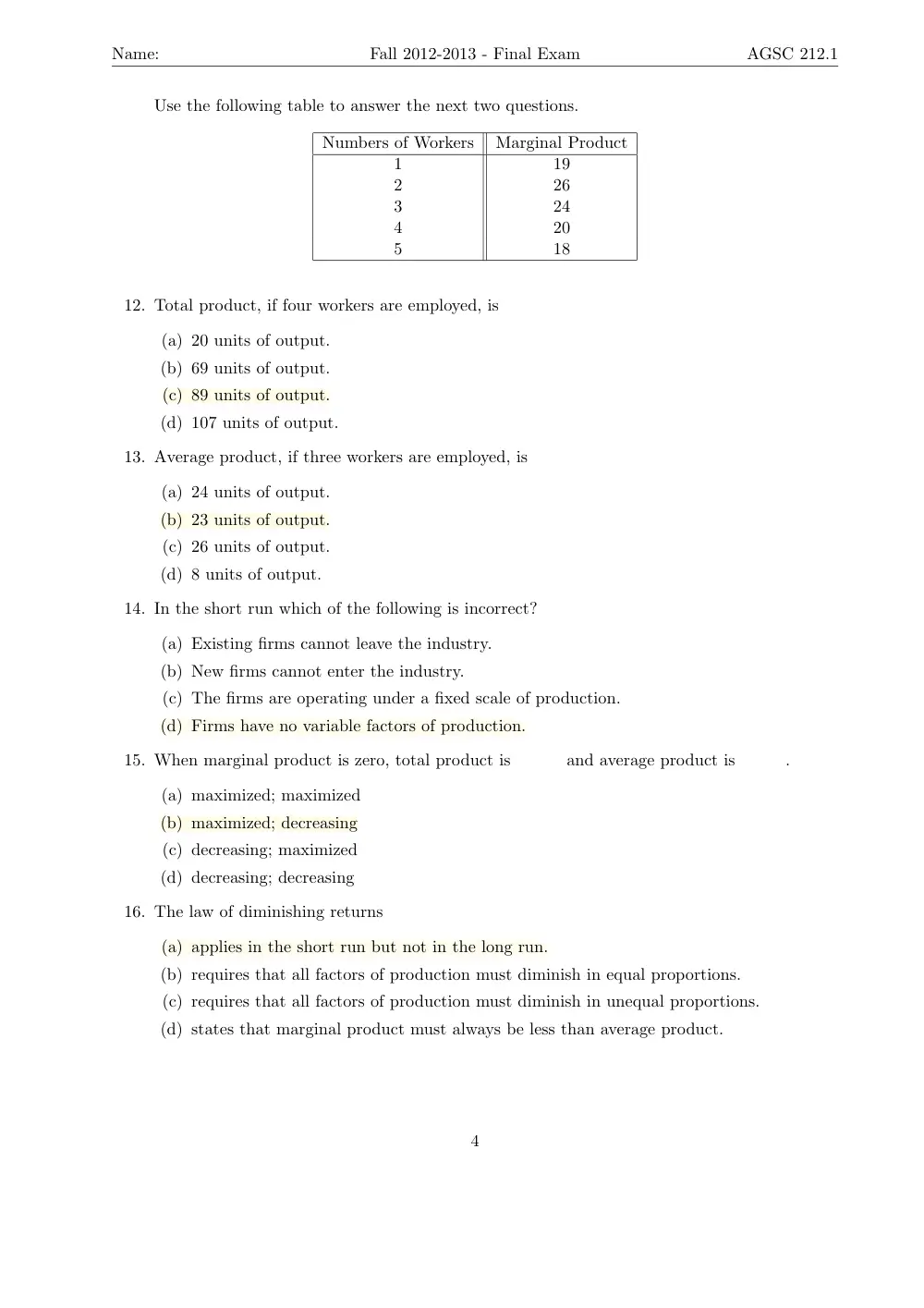
Use the following table to answer the next two questions.
Numbers of Workers
Marginal Product
1
19
2
26
3
24
4
20
5
18
12. Total product, if four workers are employed, is
(a) 20 units of output.
(b) 69 units of output.
(c) 89 units of output.
(d) 107 units of output.
13. Average product, if three workers are employed, is
(a) 24 units of output.
(b) 23 units of output.
(c) 26 units of output.
(d) 8 units of output.
14. In the short run which of the following is incorrect?
(a) Existing firms cannot leave the industry.
(b) New firms cannot enter the industry.
(c) The firms are operating under a fixed scale of production.
(d) Firms have no variable factors of production.
15. When marginal product is zero, total product is
and average product is
.
(a) maximized; maximized
(b) maximized; decreasing
(c) decreasing; maximized
(d) decreasing; decreasing
16. The law of diminishing returns
(a) applies in the short run but not in the long run.
(b) requires that all factors of production must diminish in equal proportions.
(c) requires that all factors of production must diminish in unequal proportions.
(d) states that marginal product must always be less than average product.
4
Name:
Fall 2012-2013 - Final Exam
AGSC 212.1
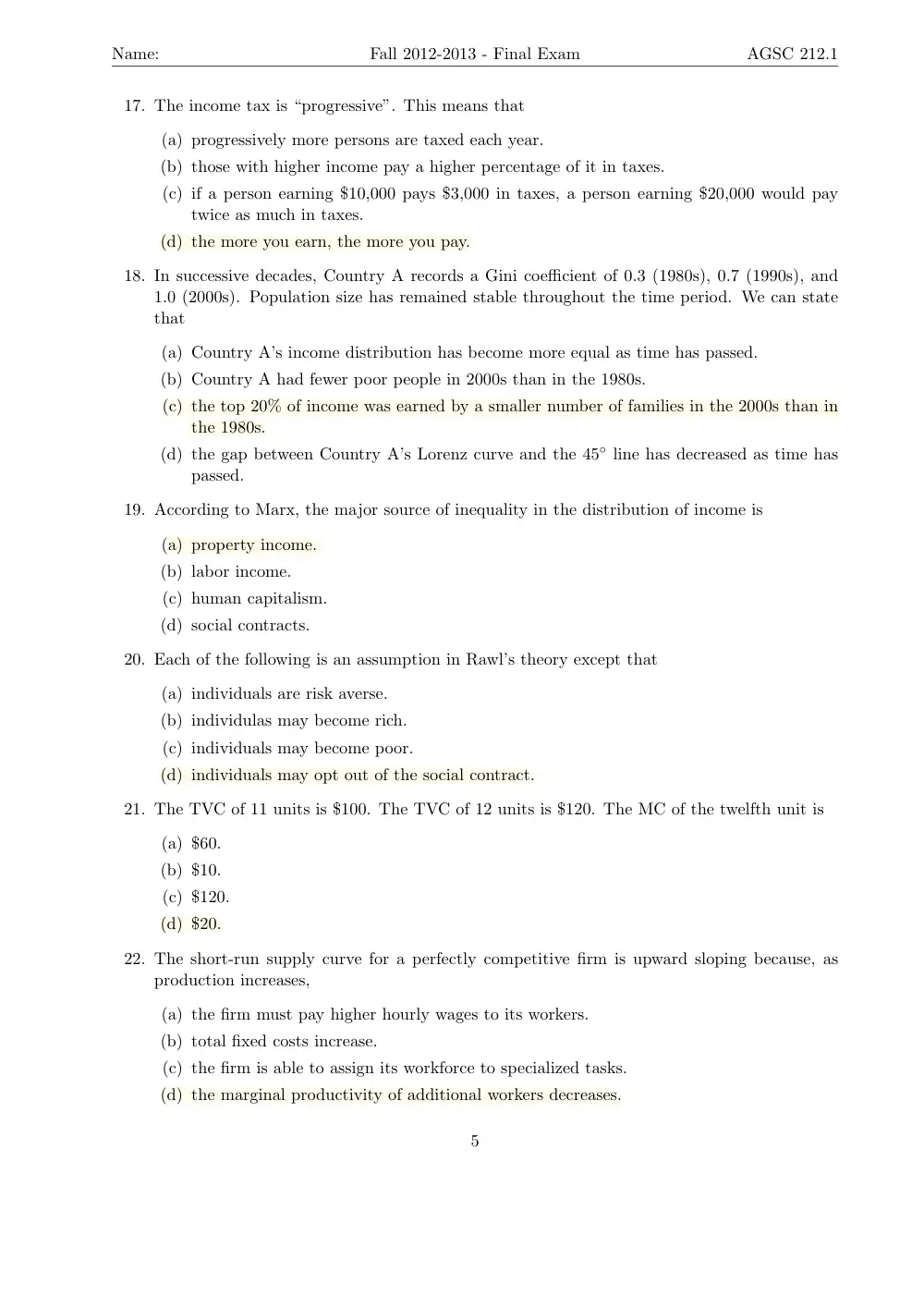
17. The income tax is “progressive”. This means that
(a) progressively more persons are taxed each year.
(b) those with higher income pay a higher percentage of it in taxes.
(c) if a person earning $10,000 pays $3,000 in taxes, a person earning $20,000 would pay
twice as much in taxes.
(d) the more you earn, the more you pay.
18. In successive decades, Country A records a Gini coefficient of 0.3 (1980s), 0.7 (1990s), and
1.0 (2000s). Population size has remained stable throughout the time period. We can state
that
(a) Country A’s income distribution has become more equal as time has passed.
(b) Country A had fewer poor people in 2000s than in the 1980s.
(c) the top 20% of income was earned by a smaller number of families in the 2000s than in
the 1980s.
(d) the gap between Country A’s Lorenz curve and the 45◦ line has decreased as time has
passed.
19. According to Marx, the major source of inequality in the distribution of income is
(a) property income.
(b) labor income.
(c) human capitalism.
(d) social contracts.
20. Each of the following is an assumption in Rawl’s theory except that
(a) individuals are risk averse.
(b) individulas may become rich.
(c) individuals may become poor.
(d) individuals may opt out of the social contract.
21. The TVC of 11 units is $100. The TVC of 12 units is $120. The MC of the twelfth unit is
(a) $60.
(b) $10.
(c) $120.
(d) $20.
22. The short-run supply curve for a perfectly competitive firm is upward sloping because, as
production increases,
(a) the firm must pay higher hourly wages to its workers.
(b) total fixed costs increase.
(c) the firm is able to assign its workforce to specialized tasks.
(d) the marginal productivity of additional workers decreases.
5
Name:
Fall 2012-2013 - Final Exam
AGSC 212.1
23. In the short run, which of the following is possible?
(a) AFC may be greater than ATC.
(b) MC may intersect ATC when ATC is decreasing.
(c) AFC may be greater than AVC.
(d) TFC falls as output rises.
24. The firm is at the output level where marginal cost intersects average variable cost. We can
infer that
(a) average variable cost is rising.
(b) average variable cost is falling.
(c) average total cost is falling.
(d) average total cost is rising.
25. Opel cuts usage of all inputs by 50%. Production falls by more than 50%. Opel is experiecing
(a) external economies of scale.
(b) external diseconomies of scale.
(c) increasing returns to scale.
(d) decreasing returns to scale.
26. In the short run, a perfectly competitive firm incurring losses should still produce if it can
cover its
(a) average costs.
(b) variable costs.
(c) fixed costs.
(d) economic costs.
Use the following information for the next four questions. Ipad sell for $400 a piece. Apple
can produce one Ipad for a total cost of $300, two Ipads for a total cost of $600, three for
$1000, four for $1500, and five for $2100. Total fixed cost is $100.
27. The marginal revenue of the fourth unit is
(a) $200
(b) $300
(c) $400
(d) $500
28. The marginal cost of the second unit is
(a) $300
(b) $400
(c) $500
(d) $600
6
Name:
Fall 2012-2013 - Final Exam
AGSC 212.1
29. To maximize profits, Apple will produce
(a) two units,
(b) three units.
(c) four units.
(d) five units.
30. The average variable cost of five units is
(a) $ 380
(b) $ 400
(c) $ 420
(d) $440
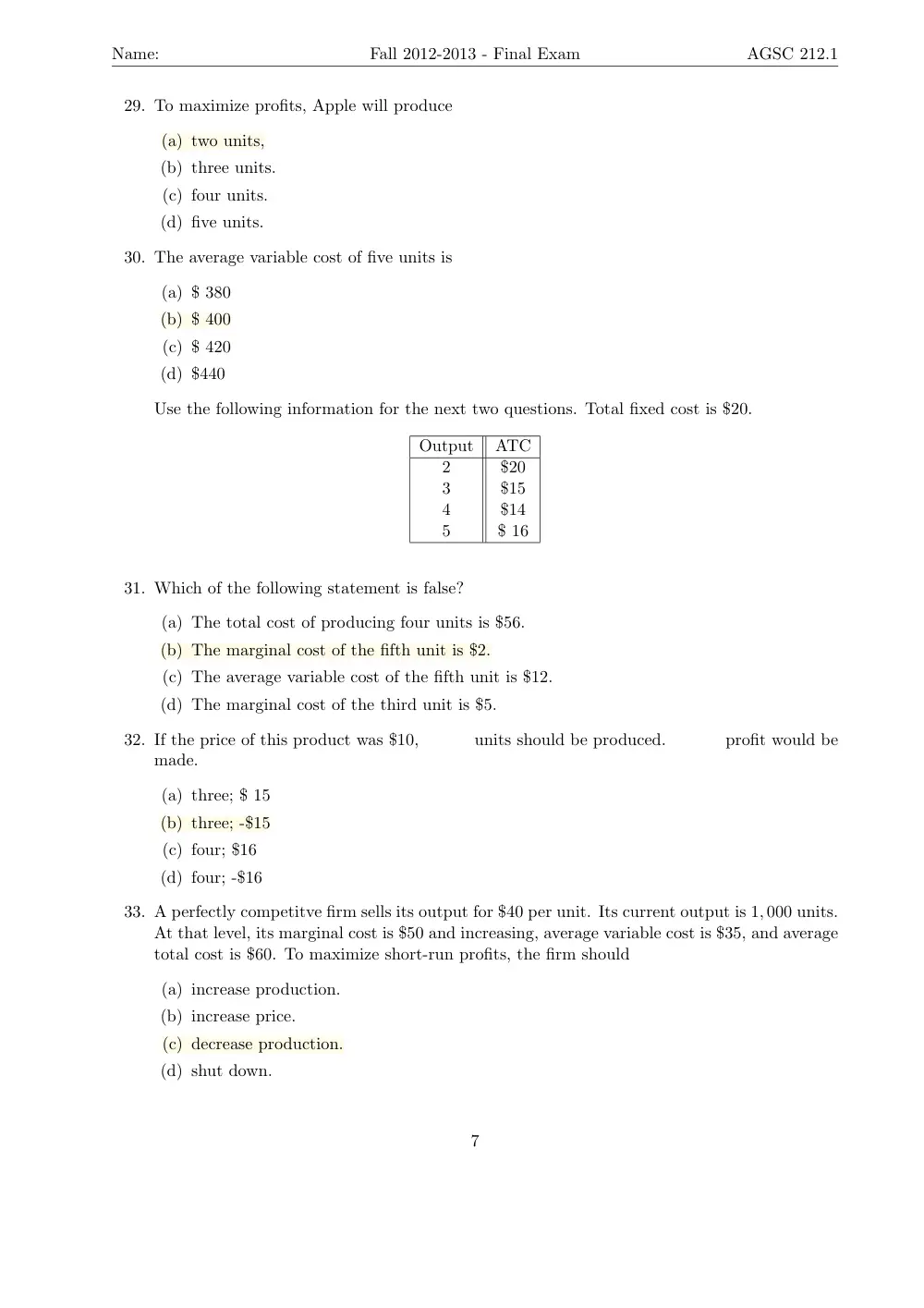
Use the following information for the next two questions. Total fixed cost is $20.
Output
ATC
2
$20
3
$15
4
$14
5
$ 16
31. Which of the following statement is false?
(a) The total cost of producing four units is $56.
(b) The marginal cost of the fifth unit is $2.
(c) The average variable cost of the fifth unit is $12.
(d) The marginal cost of the third unit is $5.
32. If the price of this product was $10,
units should be produced.
profit would be
made.
(a) three; $ 15
(b) three; -$15
(c) four; $16
(d) four; -$16
33. A perfectly competitve firm sells its output for $40 per unit. Its current output is 1, 000 units.
At that level, its marginal cost is $50 and increasing, average variable cost is $35, and average
total cost is $60. To maximize short-run profits, the firm should
(a) increase production.
(b) increase price.
(c) decrease production.
(d) shut down.
7
Name:
Fall 2012-2013 - Final Exam
AGSC 212.1
Use the diagram above, which refer to Halloum production, to answer the next six questions.
34. The profit maximizing output level is
(a) 400
(b) 600
(c) 900
(d) 1000
35. If the firm producces 600 Halloum, its profit will be
(a) zero.
(b) $2,400.
(c) $3,600.
(d) $6,300.
36. If the firm produces 400 Halloum, its total cost will be
(a) $10.
(b) $400.
(c) $800.
(d) $4,000.
37. if the firm is producing 600 Halloum it should
to maximize profits.
(a) increase output to 900
(b) increase output to 1, 000
(c) maintain its current output level
(d) increase price to $20 and increase output to 1, 000
38. If the firm produces 900 Halloum, total revenue is
(a) $2,700.
(b) $5,600.
(c) $6,300.
(d) $9,000.
8
Name:
Fall 2012-2013 - Final Exam
AGSC 212.1
39. If the firm expands production from 600 halloum to 900 Halloum, profit will
(a) increase from zero to $2,700.
(b) decrease from $2,400 to zero.
(c) decrease from $2,400 to $1,800.
(d) increase fromm $2,400 to $2,700.
40. When P < LRAC, we would expect
and
firms in this industry.
(a) investment; fewer
(b) investment; more
(c) disinvestment; fewer
(d) disinvestment; more
9