
AROL 215 Final, Fall 2008
American University of Beirut · The Near East in the Bronze Ages · 2 pages
More AROL 215 files
Show the text of this final exam
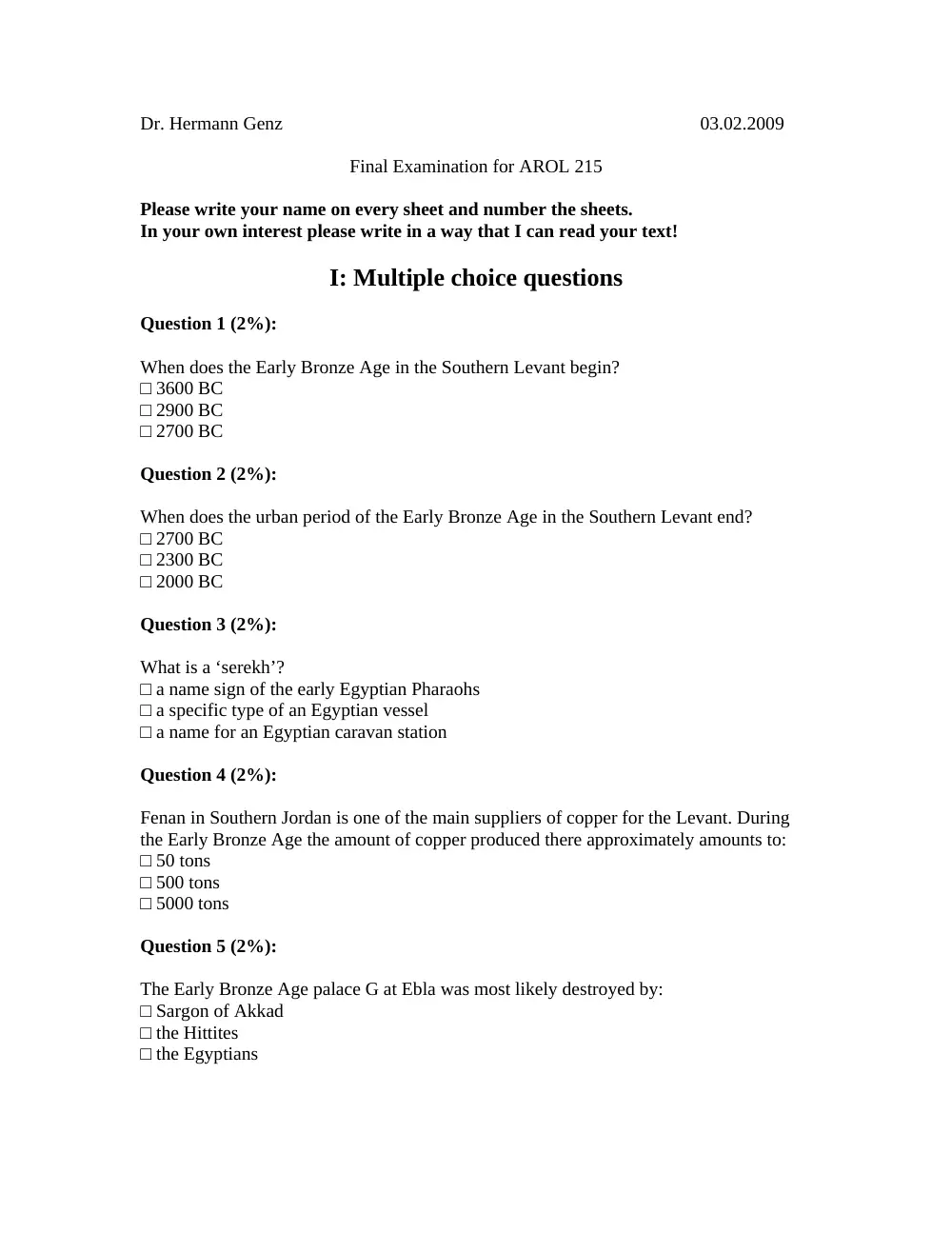
Dr. Hermann Genz
03.02.2009
Final Examination for AROL 215
Please write your name on every sheet and number the sheets.
In your own interest please write in a way that I can read your text!
I: Multiple choice questions
Question 1 (2%):
When does the Early Bronze Age in the Southern Levant begin?
□ 3600 BC
□ 2900 BC
□ 2700 BC
Question 2 (2%):
When does the urban period of the Early Bronze Age in the Southern Levant end?
□ 2700 BC
□ 2300 BC
□ 2000 BC
Question 3 (2%):
What is a ‘serekh’?
□ a name sign of the early Egyptian Pharaohs
□ a specific type of an Egyptian vessel
□ a name for an Egyptian caravan station
Question 4 (2%):
Fenan in Southern Jordan is one of the main suppliers of copper for the Levant. During
the Early Bronze Age the amount of copper produced there approximately amounts to:
□ 50 tons
□ 500 tons
□ 5000 tons
Question 5 (2%):
The Early Bronze Age palace G at Ebla was most likely destroyed by:
□ Sargon of Akkad
□ the Hittites
□ the Egyptians
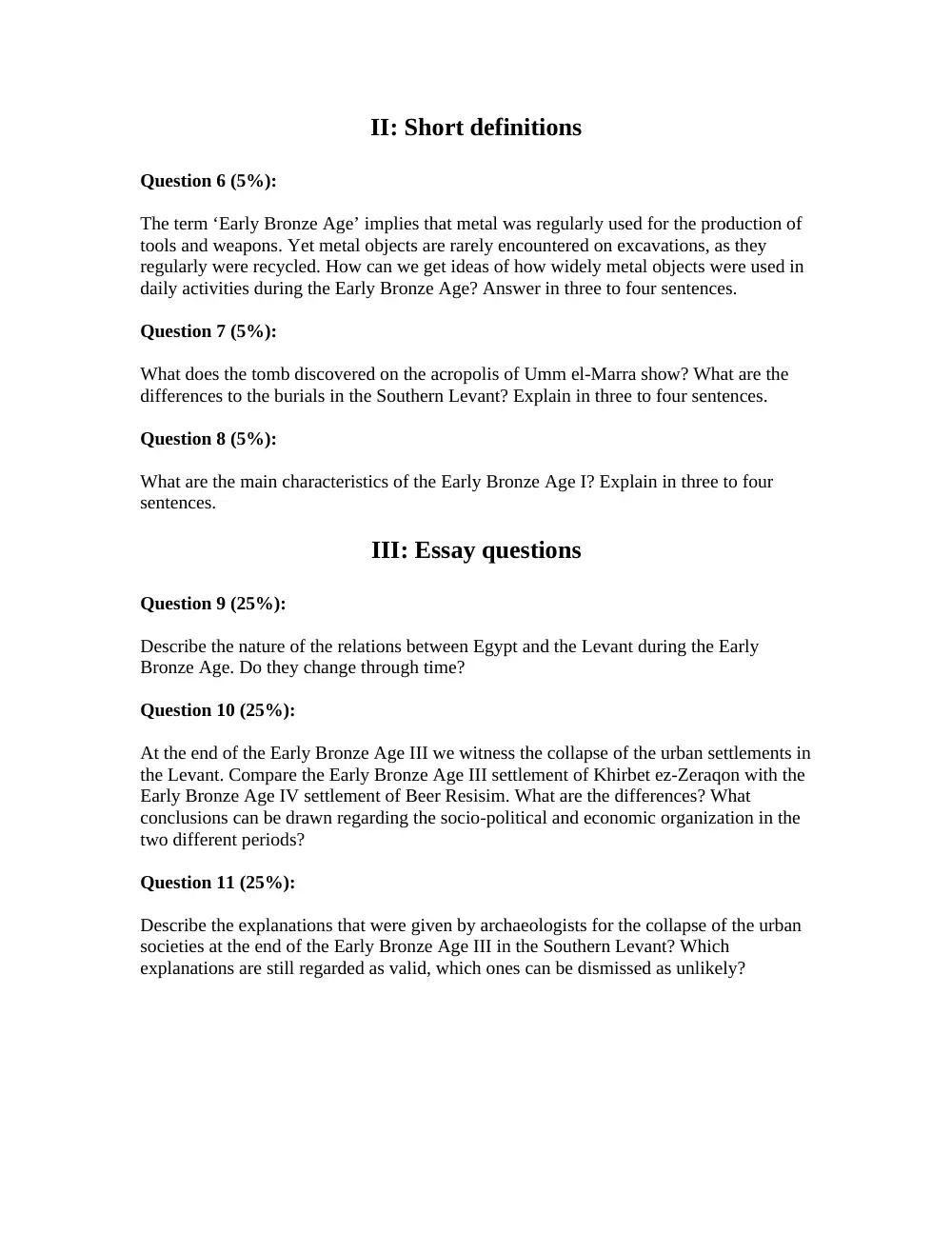
II: Short definitions
Question 6 (5%):
The term ‘Early Bronze Age’ implies that metal was regularly used for the production of
tools and weapons. Yet metal objects are rarely encountered on excavations, as they
regularly were recycled. How can we get ideas of how widely metal objects were used in
daily activities during the Early Bronze Age? Answer in three to four sentences.
Question 7 (5%):
What does the tomb discovered on the acropolis of Umm el-Marra show? What are the
differences to the burials in the Southern Levant? Explain in three to four sentences.
Question 8 (5%):
What are the main characteristics of the Early Bronze Age I? Explain in three to four
sentences.
III: Essay questions
Question 9 (25%):
Describe the nature of the relations between Egypt and the Levant during the Early
Bronze Age. Do they change through time?
Question 10 (25%):
At the end of the Early Bronze Age III we witness the collapse of the urban settlements in
the Levant. Compare the Early Bronze Age III settlement of Khirbet ez-Zeraqon with the
Early Bronze Age IV settlement of Beer Resisim. What are the differences? What
conclusions can be drawn regarding the socio-political and economic organization in the
two different periods?
Question 11 (25%):
Describe the explanations that were given by archaeologists for the collapse of the urban
societies at the end of the Early Bronze Age III in the Southern Levant? Which
explanations are still regarded as valid, which ones can be dismissed as unlikely?