
BIO 101 Notes, Spring 2020
American University of Beirut · Basic Concepts in Biology · 5 pages


Show the text of this notes
Chapter 2: Basic Chemistry
Define matter.
-
Matter is anything that has mass and occupies space
What states does matter exist in?
1.
Solid
2.
Liquid
3.
Gas
All matter (both living and non-living) is composed of 92 naturally-occurring elements.
Define an element.
-
An element is a substance that cannot be broken down into substances with
different properties; composed of one type of atom
What are the six elements that make up 95% of the body weight of organisms?
1.
Carbon
2.
Hydrogen
3.
Nitrogen
4.
Oxygen
5.
Phosphorus
6.
Sulfur (CHNOPS)
Elements consist of tiny particles called atoms.
Define an atom.
-
An atom is the smallest unit of an element that displays the properties of an
element.
What are the subatomic particles its composed of?
1.
Protons
2.
Neutrons
3.
Electrons
What subatomic particles are found in the central nucleus?
-
Protons – positively charged, 1 amu (atomic mass unit)
-
Neutrons – no charge, 1 amu
Where subatomic particles are found orbiting clouds around the nucleus? (electron shells)
-
Electrons – negatively charged, very low mass-negligible in calculations (0 amu)
Electrons and energy:
In an electrically neutral atom, the positively charged protons are balanced by the negatively
charged electrons (remember that neutrons are electrically neutral).
Since electrons are found outside the nucleus and occupy orbitals around the nucleus, many
scientists have tried to create models to show the exact location of the electrons.
The Bohr model (named after physicist Niels Bohr) is a helpful way to visualize electron location
in an element.
According to the Bohr model, electrons occupy orbitals within various energy levels (or electron
shells) near or distant from the nucleus of the atom. The farther the orbital from the nucleus,
the higher the energy level.
When atoms absorb energy during photosynthesis, electrons are boosted to higher energy
levels. When the electrons return to their original energy level, the released energy is converted
into chemical energy. This chemical energy supports all life on Earth.
The innermost shell of an atom is complete with 2 electrons; all other shells are complete with 8
electrons. This is called the octet rule.
The outermost electron shell is called the valence shell and determines the atom’s chemical
properties; atoms will give up, accept, or share electrons in order to have 8 electrons in its
valence shell.
What is the atomic number equal to?
-
The atomic number is equal to the number of protons in each atom of an
element.
What is the mass number?
-
The mass number of an atom is equal to the number of protons and neutrons in
an atom’s nucleus
Groups are the vertical columns in the table and periods are the horizontal rows.
Define isotopes.
-
Isotopes are atoms of the same element that differ in the number of neutrons
(and therefore different atomic masses)
A carbon atom with 8 rather than 6 neutrons is unstable; it releases energy and subatomic
particles and is thus a radioactive isotope.
Because the chemical behavior of a radioactive isotope is the same as a stable isotope of a
particular element, low levels of the radioactive isotope (e.g., radioactive iodine or glucose)
allow researchers to trace the location and activity of the element in living tissues; these
isotopes are called tracers.
Define a molecule.
-
A molecule is two or more elements bonded together.
Define a compound.
-
A compound is a molecule containing at least two different elements bonded
together.
Chemical Bonding
Bonds that exist between atoms in molecules contain energy.
Bonds between atoms are caused by the interactions between electrons in outermost energy
shells.
Define a chemical reaction.
-
A chemical reaction is the process of bond formation.
Types of bonding: Ionic bonding
Define an ion.
-
An ion is an atom that has lost or gained an electron.
How does an ionic bond form?
-
An ionic bond forms when electrons are transferred from one atom to another
atom and the oppositely charged ions are attracted to one another.
Salts are solid substances that usually separate and exist as individual ions in water.
Covalent Bonds
What do covalent bonds result from?
-
Covalent bonds result when two atoms share electrons, so each atom has an
octet of electrons in the outer shell. (in the case of hydrogen, the outer energy
shell is complete when it contains 2 electrons)
In a nonpolar covalent bond, electrons are shared equally between atoms.
In a polar covalent bond, electrons are shared unequally.
Define electronegativity.
-
Electronegativity is the ability of an atom to attract electrons towards itself in a
chemical bond.
The Chemistry of Water
Life started in water.
The earth is about 72% covered in water.
Living organisms are 70% water.
All living organisms spend their early life stages in water or moist environments.
Why is water important?
1.
It is liquid at relatively low temperatures.
2.
It is a great filter at UV radiation.
Water is a polar molecule.
-
The shape of a water molecule and its polarity make hydrogen bonding possible.
A hydrogen bond is a weak attraction between a slightly positive hydrogen atom and a slightly
negative atom.
-
A single hydrogen bond is easily broken while multiple hydrogen bonds are
collectively quite strong.
-
Help to maintain the proper structure and function of complex molecules such
as proteins and DNA.
-
Hydrogen bonds reason for many of water’s properties.
-
Because of electrical charges and polarity, it dissolves other charged particles.
What are properties of water?
1.
Water has a high heat capacity
-
The temperature of liquid water
rises and falls more slowly than
that of most other liquids.
-
A calorie is the amount of heat
energy required to raise the
temperature of one gram of water
1°C.
-
Because the hydrogen bonds
between water molecules hold
more heat, water temperature falls
more slowly than other liquids; this
protects organisms from rapid
temperature changes and helps
them maintain homeostatic
temperature.
-
2.
Water has a high heat of vaporization.
-
Hydrogen bonds must be broken down to evaporate water.
-
Bodies of organisms cool when their heat is used to evaporate water.
3.
Water is a good solvent.
-
Water is a good solvent because of its polarity.
-
Hydrophilic molecules (polar, ionized) dissolve in water
-
Hydrophobic molecules (non-polar, non-ionized) do not dissolve in water.
4.
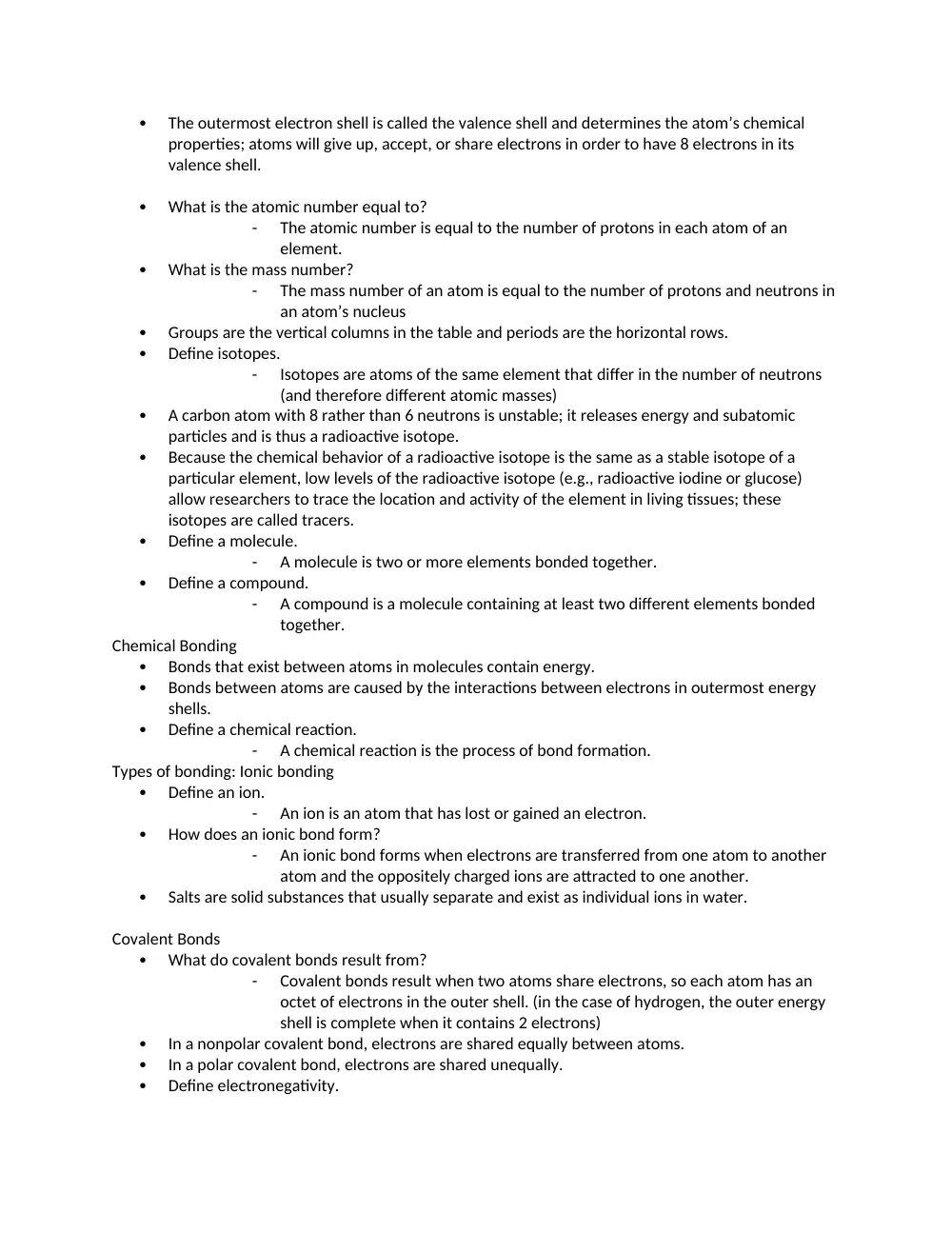
Water molecules are cohesive and adhesive
-
Cohesion is the ability of water molecules to cling to each other due to
hydrogen bonding.
Water flows freely
Surface tension. (high surface tension makes it difficult
to break through at its surface)
-
Adhesion is the ability of water molecule to cling to other polar surfaces.
Adhesion is due to water’s polarity
Capillary action
-
Cohesion and adhesion account for water transport in plants as well as
transport in blood vessels
5.
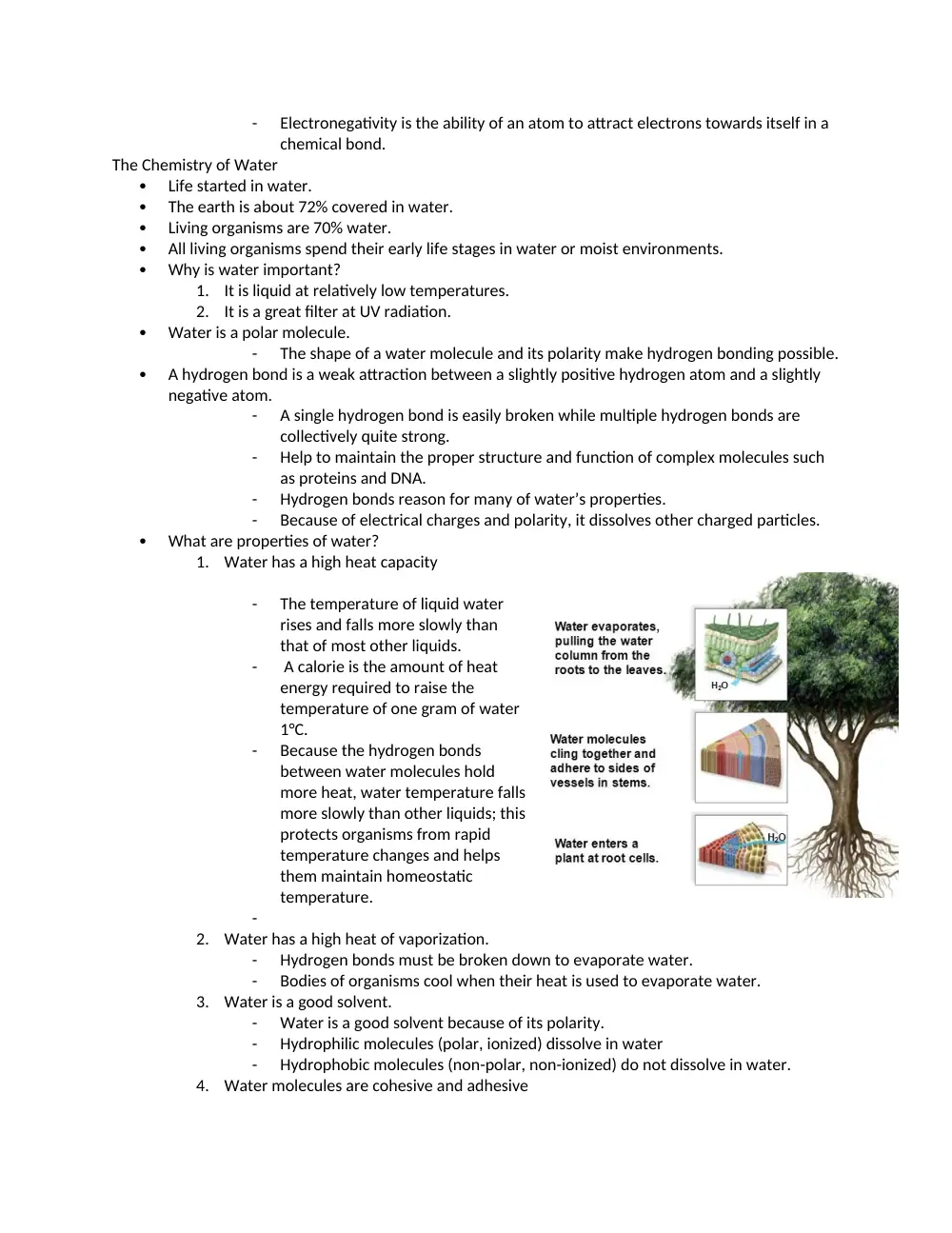
Ice is less dense than liquid water
-
At temperatures below 4 C, hydrogen
bonds between water molecules
become more rigid but more open,
causing expansion.
-
Water expands as it reaches 0C and
freezes.
-
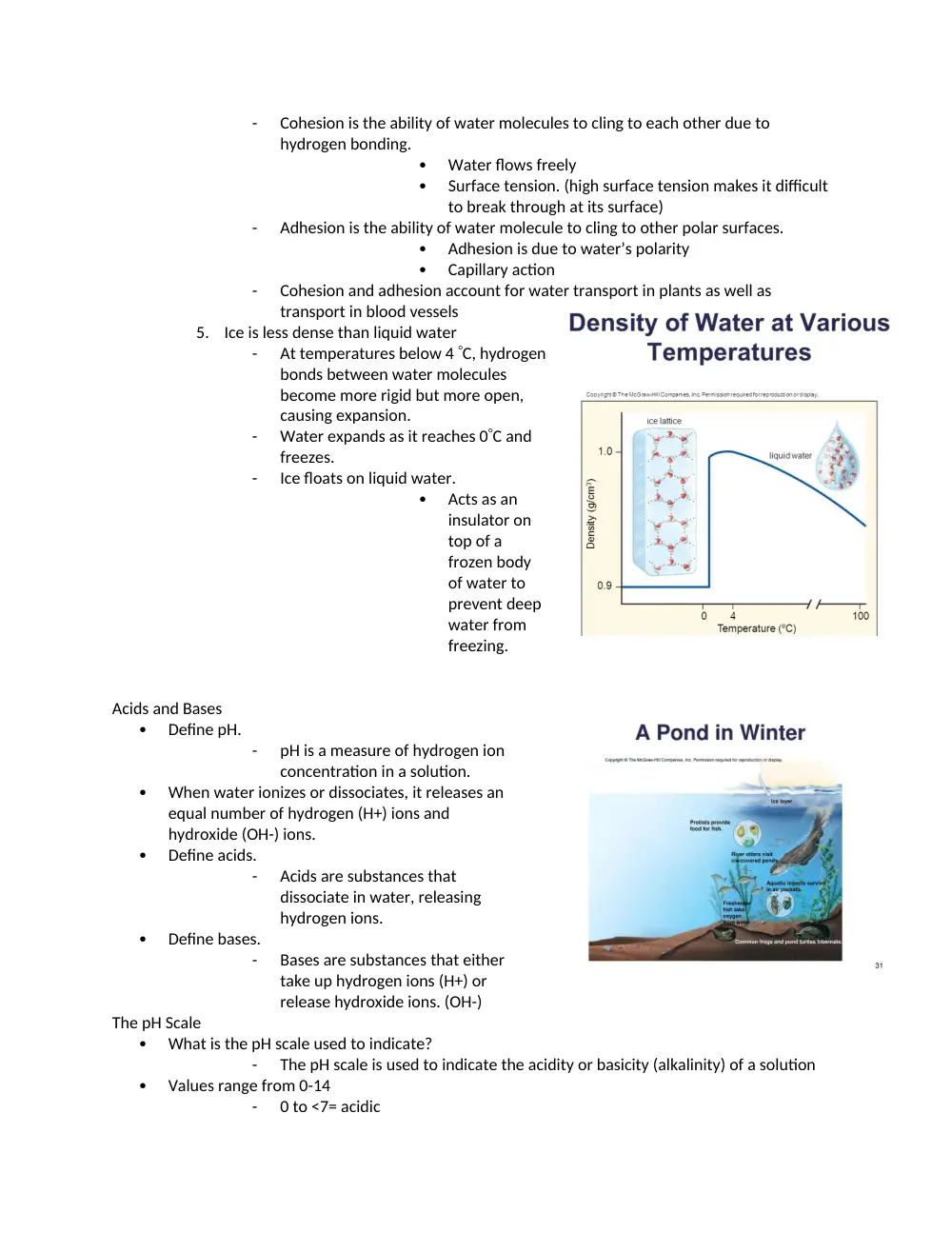
Ice floats on liquid water.
Acts as an
insulator on
top of a
frozen body
of water to
prevent deep
water from
freezing.
Acids and Bases
Define pH.
-
pH is a measure of hydrogen ion
concentration in a solution.
When water ionizes or dissociates, it releases an
equal number of hydrogen (H+) ions and
hydroxide (OH-) ions.
Define acids.
-
Acids are substances that
dissociate in water, releasing
hydrogen ions.
Define bases.
-
Bases are substances that either
take up hydrogen ions (H+) or
release hydroxide ions. (OH-)
The pH Scale
What is the pH scale used to indicate?
-
The pH scale is used to indicate the acidity or basicity (alkalinity) of a solution
Values range from 0-14
-
0 to <7= acidic
-
7=neutral
-
>7 to 14=basic (or alkaline)
Logarithm scale
-
Each unit change in pH represents a 10-fold change in H+ concentration
-
pH of 4 is 10x as acidic as pH of 5.
-
pH of 10 is 100x more basic than pH of 8.
The normal pH of blood is 7.4.
Buffers and pH
Define a buffer.
-
A buffer is a chemical or a combination of chemicals that keeps pH within
normal limits.
Health of organisms requires maintaining the pH of body fluids within narrow limits.
-
If blood pH drops below 7.0, acidosis results.
-
If blood pH rises above 7.0, alkalosis results.
-
Both are life-threatening situations.
Carbonic acid helps keep blood pH within normal limits.
Body has built-in mechanisms to prevent pH changes.
H2CO3 is a buffer that reduces basicity.
NaHCO3 is a buffer that reduces acidity.