
BIO 201 Chapter 1 Summary, Fall 2011
American University of Beirut · General Biology I · 3 pages

More BIO 201 files
- Questions Test Banks Chapters 41 · Fall 2015ChapterView
- Questions Test Banks Chapters 31 · Fall 2015ChapterView
- Questions Test Banks Chapters 21 · Fall 2015ChapterView
- Questions Test Banks Chapters 11 · Fall 2015ChapterView
- Questions Test Banks Chapters 51 · Fall 2015ChapterView
- Questions Test Banks Chapters 1 · Fall 2015ChapterView
- Notes The Science of Life Chapter Outline · Spring 2018NotesView
- Exam 1 · Spring 2013ExamView
Show the text of this chapter
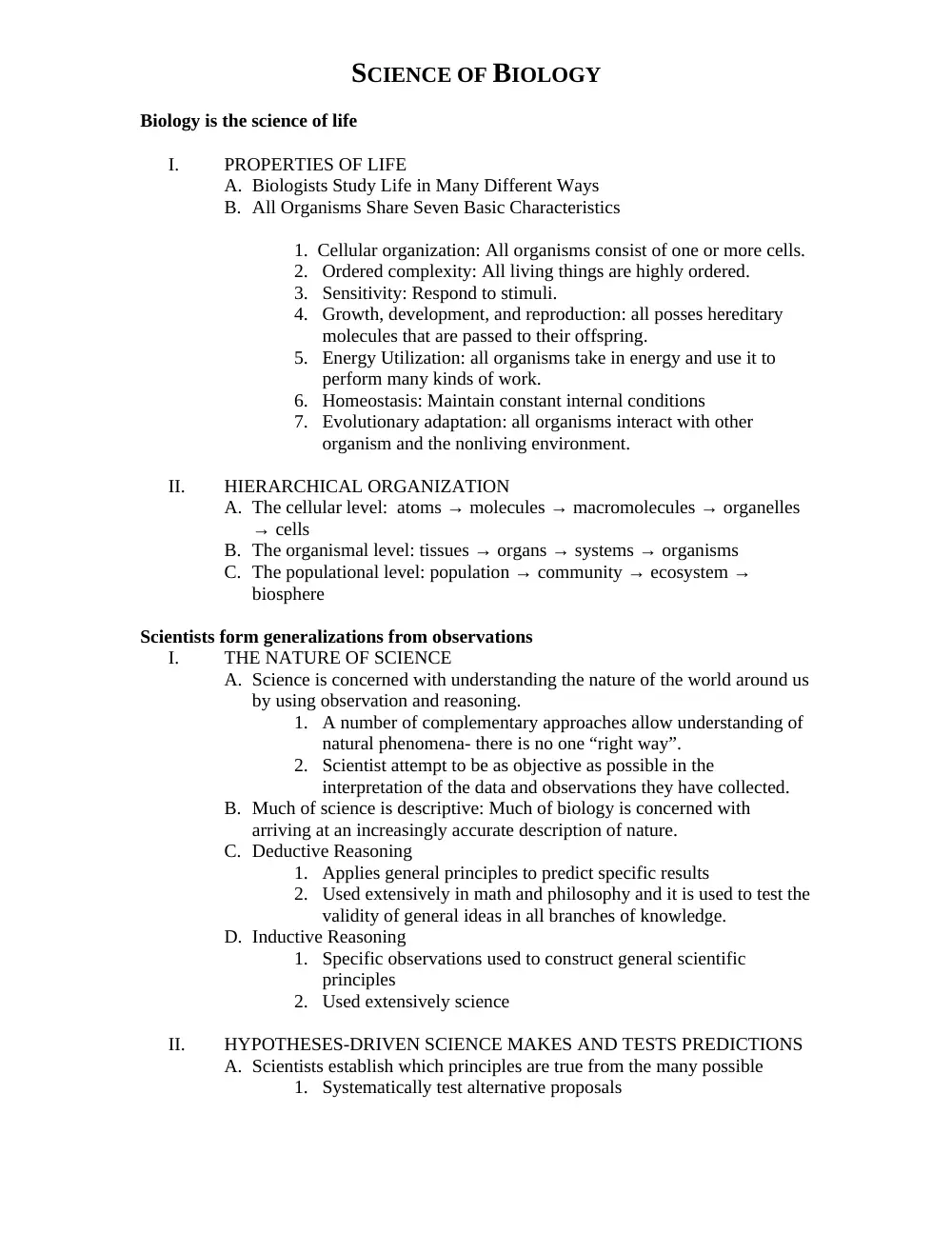
SCIENCE OF BIOLOGY
Biology is the science of life
I.
PROPERTIES OF LIFE
A. Biologists Study Life in Many Different Ways
B. All Organisms Share Seven Basic Characteristics
1. Cellular organization: All organisms consist of one or more cells.
2. Ordered complexity: All living things are highly ordered.
3. Sensitivity: Respond to stimuli.
4. Growth, development, and reproduction: all posses hereditary
molecules that are passed to their offspring.
5. Energy Utilization: all organisms take in energy and use it to
perform many kinds of work.
6. Homeostasis: Maintain constant internal conditions
7. Evolutionary adaptation: all organisms interact with other
organism and the nonliving environment.
II.
HIERARCHICAL ORGANIZATION
A. The cellular level: atoms → molecules → macromolecules → organelles
→ cells
B. The organismal level: tissues → organs → systems → organisms
C. The populational level: population → community → ecosystem →
biosphere
Scientists form generalizations from observations
I.
THE NATURE OF SCIENCE
A. Science is concerned with understanding the nature of the world around us
by using observation and reasoning.
1. A number of complementary approaches allow understanding of
natural phenomena- there is no one “right way”.
2. Scientist attempt to be as objective as possible in the
interpretation of the data and observations they have collected.
B. Much of science is descriptive: Much of biology is concerned with
arriving at an increasingly accurate description of nature.
C. Deductive Reasoning
1. Applies general principles to predict specific results
2. Used extensively in math and philosophy and it is used to test the
validity of general ideas in all branches of knowledge.
D. Inductive Reasoning
1. Specific observations used to construct general scientific
principles
2. Used extensively science
II.
HYPOTHESES-DRIVEN SCIENCE MAKES AND TESTS PREDICTIONS
A. Scientists establish which principles are true from the many possible
1. Systematically test alternative proposals
2. After making careful observations, scientists construct a
hypothesis: Suggested explanation that accounts for those
observations.
3. Subject to future rejection or alteration
B. Testing Hypotheses
1. Experiment: Test of a hypothesis
2. Reject if inconsistent with data, conditionally accept if consistent
with data
3. New ideas constantly replacing old ones
C. Establishing Controls
1. Variables are factors that influence processes. To evaluate
alternative hypotheses about one variable, all other variables
must be kept constant.
2. Two experiments carried out in parallel
1. In one experiment all variables except the
one being tested are kept constant
2. In control experiment test variable is not
changed
3. Differences in parallel experiments attributed to test variable
D. Using Predictions
1. Most useful hypothesis makes predictions
2. If an experiment produces results inconsistent with the
predictions, the hypothesis must be rejected or modified.
3. Example: Spontaneous generation vs. germ hypothesis
III.
REDUCTIONISM BREAKS LARGER SYSTEMS INTO THEIR
COMPONENT PARTS
A. Reducing a complex system into its working parts.
B. However, reductionism has limits when applied to living systems because
parts do not behave in isolation as they do in their normal context.
C. Complex networking of many networked functions lead to emergent
properties that cannot be predicted based on the working of the parts.
D. Developing Theories
1. First usage of the word “theory”
a.
Explanation of natural phenomenon based on general
principles
b. Unify concepts that were previously believed to be
unrelated.
c.
Example: Newton’s “theory of gravity”
2. Second use of word
a.
Body of interconnected concepts supported by
experimental evidence
b. Explains facts in some area of study
c.
Example: Quantum theory of physics
3. Theory to scientist indicates certainty
4. Theory to general public implies lack of knowledge, a guess
5. Example: Theory of evolution
a.
Hypothesis is accepted scientific fact
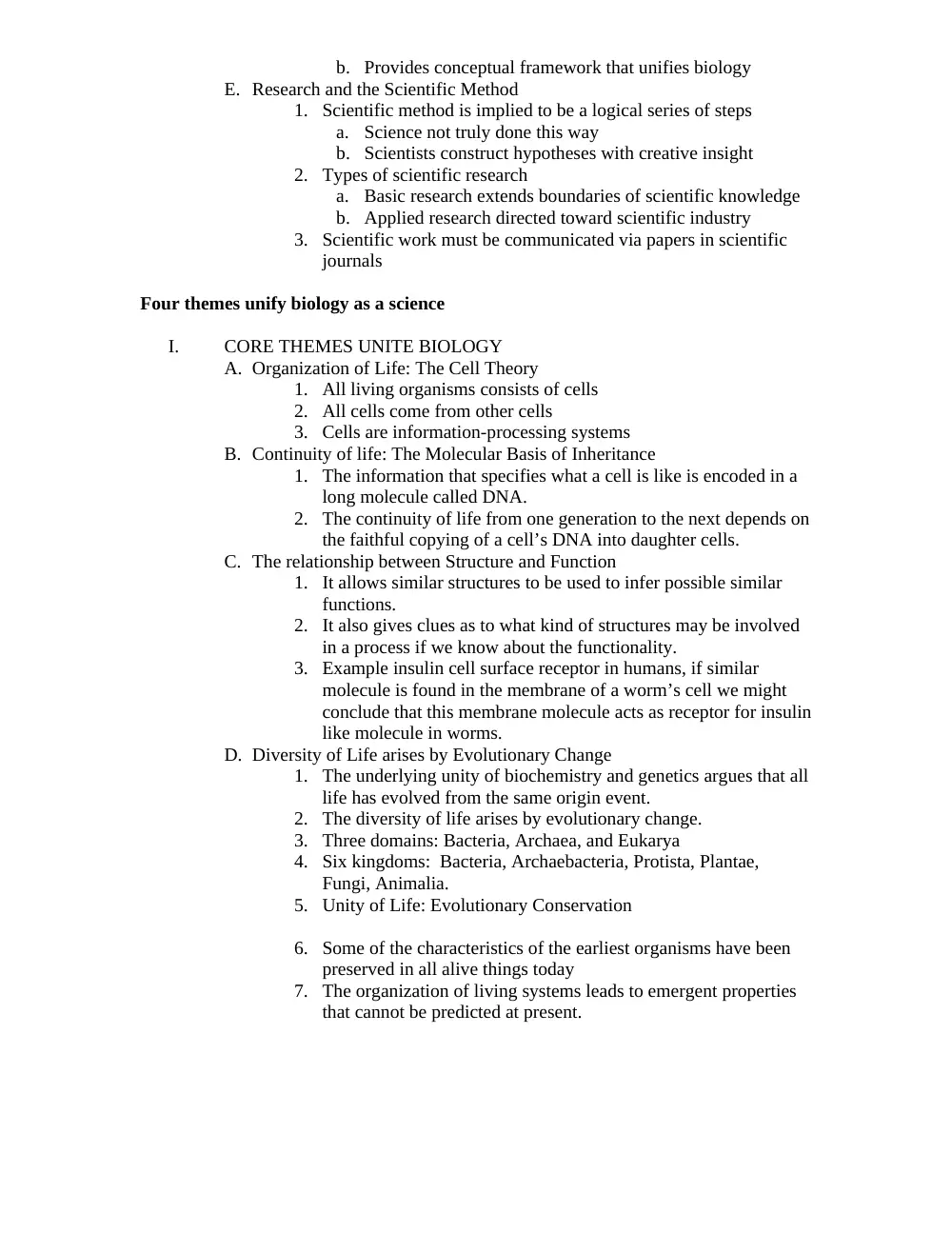
b. Provides conceptual framework that unifies biology
E. Research and the Scientific Method
1. Scientific method is implied to be a logical series of steps
a.
Science not truly done this way
b. Scientists construct hypotheses with creative insight
2. Types of scientific research
a.
Basic research extends boundaries of scientific knowledge
b. Applied research directed toward scientific industry
3. Scientific work must be communicated via papers in scientific
journals
Four themes unify biology as a science
I.
CORE THEMES UNITE BIOLOGY
A. Organization of Life: The Cell Theory
1. All living organisms consists of cells
2. All cells come from other cells
3. Cells are information-processing systems
B. Continuity of life: The Molecular Basis of Inheritance
1. The information that specifies what a cell is like is encoded in a
long molecule called DNA.
2. The continuity of life from one generation to the next depends on
the faithful copying of a cell’s DNA into daughter cells.
C. The relationship between Structure and Function
1. It allows similar structures to be used to infer possible similar
functions.
2. It also gives clues as to what kind of structures may be involved
in a process if we know about the functionality.
3. Example insulin cell surface receptor in humans, if similar
molecule is found in the membrane of a worm’s cell we might
conclude that this membrane molecule acts as receptor for insulin
like molecule in worms.
D. Diversity of Life arises by Evolutionary Change
1. The underlying unity of biochemistry and genetics argues that all
life has evolved from the same origin event.
2. The diversity of life arises by evolutionary change.
3. Three domains: Bacteria, Archaea, and Eukarya
4. Six kingdoms: Bacteria, Archaebacteria, Protista, Plantae,
Fungi, Animalia.
5. Unity of Life: Evolutionary Conservation
6. Some of the characteristics of the earliest organisms have been
preserved in all alive things today
7. The organization of living systems leads to emergent properties
that cannot be predicted at present.