
BIO 201 Exam 2 Sample, Spring 2011
American University of Beirut · General Biology I · 4 pages
More BIO 201 files
- Exam 1 · Spring 2013ExamView
- Exam 1 · Fall 2012ExamView
- Exam 1 Sample · Spring 2011ExamView
- Exam 2 Sample · Spring 2011ExamView
- Notes The Science of Life Chapter Outline · Spring 2018NotesView
- Questions Test Banks Chapters 11 · Fall 2015ChapterView
- Questions Test Banks Chapters 51 · Fall 2015ChapterView
- Questions Test Banks Chapters 21 · Fall 2015ChapterView
Show the text of this exam
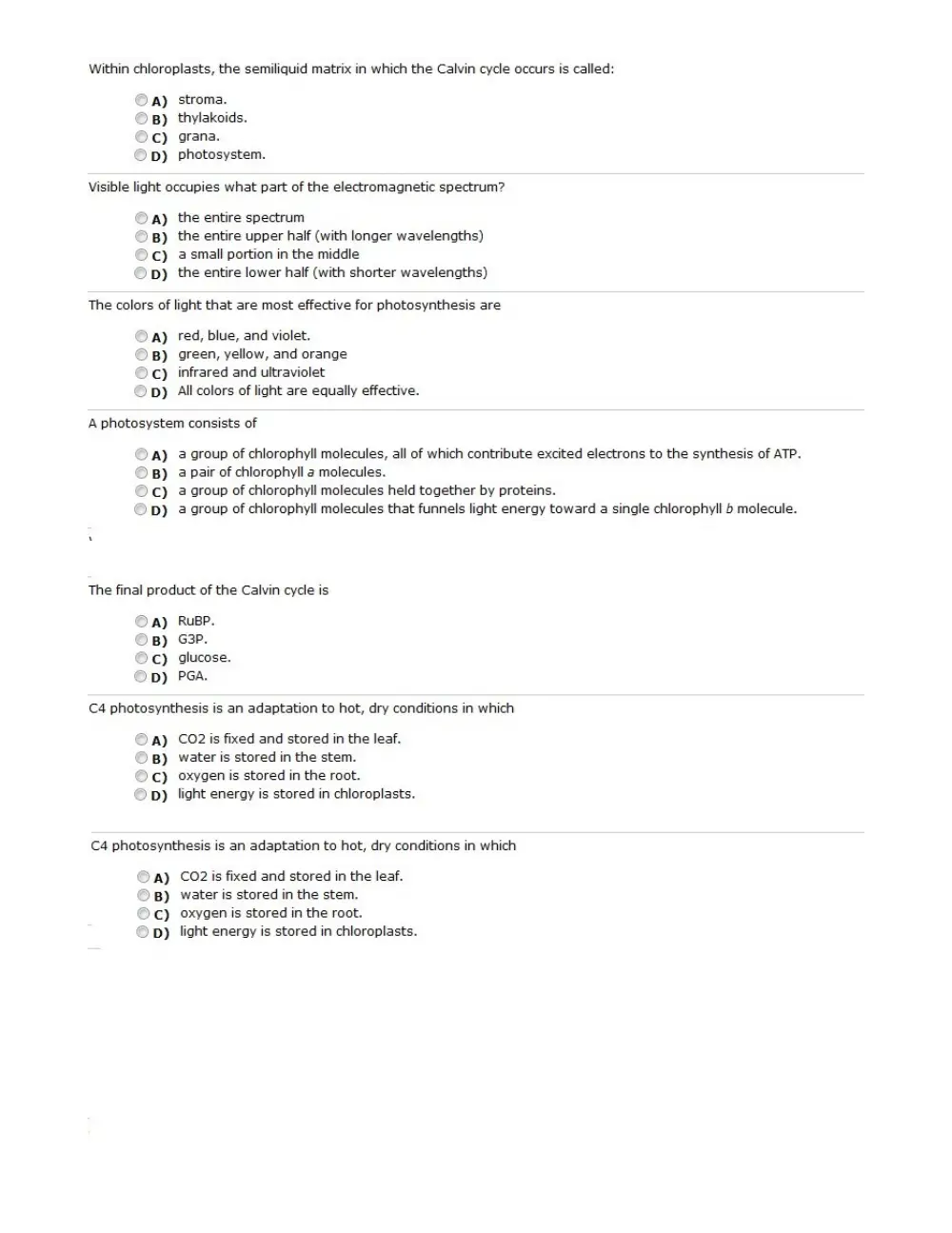
Within chloroplasts, the semiliquid matrix in which the Calvin cycle occurs is called:
Oa) stroma.
©B) thylakoids.
©c) grana.
©D) photosystem.
Visible light occupies what part of the electromagnetic spectrum?
©) the entire spectrum
©.B) the entire upper half (with longer wavelengths)
©) asmall portion in the middle
©D) the entire lower half (with shorter wavelengths)
The colors of light that are most effective for photosynthesis are
Oa) red, blue, and violet.
©.B) green, yellow, and orange
©) infrared and ultraviolet
©pD) All colors of light are equally effective.
A photosystem consists of
© A) 2 group of chlorophyll molecules, all of which contribute excited electrons to the synthesis of ATP.
©B) a pair of chlorophyll a molecules.
©) a group of chlorophyll molecules held together by proteins.
©D) a group of chlorophyll molecules that funnels light energy toward a single chlorophyll 6 molecule.
The final product of the Calvin cycle is
Oa) RuBP.
©B) G3P.
©c) glucose.
OD) PGA.
C4 photosynthesis is an adaptation to hot, dry conditions in which
© A) CO2 is fixed and stored in the leaf.
© B) water is stored in the stem.
©) oxygen is stored in the root.
© D) light energy is stored in chloroplasts.
C4 photosynthesis is an adaptation to hot, dry conditions in which
© a) CO2 is fixed and stored in the leaf.
) B) water is stored in the stem.
oxygen is stored in the root.
light energy is stored in chloroplasts.
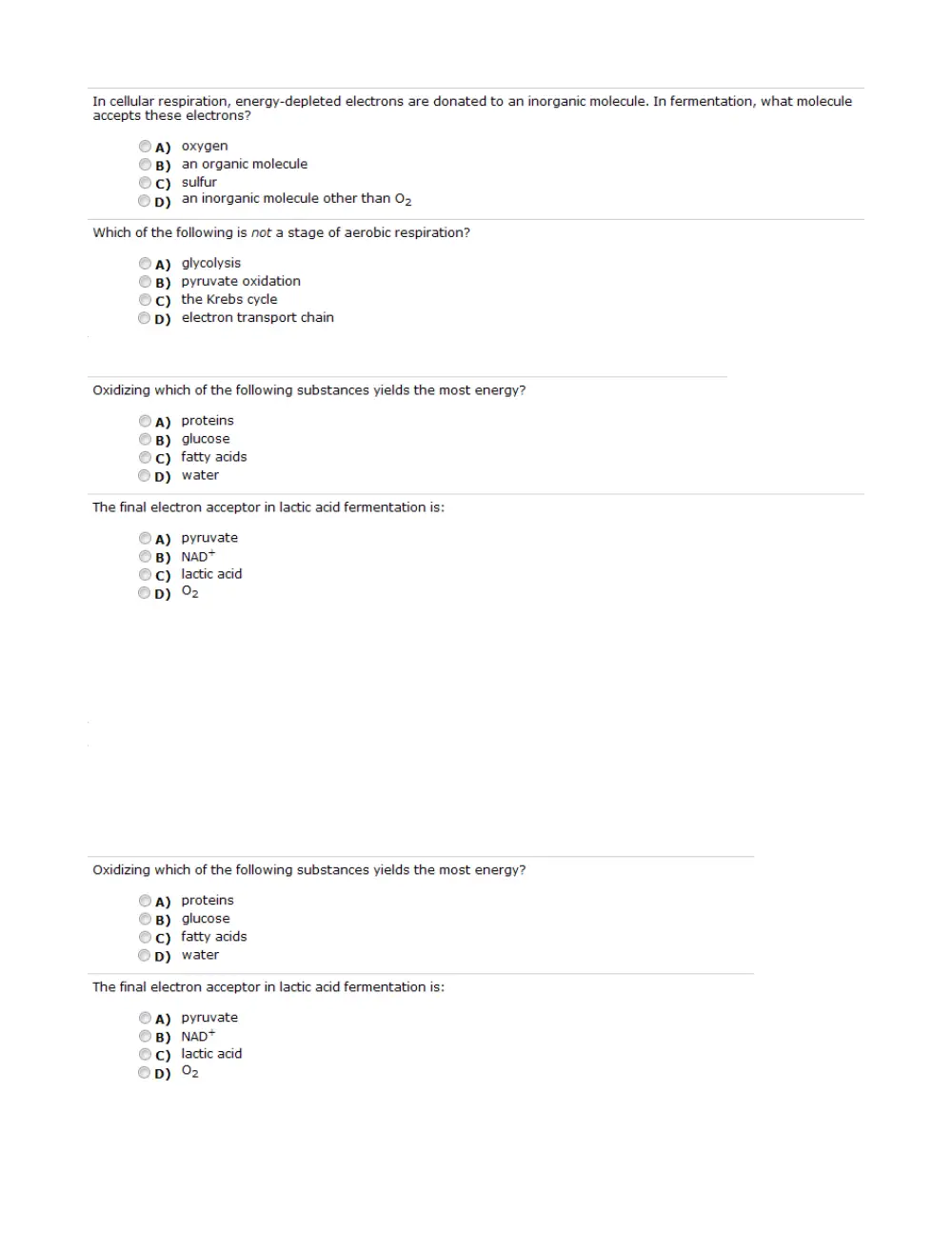
In cellular respiration, energy-depleted electrons are donated to an inorganic molecule. In fermentation, what molecule
accepts these electrons?
©a) oxygen
©B) an organic molecule
©c) sulfur
©p) aninorganic molecule other than O2
Which of the following is not a stage of aerobic respiration?
©a) glycolysis
©B) pyruvate oxidation
©c) the Krebs cycle
©D) electron transport chain
Oxidizing which of the following substances yields the most energy?
OA) proteins
©B) glucose
Oc) fatty acids
OD) water
The final electron acceptor in lactic acid fermentation is:
OA) pyruvate
©Bs) NAD*
Oc) lactic acid
Op)
Oxidizing which of the following substances yields the most energy?
Oa) proteins
©.B) glucose
Oc) fatty acids
OD) water
The final electron acceptor in lactic acid fermentation is:
OA) pyruvate
©B) NAD*
©c) lactic acid
Op) 2
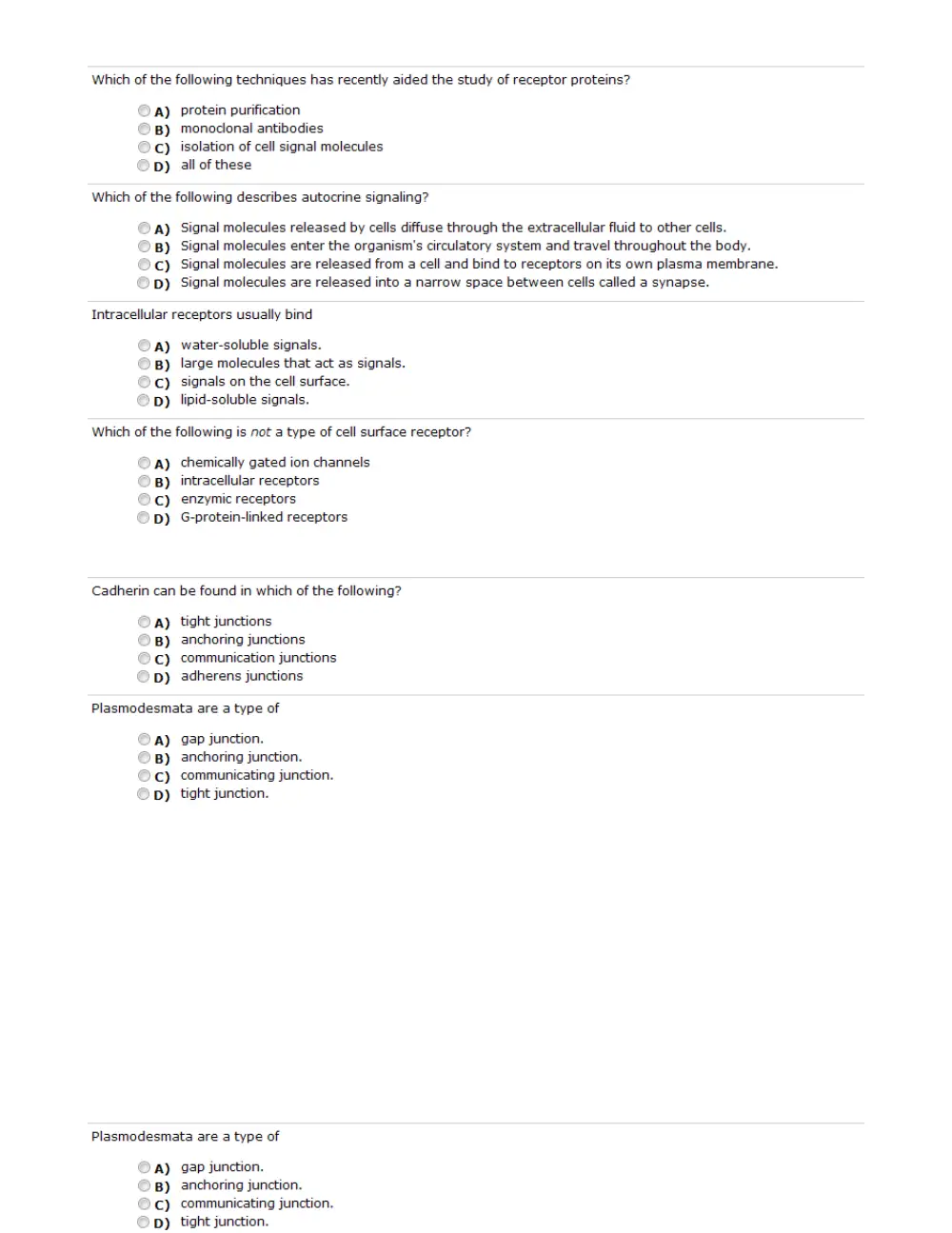
Which of the following techniques has recently aided the study of receptor proteins?
© A) protein purification
©B) monoclonal antibodies
©) isolation of cell signal molecules
©pD) all of these
Which of the following describes autocrine signaling?
© a) Signal molecules released by cells diffuse through the extracellular fluid to other cells.
©B) Signal molecules enter the organism's circulatory system and travel throughout the body.
©) Signal molecules are released from a cell and bind to receptors on its own plasma membrane.
©D) Signal molecules are released into a narrow space between cells called a synapse.
Intracellular receptors usually bind
©) water-soluble signals.
©) large molecules that act as signals.
©) signals on the cell surface.
©D) lipid-soluble signals.
Which of the following is not a type of cell surface receptor?
© A) chemically gated ion channels
©) intracellular receptors
©c) enzymic receptors
©D) G-protein-inked receptors
Cadherin can be found in which of the following?
> A) tight junctions
>) B) anchoring junctions
©) communication junctions
©) adherens junctions
Plasmodesmata are a type of
© A) gap junction.
©B) anchoring junction.
©) communicating junction.
© D) tight junction.
Plasmodesmata are a type of
© A) gap junction.
©B) anchoring junction.
©) communicating junction.
© D) tight junction.
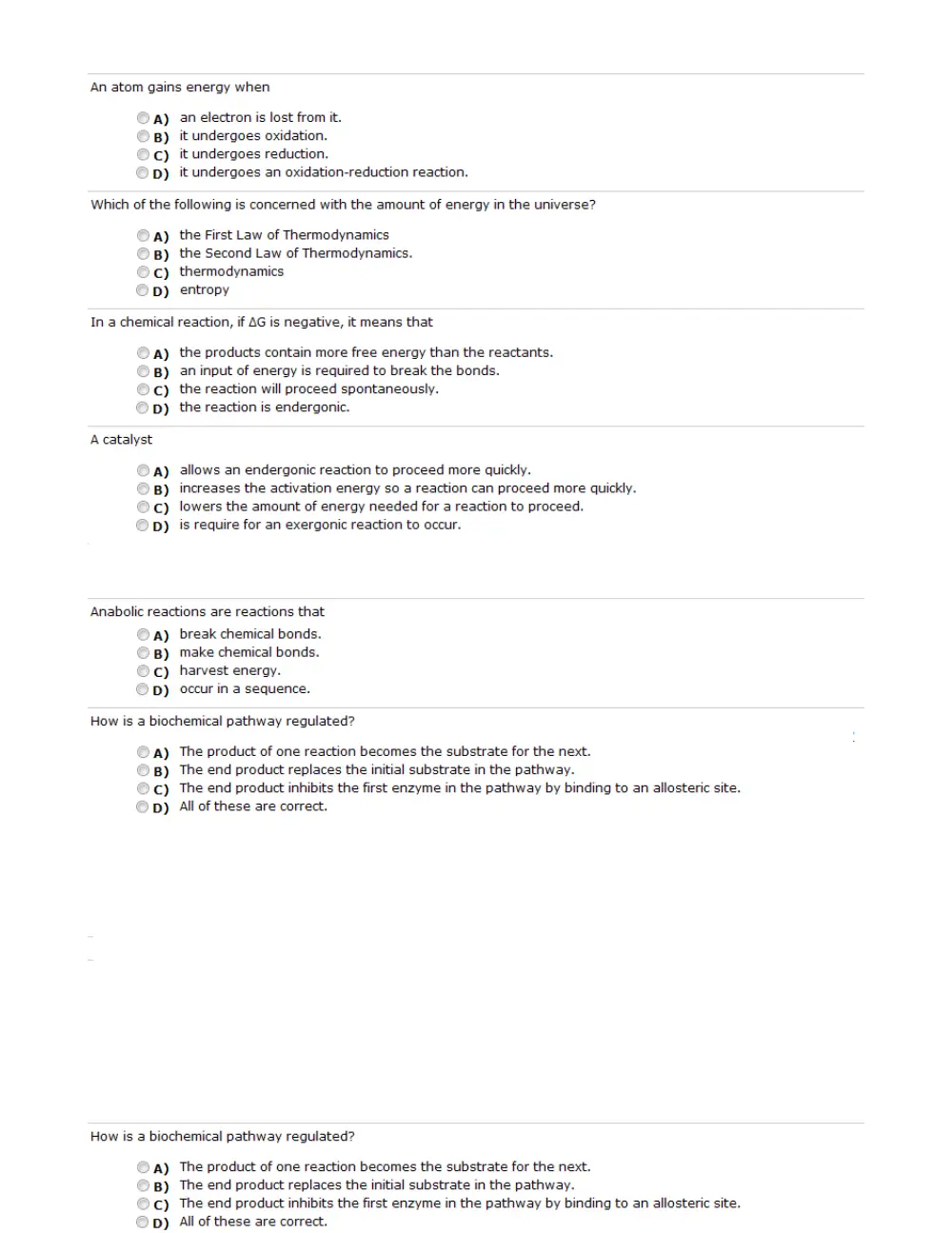
An atom gains energy when
Oa) an electron is lost from it.
©B) it undergoes oxidation.
©) it undergoes reduction.
© D) it undergoes an oxidation-reduction reaction.
Which of the following is concerned with the amount of energy in the universe?
Oa) the First Law of Thermodynamics
©.) the Second Law of Thermodynamics.
©c) thermodynamics
OD) entropy
In a chemical reaction, if AG is negative, it means that
© a) the products contain more free energy than the reactants.
©B) an input of energy is required to break the bonds.
©) the reaction will proceed spontaneously.
©D) the reaction is endergonic.
A catalyst
Oa) allows an endergonic reaction to proceed more quickly.
©.) increases the activation energy so a reaction can proceed more quickly.
©) lowers the amount of energy needed for a reaction to proceed.
©D) is require for an exergonic reaction to occur.
Anabolic reactions are reactions that
© a) break chemical bonds.
©.B) make chemical bonds.
©c) harvest energy.
©p) occur in a sequence.
How is a biochemical pathway regulated?
© a) The product of one reaction becomes the substrate for the next.
©.) The end product replaces the initial substrate in the pathway.
©) The end product inhibits the first enzyme in the pathway by binding to an allosteric site.
©D) All of these are correct.
How is a biochemical pathway regulated?
© A) The product of one reaction becomes the substrate for the next.
©.) The end product replaces the initial substrate in the pathway.
©) The end product inhibits the first enzyme in the pathway by binding to an allosteric site.
OD) All of these are correct.