
BIO 240 Chapter 1, Spring 2014
American University of Beirut · Animal Behavior · 20 pages
Showing the first 10 of 20 pages. Download the PDF to see all of it.
More BIO 240 files
Show the text of this chapter
Animal Behavior
Introduction
Purposes of studying animal behavior
•
Utilitarian: for dealing with:
– Animal production
p
– Hunting and fishing
– Pest control
•
Environmental:
– Dealing with conservation issues
– Understanding ecological relationships
•
Scientific
– Understanding evolutionary processes
– Relating behavior to neurobiology
•
Social and psychological:
– Understanding human behavior
How is the study of animal behavior
approached?
We can illustrate this using
examples.
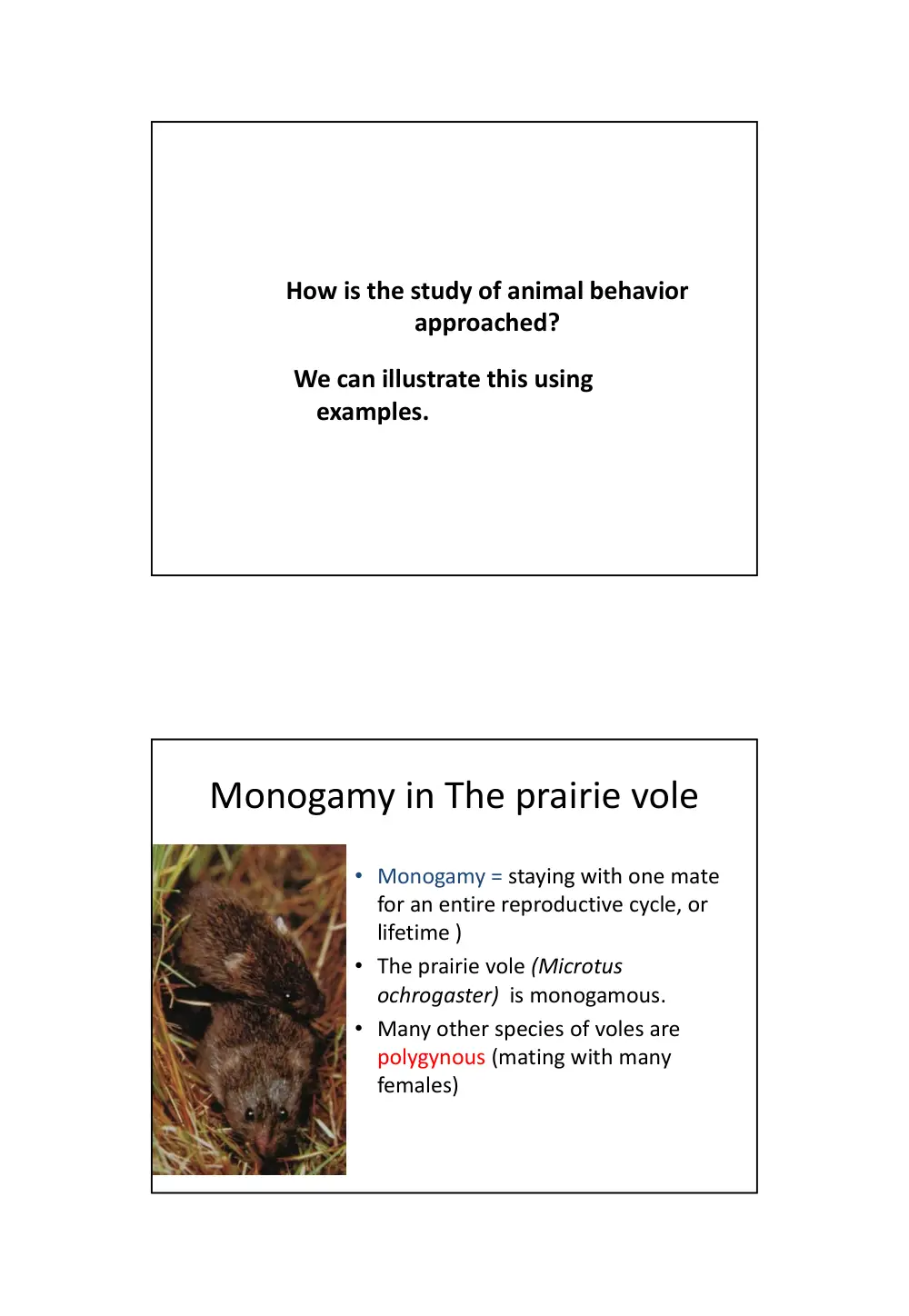
Monogamy in The prairie vole
• Monogamy = staying with one mate
for an entire reproductive cycle, or
lifetime )
• The prairie vole (Microtus
ochrogaster) is monogamous.
• Many other species of voles are
polygynous (mating with many
females)
Q
ti
Wh i th
i i
l
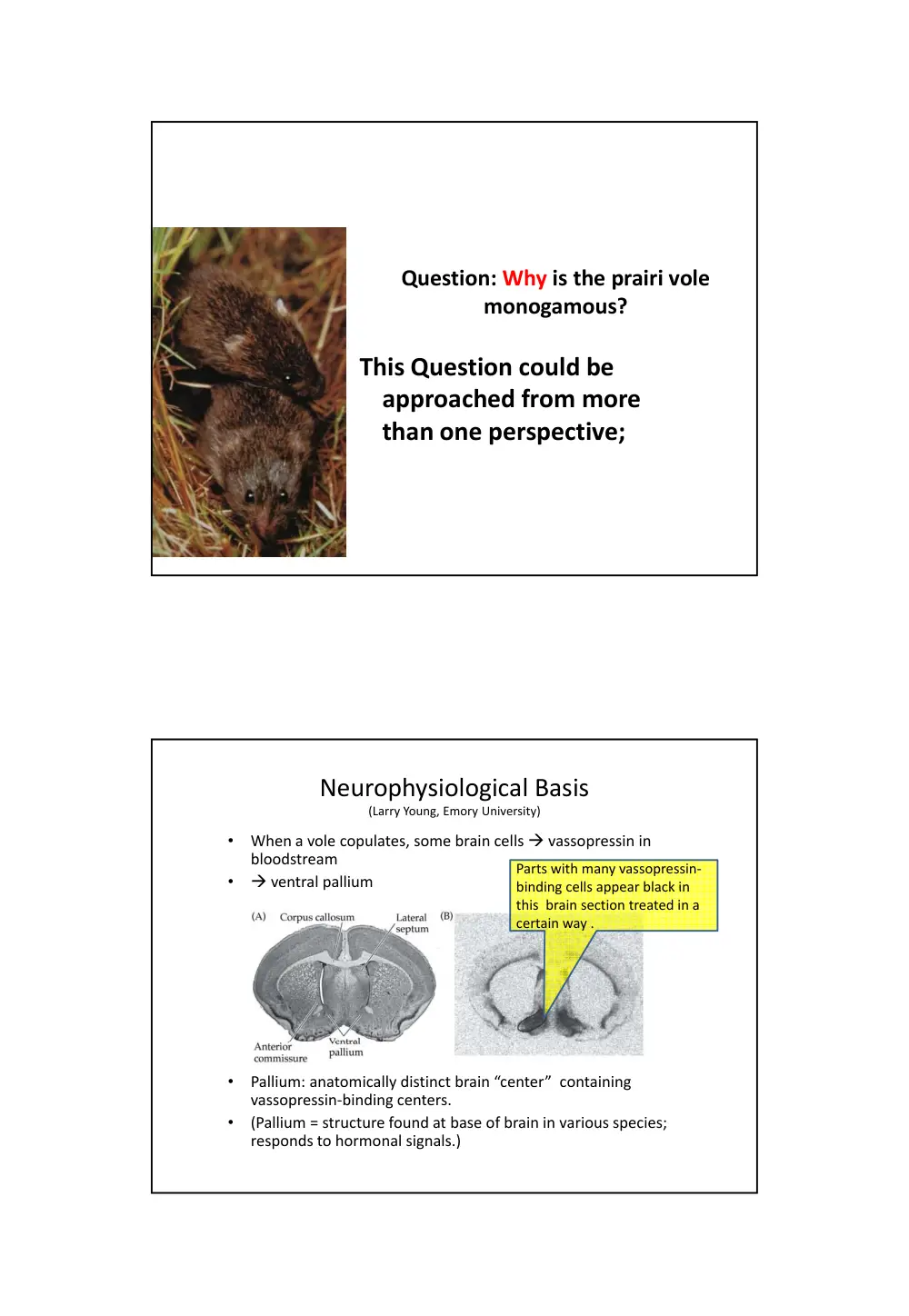
Question: Why is the prairi vole
monogamous?
This Question could be
approached from more
th
ti
than one perspective;
Neurophysiological Basis
(Larry Young, Emory University)
•
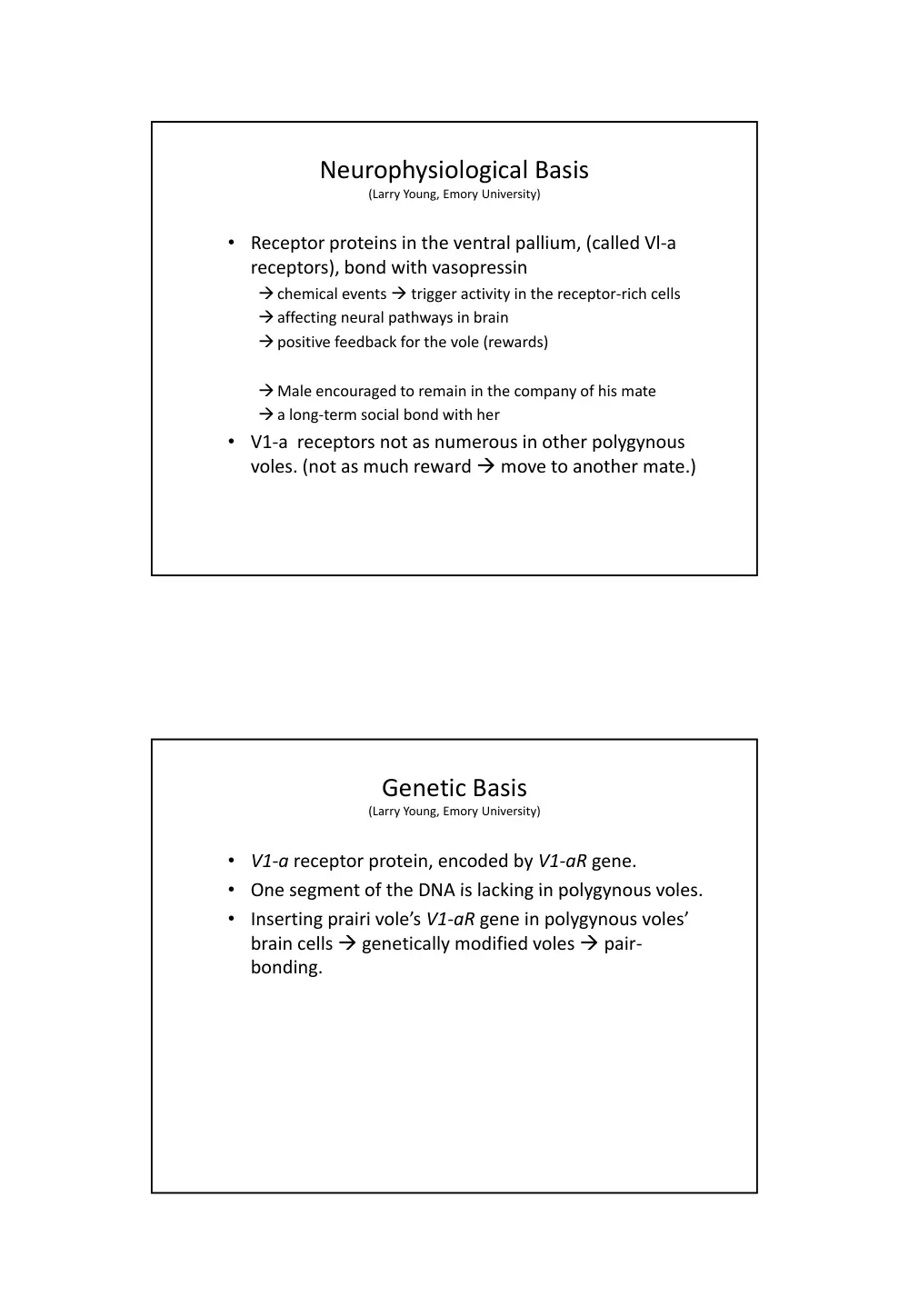
When a vole copulates, some brain cells � vassopressin in
bloodstream
•
� ventral pallium
Parts with many vassopressin‐
binding cells appear black in
binding cells appear black in
this brain section treated in a
certain way .
•
Pallium: anatomically distinct brain “center” containing
vassopressin‐binding centers.
•
(Pallium = structure found at base of brain in various species;
responds to hormonal signals.)
Neurophysiological Basis
(Larry Young, Emory University)
• Receptor proteins in the ventral pallium, (called Vl‐a
receptors), bond with vasopressin
receptors), bond with vasopressin
�chemical events � trigger activity in the receptor‐rich cells
�affecting neural pathways in brain
�positive feedback for the vole (rewards)
�Male encouraged to remain in the company of his mate
�a long‐term social bond with her
• V1‐a receptors not as numerous in other polygynous
voles. (not as much reward � move to another mate.)
Genetic Basis
(Larry Young, Emory University)
• V1‐a receptor protein, encoded by V1‐aR gene.
• One segment of the DNA is lacking in polygynous voles
• One segment of the DNA is lacking in polygynous voles.
• Inserting prairi vole’s V1‐aR gene in polygynous voles’
brain cells � genetically modified voles � pair‐
bonding.
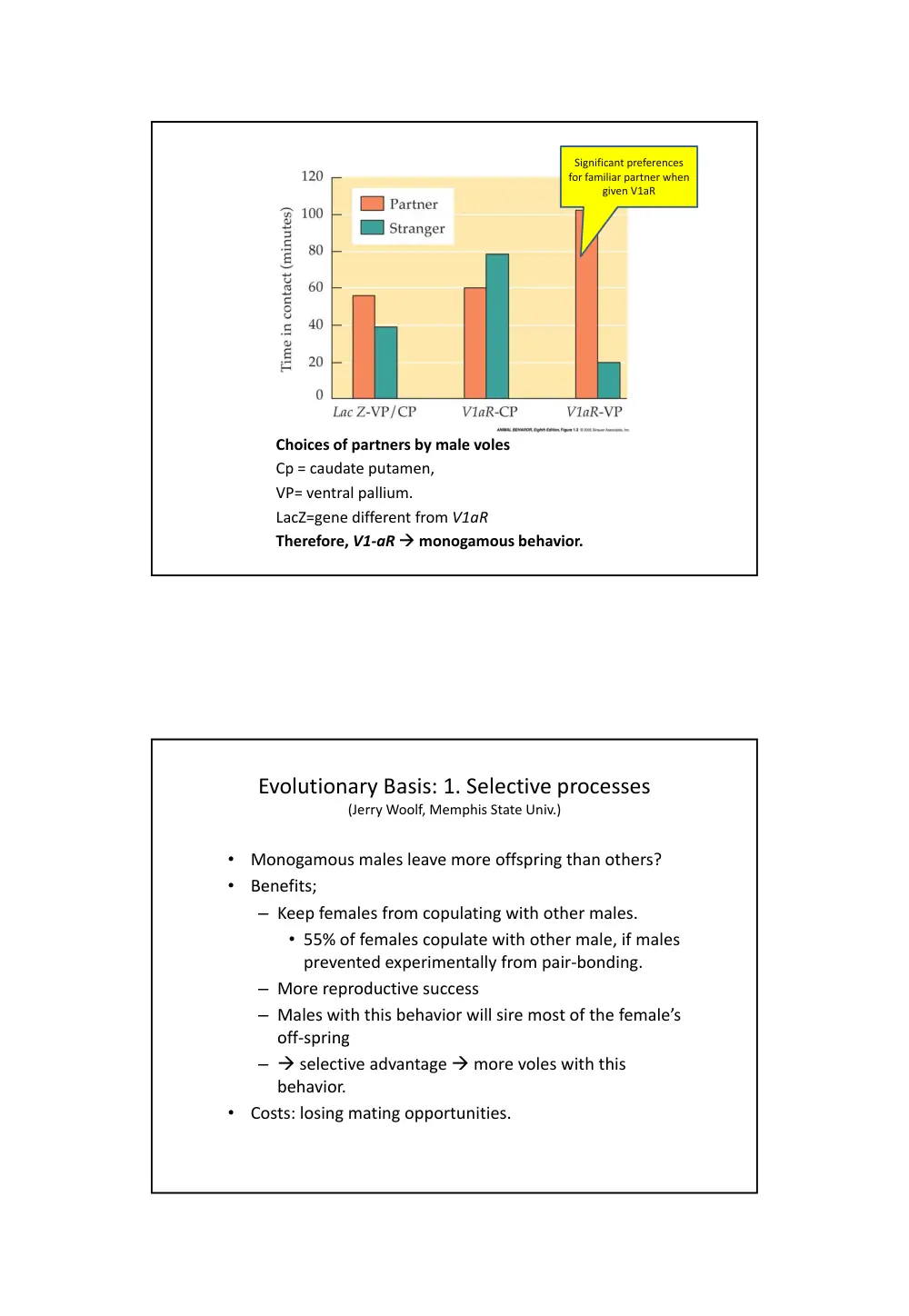
Significant preferences
for familiar partner when
given V1aR
Choices of partners by male voles
Cp = caudate putamen,
VP= ventral pallium.
LacZ=gene different from V1aR
Therefore, V1‐aR � monogamous behavior.
Evolutionary Basis: 1. Selective processes
(Jerry Woolf, Memphis State Univ.)
•
Monogamous males leave more offspring than others?
•
Benefits;
Benefits;
– Keep females from copulating with other males.
• 55% of females copulate with other male, if males
prevented experimentally from pair‐bonding.
– More reproductive success
– Males with this behavior will sire most of the female’s
off‐spring
off spring
– � selective advantage � more voles with this
behavior.
•
Costs: losing mating opportunities.
Evolutionary Basis: 2. History
• Requires tracing sequence of events �
monogamy.
– Examining ancestry of vole species.
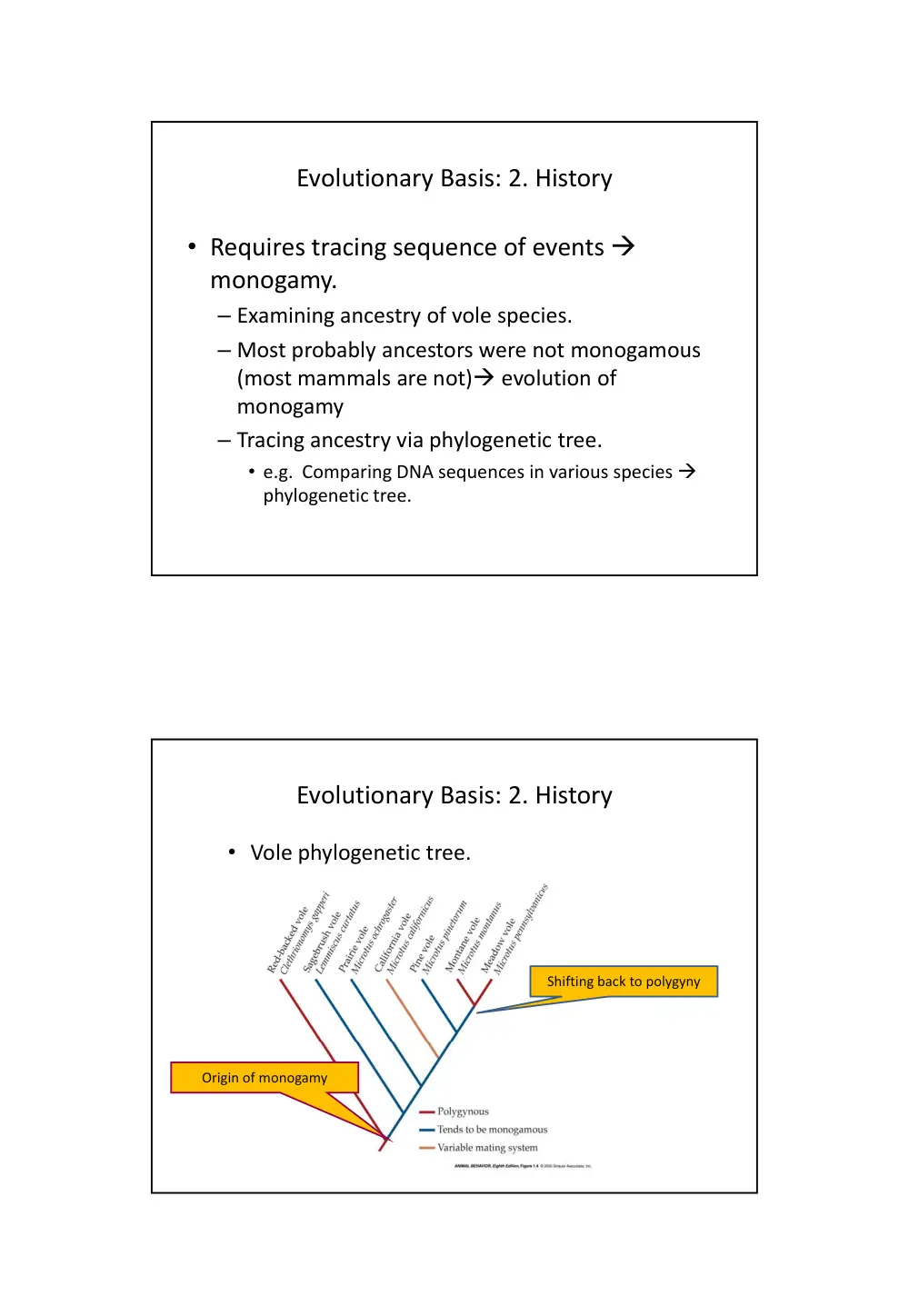
– Most probably ancestors were not monogamous
(most mammals are not)� evolution of
monogamy
– Tracing ancestry via phylogenetic tree.
• e.g. Comparing DNA sequences in various species �
phylogenetic tree.
Evolutionary Basis: 2. History
• Vole phylogenetic tree.
Shifting back to polygyny
Origin of monogamy
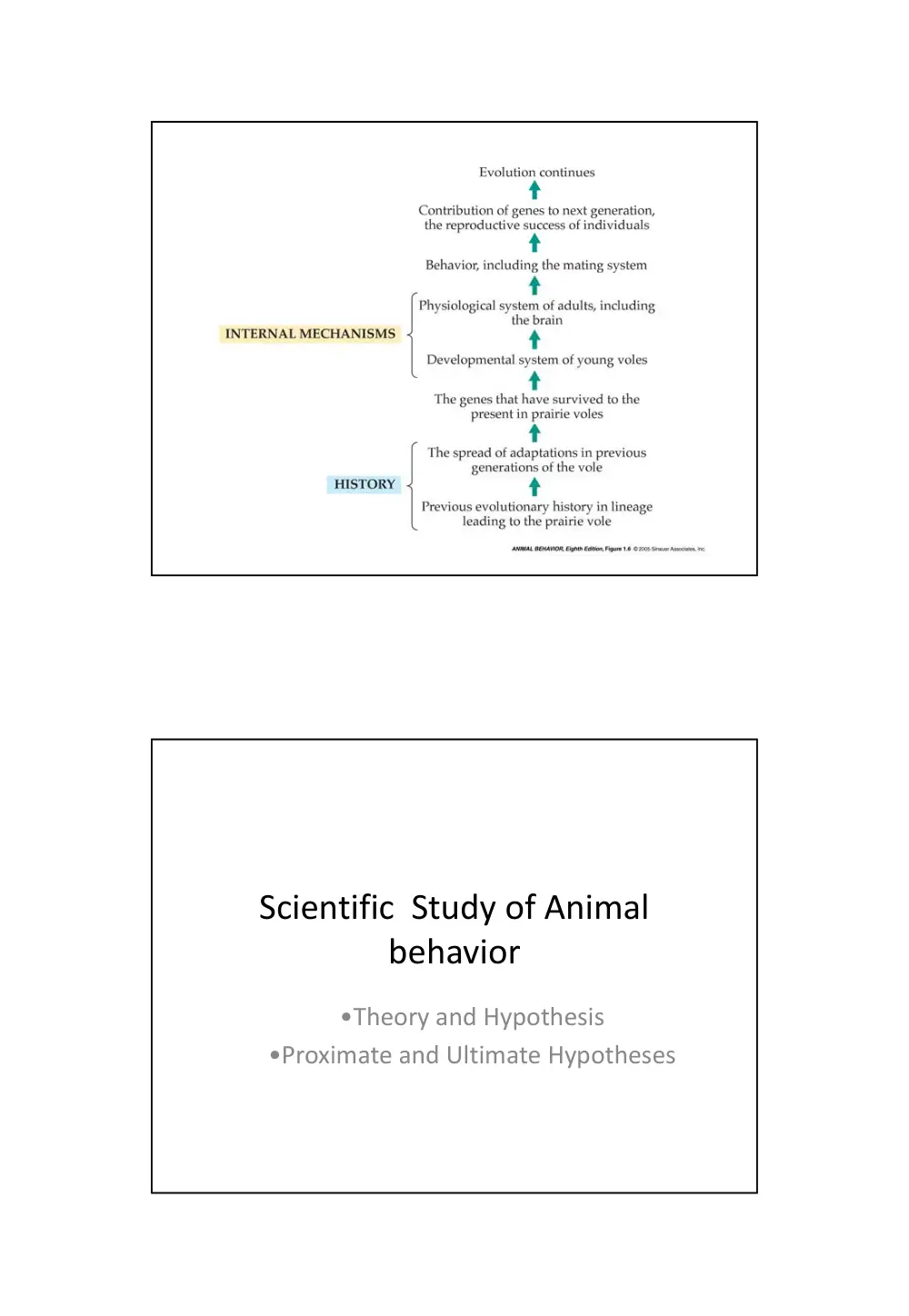
Levels of analysis
Researchers had the following approaches:
1) how a gene contributes to the development of the behavior
1) how a gene contributes to the development of the behavior
in male voles,
2) the physiological foundation for the behavior in terms of the
operation of the male vole's brain,
3) the adaptive value of the behavior in terms of its
contribution to male reproductive success, and
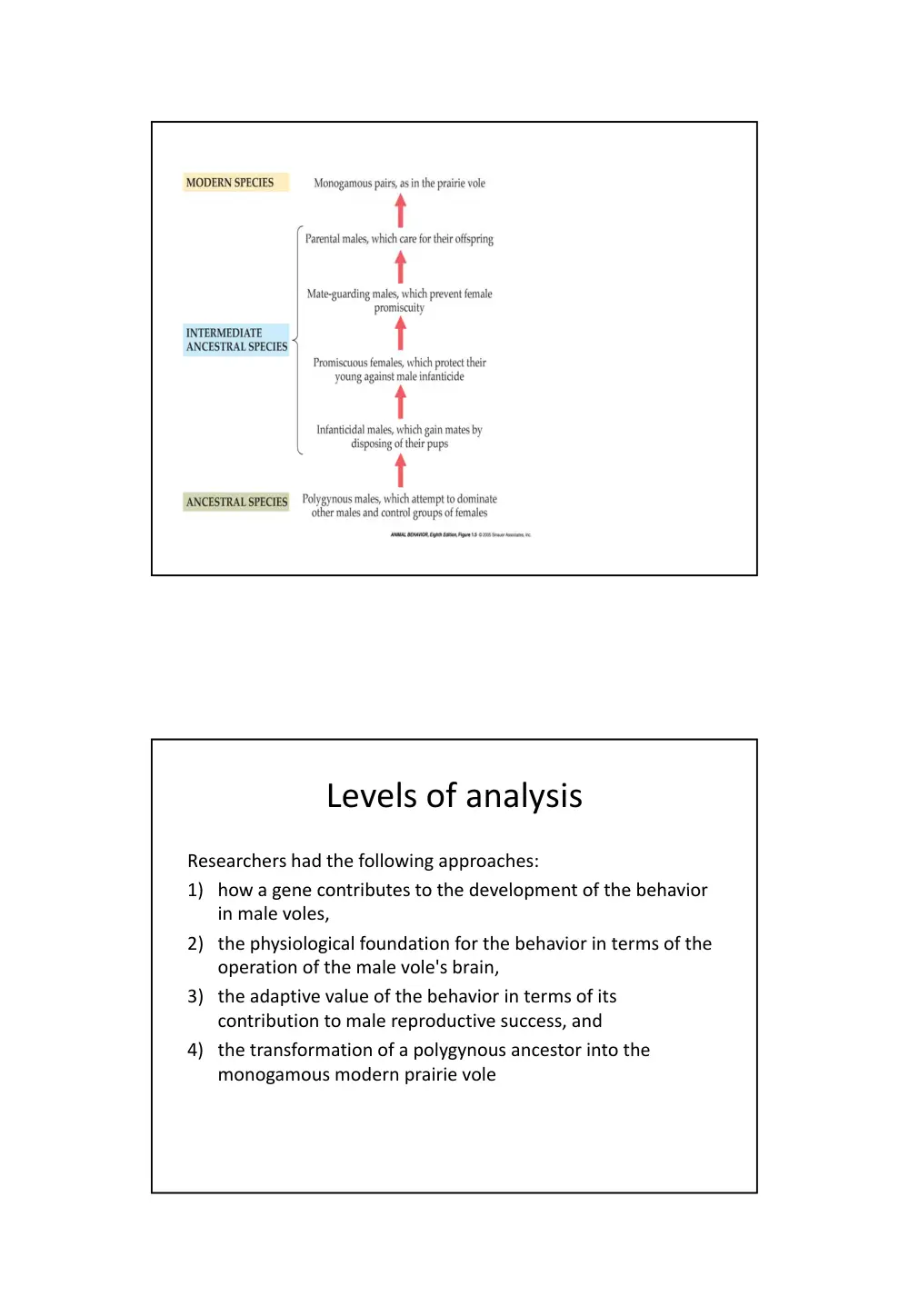
4) the transformation of a polygynous ancestor into the
monogamous modern prairie vole
Levels of analysis
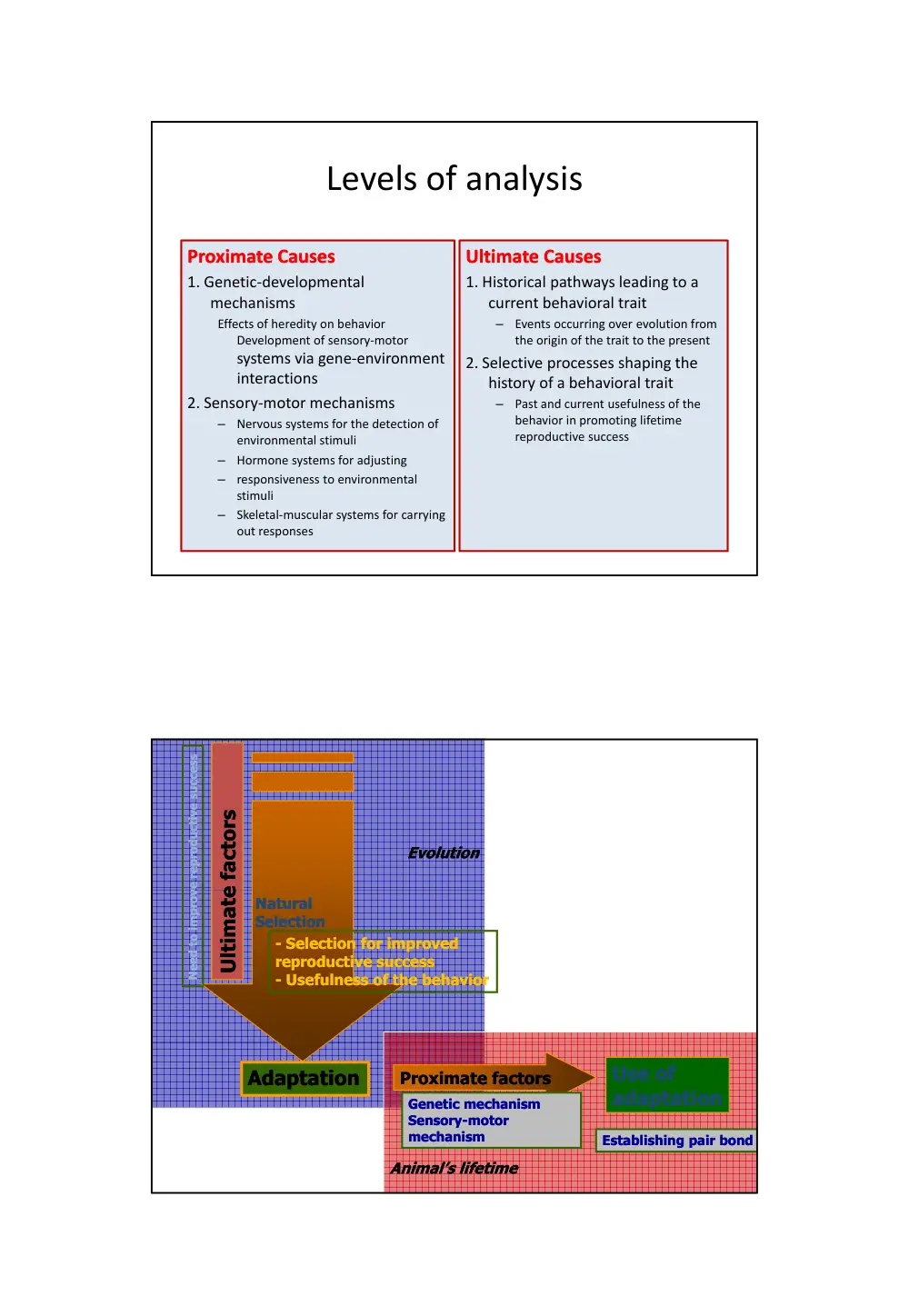
Proximate Causes
Proximate Causes
Ultimate Causes
Ultimate Causes
1. Genetic‐developmental
mechanisms
Effects of heredity on behavior
Development of sensory‐motor
systems via gene‐environment
interactions
2. Sensory‐motor mechanisms
–
Nervous systems for the detection of
1. Historical pathways leading to a
current behavioral trait
–
Events occurring over evolution from
the origin of the trait to the present
2. Selective processes shaping the
history of a behavioral trait
–
Past and current usefulness of the
behavior in promoting lifetime
–
Nervous systems for the detection of
environmental stimuli
–
Hormone systems for adjusting
–
responsiveness to environmental
stimuli
–
Skeletal‐muscular systems for carrying
out responses
be a o
p o ot g
et
e
reproductive success
Evolution
Evolution
e factors
e factors
ve reproductive success
ve reproductive success
Natural
Natural
Selection
Selection
Ultimate
Ultimate
Need to improv
Need to improv
- Selection for improved
Selection for improved
reproductive success
reproductive success
- Usefulness of the behavior
Usefulness of the behavior
Animal’s lifetime
Animal’s lifetime
Adaptation
Adaptation
Proximate factors
Proximate factors
Use of
Use of
adaptation
adaptation
Establishing pair bond
Establishing pair bond
Genetic mechanism
Genetic mechanism
Sensory
Sensory--motor
motor
mechanism
mechanism
Scientific Study of Animal
behavior
•Theory and Hypothesis
•Proximate and Ultimate Hypotheses
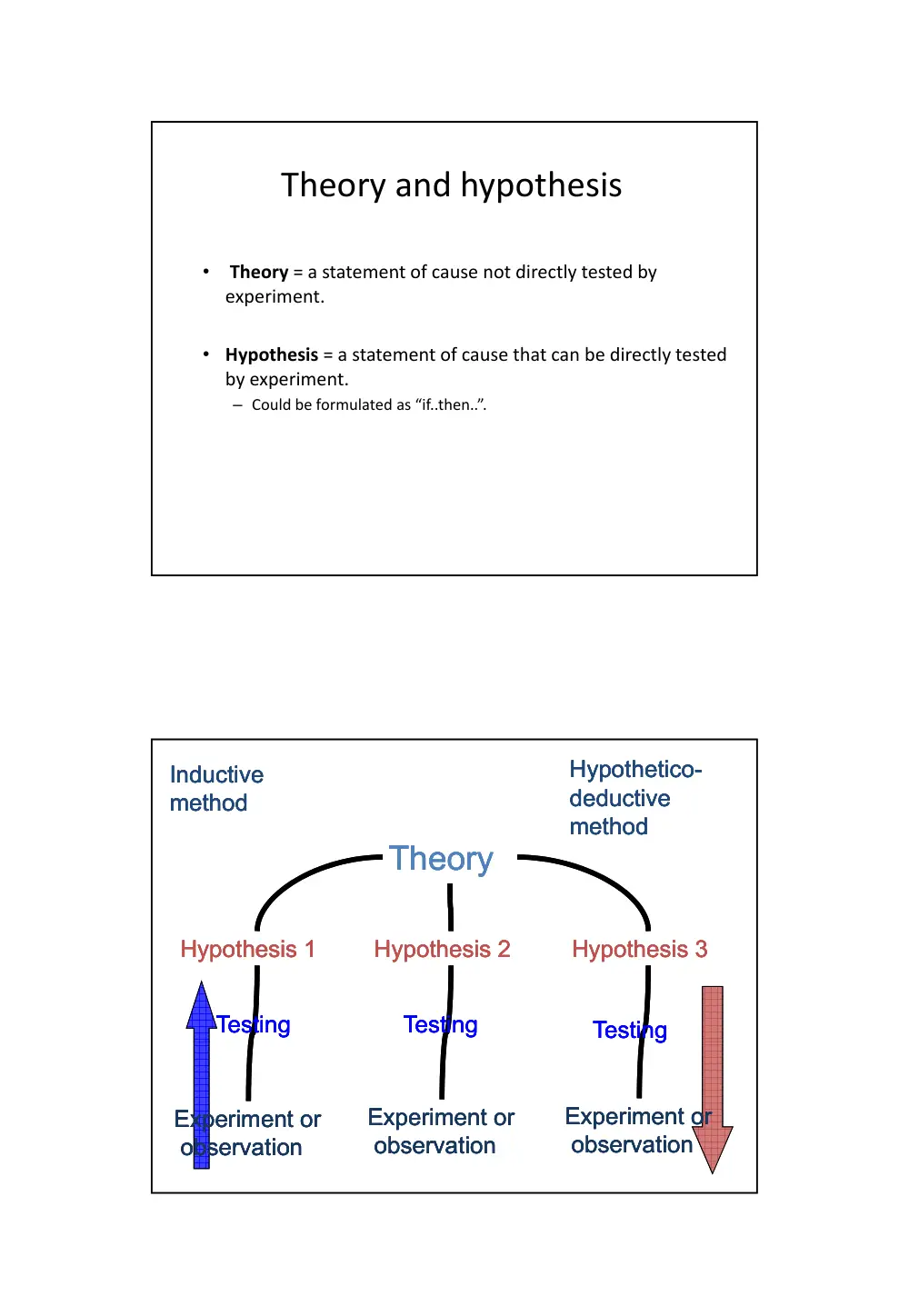
Theory and hypothesis
•
Theory = a statement of cause not directly tested by
•
Theory = a statement of cause not directly tested by
experiment.
• Hypothesis = a statement of cause that can be directly tested
by experiment.
– Could be formulated as “if..then..”.
Inductive
Inductive
method
method
Inductive
Inductive
method
method
Hypothetico
Hypothetico--
deductive
deductive
method
method
Hypothetico
Hypothetico--
deductive
deductive
method
method
Theory
Theory
Theory
Theory
Hypothesis
Hypothesis 11
Hypothesis
Hypothesis 11
Hypothesis
Hypothesis 22
Hypothesis
Hypothesis 22
Hypothesis
Hypothesis 33
Hypothesis
Hypothesis 33
Testing
Testing
Testing
Testing
Testing
Testing
Testing
Testing
Testing
Testing
Testing
Testing
Experiment or
Experiment or
observation
observation
Experiment or
Experiment or
observation
observation
Experiment or
Experiment or
observation
observation
Experiment or
Experiment or
observation
observation
Experiment or
Experiment or
observation
observation
Experiment or
Experiment or
observation
observation
g
Proximate hypothesis
• Example:
How could we state this
hypothesis?
Ultimate hypothesis
Darwinian Theory
Ultimate
Hypotheses
Darwinian Evolution
Evolution will occur given the following conditions:
1. Variation: members of a species differ in some of their
characteristics.
2. Heredity: parents able to pass on some of their distinctive
characteristics to their offspring
3. Differences in reproductive success: some individuals have
surviving offspring > others in their population, thanks to their
distinctive characteristics
Genetic variation
•
Occurs when a given gene exists in 2 or more alleles,
•
species' gene pool = Various alleles
•
genetically different individuals � different alleles � diff. proteins
•
If some alleles are more successful than others
� make individuals reproductively successful, � those alleles will
get themselves passed on from generation to generation � more
common over time
� gradually displace other "competitors" over the course of
evolution.
Genetic variation + differential reproduction = evolutionary change at
p
y
g
the genetic level
•
alleles will spread in proportion to how well they make their bearers
good at reproducing.
Natural Selection
• E.g. Ladybirds
Natural Selection
Darwinism and Behavior
•
Darwinian evolution could account for many problems in the
evolution of behavior.
•
Evolutionary explanations do not seem to account for other
behaviors.
•
Infanticide:
–
Behavior found in many species
Infanticide
e.g. Hanuman langurs
Ad
l
•
Advantages: male gets
exclusive access to females in
group that bear his offspring.
Infanticide
•
Disadvantages
I
l
ti
d
– Involves time and energy
expenditure
– Involves risk to infanticidal male
(females fight back)
– Might not endear male to female.
Infanticide: 3 possible explanations
1. Pathological inclinations due to
stress caused by overcrowding
2. Darwinian selection:
l
b
h i
d
i
stress caused by overcrowding
and shortage of food.
Males boost their reproductive
success, where females have no
choice but to mate with them.
3. as a means of population regulation, to
prevent overpopulation .
p
p p
i.e. for the good of the group??
(Group Selection?)
Group Selection
• Selection between groups rather than individuals.
• Groups (or species) with infanticide have a better
• Groups (or species) with infanticide have a better
chance of survival than groups without infanticide,
because they would regulate their densities in
harmony with resources.
• Problems of group selection:
– Individual (Darwinian ) selection is stronger.
Group selection can occur in limited circumstances that
– Group selection can occur in limited circumstances that
involve keeping group integrity for long periods, i.e. not be
invaded by ‘selfish” alleles which will replace group‐oriented
individuals.
Infanticide: 3 possible explanations
1. Social pathology hypothesis:
2. Quicker reproduction hypothesis
(Darwinian selection)
If true, infanticide would occur only in
crowded situations
NOT TRUE
(Darwinian selection)
3. Population regulation hypothesis
If true, infanticide would occur only in
crowded situations
NOT TRUE
Infanticide: possible explanations
2. Quicker reproduction hypothesis (Darwinian selection)
(cannibalism might be an explanation but not observed)
Implications of Quicker reproduction hypothesis
1.
Males should not kill their own young: DNA testing proves this.
2.
Females would resume reproductive cycle, and mate with the
infant‐killer: Observations show this is true.
infant killer: Observations show this is true.
Infanticide
Anthropomorphism
Anthropomorphism
("of human form")
Att ib ti
f h
liti
t
h
thi
= Attribution of human qualities to non‐human things.
e.g. in animal behavior.
Uncritical anthropomorphism:
Uncritical anthropomorphism:
==> Purposeful behavior
==> Purposeful behavior
e g caring for young as if "knowing" the purpose
e g caring for young as if "knowing" the purpose
e.g. caring for young as if knowing the purpose.
e.g. caring for young as if knowing the purpose.
Problems:
Problems:
‐ Observations
Observations � animal behavior is purposeful
animal behavior is purposeful
‐
Animals respond to stimuli; absence of stimulus inhibits
Animals respond to stimuli; absence of stimulus inhibits
behavior e.g. maternal behavior.
behavior e.g. maternal behavior.
‐
Even human behavior includes poorly
Even human behavior includes poorly‐understood
understood
compulsive behavior (e.g. Alcoholism, overeating, odd
compulsive behavior (e.g. Alcoholism, overeating, odd
sexual behavior)
sexual behavior)
Rejected Anthropomorphism
Rejected Anthropomorphism
‐
There is a tendency to reject anthropomorphism completely
There is a tendency to reject anthropomorphism completely
‐
i.e. an animal is viewed as a machine with senses and pre
i.e. an animal is viewed as a machine with senses and pre‐
i.e. an animal is viewed as a machine with senses and pre
i.e. an animal is viewed as a machine with senses and pre
programmed responses
programmed responses
‐
Even humans can be viewed as not much different from other
Even humans can be viewed as not much different from other
animals (but more advanced).
animals (but more advanced).
‐
“anthropomorphism is dead” because it constrains the formulation
“anthropomorphism is dead” because it constrains the formulation
of well informed theories and hypothesis.
of well informed theories and hypothesis.
Critical anthropomorphism
•
Bridge between two extremes
•
One Could use human thoughts and feelings, imagining being the animal,
g
g
g
g
g
observations of human subjects � understanding animal behavior.
• The debate continues
23:45
39