
BUSS 211 Notes, Fall 2011
American University of Beirut · Business Law · 15 pages
Showing the first 10 of 15 pages. Download the PDF to see all of it.
More BUSS 211 files
Show the text of this notes
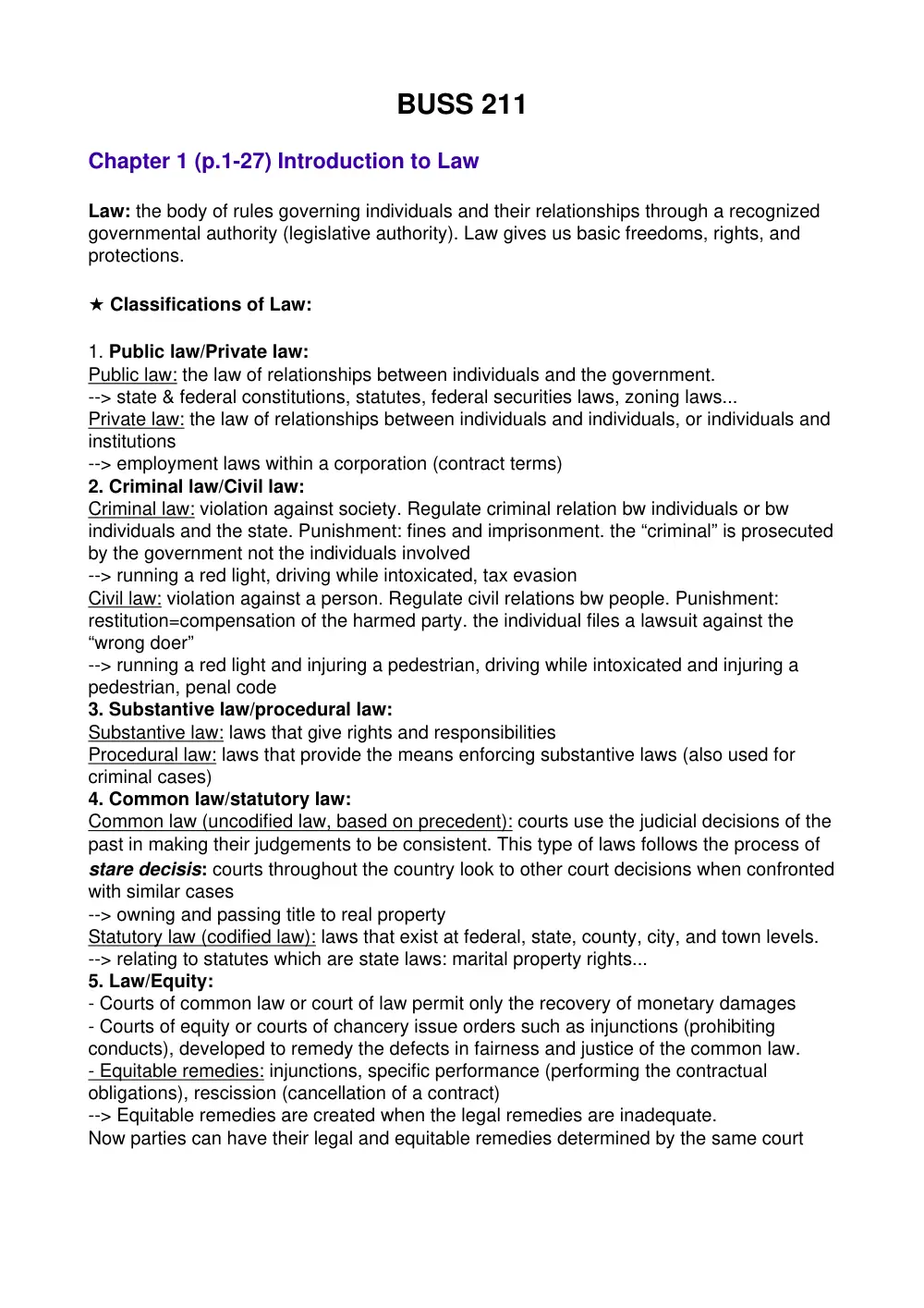
BUSS 211
Chapter 1 (p.1-27) Introduction to Law
Law: the body of rules governing individuals and their relationships through a recognized
governmental authority (legislative authority). Law gives us basic freedoms, rights, and
protections.
★ Classifications of Law:
1. Public law/Private law:
Public law: the law of relationships between individuals and the government.
--> state & federal constitutions, statutes, federal securities laws, zoning laws...
Private law: the law of relationships between individuals and individuals, or individuals and
institutions
--> employment laws within a corporation (contract terms)
2. Criminal law/Civil law:
Criminal law: violation against society. Regulate criminal relation bw individuals or bw
individuals and the state. Punishment: fines and imprisonment. the “criminal” is prosecuted
by the government not the individuals involved
--> running a red light, driving while intoxicated, tax evasion
Civil law: violation against a person. Regulate civil relations bw people. Punishment:
restitution=compensation of the harmed party. the individual files a lawsuit against the
“wrong doer”
--> running a red light and injuring a pedestrian, driving while intoxicated and injuring a
pedestrian, penal code
3. Substantive law/procedural law:
Substantive law: laws that give rights and responsibilities
Procedural law: laws that provide the means enforcing substantive laws (also used for
criminal cases)
4. Common law/statutory law:
Common law (uncodified law, based on precedent): courts use the judicial decisions of the
past in making their judgements to be consistent. This type of laws follows the process of
stare decisis: courts throughout the country look to other court decisions when confronted
with similar cases
--> owning and passing title to real property
Statutory law (codified law): laws that exist at federal, state, county, city, and town levels.
--> relating to statutes which are state laws: marital property rights...
5. Law/Equity:
- Courts of common law or court of law permit only the recovery of monetary damages
- Courts of equity or courts of chancery issue orders such as injunctions (prohibiting
conducts), developed to remedy the defects in fairness and justice of the common law.
- Equitable remedies: injunctions, specific performance (performing the contractual
obligations), rescission (cancellation of a contract)
--> Equitable remedies are created when the legal remedies are inadequate.
Now parties can have their legal and equitable remedies determined by the same court
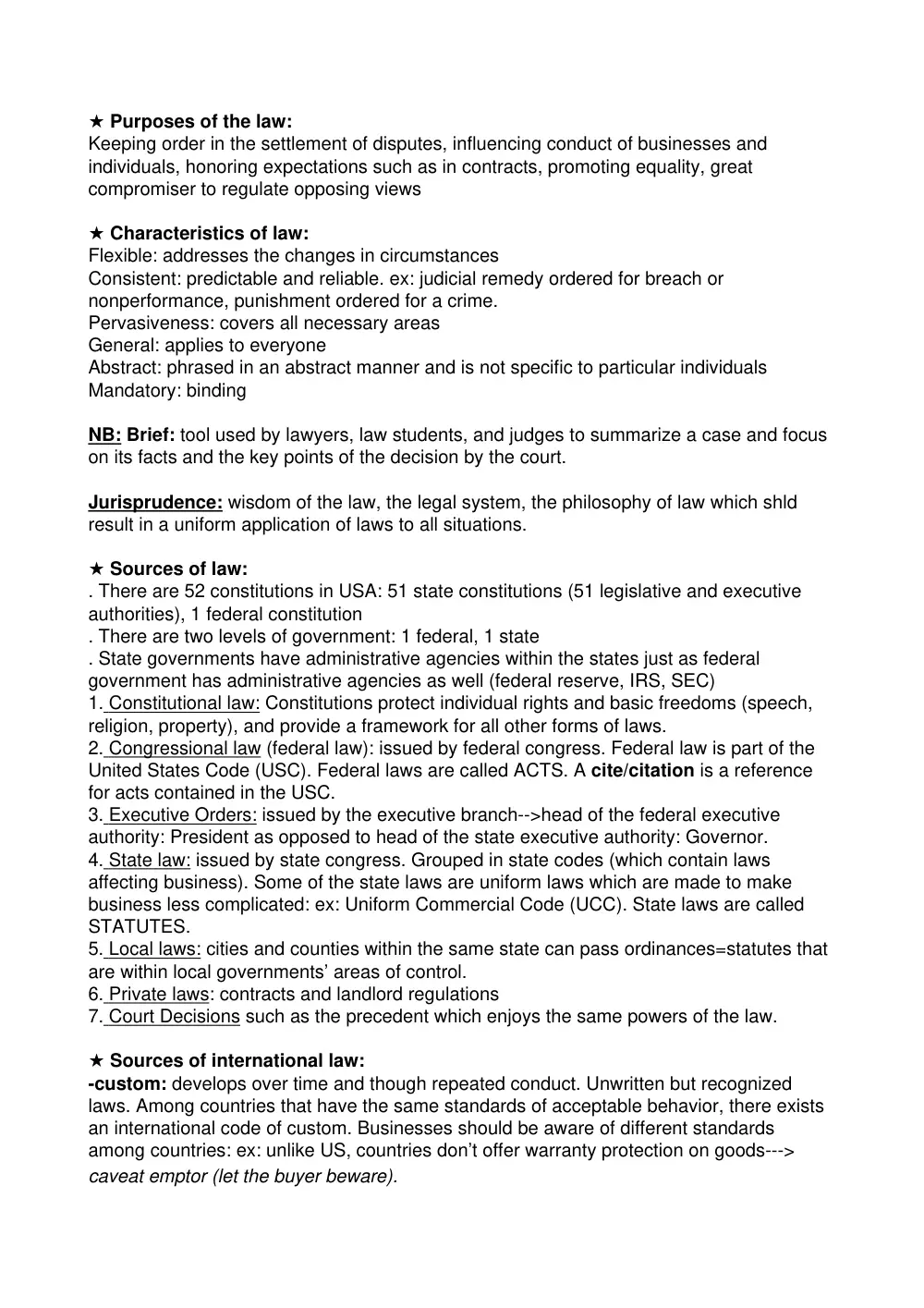
★ Purposes of the law:
Keeping order in the settlement of disputes, influencing conduct of businesses and
individuals, honoring expectations such as in contracts, promoting equality, great
compromiser to regulate opposing views
★ Characteristics of law:
Flexible: addresses the changes in circumstances
Consistent: predictable and reliable. ex: judicial remedy ordered for breach or
nonperformance, punishment ordered for a crime.
Pervasiveness: covers all necessary areas
General: applies to everyone
Abstract: phrased in an abstract manner and is not specific to particular individuals
Mandatory: binding
NB: Brief: tool used by lawyers, law students, and judges to summarize a case and focus
on its facts and the key points of the decision by the court.
Jurisprudence: wisdom of the law, the legal system, the philosophy of law which shld
result in a uniform application of laws to all situations.
★ Sources of law:
. There are 52 constitutions in USA: 51 state constitutions (51 legislative and executive
authorities), 1 federal constitution
. There are two levels of government: 1 federal, 1 state
. State governments have administrative agencies within the states just as federal
government has administrative agencies as well (federal reserve, IRS, SEC)
1. Constitutional law:
Constitutions protect individual rights and basic freedoms (speech,
religion, property), and provide a framework for all other forms of laws.
2. Congressional law
(federal law): issued by federal congress. Federal law is part of the
United States Code (USC). Federal laws are called ACTS. A cite/citation is a reference
for acts contained in the USC.
3. Executive Orders:
issued by the executive branch-->head of the federal executive
authority: President as opposed to head of the state executive authority: Governor.
4. State law:
issued by state congress. Grouped in state codes (which contain laws
affecting business). Some of the state laws are uniform laws which are made to make
business less complicated: ex: Uniform Commercial Code (UCC). State laws are called
STATUTES.
5. Local laws:
cities and counties within the same state can pass ordinances=statutes that
are within local governments’ areas of control.
6. Private laws
: contracts and landlord regulations
7. Court Decisions
such as the precedent which enjoys the same powers of the law.
★ Sources of international law:
-custom: develops over time and though repeated conduct. Unwritten but recognized
laws. Among countries that have the same standards of acceptable behavior, there exists
an international code of custom. Businesses should be aware of different standards
among countries: ex: unlike US, countries don’t offer warranty protection on goods--->
caveat emptor (let the buyer beware).
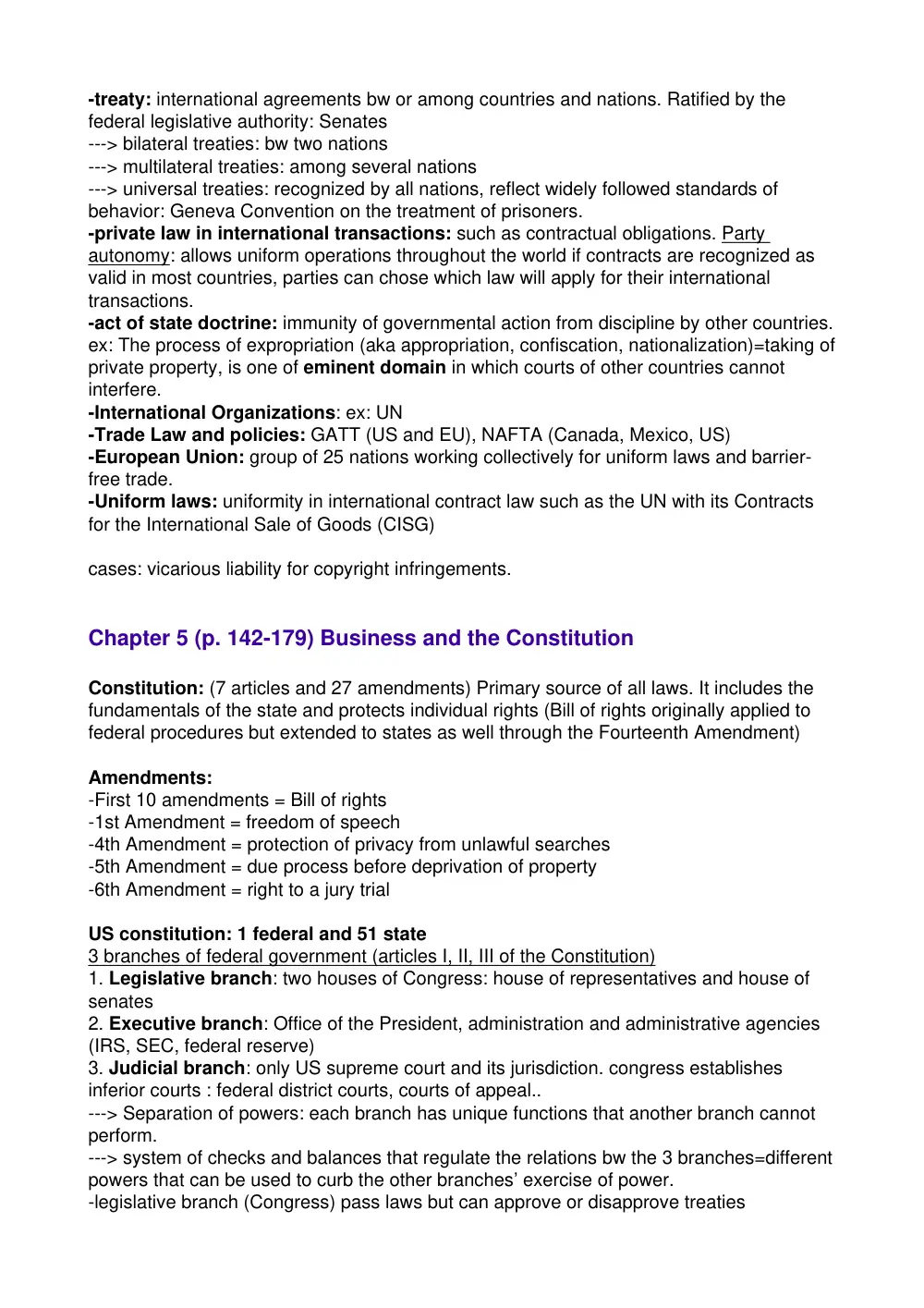
-treaty: international agreements bw or among countries and nations. Ratified by the
federal legislative authority: Senates
---> bilateral treaties: bw two nations
---> multilateral treaties: among several nations
---> universal treaties: recognized by all nations, reflect widely followed standards of
behavior: Geneva Convention on the treatment of prisoners.
-private law in international transactions: such as contractual obligations. Party
autonomy: allows uniform operations throughout the world if contracts are recognized as
valid in most countries, parties can chose which law will apply for their international
transactions.
-act of state doctrine: immunity of governmental action from discipline by other countries.
ex: The process of expropriation (aka appropriation, confiscation, nationalization)=taking of
private property, is one of eminent domain in which courts of other countries cannot
interfere.
-International Organizations: ex: UN
-Trade Law and policies: GATT (US and EU), NAFTA (Canada, Mexico, US)
-European Union: group of 25 nations working collectively for uniform laws and barrier-
free trade.
-Uniform laws: uniformity in international contract law such as the UN with its Contracts
for the International Sale of Goods (CISG)
cases: vicarious liability for copyright infringements.
Chapter 5 (p. 142-179) Business and the Constitution
Constitution: (7 articles and 27 amendments) Primary source of all laws. It includes the
fundamentals of the state and protects individual rights (Bill of rights originally applied to
federal procedures but extended to states as well through the Fourteenth Amendment)
Amendments:
-First 10 amendments = Bill of rights
-1st Amendment = freedom of speech
-4th Amendment = protection of privacy from unlawful searches
-5th Amendment = due process before deprivation of property
-6th Amendment = right to a jury trial
US constitution: 1 federal and 51 state
3 branches of federal government (articles I, II, III of the Constitution)
1. Legislative branch: two houses of Congress: house of representatives and house of
senates
2. Executive branch: Office of the President, administration and administrative agencies
(IRS, SEC, federal reserve)
3. Judicial branch: only US supreme court and its jurisdiction. congress establishes
inferior courts : federal district courts, courts of appeal..
---> Separation of powers: each branch has unique functions that another branch cannot
perform.
---> system of checks and balances that regulate the relations bw the 3 branches=different
powers that can be used to curb the other branches’ exercise of power.
-legislative branch (Congress) pass laws but can approve or disapprove treaties
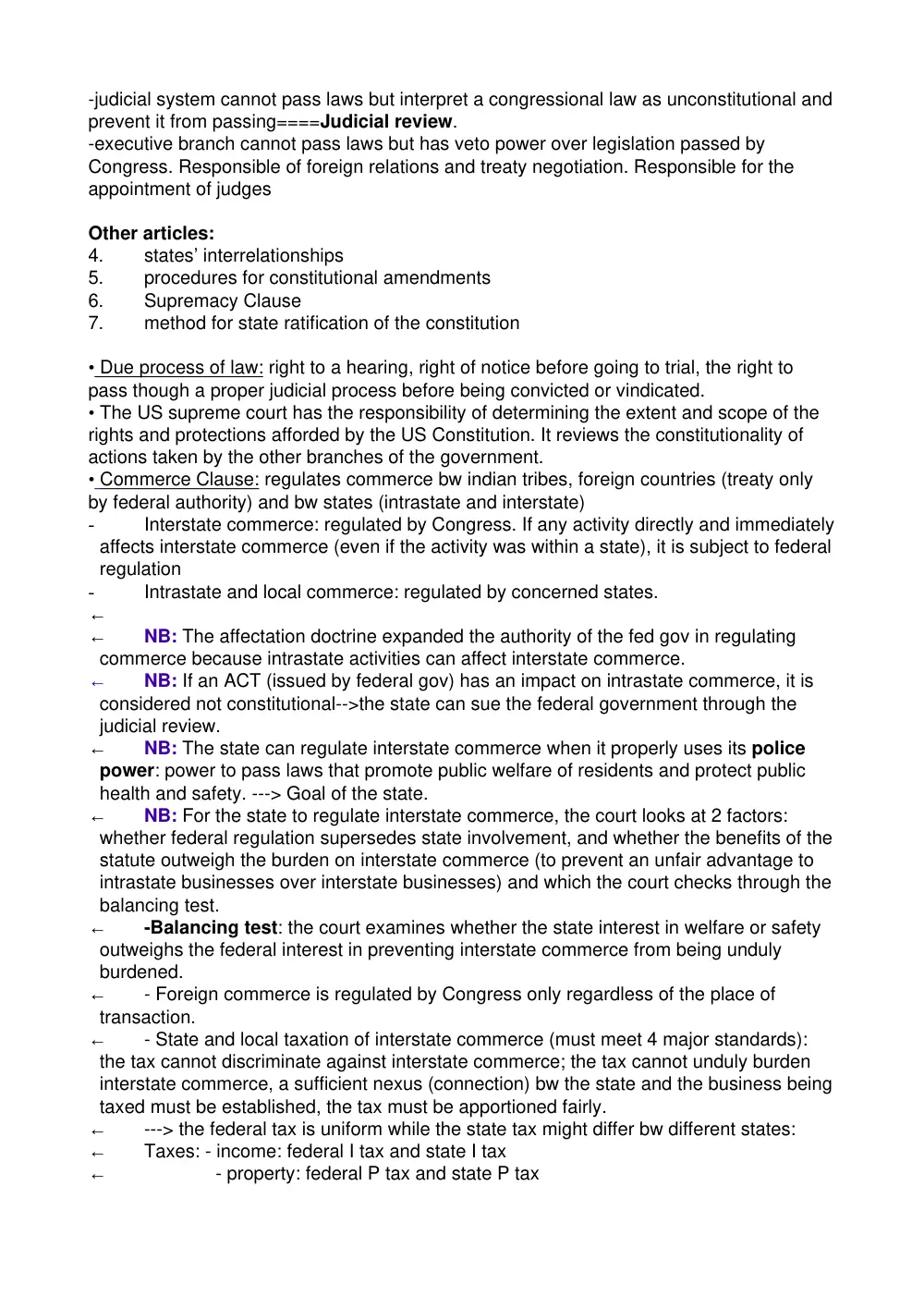
-judicial system cannot pass laws but interpret a congressional law as unconstitutional and
prevent it from passing====Judicial review.
-executive branch cannot pass laws but has veto power over legislation passed by
Congress. Responsible of foreign relations and treaty negotiation. Responsible for the
appointment of judges
Other articles:
4.
states’ interrelationships
5.
procedures for constitutional amendments
6.
Supremacy Clause
7.
method for state ratification of the constitution
• Due process of law:
right to a hearing, right of notice before going to trial, the right to
pass though a proper judicial process before being convicted or vindicated.
• The US supreme court has the responsibility of determining the extent and scope of the
rights and protections afforded by the US Constitution. It reviews the constitutionality of
actions taken by the other branches of the government.
• Commerce Clause:
regulates commerce bw indian tribes, foreign countries (treaty only
by federal authority) and bw states (intrastate and interstate)
-
Interstate commerce: regulated by Congress. If any activity directly and immediately
affects interstate commerce (even if the activity was within a state), it is subject to federal
regulation
-
Intrastate and local commerce: regulated by concerned states.
←
←
NB: The affectation doctrine expanded the authority of the fed gov in regulating
commerce because intrastate activities can affect interstate commerce.
←
NB: If an ACT (issued by federal gov) has an impact on intrastate commerce, it is
considered not constitutional-->the state can sue the federal government through the
judicial review.
←
NB: The state can regulate interstate commerce when it properly uses its police
power: power to pass laws that promote public welfare of residents and protect public
health and safety. ---> Goal of the state.
←
NB: For the state to regulate interstate commerce, the court looks at 2 factors:
whether federal regulation supersedes state involvement, and whether the benefits of the
statute outweigh the burden on interstate commerce (to prevent an unfair advantage to
intrastate businesses over interstate businesses) and which the court checks through the
balancing test.
←
-Balancing test: the court examines whether the state interest in welfare or safety
outweighs the federal interest in preventing interstate commerce from being unduly
burdened.
←
- Foreign commerce is regulated by Congress only regardless of the place of
transaction.
←
- State and local taxation of interstate commerce (must meet 4 major standards):
the tax cannot discriminate against interstate commerce; the tax cannot unduly burden
interstate commerce, a sufficient nexus (connection) bw the state and the business being
taxed must be established, the tax must be apportioned fairly.
←
---> the federal tax is uniform while the state tax might differ bw different states:
←
Taxes: - income: federal I tax and state I tax
←
- property: federal P tax and state P tax
←
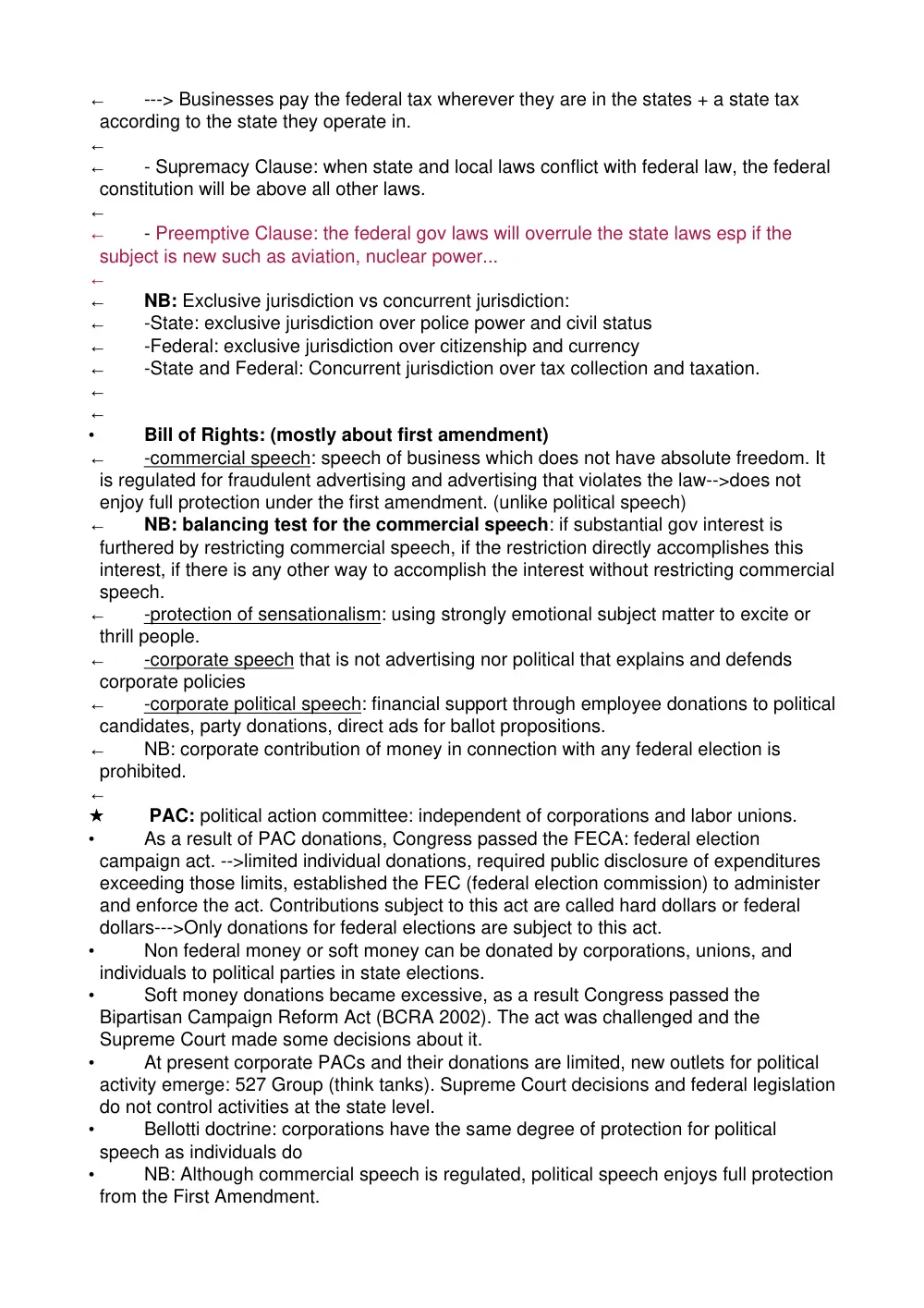
---> Businesses pay the federal tax wherever they are in the states + a state tax
according to the state they operate in.
←
←
- Supremacy Clause: when state and local laws conflict with federal law, the federal
constitution will be above all other laws.
←
←
- Preemptive Clause: the federal gov laws will overrule the state laws esp if the
subject is new such as aviation, nuclear power...
←
←
NB: Exclusive jurisdiction vs concurrent jurisdiction:
←
-State: exclusive jurisdiction over police power and civil status
←
-Federal: exclusive jurisdiction over citizenship and currency
←
-State and Federal: Concurrent jurisdiction over tax collection and taxation.
←
←
•
Bill of Rights: (mostly about first amendment)
←
-commercial speech
: speech of business which does not have absolute freedom. It
is regulated for fraudulent advertising and advertising that violates the law-->does not
enjoy full protection under the first amendment. (unlike political speech)
←
NB: balancing test for the commercial speech: if substantial gov interest is
furthered by restricting commercial speech, if the restriction directly accomplishes this
interest, if there is any other way to accomplish the interest without restricting commercial
speech.
←
-protection of sensationalism
: using strongly emotional subject matter to excite or
thrill people.
←
-corporate speech
that is not advertising nor political that explains and defends
corporate policies
←
-corporate political speech
: financial support through employee donations to political
candidates, party donations, direct ads for ballot propositions.
←
NB: corporate contribution of money in connection with any federal election is
prohibited.
←
★
PAC: political action committee: independent of corporations and labor unions.
•
As a result of PAC donations, Congress passed the FECA: federal election
campaign act. -->limited individual donations, required public disclosure of expenditures
exceeding those limits, established the FEC (federal election commission) to administer
and enforce the act. Contributions subject to this act are called hard dollars or federal
dollars--->Only donations for federal elections are subject to this act.
•
Non federal money or soft money can be donated by corporations, unions, and
individuals to political parties in state elections.
•
Soft money donations became excessive, as a result Congress passed the
Bipartisan Campaign Reform Act (BCRA 2002). The act was challenged and the
Supreme Court made some decisions about it.
•
At present corporate PACs and their donations are limited, new outlets for political
activity emerge: 527 Group (think tanks). Supreme Court decisions and federal legislation
do not control activities at the state level.
•
Bellotti doctrine: corporations have the same degree of protection for political
speech as individuals do
•
NB: Although commercial speech is regulated, political speech enjoys full protection
from the First Amendment.
←
←
←
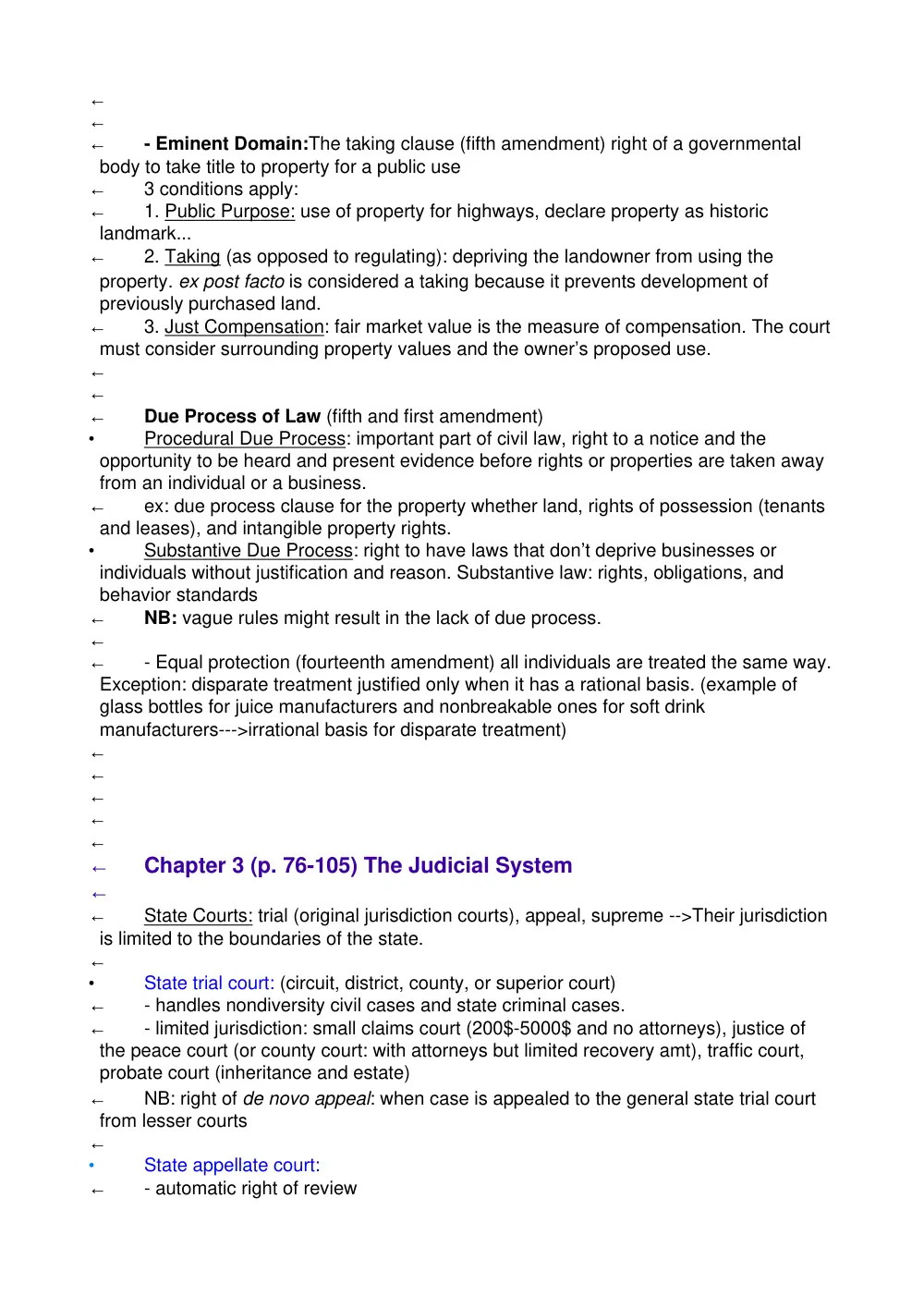
- Eminent Domain:The taking clause (fifth amendment) right of a governmental
body to take title to property for a public use
←
3 conditions apply:
←
1. Public Purpose: use of property for highways, declare property as historic
landmark...
←
2. Taking (as opposed to regulating): depriving the landowner from using the
property. ex post facto is considered a taking because it prevents development of
previously purchased land.
←
3. Just Compensation: fair market value is the measure of compensation. The court
must consider surrounding property values and the owner’s proposed use.
←
←
←
Due Process of Law (fifth and first amendment)
•
Procedural Due Process
: important part of civil law, right to a notice and the
opportunity to be heard and present evidence before rights or properties are taken away
from an individual or a business.
←
ex: due process clause for the property whether land, rights of possession (tenants
and leases), and intangible property rights.
•
Substantive Due Process
: right to have laws that don’t deprive businesses or
individuals without justification and reason. Substantive law: rights, obligations, and
behavior standards
←
NB: vague rules might result in the lack of due process.
←
←
- Equal protection (fourteenth amendment) all individuals are treated the same way.
Exception: disparate treatment justified only when it has a rational basis. (example of
glass bottles for juice manufacturers and nonbreakable ones for soft drink
manufacturers--->irrational basis for disparate treatment)
←
←
←
←
←
←
Chapter 3 (p. 76-105) The Judicial System
←
←
State Courts:
trial (original jurisdiction courts), appeal, supreme -->Their jurisdiction
is limited to the boundaries of the state.
←
•
State trial court: (circuit, district, county, or superior court)
←
- handles nondiversity civil cases and state criminal cases.
←
- limited jurisdiction: small claims court (200$-5000$ and no attorneys), justice of
the peace court (or county court: with attorneys but limited recovery amt), traffic court,
probate court (inheritance and estate)
←
NB: right of de novo appeal: when case is appealed to the general state trial court
from lesser courts
←
•
State appellate court:
←
- automatic right of review
←
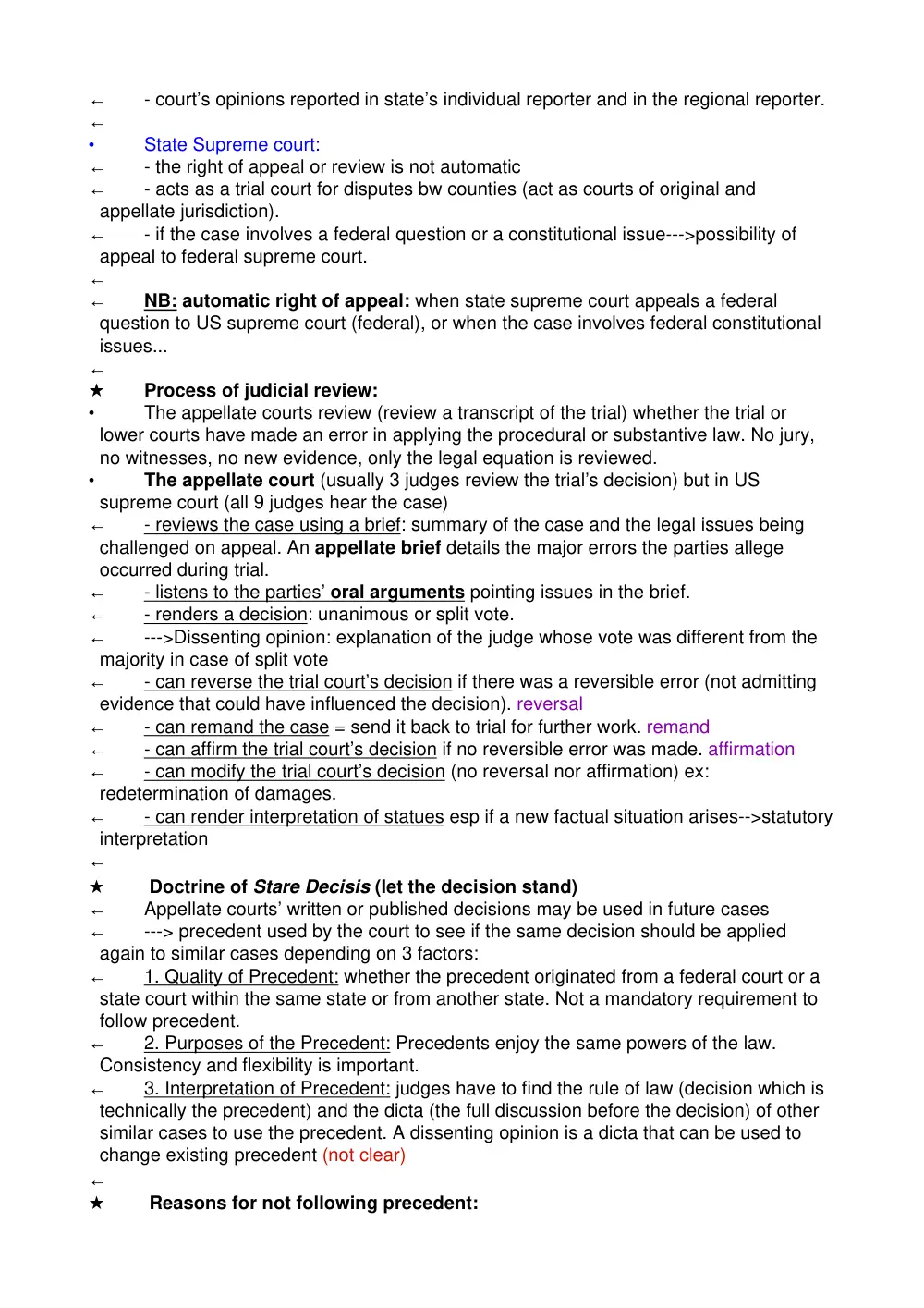
- court’s opinions reported in state’s individual reporter and in the regional reporter.
←
•
State Supreme court:
←
- the right of appeal or review is not automatic
←
- acts as a trial court for disputes bw counties (act as courts of original and
appellate jurisdiction).
←
- if the case involves a federal question or a constitutional issue--->possibility of
appeal to federal supreme court.
←
←
NB:
automatic right of appeal: when state supreme court appeals a federal
question to US supreme court (federal), or when the case involves federal constitutional
issues...
←
★
Process of judicial review:
•
The appellate courts review (review a transcript of the trial) whether the trial or
lower courts have made an error in applying the procedural or substantive law. No jury,
no witnesses, no new evidence, only the legal equation is reviewed.
•
The appellate court (usually 3 judges review the trial’s decision) but in US
supreme court (all 9 judges hear the case)
←
- reviews the case using a brief
: summary of the case and the legal issues being
challenged on appeal. An appellate brief details the major errors the parties allege
occurred during trial.
←
- listens to the parties’
oral arguments
pointing issues in the brief.
←
- renders a decision
: unanimous or split vote.
←
--->Dissenting opinion: explanation of the judge whose vote was different from the
majority in case of split vote
←
- can reverse the trial court’s decision
if there was a reversible error (not admitting
evidence that could have influenced the decision). reversal
←
- can remand the case
= send it back to trial for further work. remand
←
- can affirm the trial court’s decision
if no reversible error was made. affirmation
←
- can modify the trial court’s decision
(no reversal nor affirmation) ex:
redetermination of damages.
←
- can render interpretation of statues
esp if a new factual situation arises-->statutory
interpretation
←
★
Doctrine of Stare Decisis (let the decision stand)
←
Appellate courts’ written or published decisions may be used in future cases
←
---> precedent used by the court to see if the same decision should be applied
again to similar cases depending on 3 factors:
←
1. Quality of Precedent:
whether the precedent originated from a federal court or a
state court within the same state or from another state. Not a mandatory requirement to
follow precedent.
←
2. Purposes of the Precedent:
Precedents enjoy the same powers of the law.
Consistency and flexibility is important.
←
3. Interpretation of Precedent:
judges have to find the rule of law (decision which is
technically the precedent) and the dicta (the full discussion before the decision) of other
similar cases to use the precedent. A dissenting opinion is a dicta that can be used to
change existing precedent (not clear)
←
★
Reasons for not following precedent:
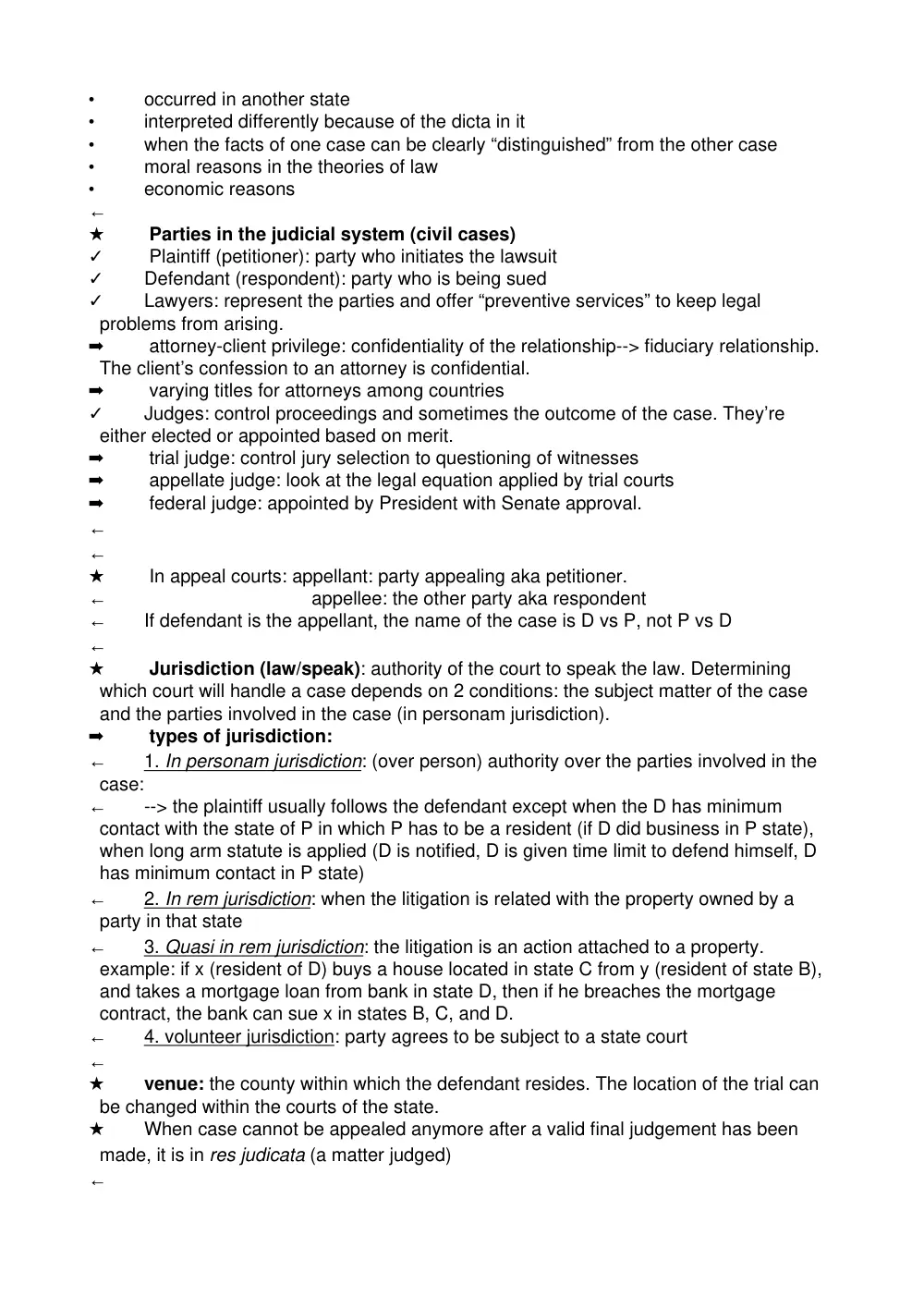
•
occurred in another state
•
interpreted differently because of the dicta in it
•
when the facts of one case can be clearly “distinguished” from the other case
•
moral reasons in the theories of law
•
economic reasons
←
★
Parties in the judicial system (civil cases)
✓
Plaintiff (petitioner): party who initiates the lawsuit
✓
Defendant (respondent): party who is being sued
✓
Lawyers: represent the parties and offer “preventive services” to keep legal
problems from arising.
➡
attorney-client privilege: confidentiality of the relationship--> fiduciary relationship.
The client’s confession to an attorney is confidential.
➡
varying titles for attorneys among countries
✓
Judges: control proceedings and sometimes the outcome of the case. They’re
either elected or appointed based on merit.
➡
trial judge: control jury selection to questioning of witnesses
➡
appellate judge: look at the legal equation applied by trial courts
➡
federal judge: appointed by President with Senate approval.
←
←
★
In appeal courts: appellant: party appealing aka petitioner.
←
appellee: the other party aka respondent
←
If defendant is the appellant, the name of the case is D vs P, not P vs D
←
★
Jurisdiction (law/speak): authority of the court to speak the law. Determining
which court will handle a case depends on 2 conditions: the subject matter of the case
and the parties involved in the case (in personam jurisdiction).
➡
types of jurisdiction:
←
1.
In personam jurisdiction
: (over person) authority over the parties involved in the
case:
←
--> the plaintiff usually follows the defendant except when the D has minimum
contact with the state of P in which P has to be a resident (if D did business in P state),
when long arm statute is applied (D is notified, D is given time limit to defend himself, D
has minimum contact in P state)
←
2.
In rem jurisdiction
: when the litigation is related with the property owned by a
party in that state
←
3.
Quasi in rem jurisdiction
: the litigation is an action attached to a property.
example: if x (resident of D) buys a house located in state C from y (resident of state B),
and takes a mortgage loan from bank in state D, then if he breaches the mortgage
contract, the bank can sue x in states B, C, and D.
←
4. volunteer jurisdiction
: party agrees to be subject to a state court
←
★
venue: the county within which the defendant resides. The location of the trial can
be changed within the courts of the state.
★
When case cannot be appealed anymore after a valid final judgement has been
made, it is in res judicata (a matter judged)
←
★
Federal Court System (Federal Circuit): federal trial court (federal district court),
federal appeal court, federal supreme court.
←
•
Federal trial courts have limited subject matter jurisdiction---> 3 conditions:
←
1. If the party involved (P or D) is the US, the lawsuit must be filed before the
federal circuit who has exclusive jurisdiction. If the party is a federal agency or the case
involves a treaty.
←
2. If the subject matter is a federal question (certain litigation related to a clause
in the constitution). Example: doctrine of selective incorporation---> act of referring to the
federal constitution to ask abt the missing clause in the state constitution. Exception:
there are federal questions that can be heard by a state court: it’s up to the P to decide
bw federal or state court.
←
3. Diversity of Citizenship: - all plaintiff side different from defendant side (different
states): none of the plaintiffs can be from the same state as any of the defendants.
←
- litigation > 75,000$
←
---> To prevent state laws from discriminating against residents of the other state (to
prevent prejudice), and because different states have different law; parties have the right
to shift the case from state court to federal court
←
---> In diversity cases, state and federal courts have concurrent jurisdiction.
←
←
NB:
Federal trial courts have:
←
- limited jurisdiction: compensation < 5000$
←
subject matter such as bankruptcy, taxes, trade...
←
---> courts with limited jurisdiction: Tax court, Bankruptcy court, US claims court
(handles eminent domain issues), US court of international trade, Administrative
agencies (quasi-judicial)
←
- unlimited jurisdiction: compensation > 5000$
←
subject matter
←
←
NB: each state has at least one federal district court depending on their caseload &
pop.
←
NB: the opinions of the judges in federal district cases are published in “Federal
Supplement” which can provide precedent for use in future cases.
←
•
Federal Appellate Court:
←
- structure: all the federal district courts are grouped into federal circuits according
to their geographic location.
←
- procedures: same as the state appeal courts
←
- opinions: published in the federal reporter with a system of citation: volume
number, abbreviation, page number, (federal circuit and date of decision)
←
•
US Supreme Court (Federal Supreme Court):
←
- This court handles appeals from the federal court of appeals under two conditions:
←
1. Whether a case merits review--->the court grants the case a writ of certiorari if it
is a state precedent related to a federal issue. (looks into the legality of the new concept)
←
2. If the federal appeal courts have contradicting judgements (because of different
laws applied by different judges in different territories), or the case presents a
constitutional issue.
←
- it acts as a trial court (aka original jurisdiction court) when states are suing each
other, or when ambassadors and foreign consuls are involved
←
- structure: 9 judges nominated for a lifetime by President and confirmed by Senate.
←
-opinions: they are precedent for every other court in the country published in 3
different reporters: US reports (printing by gov office), Supreme Court Reporter, Lawyer’s
Edition (both published by private companies)
←
★
The International Courts:
←
- International court of justice: established by the UN, has contentious jurisdiction:
consensual: when a dispute occurs the parties can agree to submit the dispute to the
ICJ.
←
- EU’s Court of Justice of European Communities, European court of human rights,
Inter-American Court of human rights. Their decisions are published in the
International Law Reports.
←
-London’s Commercial court: popular place for resolving international commercial
disputes because: advantage of being a neutral forum, use of English, wide range of
experience in international disputes, judges on the court were all once commercial
litigators, court is known for its rapid calendar, court uses a variety of creative remedies.
←
-The jurisdiction of courts is a critical issue in international law.
←
- The courts and judicial systems and procedural aspects of litigation differ bw
countries leading to conflicts of law in international disputes.
←
←
←
←
←
Chapter 4 (p.113-114; 118-140) The Litigation Process
←
Resolution of International Disputes:
International Chamber of Commerce (ICC): private org that handles arbitration cases from
parties in 123 countries.
Typical subject matters of the ICC: trade transactions, contracts, intellectual property,
agency, corporate law.
ICC processes requests for arbitration and provides mediation aka conciliation services.
International Center for settlement of Investment Disputes (ICSD) established by the world
bank arbitral org that hears disputes bw investors and the nations in which they have
made investments.
Process of a civil litigation
Lawsuits are based on feelings and when the plaintiff feels that his right has been violated,
he has the right to file a lawsuit or a claim that follows either a common law or a statutory
law. The judicial system will determine if the civil rights of the plaintiff have been violated.
Steps followed in the litigation process of a civil lawsuit are as follows:
1. The Complaint: A plaintiff (the person who brings the case before the court), files a
complaint or petition (doc describing how the plaintiff’s right has been violated) within
statues of limitations (time limits that differ according to the state in which the lawsuit
was filed and the type of rights involved: ex: 2 yrs for personal injuries and 4yrs for
contracts). The complaint must be definite enough to provide an adequate description of
the situation and must provide the subject matter jurisdiction of the court. It also
provides the remedies wanted by the plaintiff whether they are legal remedies (such as
monetary recovery) or equitable remedies (specific performance or injunctions). The
lawsuit can be filed by one plaintiff or a group of plaintiffs (class action suit: lawsuits filed
by shareholders against corporations-->derivative suits)
2. The Summons:The plaintiff files the complaint to the court with in personam jurisdiction.
Then, an officer of the court (sheriff) or a process server (licensed private firms) notifies
the defendant (the party sued or accused by the plaintiff) by serving him with a copy of
the complaint and a summons, so that the defendant knows his rights under the law (the
right to respond & to be given time to respond). The server files an affidavit to notify the
court of the time and location of the service.
←--> In principle, even if the P is a resident of a different state than of the D, he must
follow the D except when D has minimum contact with the state in which the petition
was filed or if the long-arm statue can be applied.
3. The Answer: Pleadings contain parties’ position while the answer contains the
defendant’s response in litigation which must be filed (the defendant must appear) within
20 days for in-state-defendants and 30 days for the out-state ones. A default (failure to
show up) will result in the plaintiff winning the case. The P can either renotify the D or
ask for a default judgement. The answer must be filed with the clerk of the court and a
copy should be sent to the P.
←
-->The answer could be: admit part of the P’s complaint, deny the allegations,
demand for proof of allegations (D has not enough info to admit or deny the allegations),
a counterclaim against the plaintiff, a cross-claim (within the same proceedings, the
defendant sues the other party as a defendant), hire an attorney, or a third party
complaint (a 3rd party not involved in the case can interfere with or against P/D, or the P
asks the 3rd party to interfere, or the P/D sue the 3rd party as a D)
4. Motions (pre-trial): To avoid taking the case to trial, attorneys can request motions
(written requests) which they have to defend through oral presentations and await the
judge’s ruling. Different types of motions are:
←-motion for judgement on the pleadings which the defendant uses to show that the
plaintiff has no cause of action: ex: to answer a lawsuit that he’s annoying the P.
←-motion to dismiss which the defendant can use when the court lacks in personam
jurisdiction or subject matter
←-motion for summary judgement is used to determine which contrac