
CHEM 101 Homework Chapter 4 Assignment Solution, Fall 2013
American University of Beirut · General Chemistry I · 4 pages · with solution

More CHEM 101 files
- Questions Chapter 4 + Answers · Summer 2014Chapter · with solutionView
- Questions Chapter 10 + Answers · Summer 2014Chapter · with solutionView
- Questions Chapter 2 + Answers · Summer 2014Chapter · with solutionView
- Questions Chapter 3 + Answers · Summer 2014Chapter · with solutionView
- Questions Chapter 6 + Answers · Summer 2014Chapter · with solutionView
- Questions Chapter 7 + Answers · Summer 2014Chapter · with solutionView
- Problems Chapter 1 + Answers · Summer 2014Chapter · with solutionView
- Questions Chapter 5 + Answers · Summer 2014Chapter · with solutionView
Show the text of this chapter
Chem 101
Recitation 6 Chapter 4
Chang 9
th
4.33
Recall that strong acids and strong bases are strong electrolytes. They are completely ionized in
solution. An ionic equation will show strong acids and strong bases in terms of their free ions. A
net ionic equation shows only the species that actually take part in the reaction.
(a)
Ionic: H(aq) Br(aq) NH3(aq)
NH4(aq) Br(aq)
Net ionic: H(aq) NH3(aq)
NH4(aq)
(b)
Ionic: 3Ba2(aq) 6OH(aq) 2H3PO4(aq)
Ba3(PO4)2(s) 6H2O(l)
Net ionic: 3Ba2(aq) 6OH(aq) 2H3PO4(aq)
Ba3(PO4)2(s) 6H2O(l)
(c)
Ionic: 2H(aq) 2ClO4(aq) Mg2(aq) 2OH(aq)
Mg2(aq) 2ClO4(aq) 2H2O(l)
Net ionic: 2H(aq) 2OH(aq)
2H2O(l) or H(aq) OH(aq)
H2O(l)
4.51
If nitric acid is a strong oxidizing agent and zinc is a strong reducing agent, then zinc metal will
probably reduce nitric acid when the two react; that is, N will gain electrons and the oxidation
number of N must decrease. Since the oxidation number of nitrogen in nitric acid is 5 (verify!),
then the nitrogen-containing product must have a smaller oxidation number for nitrogen. The only
compound in the list that doesn’t have a nitrogen oxidation number less than 5 is N2O5, (what is
the oxidation number of N in N2O5?). This is never a product of the reduction of nitric acid.
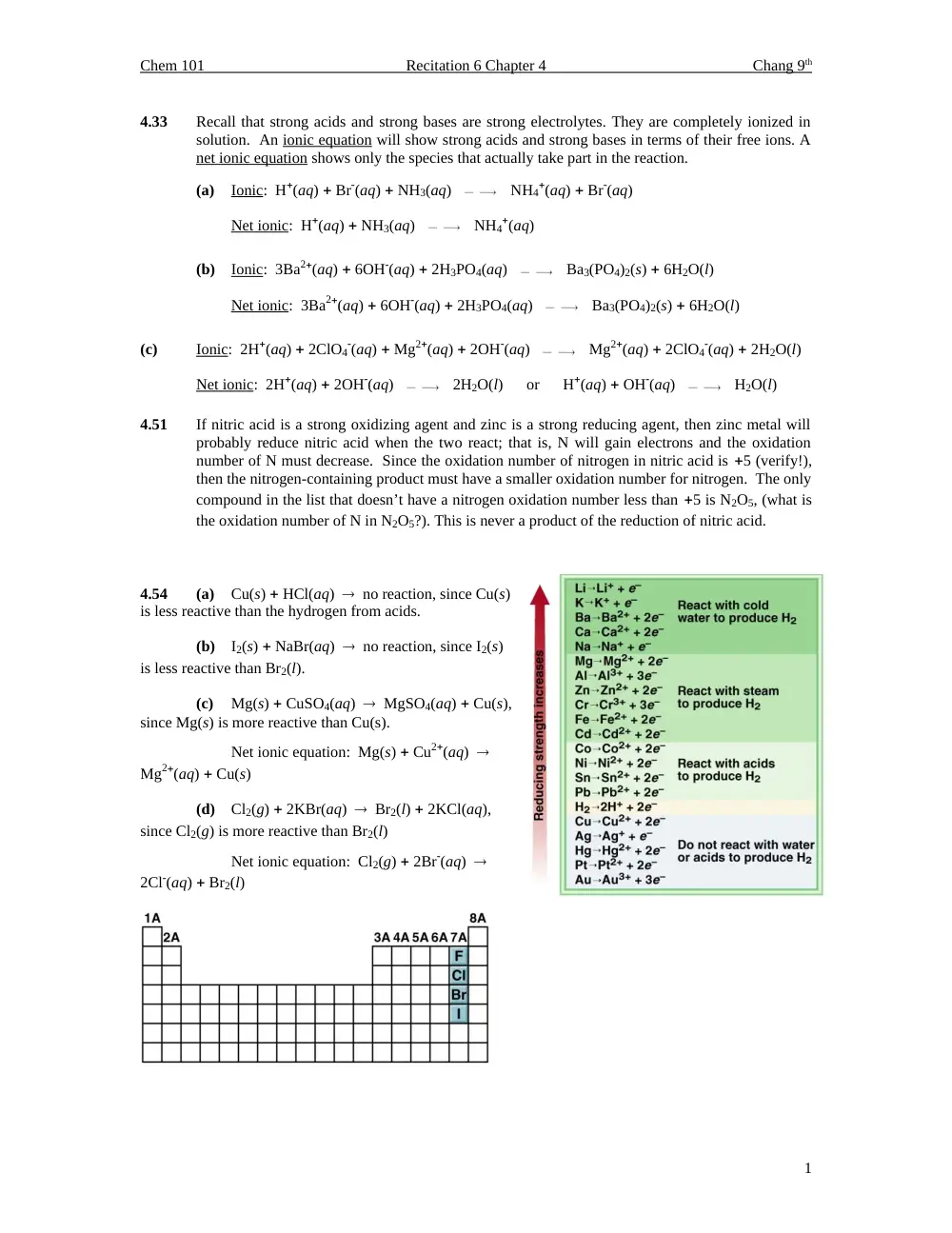
4.54
(a)
Cu(s) HCl(aq) no reaction, since Cu(s)
is less reactive than the hydrogen from acids.
(b)
I2(s) NaBr(aq) no reaction, since I2(s)
is less reactive than Br2(l).
(c)
Mg(s) CuSO4(aq) MgSO4(aq) Cu(s),
since Mg(s) is more reactive than Cu(s).
Net ionic equation: Mg(s) Cu2(aq)
Mg2(aq) Cu(s)
(d)
Cl2(g) 2KBr(aq) Br2(l) 2KCl(aq),
since Cl2(g) is more reactive than Br2(l)
Net ionic equation: Cl2(g) 2Br(aq)
2Cl(aq) Br2(l)
1
Chem 101
Recitation 6 Chapter 4
Chang 9
th
4.63
molar mass of C12H22O11 342.3 g/mol
(b)
4.65
First, calculate the moles of each solute. Then, you can calculate the volume (in L) from the
molarity and the number of moles of solute.
(a)
4.73
Moles of KMnO4 in the first solution:
Moles of KMnO4 in the second solution:
The total volume is 35.2 mL 16.7 mL 51.9 mL. The concentration of the final solution is:
4.77
The balanced equation is:
CaCl2(aq) 2AgNO3(aq)
Ca(NO3)2(aq) 2AgCl(s)
We need to determine the limiting reagent. Ag and Cl combine in a 1:1 mole ratio to produce
AgCl. Let’s calculate the amount of Ag and Cl in solution.
Since Ag and Cl combine in a 1:1 mole ratio, AgNO3 is the limiting reagent. Only 1.50 103
mole of AgCl can form. Converting to grams of AgCl:
4.78
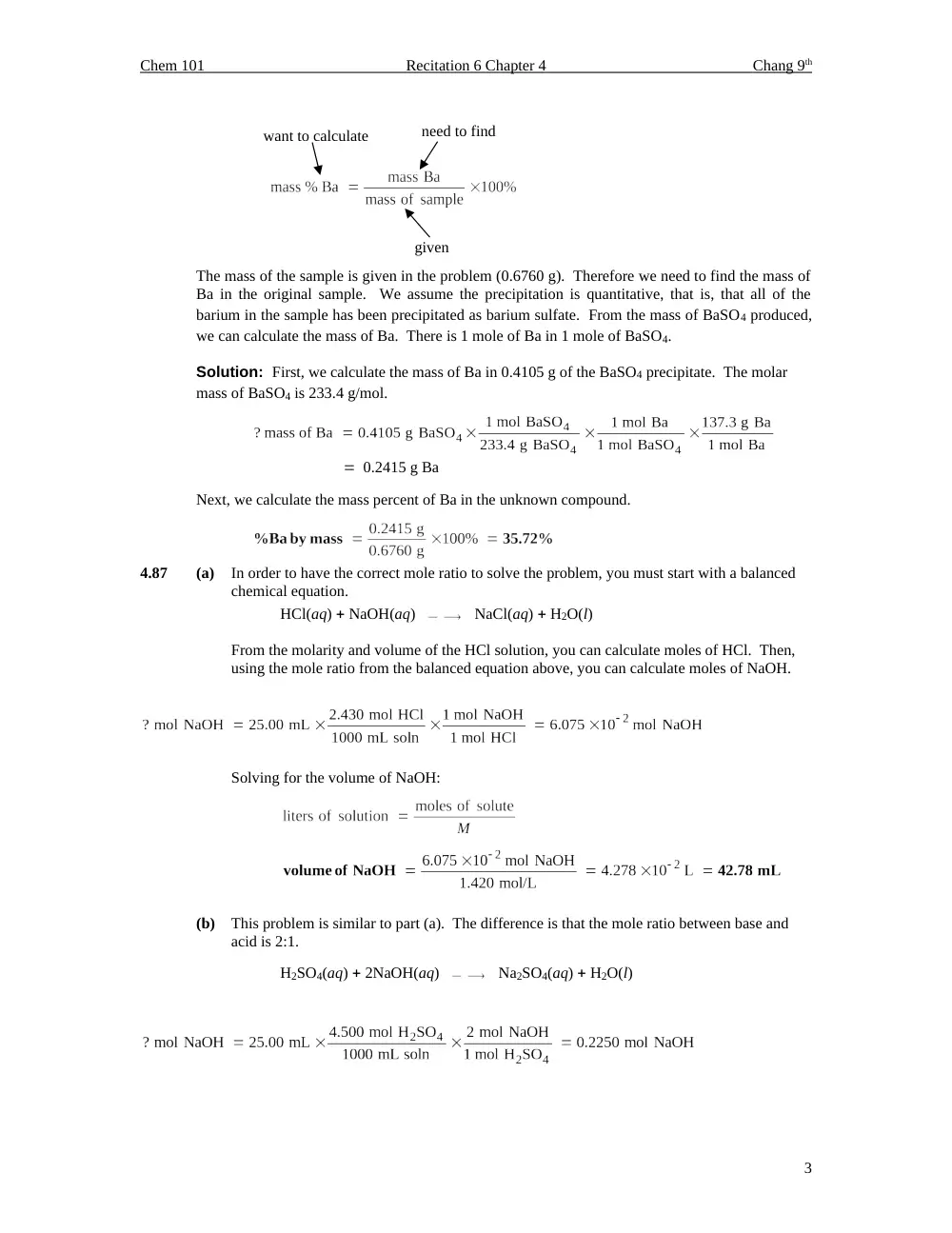
Strategy: We want to calculate the mass % of Ba in the original compound. Let's start with the
definition of mass %.
2
Chem 101
Recitation 6 Chapter 4
Chang 9
th
The mass of the sample is given in the problem (0.6760 g). Therefore we need to find the mass of
Ba in the original sample. We assume the precipitation is quantitative, that is, that all of the
barium in the sample has been precipitated as barium sulfate. From the mass of BaSO4 produced,
we can calculate the mass of Ba. There is 1 mole of Ba in 1 mole of BaSO4.
Solution: First, we calculate the mass of Ba in 0.4105 g of the BaSO4 precipitate. The molar
mass of BaSO4 is 233.4 g/mol.
0.2415 g Ba
Next, we calculate the mass percent of Ba in the unknown compound.
4.87
(a)
In order to have the correct mole ratio to solve the problem, you must start with a balanced
chemical equation.
HCl(aq) NaOH(aq)
NaCl(aq) H2O(l)
From the molarity and volume of the HCl solution, you can calculate moles of HCl. Then,
using the mole ratio from the balanced equation above, you can calculate moles of NaOH.
Solving for the volume of NaOH:
(b)
This problem is similar to part (a). The difference is that the mole ratio between base and
acid is 2:1.
H2SO4(aq) 2NaOH(aq)
Na2SO4(aq) H2O(l)
given
need to find
want to calculate
3
Chem 101
Recitation 6 Chapter 4
Chang 9
th
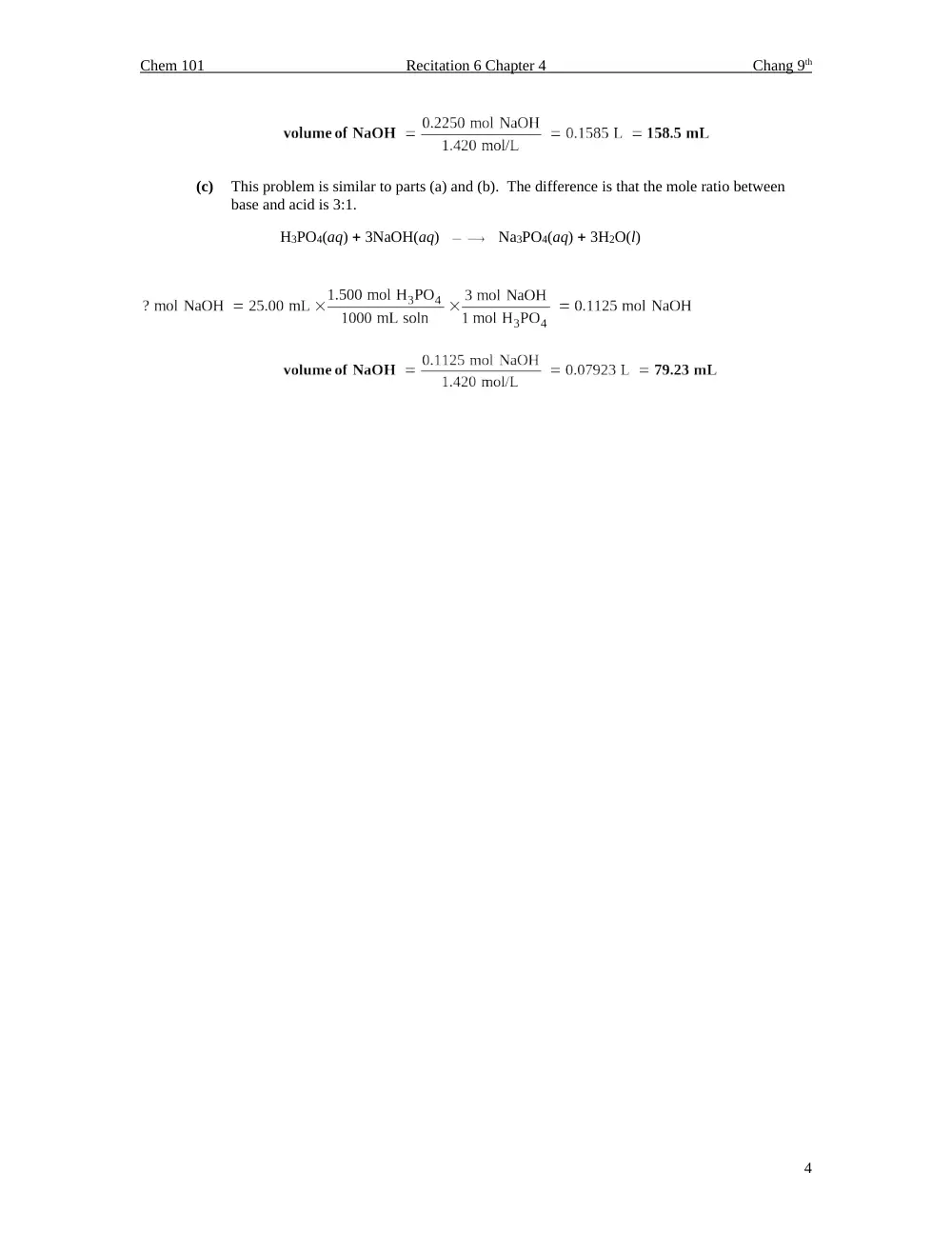
(c)
This problem is similar to parts (a) and (b). The difference is that the mole ratio between
base and acid is 3:1.
H3PO4(aq) 3NaOH(aq)
Na3PO4(aq) 3H2O(l)
4