
CHEM 101 Homework Chapter 5 Assignment Solution, Fall 2013
American University of Beirut · General Chemistry I · 6 pages · with solution
More CHEM 101 files
- Questions Chapter 4 + Answers · Summer 2014Chapter · with solutionView
- Questions Chapter 10 + Answers · Summer 2014Chapter · with solutionView
- Questions Chapter 2 + Answers · Summer 2014Chapter · with solutionView
- Questions Chapter 3 + Answers · Summer 2014Chapter · with solutionView
- Questions Chapter 6 + Answers · Summer 2014Chapter · with solutionView
- Questions Chapter 7 + Answers · Summer 2014Chapter · with solutionView
- Problems Chapter 1 + Answers · Summer 2014Chapter · with solutionView
- Questions Chapter 5 + Answers · Summer 2014Chapter · with solutionView
Show the text of this chapter
Chem 101
Recitation 9 Chapter 6
Chang 9
th
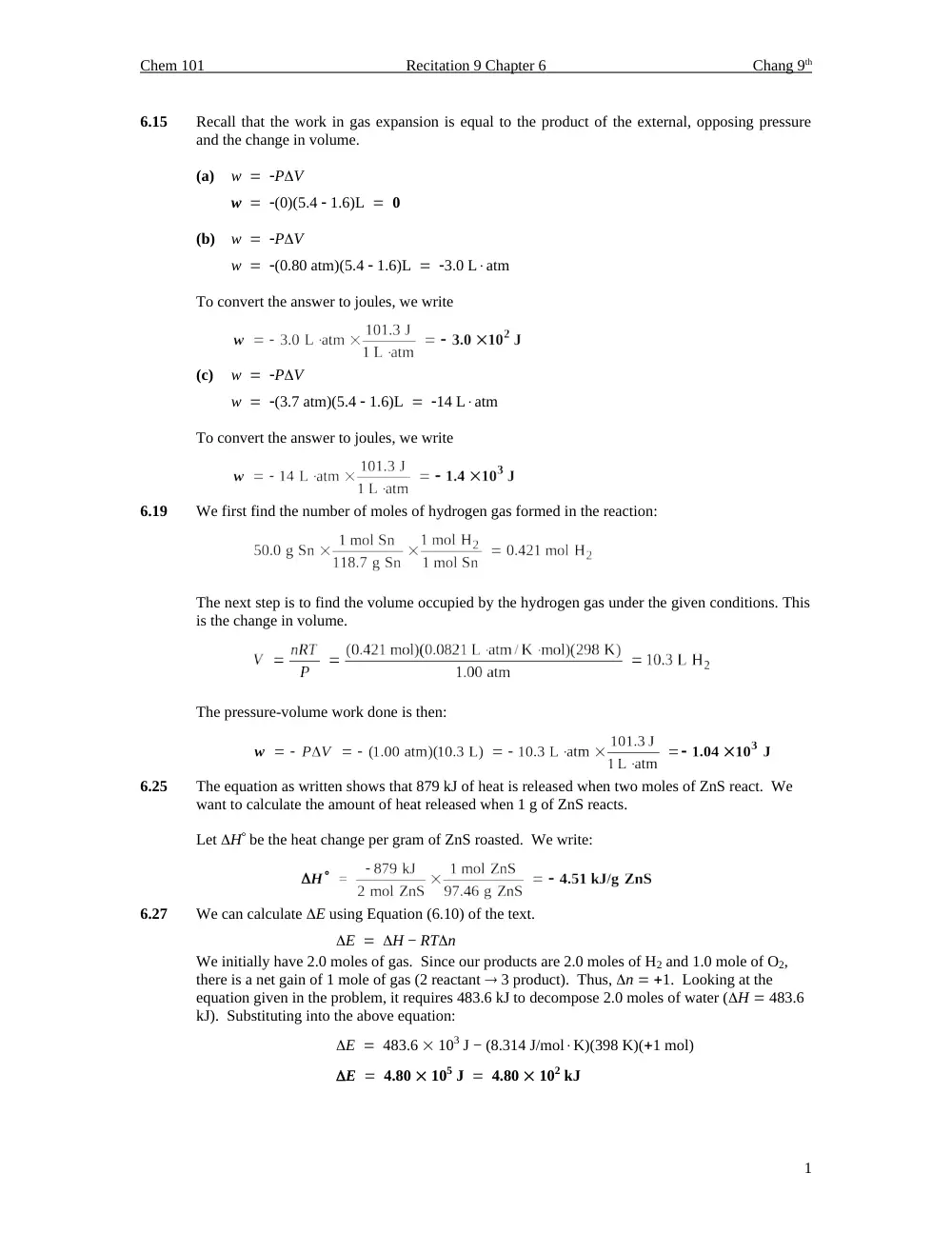
6.15
Recall that the work in gas expansion is equal to the product of the external, opposing pressure
and the change in volume.
(a)
w PV
w (0)(5.4 1.6)L 0
(b)
w PV
w (0.80 atm)(5.4 1.6)L 3.0 Latm
To convert the answer to joules, we write
(c)
w PV
w (3.7 atm)(5.4 1.6)L 14 Latm
To convert the answer to joules, we write
6.19
We first find the number of moles of hydrogen gas formed in the reaction:
The next step is to find the volume occupied by the hydrogen gas under the given conditions. This
is the change in volume.
The pressure-volume work done is then:
6.25
The equation as written shows that 879 kJ of heat is released when two moles of ZnS react. We
want to calculate the amount of heat released when 1 g of ZnS reacts.
Let H be the heat change per gram of ZnS roasted. We write:
6.27
We can calculate E using Equation (6.10) of the text.
E H − RTn
We initially have 2.0 moles of gas. Since our products are 2.0 moles of H2 and 1.0 mole of O2,
there is a net gain of 1 mole of gas (2 reactant 3 product). Thus, n 1. Looking at the
equation given in the problem, it requires 483.6 kJ to decompose 2.0 moles of water (H 483.6
kJ). Substituting into the above equation:
E 483.6 103 J − (8.314 J/molK)(398 K)(1 mol)
E 4.80 105 J 4.80 102 kJ
1
Chem 101
Recitation 9 Chapter 6
Chang 9
th
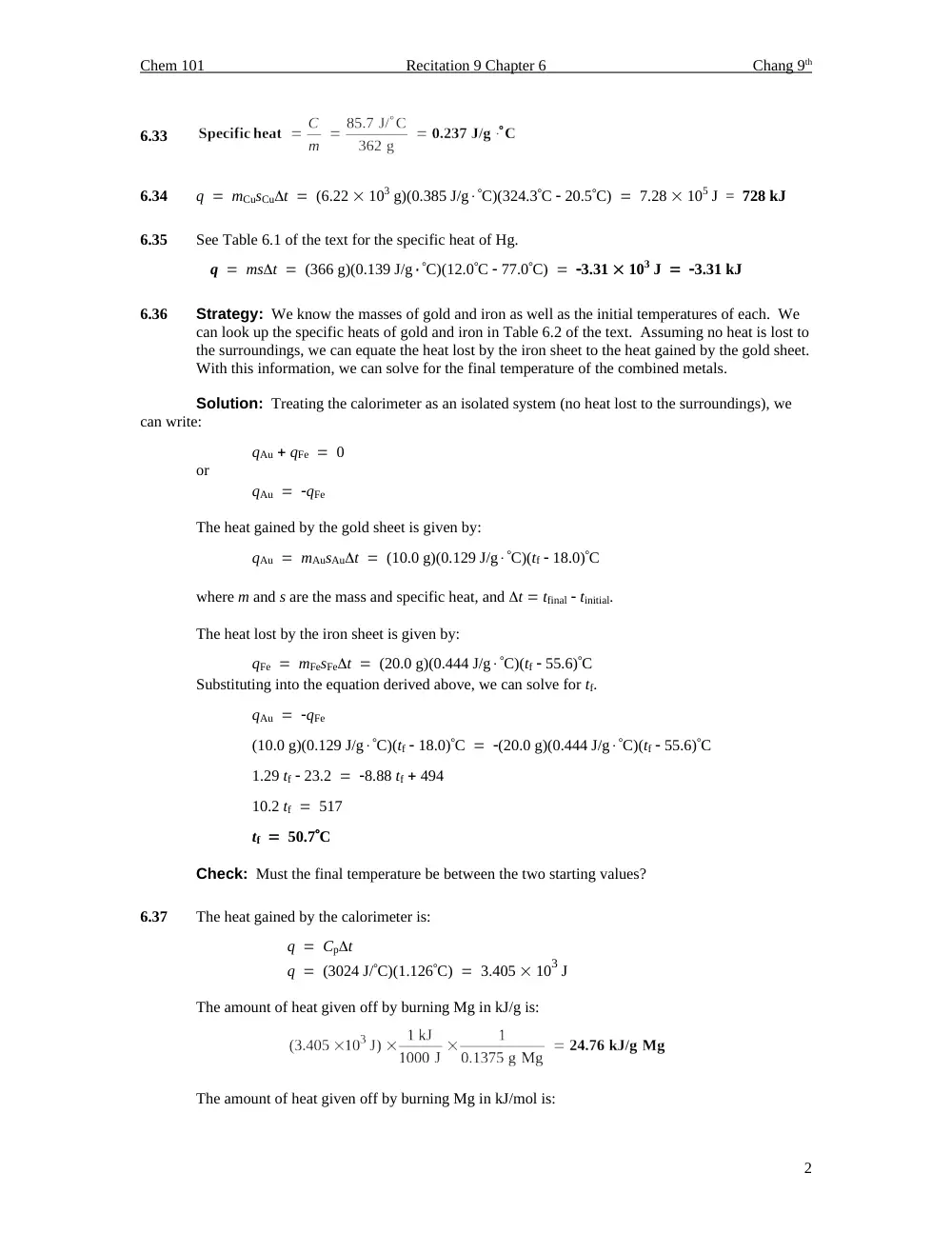
6.33
6.34
q mCusCut (6.22 103 g)(0.385 J/gC)(324.3C 20.5C) 7.28 105 J = 728 kJ
6.35
See Table 6.1 of the text for the specific heat of Hg.
q mst (366 g)(0.139 J/g·C)(12.0C 77.0C) 3.31 103 J 3.31 kJ
6.36
Strategy: We know the masses of gold and iron as well as the initial temperatures of each. We
can look up the specific heats of gold and iron in Table 6.2 of the text. Assuming no heat is lost to
the surroundings, we can equate the heat lost by the iron sheet to the heat gained by the gold sheet.
With this information, we can solve for the final temperature of the combined metals.
Solution: Treating the calorimeter as an isolated system (no heat lost to the surroundings), we
can write:
qAu qFe 0
or
qAu qFe
The heat gained by the gold sheet is given by:
qAu mAusAut (10.0 g)(0.129 J/gC)(tf 18.0)C
where m and s are the mass and specific heat, and t tfinal tinitial.
The heat lost by the iron sheet is given by:
qFe mFesFet (20.0 g)(0.444 J/gC)(tf 55.6)C
Substituting into the equation derived above, we can solve for tf.
qAu qFe
(10.0 g)(0.129 J/gC)(tf 18.0)C (20.0 g)(0.444 J/gC)(tf 55.6)C
1.29 tf 23.2 8.88 tf 494
10.2 tf 517
tf 50.7C
Check: Must the final temperature be between the two starting values?
6.37
The heat gained by the calorimeter is:
q Cpt
q (3024 J/C)(1.126C) 3.405 103 J
The amount of heat given off by burning Mg in kJ/g is:
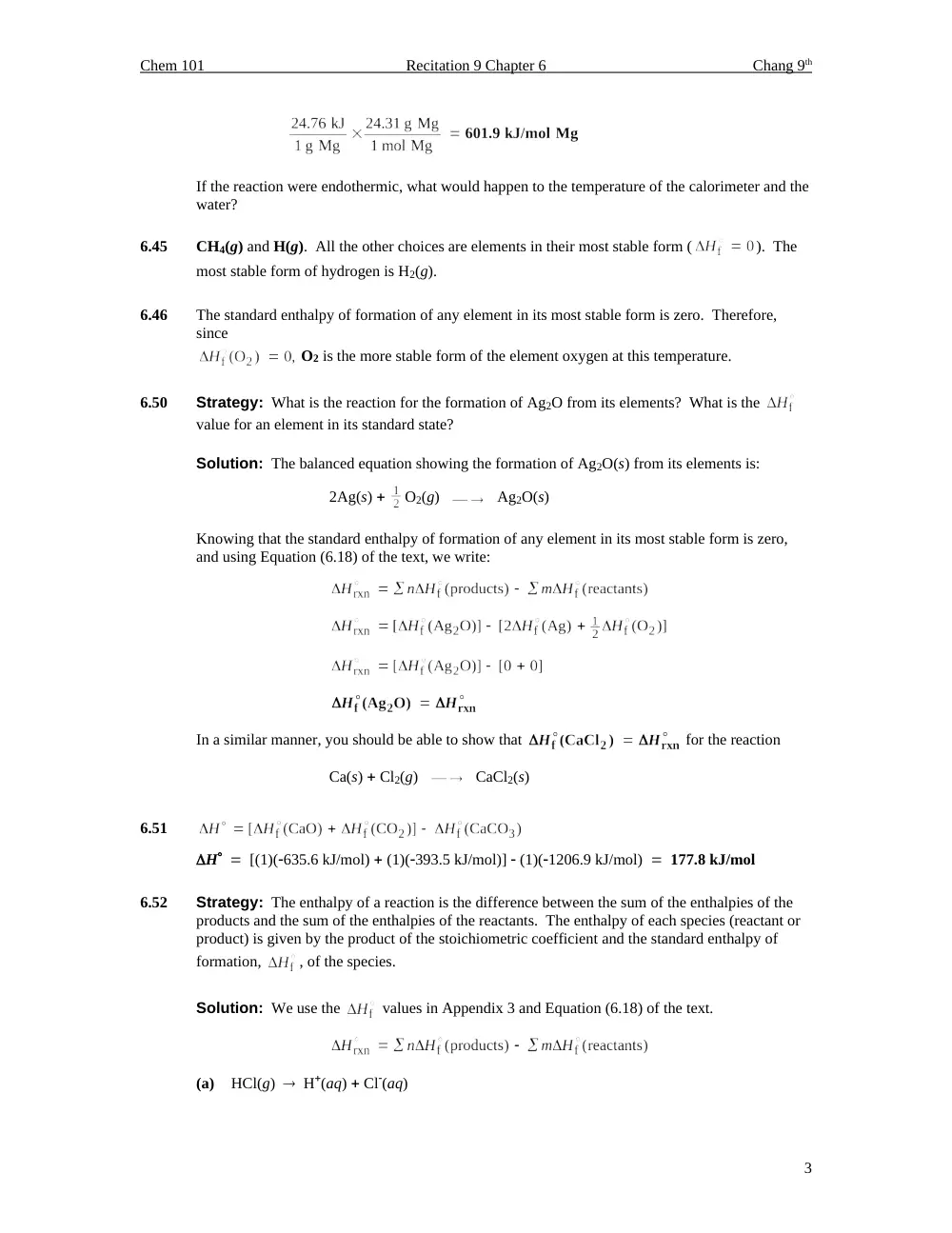
The amount of heat given off by burning Mg in kJ/mol is:
2
Chem 101
Recitation 9 Chapter 6
Chang 9
th
If the reaction were endothermic, what would happen to the temperature of the calorimeter and the
water?
6.45
CH4(g) and H(g). All the other choices are elements in their most stable form (
). The
most stable form of hydrogen is H2(g).
6.46
The standard enthalpy of formation of any element in its most stable form is zero. Therefore,
since
O2 is the more stable form of the element oxygen at this temperature.
6.50
Strategy: What is the reaction for the formation of Ag2O from its elements? What is the
value for an element in its standard state?
Solution: The balanced equation showing the formation of Ag2O(s) from its elements is:
2Ag(s)
O2(g)
Ag2O(s)
Knowing that the standard enthalpy of formation of any element in its most stable form is zero,
and using Equation (6.18) of the text, we write:
In a similar manner, you should be able to show that
for the reaction
Ca(s) Cl2(g)
CaCl2(s)
6.51
H [(1)(635.6 kJ/mol) (1)(393.5 kJ/mol)] (1)(1206.9 kJ/mol) 177.8 kJ/mol
6.52
Strategy: The enthalpy of a reaction is the difference between the sum of the enthalpies of the
products and the sum of the enthalpies of the reactants. The enthalpy of each species (reactant or
product) is given by the product of the stoichiometric coefficient and the standard enthalpy of
formation,
, of the species.
Solution: We use the
values in Appendix 3 and Equation (6.18) of the text.
(a)
HCl(g) H(aq) Cl(aq)
3
Chem 101
Recitation 9 Chapter 6
Chang 9
th
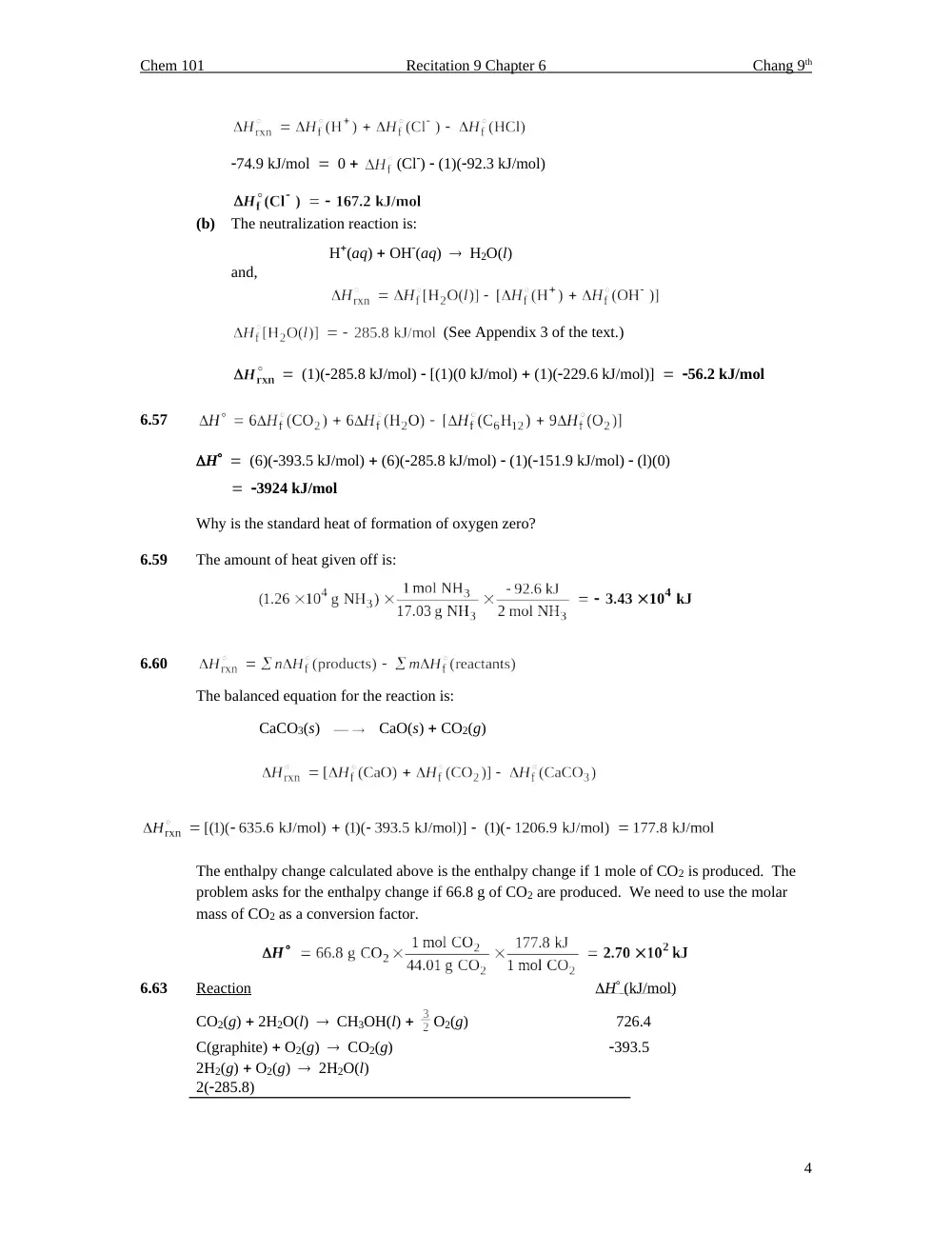
74.9 kJ/mol 0
(Cl) (1)(92.3 kJ/mol)
(b)
The neutralization reaction is:
H(aq) OH(aq) H2O(l)
and,
(See Appendix 3 of the text.)
(1)(285.8 kJ/mol) [(1)(0 kJ/mol) (1)(229.6 kJ/mol)] 56.2 kJ/mol
6.57
H (6)(393.5 kJ/mol) (6)(285.8 kJ/mol) (1)(151.9 kJ/mol) (l)(0)
3924 kJ/mol
Why is the standard heat of formation of oxygen zero?
6.59
The amount of heat given off is:
6.60
The balanced equation for the reaction is:
CaCO3(s)
CaO(s) CO2(g)
The enthalpy change calculated above is the enthalpy change if 1 mole of CO2 is produced. The
problem asks for the enthalpy change if 66.8 g of CO2 are produced. We need to use the molar
mass of CO2 as a conversion factor.
6.63
Reaction
H (kJ/mol)
CO2(g) 2H2O(l) CH3OH(l)
O2(g)
726.4
C(graphite) O2(g) CO2(g)
393.5
2H2(g) O2(g) 2H2O(l)
2(285.8)
4
Chem 101
Recitation 9 Chapter 6
Chang 9
th
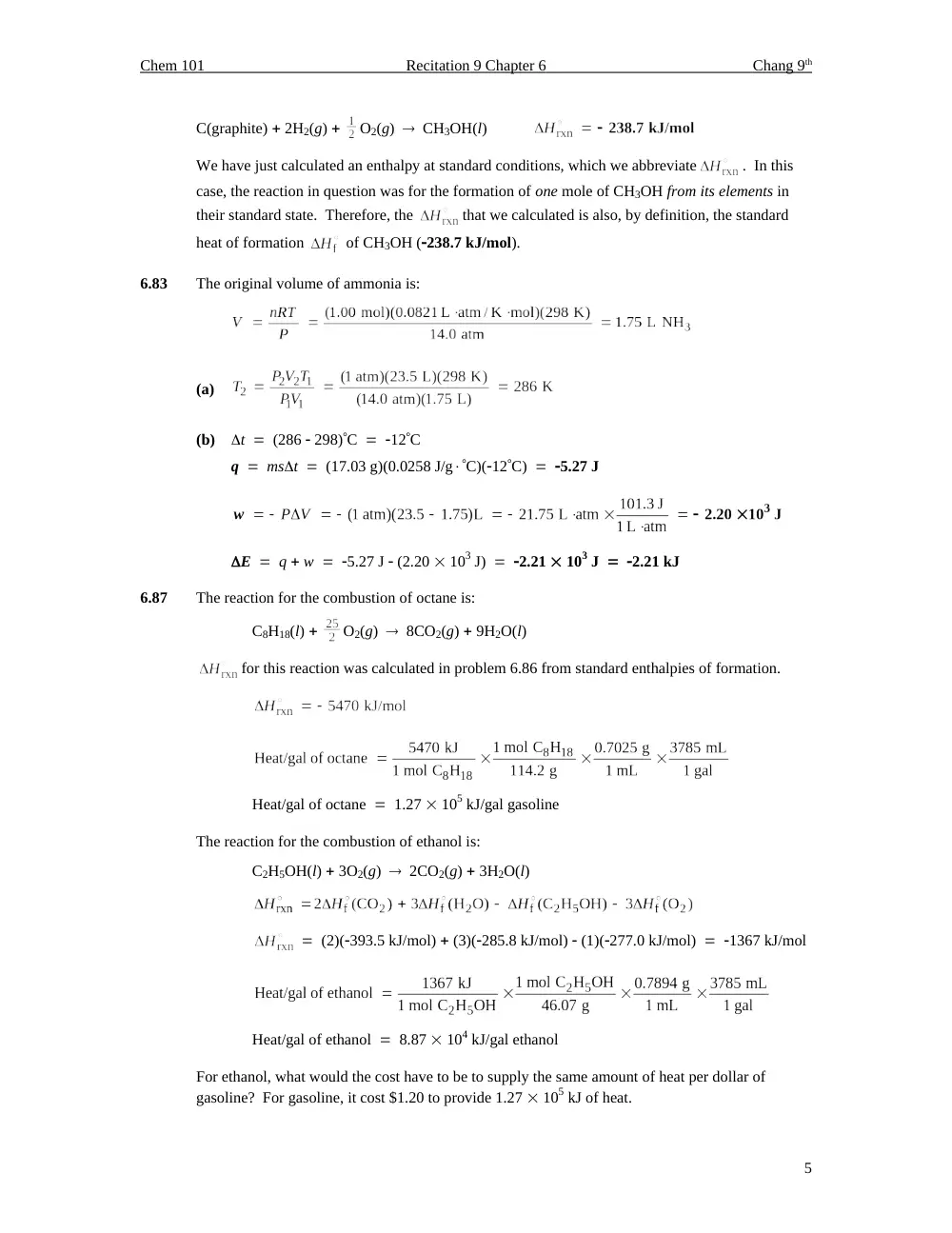
C(graphite) 2H2(g)
O2(g) CH3OH(l)
We have just calculated an enthalpy at standard conditions, which we abbreviate
. In this
case, the reaction in question was for the formation of one mole of CH3OH from its elements in
their standard state. Therefore, the
that we calculated is also, by definition, the standard
heat of formation
of CH3OH (238.7 kJ/mol).
6.83
The original volume of ammonia is:
(a)
(b)
t (286 298)C 12C
q mst (17.03 g)(0.0258 J/gC)(12C) 5.27 J
E q w 5.27 J (2.20 103 J) 2.21 103 J 2.21 kJ
6.87
The reaction for the combustion of octane is:
C8H18(l)
O2(g) 8CO2(g) 9H2O(l)
for this reaction was calculated in problem 6.86 from standard enthalpies of formation.
Heat/gal of octane 1.27 105 kJ/gal gasoline
The reaction for the combustion of ethanol is:
C2H5OH(l) 3O2(g) 2CO2(g) 3H2O(l)
(2)(393.5 kJ/mol) (3)(285.8 kJ/mol) (1)(277.0 kJ/mol) 1367 kJ/mol
Heat/gal of ethanol 8.87 104 kJ/gal ethanol
For ethanol, what would the cost have to be to supply the same amount of heat per dollar of
gasoline? For gasoline, it cost $1.20 to provide 1.27 105 kJ of heat.
5
Chem 101
Recitation 9 Chapter 6
Chang 9
th
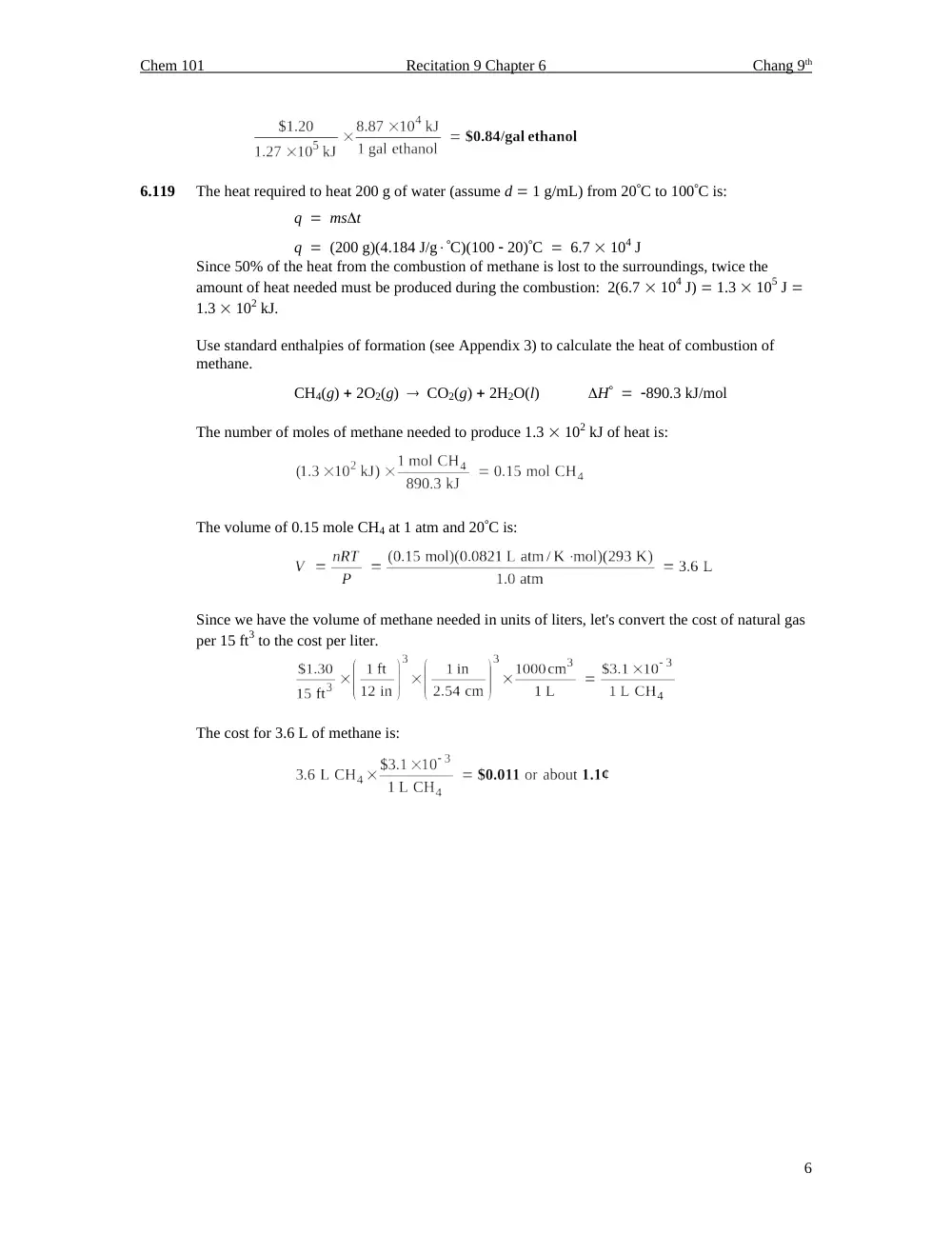
6.119
The heat required to heat 200 g of water (assume d 1 g/mL) from 20C to 100C is:
q mst
q (200 g)(4.184 J/gC)(100 20)C 6.7 104 J
Since 50% of the heat from the combustion of methane is lost to the surroundings, twice the
amount of heat needed must be produced during the combustion: 2(6.7 104 J) 1.3 105 J
1.3 102 kJ.
Use standard enthalpies of formation (see Appendix 3) to calculate the heat of combustion of
methane.
CH4(g) 2O2(g) CO2(g) 2H2O(l)
H 890.3 kJ/mol
The number of moles of methane needed to produce 1.3 102 kJ of heat is:
The volume of 0.15 mole CH4 at 1 atm and 20C is:
Since we have the volume of methane needed in units of liters, let's convert the cost of natural gas
per 15 ft3 to the cost per liter.
The cost for 3.6 L of methane is:
6