
CHEM 101 Homework Chapter 5 Assignment Solution, Fall 2013
American University of Beirut · General Chemistry I · 6 pages · with solution
More CHEM 101 files
- Questions Chapter 4 + Answers · Summer 2014Chapter · with solutionView
- Questions Chapter 10 + Answers · Summer 2014Chapter · with solutionView
- Questions Chapter 2 + Answers · Summer 2014Chapter · with solutionView
- Questions Chapter 3 + Answers · Summer 2014Chapter · with solutionView
- Questions Chapter 6 + Answers · Summer 2014Chapter · with solutionView
- Questions Chapter 7 + Answers · Summer 2014Chapter · with solutionView
- Problems Chapter 1 + Answers · Summer 2014Chapter · with solutionView
- Questions Chapter 5 + Answers · Summer 2014Chapter · with solutionView
Show the text of this chapter
Chem 101
Recitation 7 & 8 Chapter 5
Chang 9
th
5.26
This is a gas stoichiometry problem that requires knowledge of Avogadro’s law to solve.
Avogadro’s law states that the volume of a gas is directly proportional to the number of moles of
gas at constant temperature and pressure.
The volume ratio, 1 vol. Cl2 : 3 vol. F2 : 2 vol. product, can be written as a mole ratio,
1 mol Cl2 : 3 mol F2 : 2 mol product.
Attempt to write a balanced chemical equation. The subscript of F in the product will be three
times the Cl subscript, because there are three times as many F atoms reacted as Cl atoms.
1Cl2(g) 3F2(g)
2ClxF3x(g)
Balance the equation. The x must equal one so that there are two Cl atoms on each side of the
equation. If
x 1, the subscript on F is 3.
Cl2(g) 3F2(g)
2ClF3(g)
The formula of the product is ClF3.
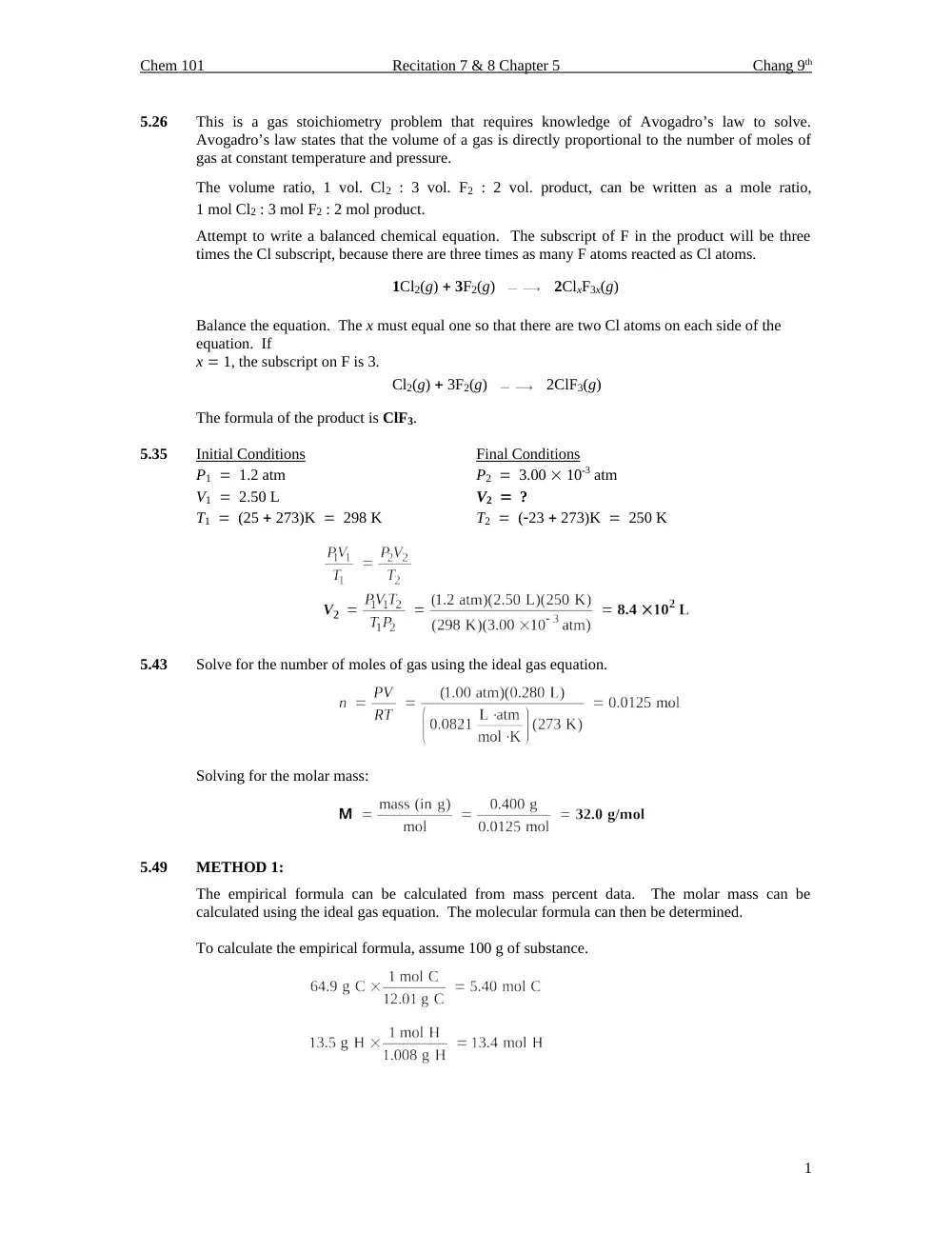
5.35
Initial Conditions
Final Conditions
P1 1.2 atm
P2 3.00 103 atm
V1 2.50 L
V2 ?
T1 (25 273)K 298 K
T2 (23 273)K 250 K
5.43
Solve for the number of moles of gas using the ideal gas equation.
Solving for the molar mass:
5.49
METHOD 1:
The empirical formula can be calculated from mass percent data. The molar mass can be
calculated using the ideal gas equation. The molecular formula can then be determined.
To calculate the empirical formula, assume 100 g of substance.
1
Chem 101
Recitation 7 & 8 Chapter 5
Chang 9
th
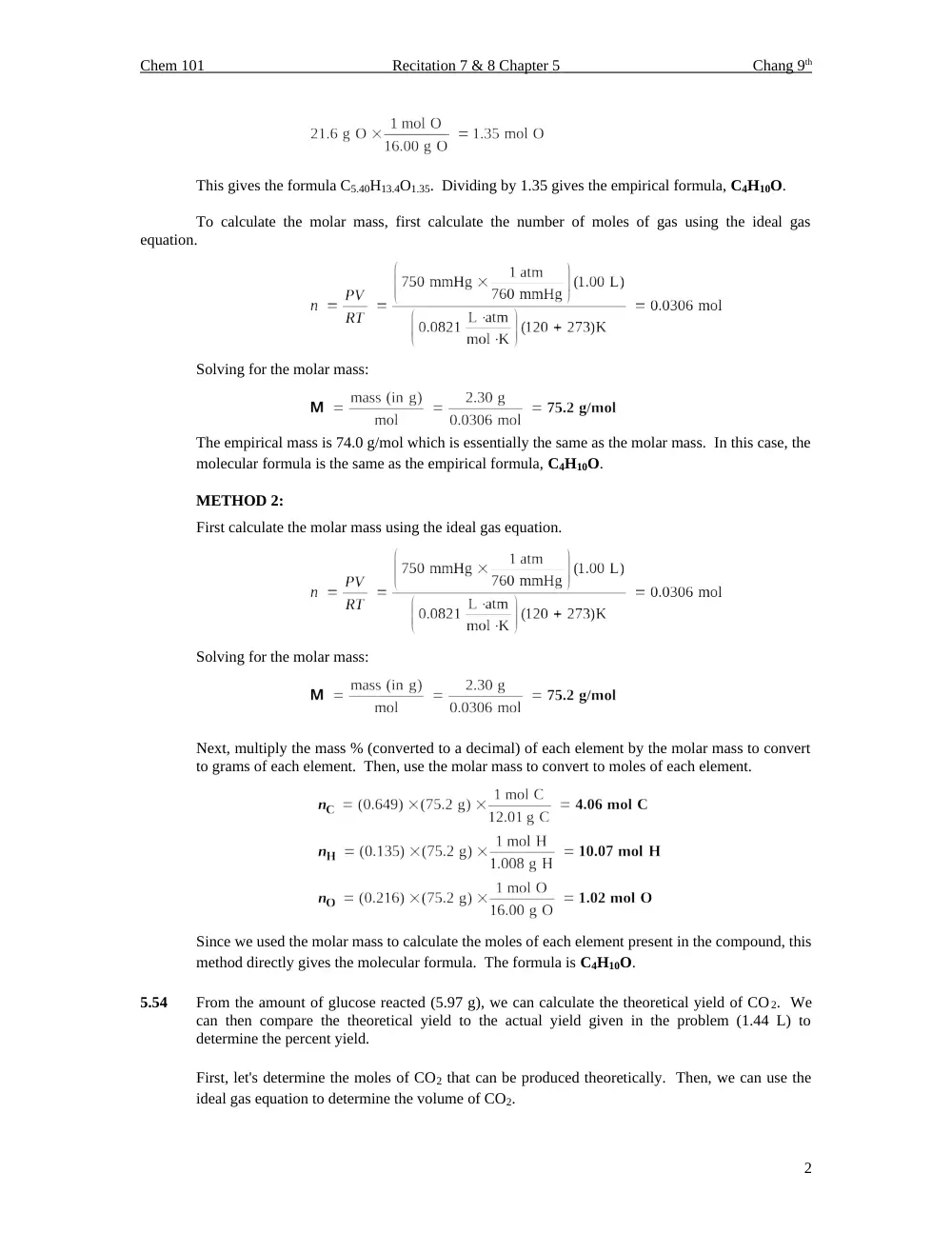
This gives the formula C5.40H13.4O1.35. Dividing by 1.35 gives the empirical formula, C4H10O.
To calculate the molar mass, first calculate the number of moles of gas using the ideal gas
equation.
Solving for the molar mass:
The empirical mass is 74.0 g/mol which is essentially the same as the molar mass. In this case, the
molecular formula is the same as the empirical formula, C4H10O.
METHOD 2:
First calculate the molar mass using the ideal gas equation.
Solving for the molar mass:
Next, multiply the mass % (converted to a decimal) of each element by the molar mass to convert
to grams of each element. Then, use the molar mass to convert to moles of each element.
Since we used the molar mass to calculate the moles of each element present in the compound, this
method directly gives the molecular formula. The formula is C4H10O.
5.54
From the amount of glucose reacted (5.97 g), we can calculate the theoretical yield of CO 2. We
can then compare the theoretical yield to the actual yield given in the problem (1.44 L) to
determine the percent yield.
First, let's determine the moles of CO2 that can be produced theoretically. Then, we can use the
ideal gas equation to determine the volume of CO2.
2
Chem 101
Recitation 7 & 8 Chapter 5
Chang 9
th
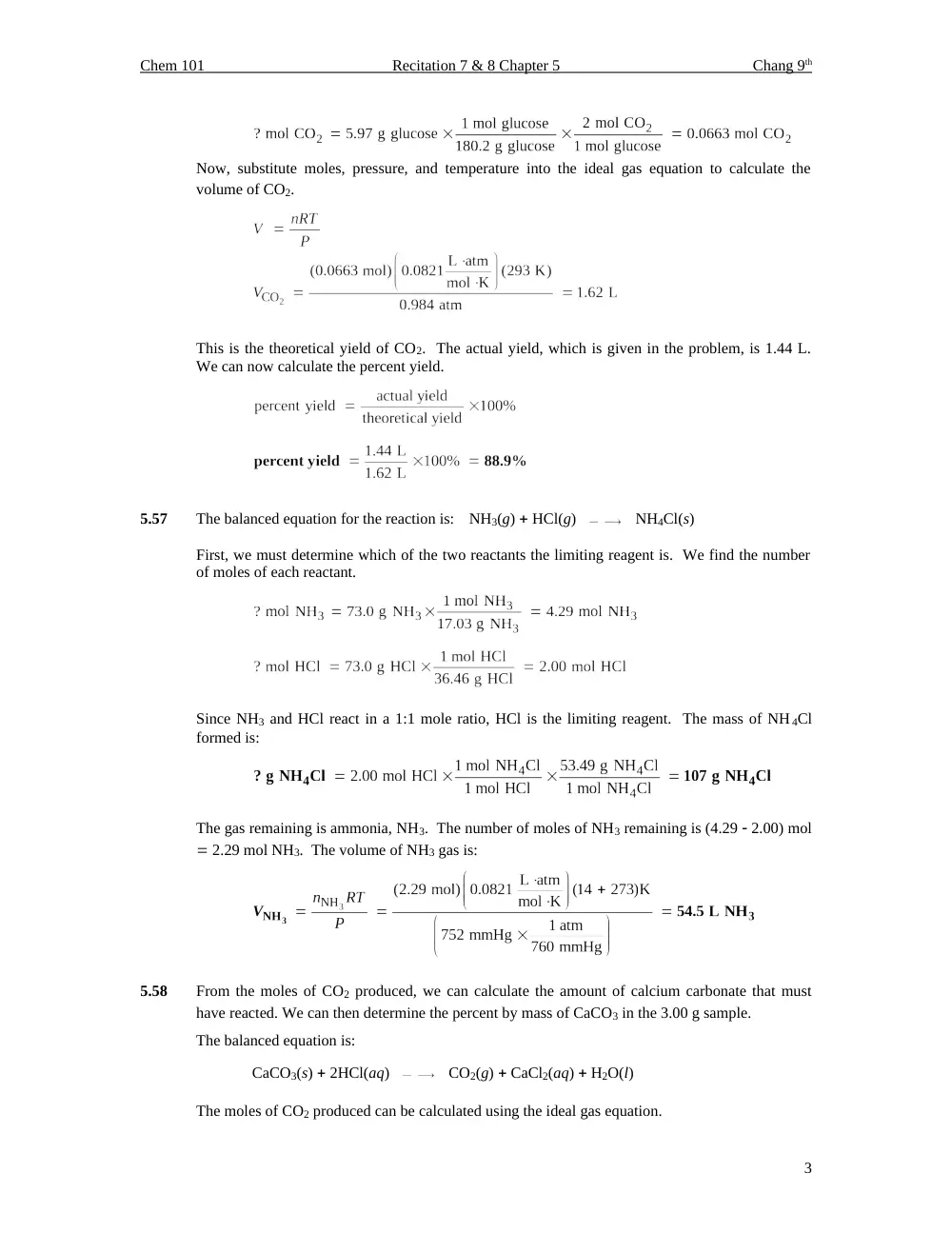
Now, substitute moles, pressure, and temperature into the ideal gas equation to calculate the
volume of CO2.
This is the theoretical yield of CO2. The actual yield, which is given in the problem, is 1.44 L.
We can now calculate the percent yield.
5.57
The balanced equation for the reaction is:
NH3(g) HCl(g)
NH4Cl(s)
First, we must determine which of the two reactants the limiting reagent is. We find the number
of moles of each reactant.
Since NH3 and HCl react in a 1:1 mole ratio, HCl is the limiting reagent. The mass of NH 4Cl
formed is:
The gas remaining is ammonia, NH3. The number of moles of NH3 remaining is (4.29 2.00) mol
2.29 mol NH3. The volume of NH3 gas is:
5.58
From the moles of CO2 produced, we can calculate the amount of calcium carbonate that must
have reacted. We can then determine the percent by mass of CaCO3 in the 3.00 g sample.
The balanced equation is:
CaCO3(s) 2HCl(aq)
CO2(g) CaCl2(aq) H2O(l)
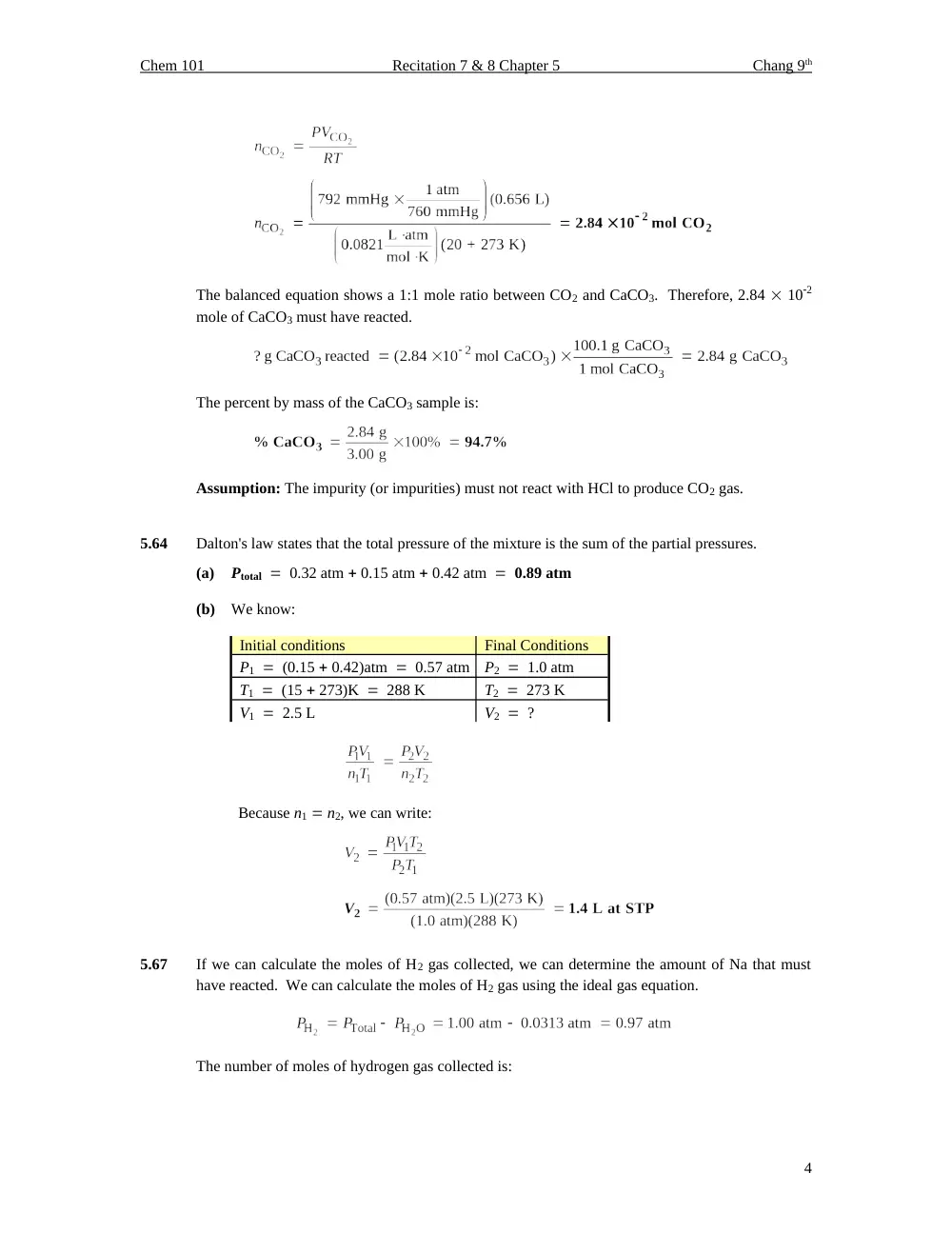
The moles of CO2 produced can be calculated using the ideal gas equation.
3
Chem 101
Recitation 7 & 8 Chapter 5
Chang 9
th
The balanced equation shows a 1:1 mole ratio between CO2 and CaCO3. Therefore, 2.84 102
mole of CaCO3 must have reacted.
The percent by mass of the CaCO3 sample is:
Assumption: The impurity (or impurities) must not react with HCl to produce CO2 gas.
5.64
Dalton's law states that the total pressure of the mixture is the sum of the partial pressures.
(a)
Ptotal 0.32 atm 0.15 atm 0.42 atm 0.89 atm
(b)
We know:
Initial conditions
Final Conditions
P1 (0.15 0.42)atm 0.57 atm
P2 1.0 atm
T1 (15 273)K 288 K
T2 273 K
V1 2.5 L
V2 ?
Because n1 n2, we can write:
5.67
If we can calculate the moles of H2 gas collected, we can determine the amount of Na that must
have reacted. We can calculate the moles of H2 gas using the ideal gas equation.
The number of moles of hydrogen gas collected is:
4
Chem 101
Recitation 7 & 8 Chapter 5
Chang 9
th
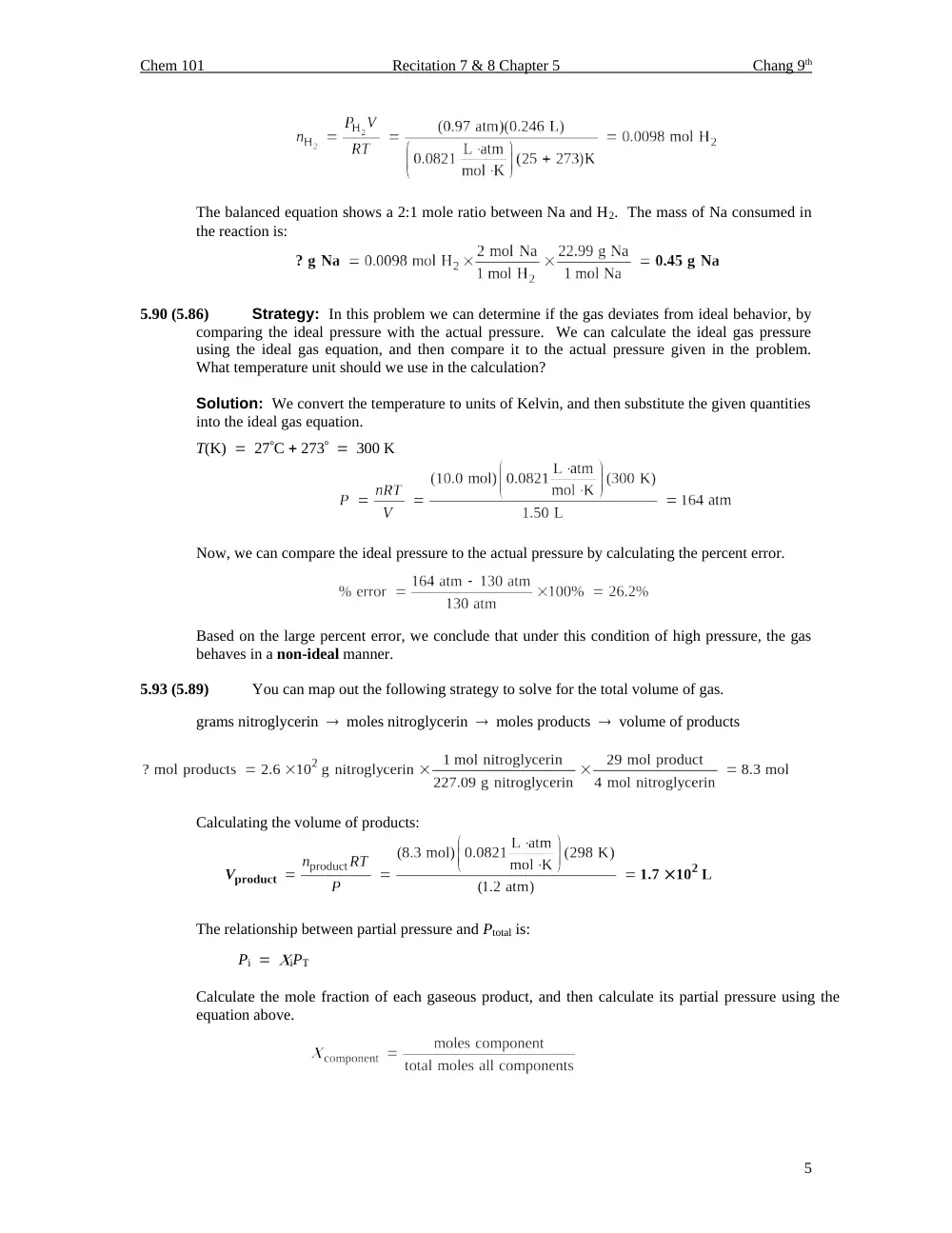
The balanced equation shows a 2:1 mole ratio between Na and H2. The mass of Na consumed in
the reaction is:
5.90 (5.86)
Strategy: In this problem we can determine if the gas deviates from ideal behavior, by
comparing the ideal pressure with the actual pressure. We can calculate the ideal gas pressure
using the ideal gas equation, and then compare it to the actual pressure given in the problem.
What temperature unit should we use in the calculation?
Solution: We convert the temperature to units of Kelvin, and then substitute the given quantities
into the ideal gas equation.
T(K) 27C 273 300 K
Now, we can compare the ideal pressure to the actual pressure by calculating the percent error.
Based on the large percent error, we conclude that under this condition of high pressure, the gas
behaves in a non-ideal manner.
5.93 (5.89)
You can map out the following strategy to solve for the total volume of gas.
grams nitroglycerin moles nitroglycerin moles products volume of products
Calculating the volume of products:
The relationship between partial pressure and Ptotal is:
Pi iPT
Calculate the mole fraction of each gaseous product, and then calculate its partial pressure using the
equation above.
5
Chem 101
Recitation 7 & 8 Chapter 5
Chang 9
th
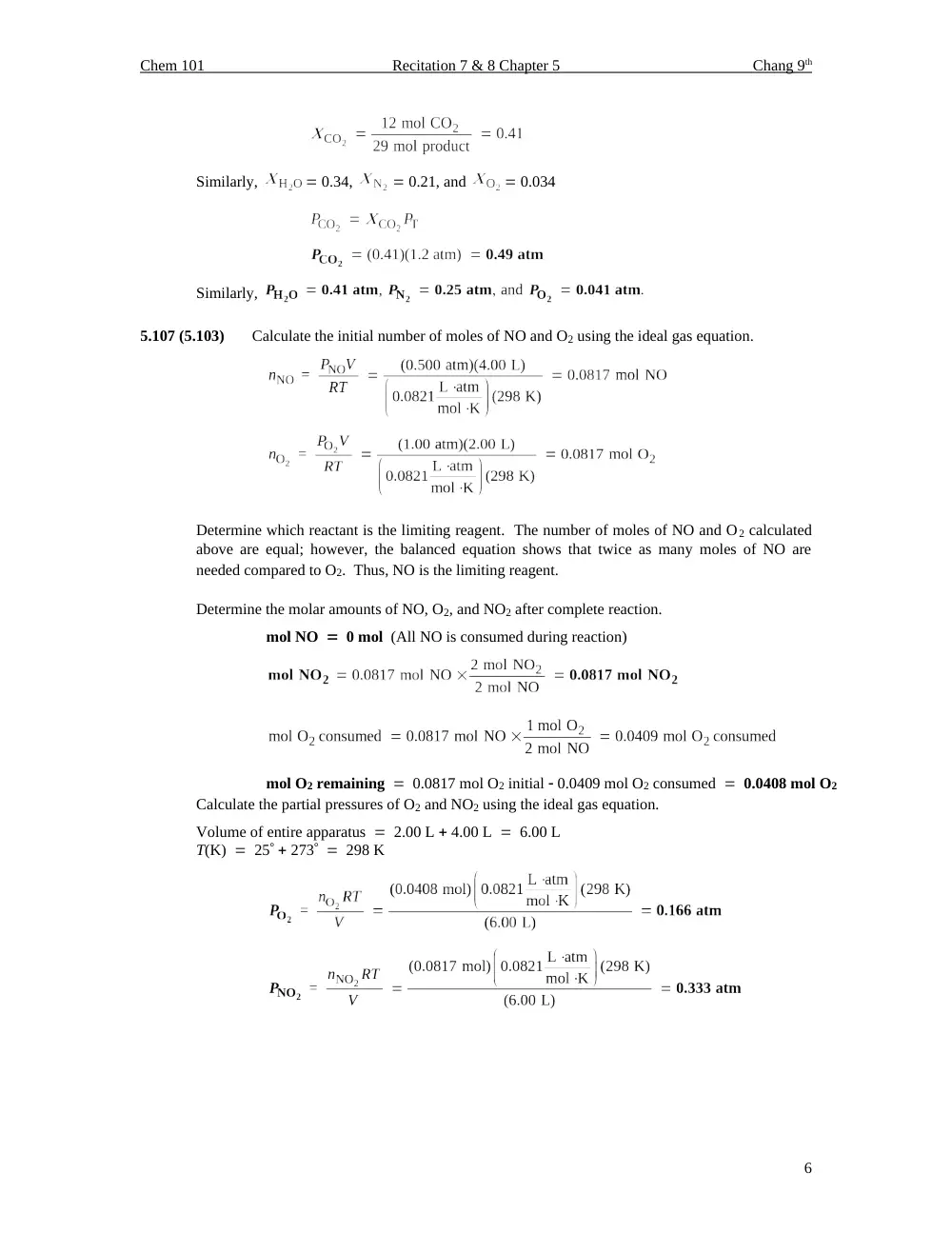
Similarly,
0.34,
0.21, and
0.034
Similarly,
5.107 (5.103)
Calculate the initial number of moles of NO and O2 using the ideal gas equation.
Determine which reactant is the limiting reagent. The number of moles of NO and O2 calculated
above are equal; however, the balanced equation shows that twice as many moles of NO are
needed compared to O2. Thus, NO is the limiting reagent.
Determine the molar amounts of NO, O2, and NO2 after complete reaction.
mol NO 0 mol (All NO is consumed during reaction)
mol O2 remaining 0.0817 mol O2 initial 0.0409 mol O2 consumed 0.0408 mol O2
Calculate the partial pressures of O2 and NO2 using the ideal gas equation.
Volume of entire apparatus 2.00 L 4.00 L 6.00 L
T(K) 25 273 298 K
6