
CHEM 201 Problems Chapter 7, Spring 2008
American University of Beirut · Chemical Principles · 4 pages

More CHEM 201 files
- Questions Test Banks All Chapters · Fall 2015ChapterView
- Questions Chapter 7 · Spring 2008ChapterView
- Questions Chapter 7 · Spring 2008ChapterView
- Other Summary · Spring 2018FileView
- Notes Review · Spring 2018NotesView
- Exam 1 · Spring 2018ExamView
- Exam 2 Sample Quiz Rabih · Fall 2018ExamView
- Exam 2 · Spring 2017ExamView
Show the text of this chapter
Recitation 03
1. Quantum Numbers:
Consider the element Arsenic (As, Z = 33) in the ground state.
Write the full electronic configuration of the ground state.
a. How many electrons have ml = 0?
b. How many electrons have l = 0?
c. How many electrons have ml = +1?
d. How many electrons have ms=+1/2 (assume the 4p3 spins are
all upwards)?
Solution:
As
Is2 2s2 2p6 3s2 3p6 4s2 3d10 3p3
(a) 15; (b) 8; (c) 7; (d) 18
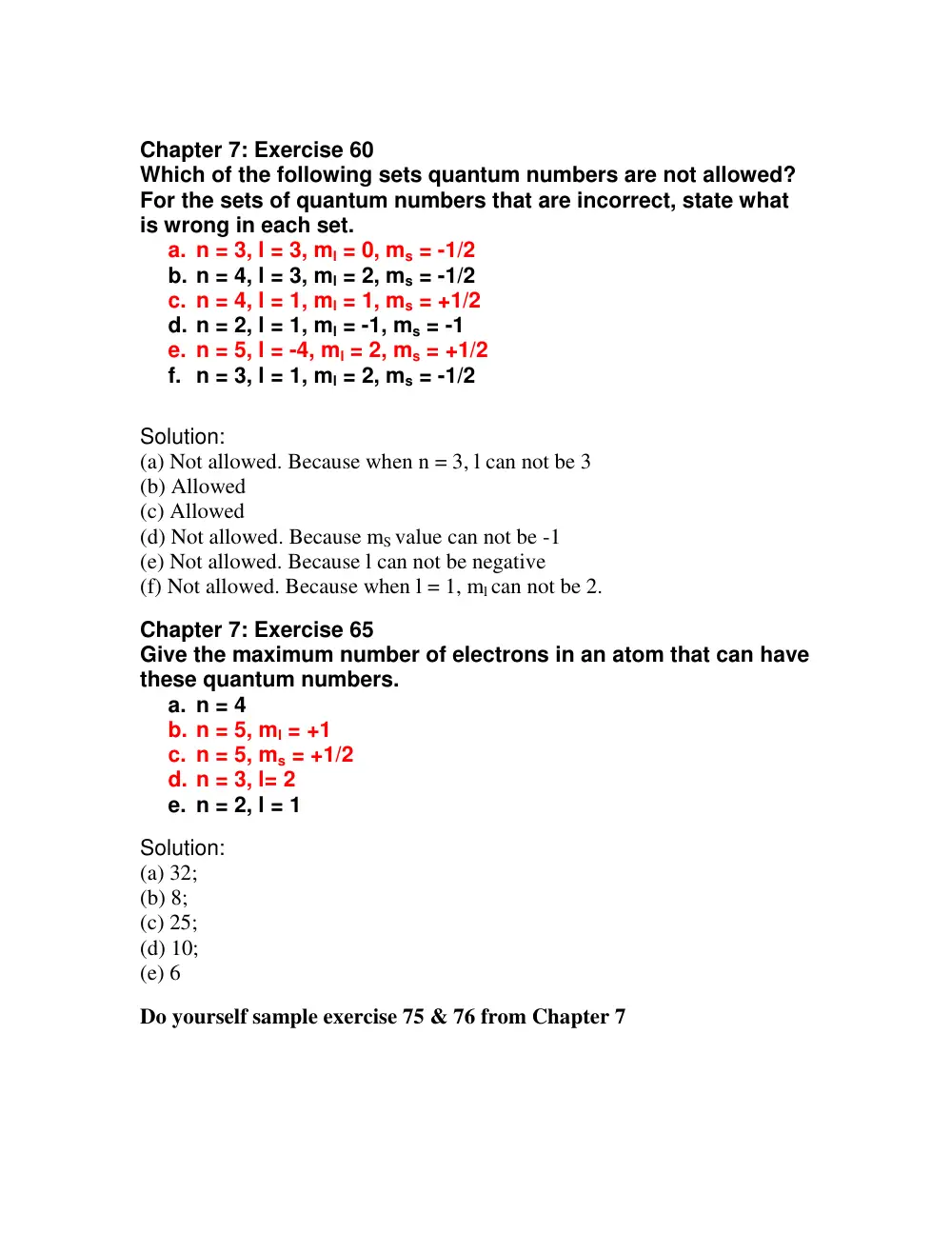
Chapter 7: Exercise 60
Which of the following sets quantum numbers are not allowed?
For the sets of quantum numbers that are incorrect, state what
is wrong in each set.
a. n = 3, l = 3, ml = 0, ms = -1/2
b. n = 4, l = 3, ml = 2, ms = -1/2
c. n = 4, l = 1, ml = 1, ms = +1/2
d. n = 2, l = 1, ml = -1, ms = -1
e. n = 5, l = -4, ml = 2, ms = +1/2
f. n = 3, l = 1, ml = 2, ms = -1/2
Solution:
(a) Not allowed. Because when n = 3, l can not be 3
(b) Allowed
(c) Allowed
(d) Not allowed. Because mS value can not be -1
(e) Not allowed. Because l can not be negative
(f) Not allowed. Because when l = 1, ml can not be 2.
Chapter 7: Exercise 65
Give the maximum number of electrons in an atom that can have
these quantum numbers.
a. n = 4
b. n = 5, ml = +1
c. n = 5, ms = +1/2
d. n = 3, l= 2
e. n = 2, l = 1
Solution:
(a) 32;
(b) 8;
(c) 25;
(d) 10;
(e) 6
Do yourself sample exercise 75 & 76 from Chapter 7
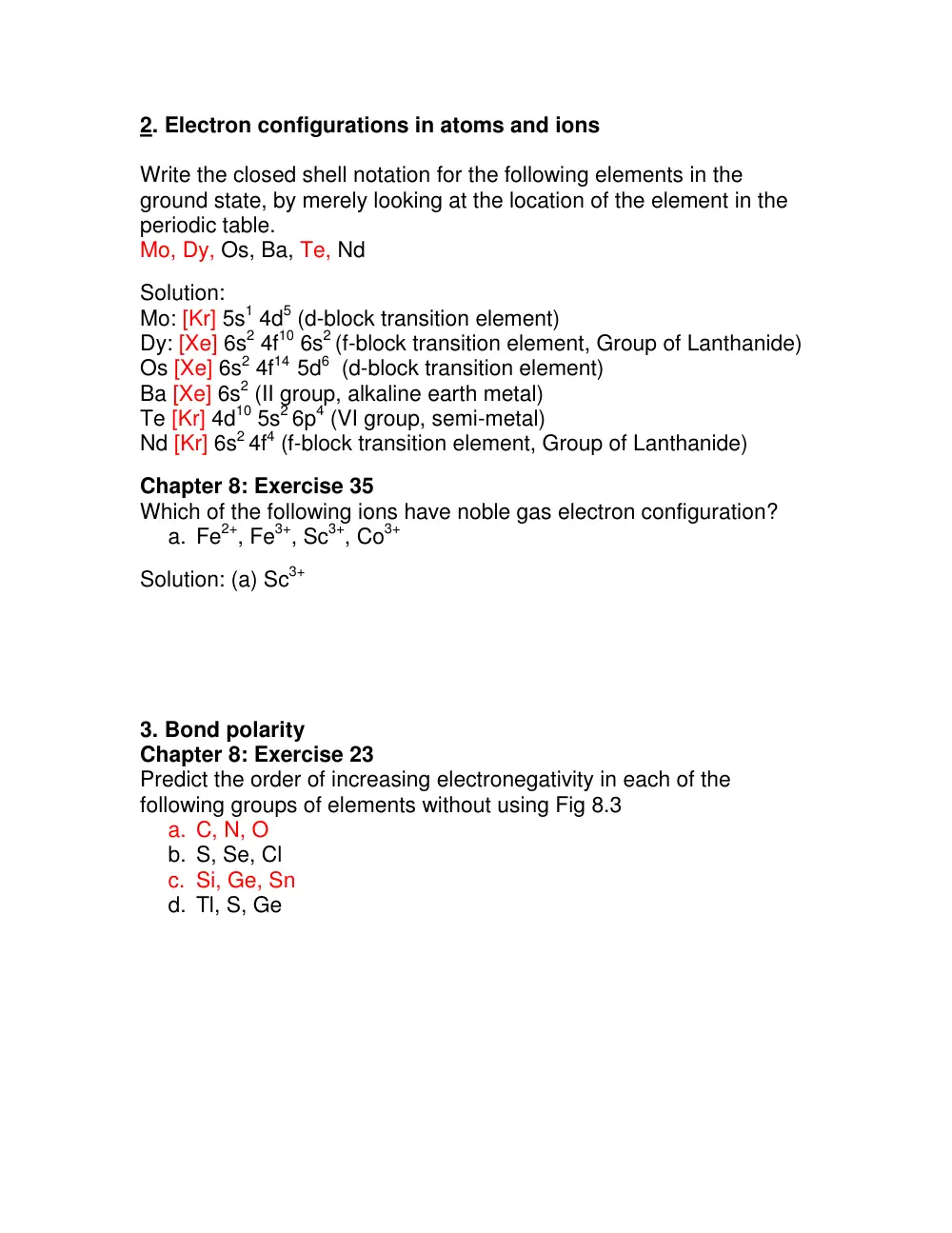
2. Electron configurations in atoms and ions
Write the closed shell notation for the following elements in the
ground state, by merely looking at the location of the element in the
periodic table.
Mo, Dy, Os, Ba, Te, Nd
Solution:
Mo: [Kr] 5s1 4d5 (d-block transition element)
Dy: [Xe] 6s2 4f10 6s2 (f-block transition element, Group of Lanthanide)
Os [Xe] 6s2 4f14 5d6 (d-block transition element)
Ba [Xe] 6s2 (II group, alkaline earth metal)
Te [Kr] 4d10 5s2 6p4 (VI group, semi-metal)
Nd [Kr] 6s2 4f4 (f-block transition element, Group of Lanthanide)
Chapter 8: Exercise 35
Which of the following ions have noble gas electron configuration?
a. Fe2+, Fe3+, Sc3+, Co3+
Solution: (a) Sc3+
3. Bond polarity
Chapter 8: Exercise 23
Predict the order of increasing electronegativity in each of the
following groups of elements without using Fig 8.3
a. C, N, O
b. S, Se, Cl
c. Si, Ge, Sn
d. Tl, S, Ge
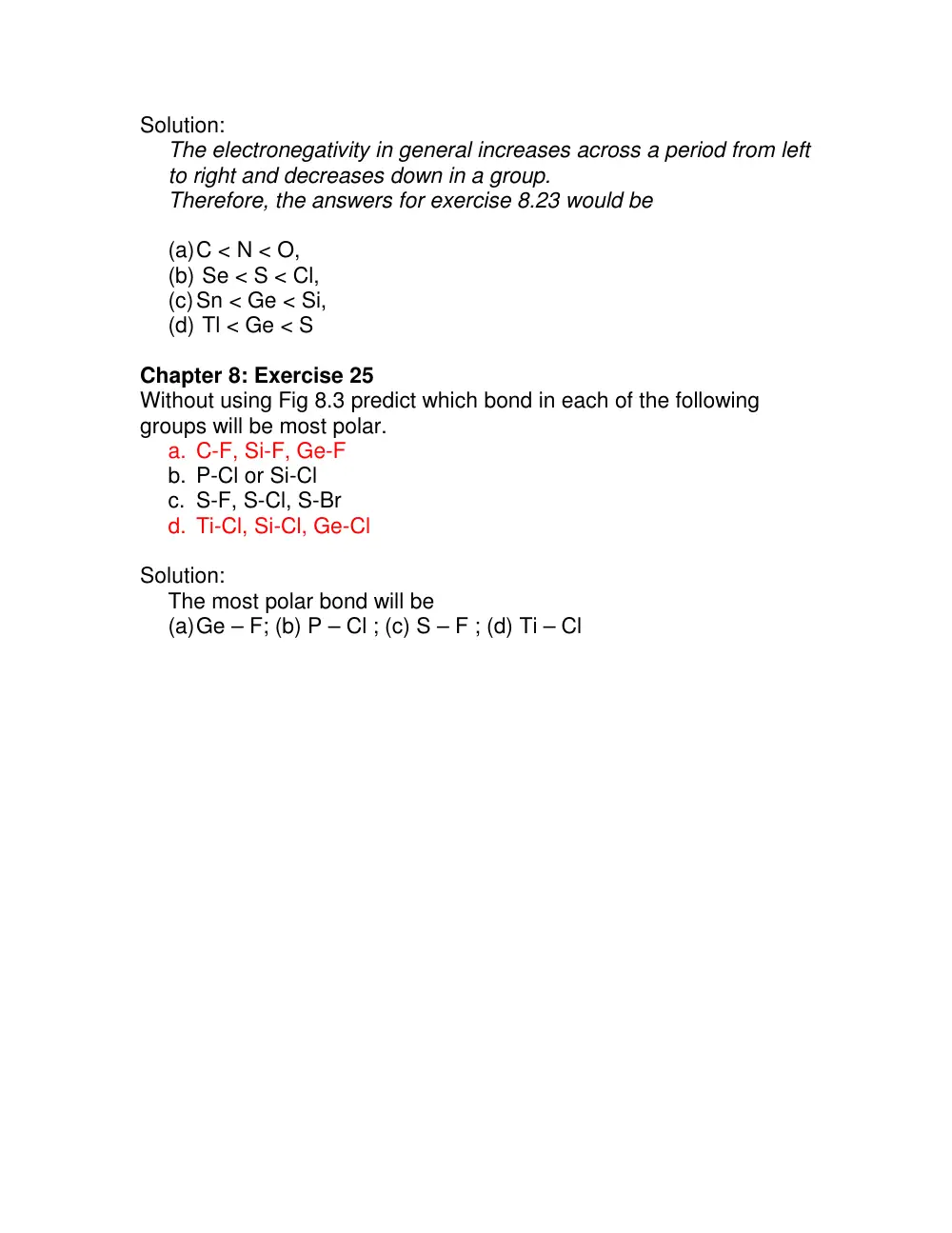
Solution:
The electronegativity in general increases across a period from left
to right and decreases down in a group.
Therefore, the answers for exercise 8.23 would be
(a) C < N < O,
(b) Se < S < Cl,
(c) Sn < Ge < Si,
(d) Tl < Ge < S
Chapter 8: Exercise 25
Without using Fig 8.3 predict which bond in each of the following
groups will be most polar.
a. C-F, Si-F, Ge-F
b. P-Cl or Si-Cl
c. S-F, S-Cl, S-Br
d. Ti-Cl, Si-Cl, Ge-Cl
Solution:
The most polar bond will be
(a) Ge – F; (b) P – Cl ; (c) S – F ; (d) Ti – Cl