
CHEM 208 Notes Final, Fall 2015
American University of Beirut · Brief Survey of Organic Chemistry · 19 pages · Dr. Randa Abi Rafi

Showing the first 10 of 19 pages. Download the PDF to see all of it.
More CHEM 208 files
Show the text of this final exam
CHEM 208
Final Exam
Notes & Reactions
Notes
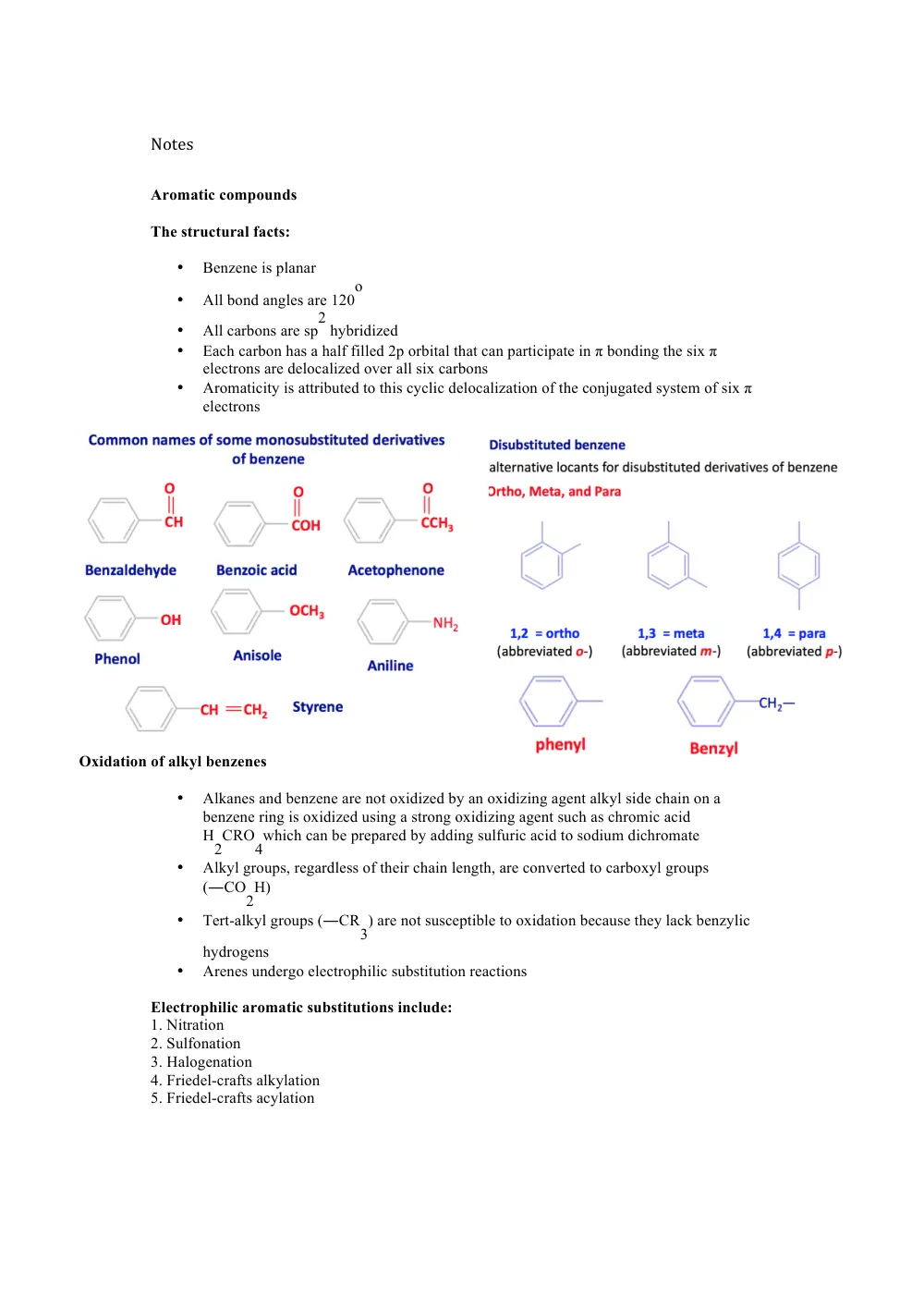
Aromatic compounds
The structural facts:
•
Benzene is planar
•
All bond angles are 120
o
•
All carbons are sp
2
hybridized
•
Each carbon has a half filled 2p orbital that can participate in π bonding the six π
electrons are delocalized over all six carbons
•
Aromaticity is attributed to this cyclic delocalization of the conjugated system of six π
electrons
Oxidation of alkyl benzenes
•
Alkanes and benzene are not oxidized by an oxidizing agent alkyl side chain on a
benzene ring is oxidized using a strong oxidizing agent such as chromic acid
H
2
CRO
4
which can be prepared by adding sulfuric acid to sodium dichromate
•
Alkyl groups, regardless of their chain length, are converted to carboxyl groups
(―CO
2
H)
•
Tert-alkyl groups (―CR
3
) are not susceptible to oxidation because they lack benzylic
hydrogens
•
Arenes undergo electrophilic substitution reactions
Electrophilic aromatic substitutions include:
1. Nitration
2. Sulfonation
3. Halogenation
4. Friedel-crafts alkylation
5. Friedel-crafts acylation
Notes
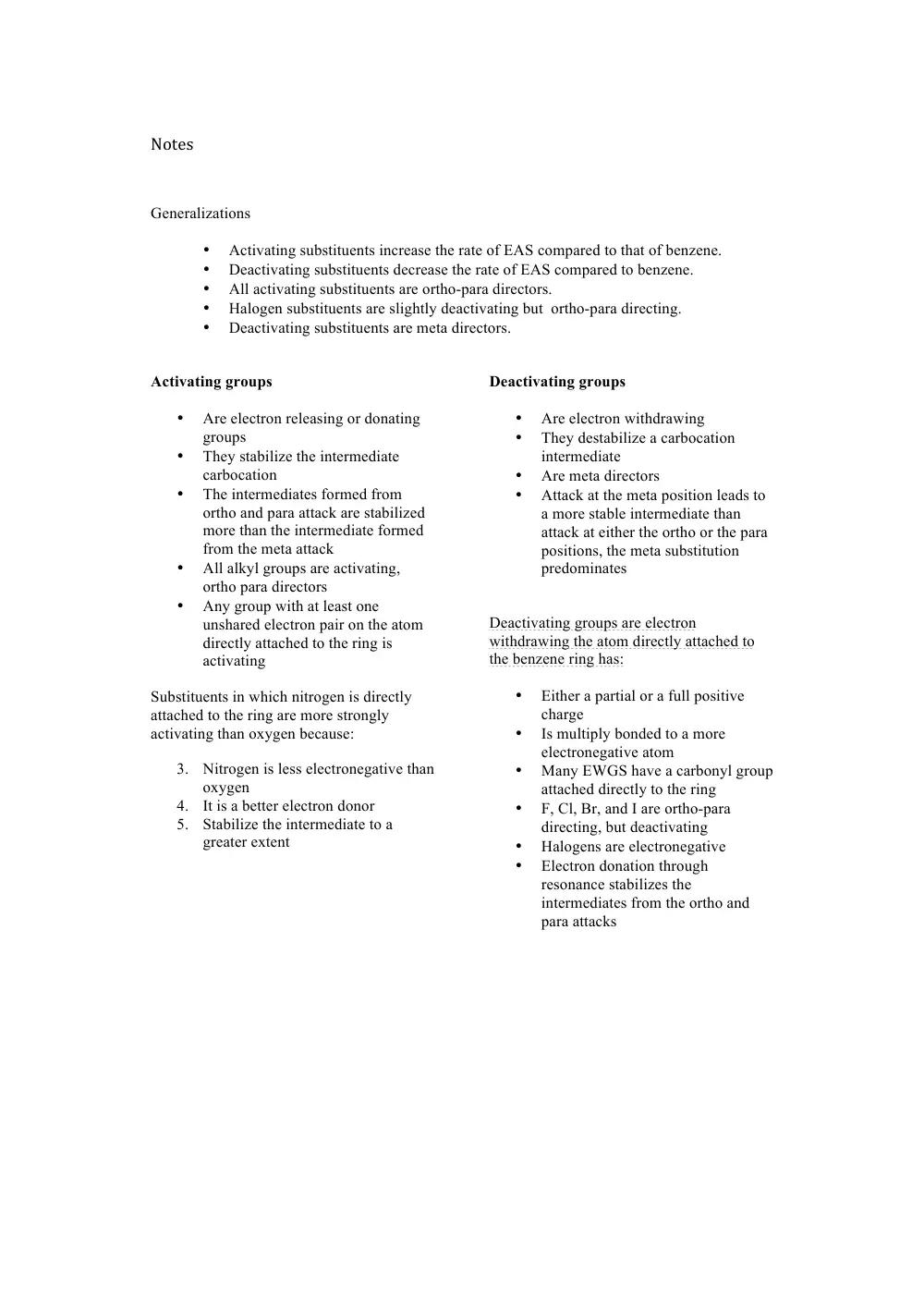
Generalizations
•
Activating substituents increase the rate of EAS compared to that of benzene.
•
Deactivating substituents decrease the rate of EAS compared to benzene.
•
All activating substituents are ortho-para directors.
•
Halogen substituents are slightly deactivating but ortho-para directing.
•
Deactivating substituents are meta directors.
Activating groups
•
Are electron releasing or donating
groups
•
They stabilize the intermediate
carbocation
•
The intermediates formed from
ortho and para attack are stabilized
more than the intermediate formed
from the meta attack
•
All alkyl groups are activating,
ortho para directors
•
Any group with at least one
unshared electron pair on the atom
directly attached to the ring is
activating
Substituents in which nitrogen is directly
attached to the ring are more strongly
activating than oxygen because:
3. Nitrogen is less electronegative than
oxygen
4. It is a better electron donor
5. Stabilize the intermediate to a
greater extent
Deactivating groups
•
Are electron withdrawing
•
They destabilize a carbocation
intermediate
•
Are meta directors
•
Attack at the meta position leads to
a more stable intermediate than
attack at either the ortho or the para
positions, the meta substitution
predominates
Deactivating groups are electron
withdrawing the atom directly attached to
the benzene ring has:
•
Either a partial or a full positive
charge
•
Is multiply bonded to a more
electronegative atom
•
Many EWGS have a carbonyl group
attached directly to the ring
•
F, Cl, Br, and I are ortho-para
directing, but deactivating
•
Halogens are electronegative
•
Electron donation through
resonance stabilizes the
intermediates from the ortho and
para attacks
Notes
Alkyl Halides Structures and Preparation from Alcohols and Alkanes
Halogen and alkyl groups are of equal rank when it comes to numbering the chain.
•
Number the chain in the direction that gives the lowest number to the group (halogen or
alkyl) that appears first.
•
If the substituents have the same numbering, use alphabetical order
•
Hydroxyl groups outrank alkyl groups when it comes to numbering the chain.
•
Number the chain in the direction that gives the lowest number to the carbon that bears
the OH group
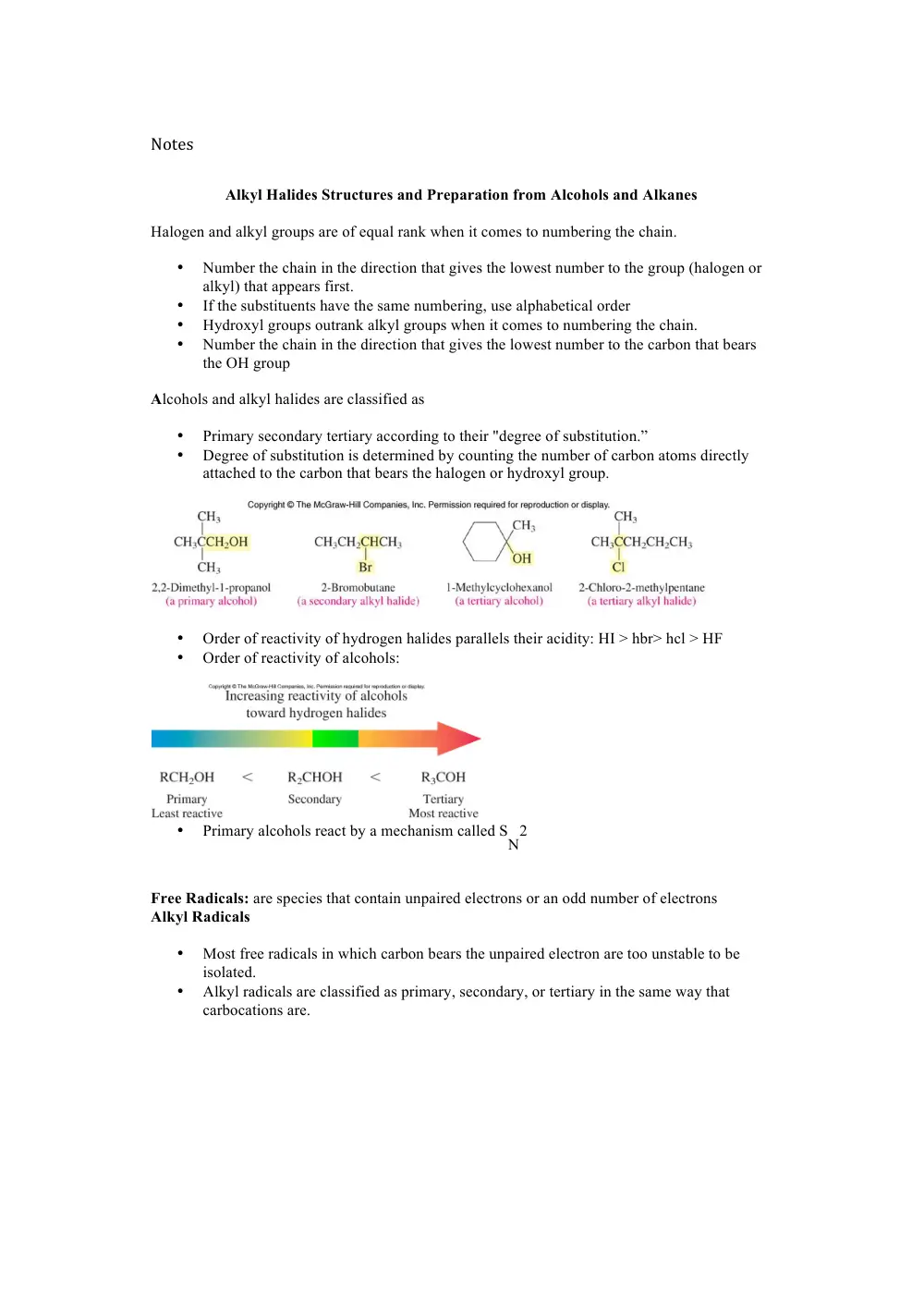
Alcohols and alkyl halides are classified as
•
Primary secondary tertiary according to their "degree of substitution.”
•
Degree of substitution is determined by counting the number of carbon atoms directly
attached to the carbon that bears the halogen or hydroxyl group.
•
Order of reactivity of hydrogen halides parallels their acidity: HI > hbr> hcl > HF
•
Order of reactivity of alcohols:
•
Primary alcohols react by a mechanism called S
N
2
Free Radicals: are species that contain unpaired electrons or an odd number of electrons
Alkyl Radicals
•
Most free radicals in which carbon bears the unpaired electron are too unstable to be
isolated.
•
Alkyl radicals are classified as primary, secondary, or tertiary in the same way that
carbocations are.
Notes
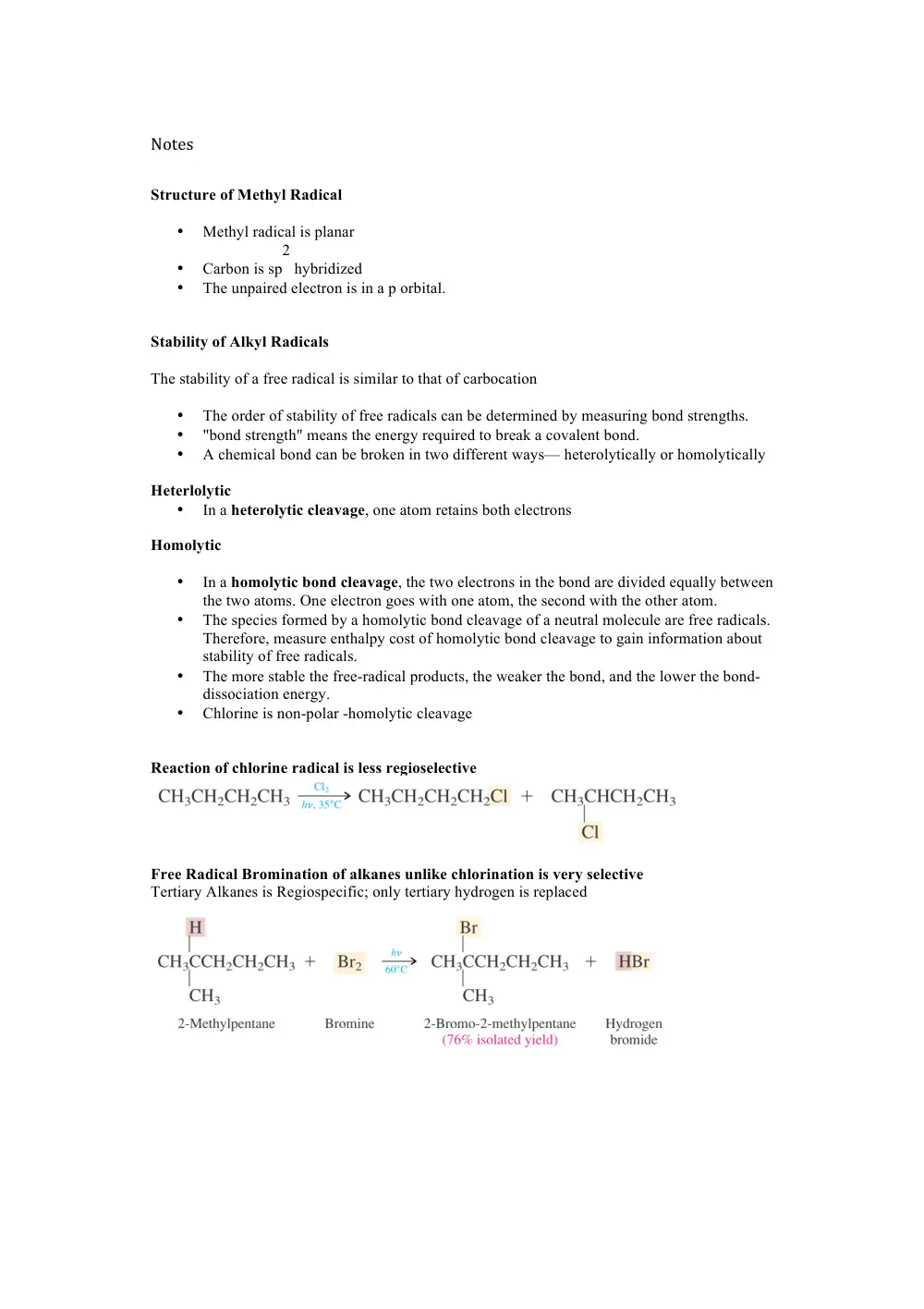
Structure of Methyl Radical
•
Methyl radical is planar
•
Carbon is sp
2
hybridized
•
The unpaired electron is in a p orbital.
Stability of Alkyl Radicals
The stability of a free radical is similar to that of carbocation
•
The order of stability of free radicals can be determined by measuring bond strengths.
•
"bond strength" means the energy required to break a covalent bond.
•
A chemical bond can be broken in two different ways— heterolytically or homolytically
Heterlolytic
•
In a heterolytic cleavage, one atom retains both electrons
Homolytic
•
In a homolytic bond cleavage, the two electrons in the bond are divided equally between
the two atoms. One electron goes with one atom, the second with the other atom.
•
The species formed by a homolytic bond cleavage of a neutral molecule are free radicals.
Therefore, measure enthalpy cost of homolytic bond cleavage to gain information about
stability of free radicals.
•
The more stable the free-radical products, the weaker the bond, and the lower the bond-
dissociation energy.
•
Chlorine is non-polar -homolytic cleavage
Reaction of chlorine radical is less regioselective
Free Radical Bromination of alkanes unlike chlorination is very selective
Tertiary Alkanes is Regiospecific; only tertiary hydrogen is replaced
Notes
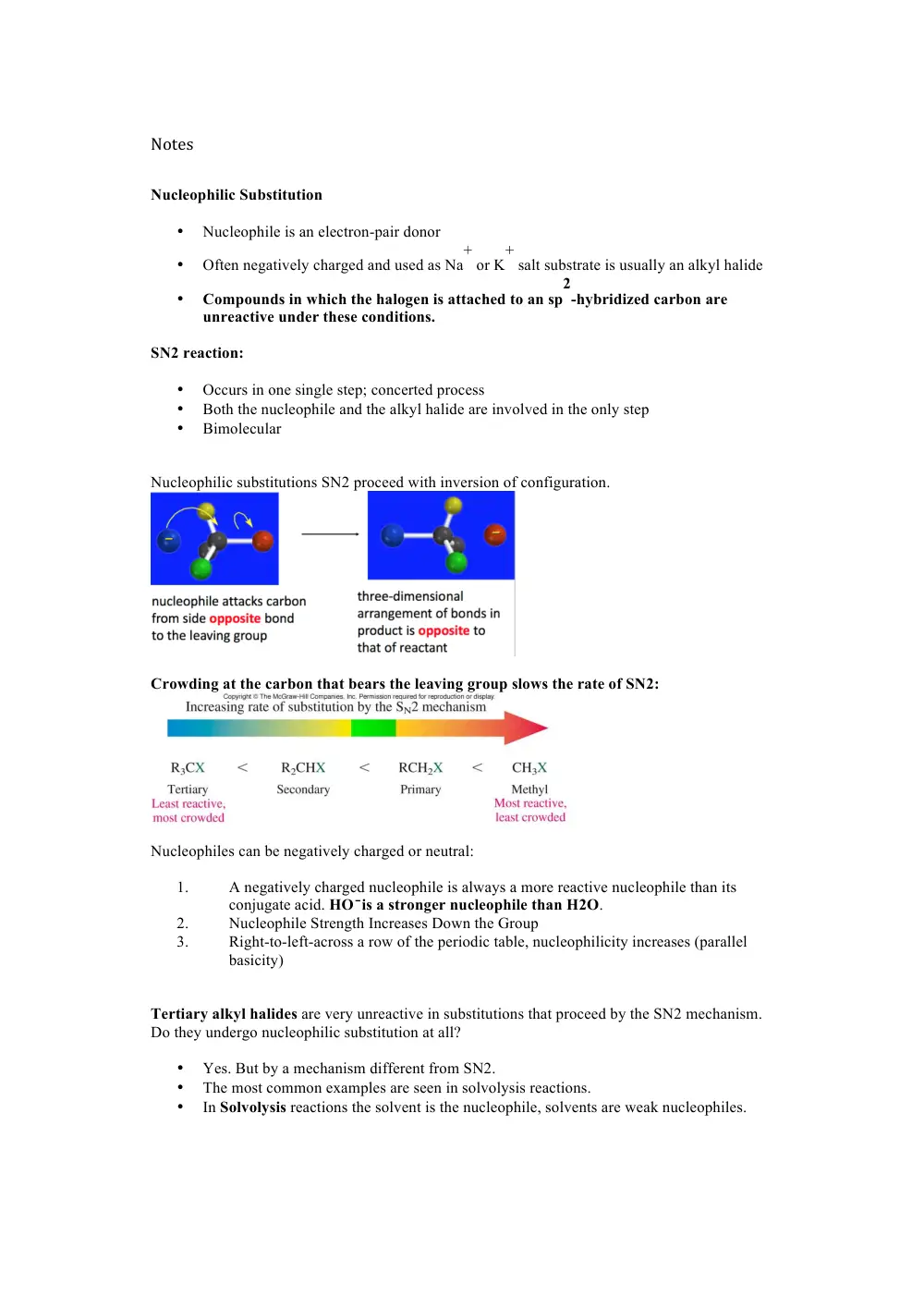
Nucleophilic Substitution
•
Nucleophile is an electron-pair donor
•
Often negatively charged and used as Na
+
or K
+
salt substrate is usually an alkyl halide
•
Compounds in which the halogen is attached to an sp
2
-hybridized carbon are
unreactive under these conditions.
SN2 reaction:
•
Occurs in one single step; concerted process
•
Both the nucleophile and the alkyl halide are involved in the only step
•
Bimolecular
Nucleophilic substitutions SN2 proceed with inversion of configuration.
Crowding at the carbon that bears the leaving group slows the rate of SN2:
Nucleophiles can be negatively charged or neutral:
1.
A negatively charged nucleophile is always a more reactive nucleophile than its
conjugate acid. HO ̄ is a stronger nucleophile than H2O.
2.
Nucleophile Strength Increases Down the Group
3.
Right-to-left-across a row of the periodic table, nucleophilicity increases (parallel
basicity)
Tertiary alkyl halides are very unreactive in substitutions that proceed by the SN2 mechanism.
Do they undergo nucleophilic substitution at all?
•
Yes. But by a mechanism different from SN2.
•
The most common examples are seen in solvolysis reactions.
•
In Solvolysis reactions the solvent is the nucleophile, solvents are weak nucleophiles.
Notes
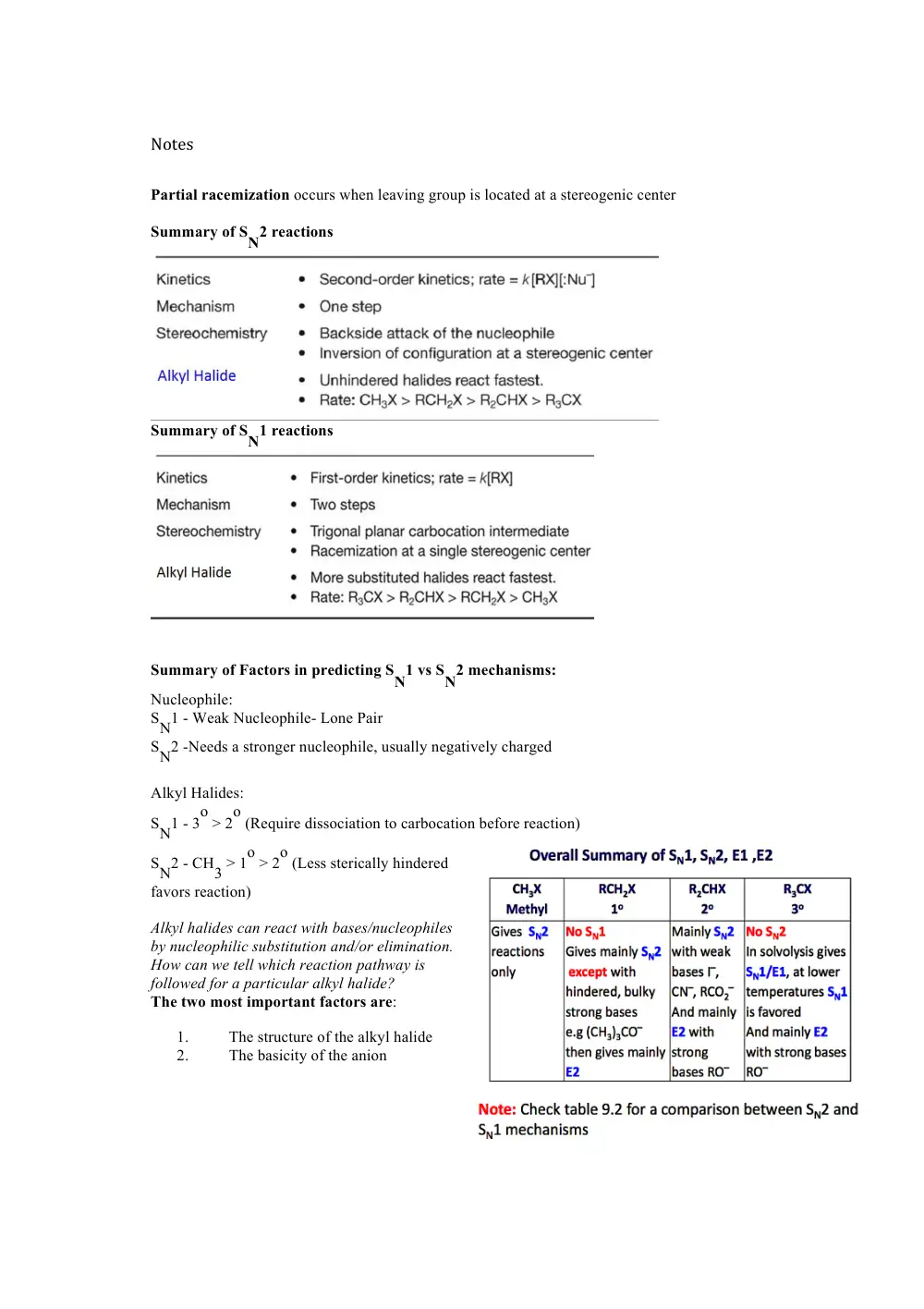
Partial racemization occurs when leaving group is located at a stereogenic center
Summary of SN2 reactions
Summary of SN1 reactions
Summary of Factors in predicting SN1 vs SN2 mechanisms:
Nucleophile:
SN1 - Weak Nucleophile- Lone Pair
SN2 -Needs a stronger nucleophile, usually negatively charged
Alkyl Halides:
SN1 - 3o > 2o (Require dissociation to carbocation before reaction)
SN2 - CH3 > 1o > 2o (Less sterically hindered
favors reaction)
Alkyl halides can react with bases/nucleophiles
by nucleophilic substitution and/or elimination.
How can we tell which reaction pathway is
followed for a particular alkyl halide?
The two most important factors are:
1.
The structure of the alkyl halide
2.
The basicity of the anion
Notes
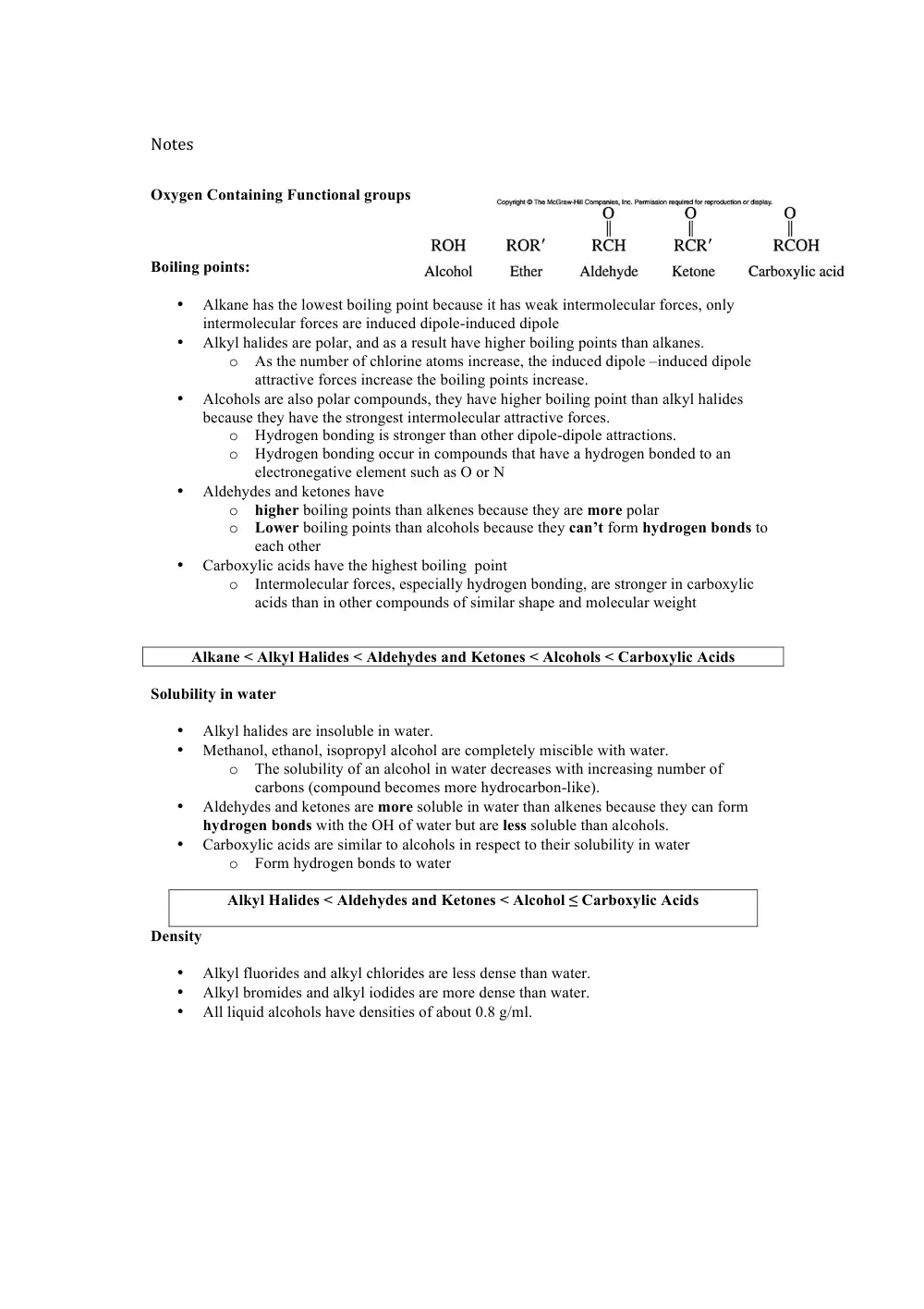
Oxygen Containing Functional groups
Boiling points:
•
Alkane has the lowest boiling point because it has weak intermolecular forces, only
intermolecular forces are induced dipole-induced dipole
•
Alkyl halides are polar, and as a result have higher boiling points than alkanes.
o As the number of chlorine atoms increase, the induced dipole –induced dipole
attractive forces increase the boiling points increase.
•
Alcohols are also polar compounds, they have higher boiling point than alkyl halides
because they have the strongest intermolecular attractive forces.
o Hydrogen bonding is stronger than other dipole-dipole attractions.
o Hydrogen bonding occur in compounds that have a hydrogen bonded to an
electronegative element such as O or N
•
Aldehydes and ketones have
o higher boiling points than alkenes because they are more polar
o Lower boiling points than alcohols because they can’t form hydrogen bonds to
each other
•
Carboxylic acids have the highest boiling point
o Intermolecular forces, especially hydrogen bonding, are stronger in carboxylic
acids than in other compounds of similar shape and molecular weight
Alkane < Alkyl Halides < Aldehydes and Ketones < Alcohols < Carboxylic Acids
Solubility in water
•
Alkyl halides are insoluble in water.
•
Methanol, ethanol, isopropyl alcohol are completely miscible with water.
o The solubility of an alcohol in water decreases with increasing number of
carbons (compound becomes more hydrocarbon-like).
•
Aldehydes and ketones are more soluble in water than alkenes because they can form
hydrogen bonds with the OH of water but are less soluble than alcohols.
•
Carboxylic acids are similar to alcohols in respect to their solubility in water
o Form hydrogen bonds to water
Alkyl Halides < Aldehydes and Ketones < Alcohol ≤ Carboxylic Acids
Density
•
Alkyl fluorides and alkyl chlorides are less dense than water.
•
Alkyl bromides and alkyl iodides are more dense than water.
•
All liquid alcohols have densities of about 0.8 g/ml.
Notes
Acidity
•
Carboxylic acids are weak acids but they are the most acidic class of compounds that
contain only carbon, hydrogen and oxygen.
•
Carboxylic acids are far more acidic than alcohols
•
Electronegative substituents increase the acidity of carboxylic acids.
•
Electronegative substituents withdraw electrons from carboxyl group; increase K for loss
of H
+
•
The order of acidity increases with an increasing number of electron-withdrawing groups.
Oxidation and Reduction
Reduction
•
An increase in the number of
carbon-hydrogen bonds
•
Or a decrease in the number of
carbon-oxygen bonds
Reducing agents:
1. Catalytic hydrogenation H
2
, Pt,
Pd, Ni, Ru
2. Metal hydride; sodium borohydride
NABH
4
3. Lithium aluminum hydride LiAlH
4
Selective reduction of a carbonyl group:
NaBH
4
and LiAlH
4
•
Reduce carbonyls to the
corresponding alcohol
•
Do not reduce carbon-carbon double
bonds
•
Catalytic hydrogenation reduces
both carbonyls and carbon-carbon
double bonds
Oxidation:
•
An increase in the number of
carbon-oxygen bonds
•
Or a decrease in the number of
carbon-hydrogen bonds
Oxidizing agents:
•
KMnO4
•
H2Cr2O4
•
H2Cr2O7
Primary alcohols can be oxidized to
aldehydes using:
1. PCC
2. PDC
Secondary alcohols are oxidized to the
ketone.
Tertiary alcohols have no hydrogen on
their hydroxyl bearing carbon and do not
undergo oxidation readily.
Reduction of an aldehyde gives a primary alcohol
Reduction of a ketone gives a secondary alcohol
Notes
Ethers
•
Contain a C-O-C unit.
•
Are relatively unreactive, they undergo few reactions
•
They are mainly used cyclic ethers have their oxygen as part of the ring, they are
heterocyclic compounds
•
Epoxides (3 membered) cyclic ethers are named are derivatives of alkanes as solvents
•
Epoxidation with peroxy acids is a syn addition to the double bond.
•
Aldehydes and Ketones react with alcohols to yield acetals
o Hemiacetal (OH & OR on the same carbon) is formed by nucleophilic addition
of the alcohol to the carbonyl
o Hemiacetal reacts further in acid to yield an acetal (two OR groups on the same
carbon)
Carboxylic Acids:
Sources of Carboxylic Acids
•
Side-chain oxidation of alkylbenzenes
•
Oxidation of primary alcohols
•
Oxidation of aldehydes
Reactions
ALCOHOLS AND ALKYL HALIDES
An alcohol can be converted into an alkyl halide by the following reaction:
Peroxide effect:
ALCOHOLS, ETHERS
Oxygen Containing Functional groups
Reduction of an aldehyde gives a primary alcohol
Selective reduction of a carbonyl group:
NaBH
4
and LiAlH
4
reduce carbonyls to the
corresponding alcohol do not reduce
carbon-carbon double bonds.
Note: Catalytic hydrogenation (H+)
reduces both carbonyls and carbon-carbon
double bonds
Reactions
Reduction of a ketone gives a secondary alcohol
Reactions of Alcohols:
1. Reaction with hydrogen halides (8.5)
2. Acid-catalyzed dehydration (5.7)
3. Oxidation of Alcohols
Primary alcohols can be oxidized to aldehydes using
1. Pyridinium chlorochromate PCC
2. Pyridinium dichromate PDC
Secondary alcohols are oxidized to the ketone
Reactions
Tertiary alcohols have no hydrogen on their hydroxyl bearing carbon and do not undergo oxidation
readily.
Preparation of Ethers:Williamson Ether Synthesis
•
Alkyl halide must be primary
•
Alkoxide ion can be derived from primary, secondary, or tertiary alcohol
Preparation of Epoxides
Epoxidation of Alkenes
Reactions
ALDEHYDES AND KETONES
Synthesis of Aldehydes and Ketones
1. From alkynes hydration (via enol)
2. From arenes friedel-crafts acylation
3. From alcohols oxidation
1. Hydration of alkynes:
2. From arenes friedel-crafts acylation
3. From alcohols oxidation
Cyanohydrin Formation
Reactions
Hydration of Aldehydes and Ketones
Aldehydes and ketones react with water in a rapid equilibrium
Acetal Formation
Reaction with Primary Amines: Imines
Aldehydes and ketones react with primary amines such as: RNH
2
and ArNH
2
The reaction occurs in two steps:
1. The amine adds to the carbonyl to give the carbinolamine
2. The carbinolamine undergoes dehydration to give the imine
Reactions
CARBOXYLIC ACIDS
Sources of Carboxylic Acids
Synthesis of Carboxylic Acids
1. Side-chain oxidation of alkylbenzenes
2. Oxidation of primary alcohols
3. Oxidation of aldehydes
Synthesis of Carboxylic Acids by the Preparation
and Hydrolysis of Nitriles
Reactions
Dicarboxylic Acid
via Cyanohydrin
Reactions of Carboxylic Acids
1. Reduction of Carboxylic Acids Gives Primary Alcohols
Lithium aluminum hydride is the only effective reducing agent !
2. Reaction with Thionyl Chloride to yield Acyl Chlorides
3. Reaction with Alcohols to yield Esters
Reactions
RECALL
Reactions