
CHEM 210 Final, Spring 1998
American University of Beirut · Organic Laboratory for Non-Majors · 5 pages



More CHEM 210 files
Show the text of this final exam
Chemistry 210 June 10, 1998
Final Examination H. Sleiman
Name:
Student Number
Major:
Instructer’
I. Show how to prepare p-nitroaniline from aniline. using chemical equations.
Ly Moe, j
IL.
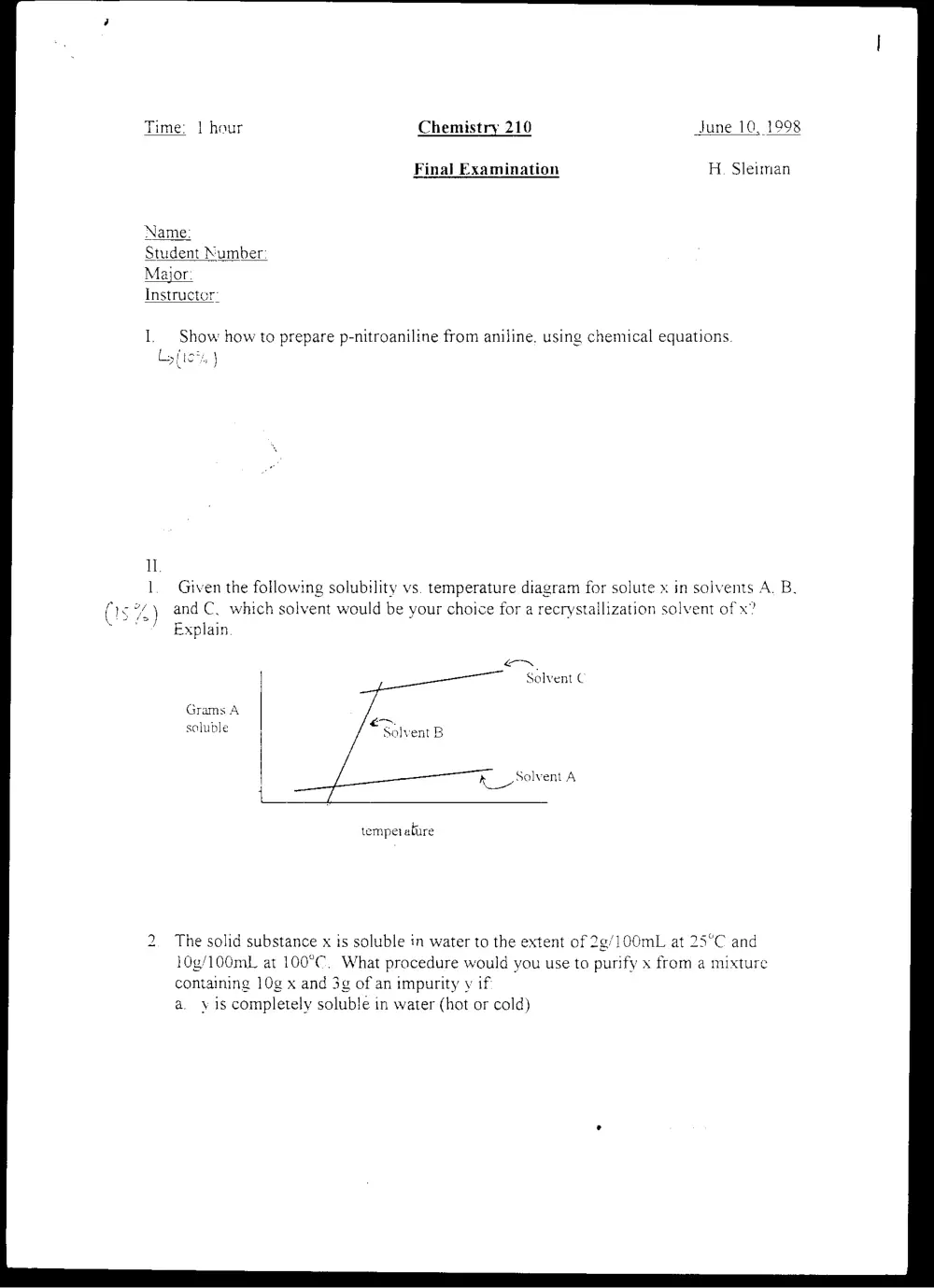
1. Given the following solubility vs. temperature diagram for solute x in solvents A, B,
(1s 4) and C, which solvent would be your choice for a recrystallization solvent of x?
Explain
<<,
Solvent C
Grams A
soluble <>
Solvent B
a__ Solvent A
temperature
2. The solid substance x is soluble in water to the extent of 2¢/100mL at 25°C and
10g/100mL at 100°C. What procedure would you use to purify x from a mixture
containing 10g x and 3g of an impurity y if
a. yis completely soluble in water (hot or cold)
b. yis completely insoluble in water
c. y has the same solubility of x in water
HL (2t:\Circle the correct choice, Only one answer is possible.
1. Circle the correct statement:
a. Added methanol increases the boiling point of ethano!
b. Added benzoic acid lowers the melting point of solid benzene
c. Added sand raises the boiling point of water
d. Added salt increases the melting point of water
tw
During a recrystallization, a minimum amount of boiling solvent is used in order to:
a. prevent a reaction of the solvent with the material to be recrystallized
b. maximize the purity of the recrystallized material
¢ maximize the yield of recystallized material
d. minimize the melting point of recrystallized material
142
Sodium bicarbonate was used in the purification of isopenty! acetate te:
a. separate isopentyl acetate from acetic acid
b. separate isopentyl acetate from isopenty! alcohol
c. drive the equilibrium of the esterification to the products
d. none of the above
A. The Rpvalnes nf p-nitroaniline. o-nitroaniline and o-nitroacetanilide are in the
following order:
a. Rdo-nitroacetanilide)> RA p-nitroaniline)> R¢o-nitroaniline)
b. Ro-nitroaniline)> R¢o-nitroacetanilide)> R¢p-nitroaniline)
c. Ro-nitroacetaniiide)> Re o-nitroaniline)> R,(p-nitroaniline)
d. Rip-nitroaniline)> Reo-nitroacetanilide)> R¢o-nitroaniline)
(Ww
§ In the following reaction (atomic weights C=12; H=1: O=16. N=14)
Oo
o 9
i .
CH,CH.O —NH. + A AL —e cn cr0 NH-C—CH, + CH,COOH
. . H.C oO CH, :
p-phenetidine acetic anhydride phenacetin
2g 2mL (d=1.08g¢/mL)
The limiting reagent 1s -------- and the theoretical yield of phenacetin 1s---- (answer
below)
a. acetic anhydride, 3.82
b. p-phenetidine, 3.8g
c. p-phenetidine, 2.6g
d. acetic anhydride. 2.6g
6, During a fractional distillation, how does the temperature of the vapor just above the
liquid compare with the temperature recorded by the thermometer above the
fractionation column?
a. Higher
b. Lower
c. Same
d. Depends on particular liquid mixture
TV. In 1951, an obscure group of chemists (lead by G. Rosenkranz and C. Djerassi) first
synthesized what they thought was cortisone. They sent a sample of this compound
to T. Reichstein, who had received the Nobel Prize for isolating cortisone trom
r natural sources, and who had samples of authentic cortisone. The chemists were
[3 2 : . . . Ge _ i
{4°/.) very happy when a telegram from Reichstein arrived: “No depression in the mixed
melting point”.
Explain
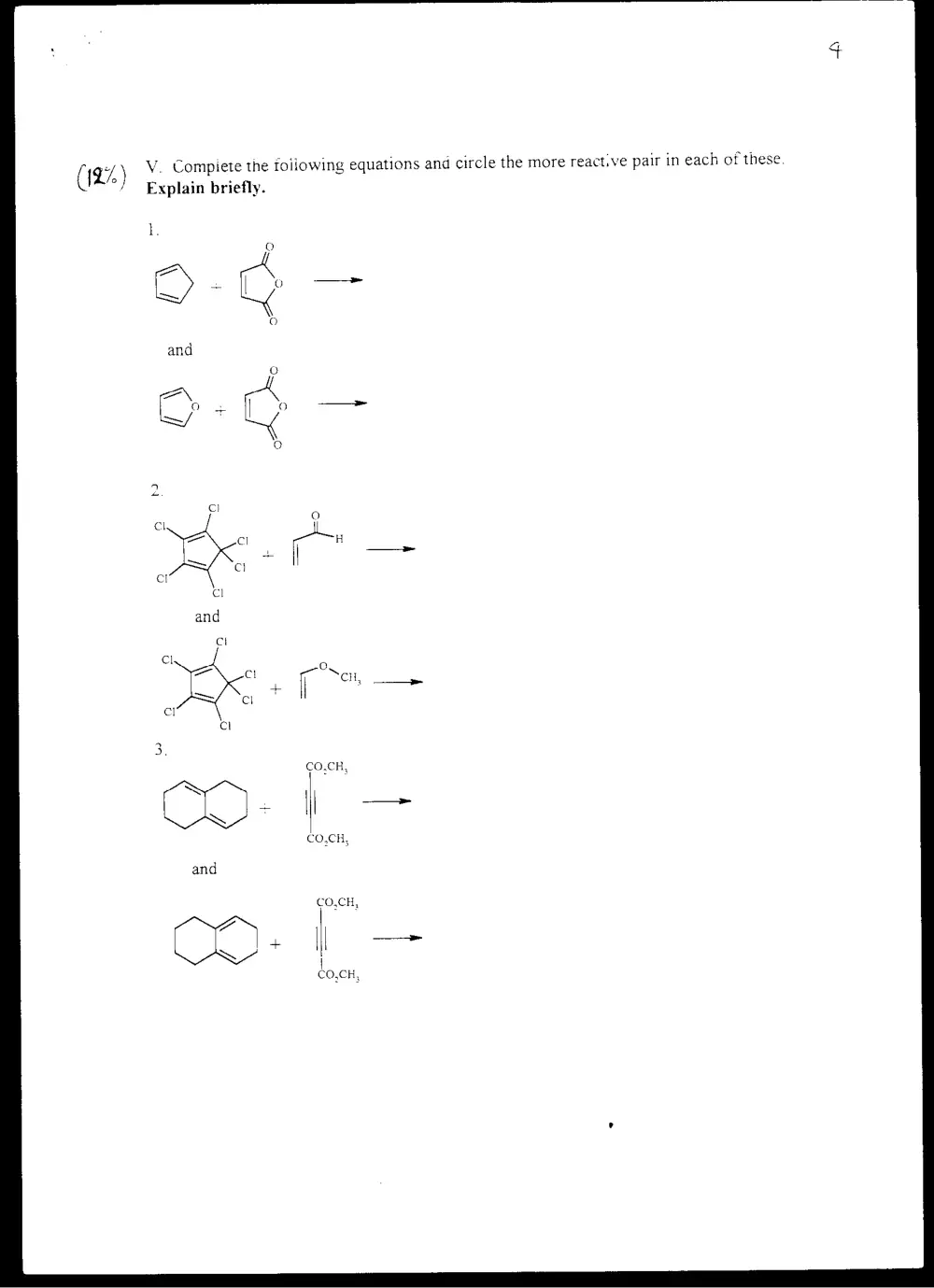
V. Compiete the foiiowing equations and circle the more reactive pair in each of these.
Explain briefly.
To what external pressure should the system be reduced, so that a mixture of 50g
n-pentane and 50g n-heptane begins to boil at 40°C? What is the weight
composition of the first drops of distillate?
(at 40°C, P°(y.pentaney=873 mm Hg and P°n-hepraney=92 mm Hg)
VIL. Draw a column chromatography set-up, labeling all parts.
( oY)
VIEL Show a step-by-step experimental procedure to prepare and purify cyclohexanone
from cyclohexanol .(use back of this page)
a
(2p)