
CHEM 211 Problems Ch 2 ACS Problems, Spring 2015
American University of Beirut · Organic Chemistry I · 9 pages
More CHEM 211 files
- Problems Ch 1 ACS Review · Spring 2015ProblemsView
- Problems Ch 5 ACS Problems · Spring 2015ProblemsView
- Problems Ch 6 ACS Problems · Spring 2015ProblemsView
- Problems Ch 4 ACS Problems · Spring 2015ProblemsView
- Problems Ch 3 ACS Problems · Spring 2015ProblemsView
- Problems Solution Manual · Spring 2012Problems · with solutionView
- Questions Review 1 · Spring 2011ProblemsView
- Questions 1 · Fall 2011ProblemsView
Show the text of this problems
ACS Review Alkanes
1. Alkanes are characterized by the general molecular formula:
A.
CnH2n-2
B.
CnH2n
C.
CnH2n+2
D.
CnH2n+4
2. Cycloalkanes are characterized by the general molecular formula:
A.
CnH2n-2
B.
CnH2n
C.
CnH2n+2
D.
CnH2n+4
3. The carbon-carbon sigma bond in ethane is formed by overlap of which two orbitals?
A.
2p-2p
B.
sp-sp
C.
sp2-sp2
D.
sp3-sp3
4. The correct IUPAC name of the following compound is:
A.
4-ethyl-2-methylhexane
B.
3-ethyl-5-methylhexane
C.
2-methyl-4-ethylhexane
D.
5-methyl-3-ethylhexane
5. The correct IUPAC name of the following compound is:
A.
2-ethyl-3,5-dimethylheptane
B.
6-ethyl-5,5-dimethylheptane
C.
3,4,4-trimethyloctane
D.
5,5,6-trimethyloctane
6. The common name of the following group is:
A.
n-butyl
B.
sec-butyl
C.
isobutyl
D.
tert-butyl
7. Which one of the following is 2,2,5-trimethylhexane?
A.
(CH3)2CHCH2C(CH3)3
B.
(CH3)2CHCH2CH2C(CH3)3
C.
CH3CH2CH(CH3)C(CH3)3
D.
(CH3)2CHCH2 CH2CH2C(CH3)3
8. The correct IUPAC name of the following is:
A.
2,4,7-trimethylnonane
B.
3,6,8-trimethylnonane
C.
7-ethyl-2,4-dimethyloctane
D.
2-ethyl-5,7-dimethyloctane
9. Which one of the following is tert-butyl chloride?
A.
CH3CH2CH2CH2Cl
B.
CH3CH2CHClCH3
C.
(CH3)2CHCH2Cl
D.
(CH3)3CCl
10. What is the IUPAC name of the following?
A.
1-ethyl-4.4-dimethylcyclopentane
B.
1-ethyl-3,3-dimethylcyclopentane
C.
3-ethyl-1,1-dimethylcyclopentane
D.
4-ethyl-1,1-dimethylcyclopentane
11. Cyclohexane is composed of:
A.
methine groups.
B.
methylene groups.
C.
methyl groups.
D.
both methine and methylene groups.
12. All the carbons in cyclopentane are:
A.
primary carbons.
B.
secondary carbons.
C.
tertiary carbons.
D.
quaternary carbons.
13. The correct name of the following compound is:
A.
(1-methylpropyl)cyclohexane
B.
(2-methylpropyl)cyclohexane
C.
(2,2-dimethylethyl)cyclohexane
D.
(2,2-dimethylpropyl)cyclohexane
14. The correct IUPAC name of the following compound is:
A.
(1-methylhexyl)cyclopentane
B.
(1-pentylethyl)cyclopentane
C.
2-cyclopentylheptane
D.
1-cyclopentyl-2-heptane
15. The C-C sigma bond in acetylene is formed by the overlap of which two orbitals?
A.
2p-2p
B.
sp-sp
C.
sp2-sp2
D.
sp3-sp3
16. The boiling point of isobutane (-10.2°C) is lower than n-butane (-0.4°C) because isobutane has:
A.
weaker intermolecular van der Waals forces.
B.
stronger intermolecular van der Waals forces.
C.
weaker dipole-dipole attractive forces.
D.
stronger dipole-dipole attractive forces.
17. Which of the following are constitutional isomers?
A.
I, II, and III
B.
I, III, and IV
C.
only I and III
D.
all are constitutional isomers
18. Arrange the following isomeric alkanes in order of increasing boiling point.
I. n-heptane
II. 2,3-dimethylpentane
III. 2,2,3-trimethylbutane
A.
I < II < III
B.
II < III < I
C.
III < I < II
D.
III < II < I
19. The oxidation states of carbon range from:
A.
0 to +2
B.
0 to +4
C.
-4 to 0
D.
-4 to +4
20. Which of the following has(have) a higher oxidation state of carbon than the carbon in formaldehyde,
H2C=O?
I. CH3OH
II. HCO2H
III. H2CO3
A.
I
B.
III
C.
II and III
D.
I, II, and III
21. The tert-butyl group can also be called:
A.
1,1-dimethylpropyl
B.
1,1-dimethylethyl
C.
2,2-dimethylpropyl
D.
2,2-dimethylethyl
22. Carbon atoms 1, 2, and 3 in the following structure are classified, respectively, as:
A.
tertiary, primary, secondary.
B.
quaternary, primary, tertiary.
C.
quaternary, secondary, secondary.
D.
quaternary, secondary, tertiary.
23. Identify the isomer of C6H14 that only has primary and tertiary carbons.
A.
hexane
B.
2,2-dimethylbutane
C.
3-methylpentane
D.
2,3-dimethylbutane
24. Why can heats of combustion of constitutional isomers of hydrocarbons be used to measure their
stabilities?
I. Combustion of constitutional isomers gives different final states.
II. Combustion of constitutional isomers gives the same final states.
III. Constitutional isomers of hydrocarbons have the same potential energies.
IV. Constitutional isomers of hydrocarbons have different potential energies.
A.
only I
B.
only II
C.
I and III
D.
II and IV
25. The heats of combustion (-∆H°) of heptane and 3,3-dimethypentane are 4,817 and 4,809 kJ/mol,
respectively. Which statement is true?
A.
Heptane is 8 kJ/mol more stable then 3,3-dimethylpentane.
B.
3,3-Dimethylpentane is 8 kJ/mol more stable then heptane.
C.
Stabilities cannot be compared since they are not isomers.
D.
Stabilities cannot be compared since they give different combustion products.
26. The reaction of acetylene with hydrogen gas is shown below. Which statements are true concerning the
reaction?
I. Acetylene is oxidized to ethane.
II. Acetylene is reduced to ethane.
III. Carbon changes oxidation state from -1 to -3.
IV. Hydrogen (from H2) changes oxidation state from 0 to +1.
A.
I and III
B.
II and IV
C.
I, III, and IV
D.
II, III, and IV
27. How many methine groups are there in isopropylcyclopentane?
A.
one
B.
two
C.
three
D.
four
28. What is the total number of constitutional isomers with the formula C5H12?
A.
two
B.
three
C.
four
D.
five
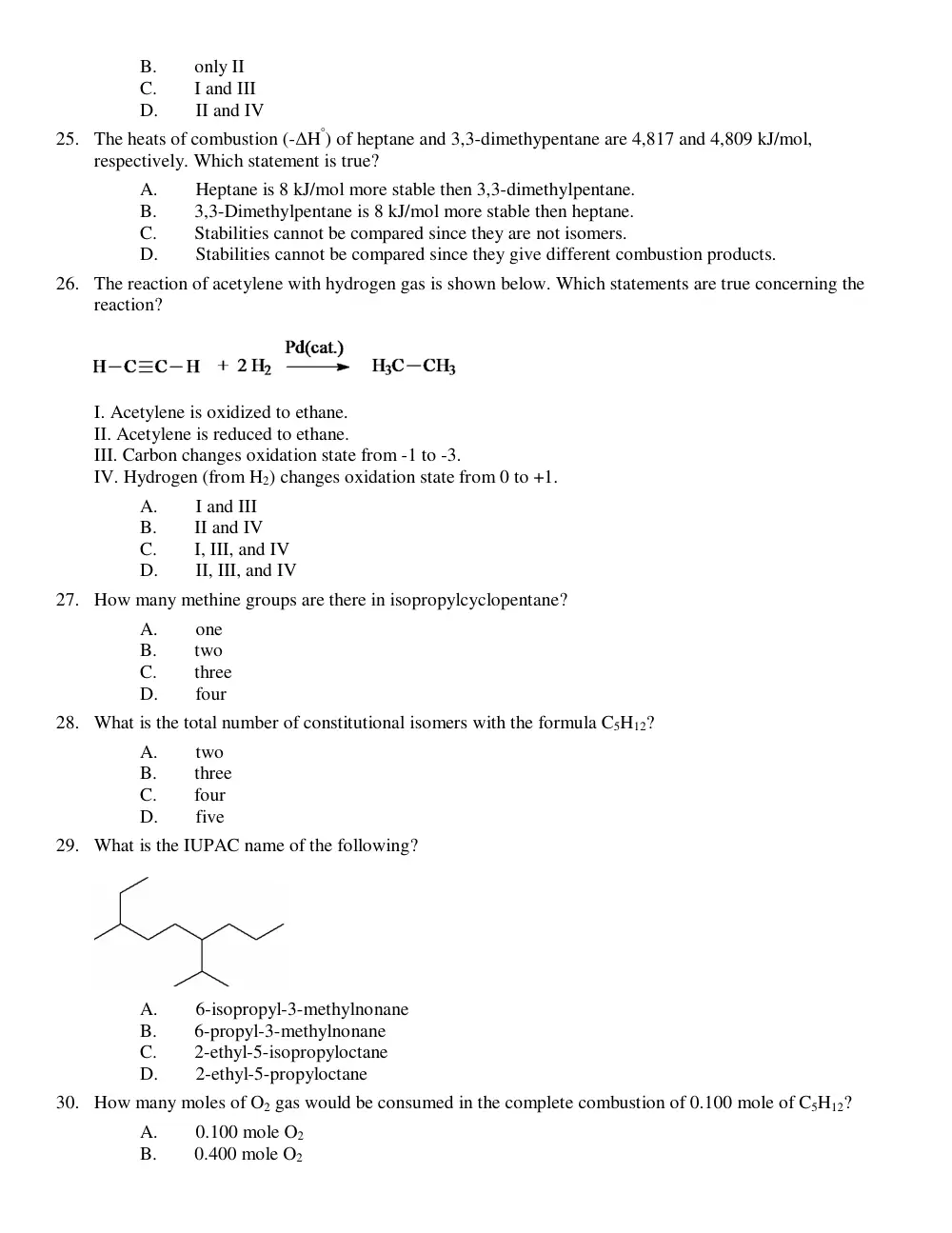
29. What is the IUPAC name of the following?
A.
6-isopropyl-3-methylnonane
B.
6-propyl-3-methylnonane
C.
2-ethyl-5-isopropyloctane
D.
2-ethyl-5-propyloctane
30. How many moles of O2 gas would be consumed in the complete combustion of 0.100 mole of C5H12?
A.
0.100 mole O2
B.
0.400 mole O2
C.
0.800 mole O2
D.
1.60 mole O2
31. The systematic name of the following group is:
A.
5-ethyl-2-methylpentyl
B.
1-ethyl-4-methylpentyl
C.
6-methyl-3-heptyl
D.
2-methyl-5-heptyl
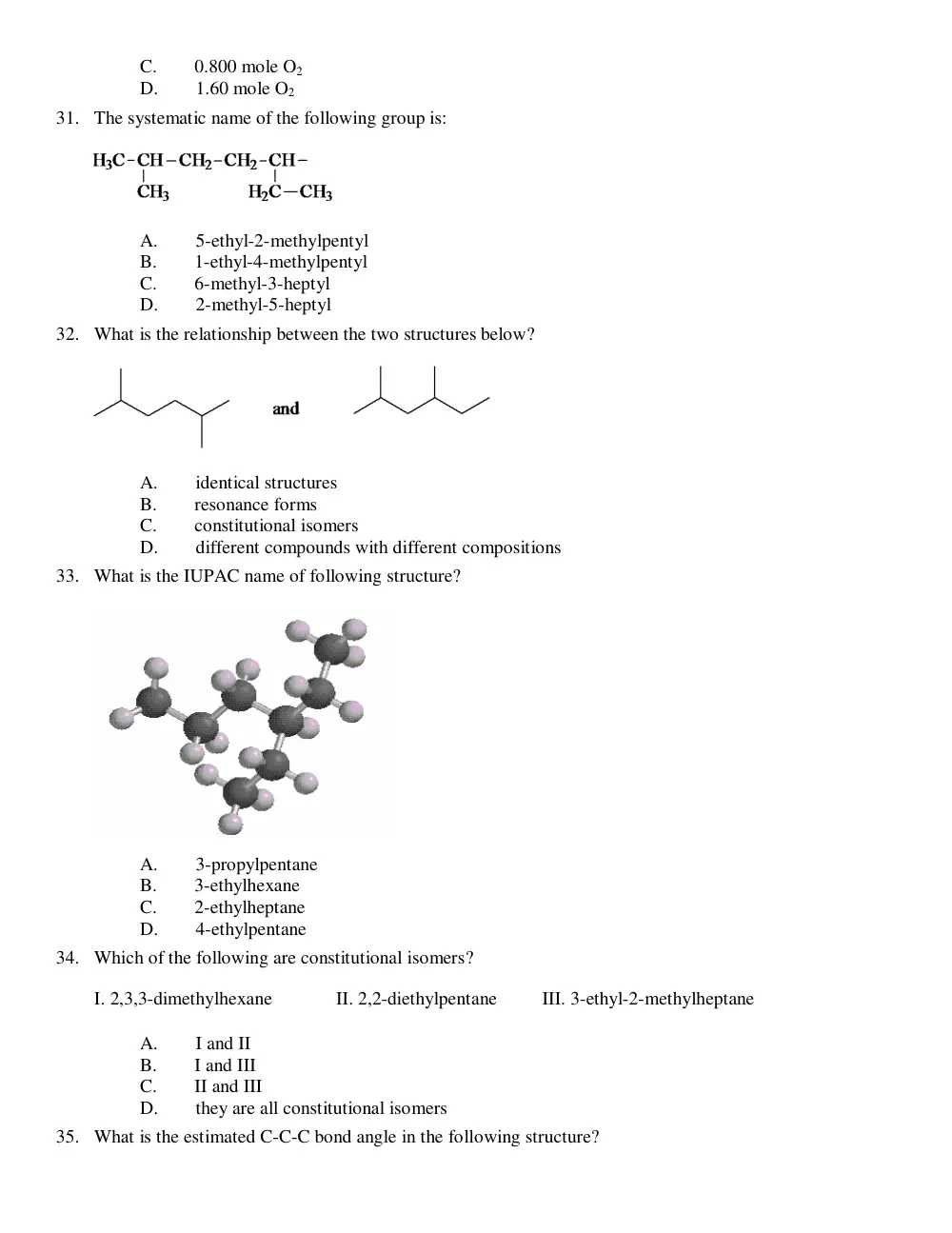
32. What is the relationship between the two structures below?
A.
identical structures
B.
resonance forms
C.
constitutional isomers
D.
different compounds with different compositions
33. What is the IUPAC name of following structure?
A.
3-propylpentane
B.
3-ethylhexane
C.
2-ethylheptane
D.
4-ethylpentane
34. Which of the following are constitutional isomers?
I. 2,3,3-dimethylhexane
II. 2,2-diethylpentane
III. 3-ethyl-2-methylheptane
A.
I and II
B.
I and III
C.
II and III
D.
they are all constitutional isomers
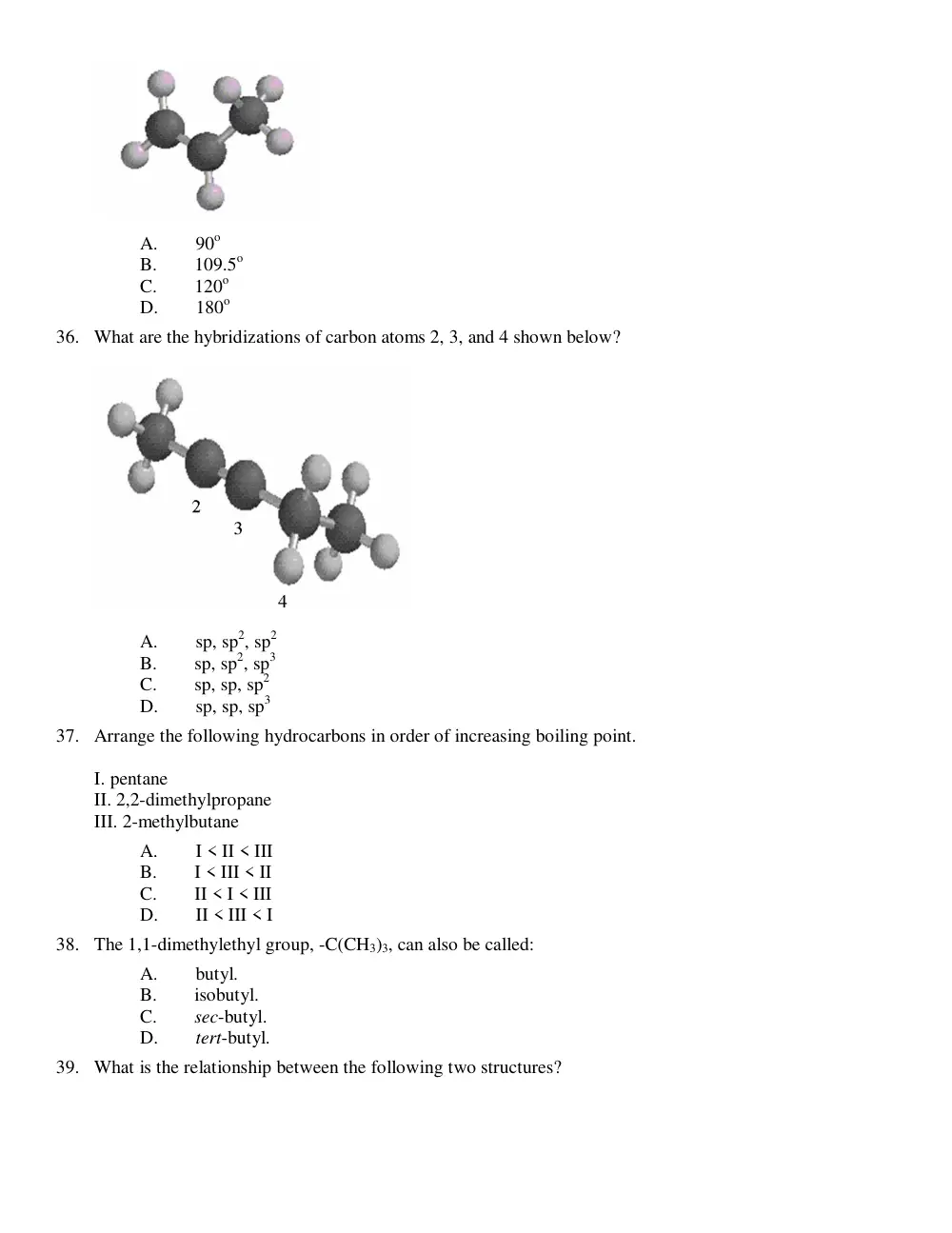
35. What is the estimated C-C-C bond angle in the following structure?
A.
90o
B.
109.5o
C.
120o
D.
180o
36. What are the hybridizations of carbon atoms 2, 3, and 4 shown below?
A.
sp, sp2, sp2
B.
sp, sp2, sp3
C.
sp, sp, sp2
D.
sp, sp, sp3
37. Arrange the following hydrocarbons in order of increasing boiling point.
I. pentane
II. 2,2-dimethylpropane
III. 2-methylbutane
A.
I < II < III
B.
I < III < II
C.
II < I < III
D.
II < III < I
38. The 1,1-dimethylethyl group, -C(CH3)3, can also be called:
A.
butyl.
B.
isobutyl.
C.
sec-butyl.
D.
tert-butyl.
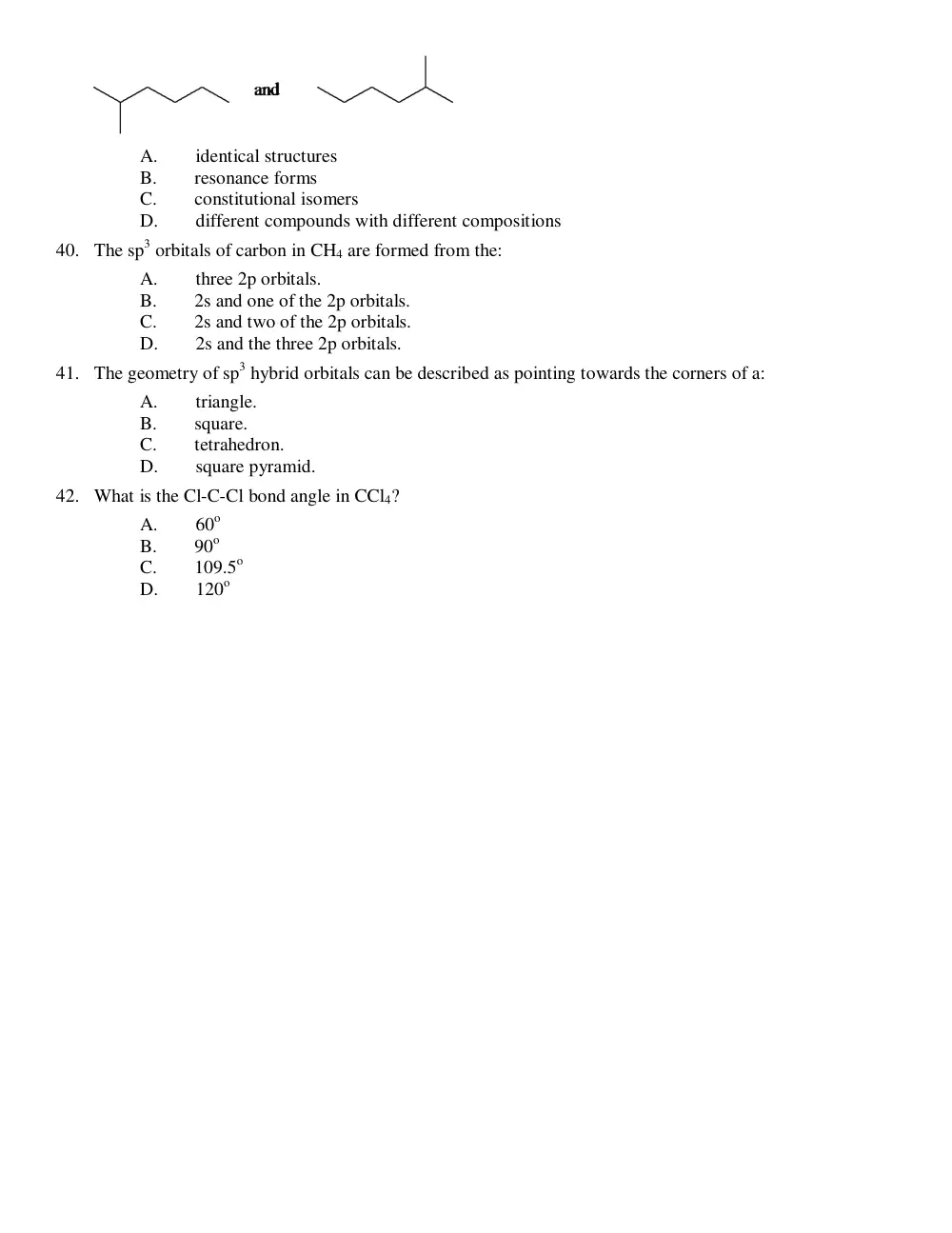
39. What is the relationship between the following two structures?
A.
identical structures
B.
resonance forms
C.
constitutional isomers
D.
different compounds with different compositions
40. The sp3 orbitals of carbon in CH4 are formed from the:
A.
three 2p orbitals.
B.
2s and one of the 2p orbitals.
C.
2s and two of the 2p orbitals.
D.
2s and the three 2p orbitals.
41. The geometry of sp3 hybrid orbitals can be described as pointing towards the corners of a:
A.
triangle.
B.
square.
C.
tetrahedron.
D.
square pyramid.
42. What is the Cl-C-Cl bond angle in CCl4?
A.
60o
B.
90o
C.
109.5o
D.
120o
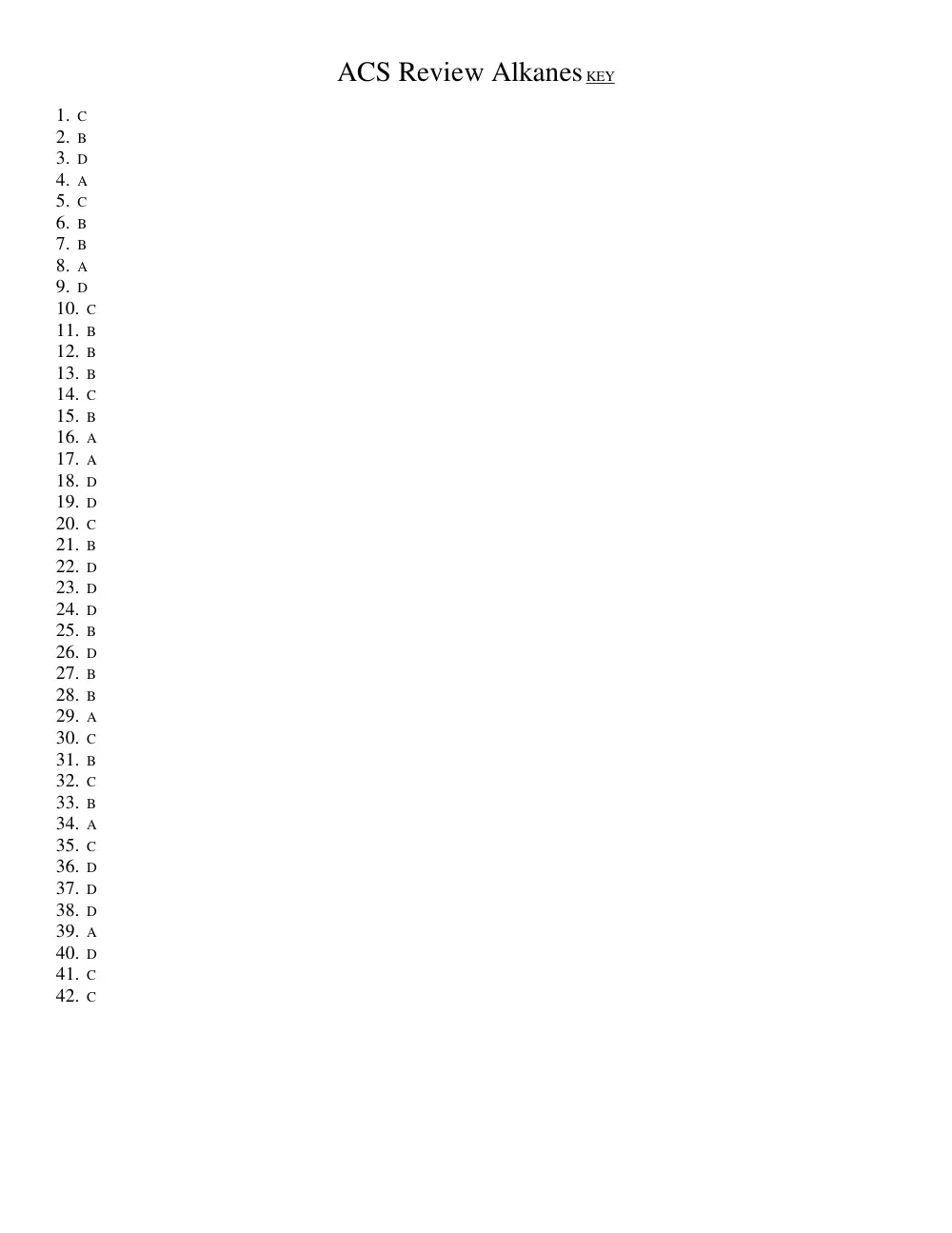
ACS Review Alkanes KEY
1. C
2. B
3. D
4. A
5. C
6. B
7. B
8. A
9. D
10. C
11. B
12. B
13. B
14. C
15. B
16. A
17. A
18. D
19. D
20. C
21. B
22. D
23. D
24. D
25. B
26. D
27. B
28. B
29. A
30. C
31. B
32. C
33. B
34. A
35. C
36. D
37. D
38. D
39. A
40. D
41. C
42. C