
CHEM 211 Problems Solution Manual Chapter 1, Fall 2013
American University of Beirut · Organic Chemistry I · 64 pages · with solution





Showing the first 10 of 64 pages. Download the PDF to see all of it.
More CHEM 211 files
- Useful File CHEM BOOK AND SOLUTION MANUAL · Spring 2015File · with solutionView
- Lecture Ch 10 Kaafarani Slides · Spring 2015LabView
- Lecture Ch 11 Kaafarani Slides · Spring 2015LabView
- Lecture Ch 12 Kaafarani Slides · Spring 2015LabView
- Lecture Ch 4 and 8 Kaafarani Slides · Spring 2015LabView
- Lecture Ch 5 Kaafarani Slides · Spring 2015LabView
- Lecture Ch 6 Kaafarani Slides · Spring 2015LabView
- Lecture Ch 7 Kaafarani Slides · Spring 2015LabView
Show the text of this chapter
Organic Chemistry
Course
American Univerity of Beirut
Chemistry
http://create.mcgraw-hill.com
Copyright
by The McGraw-Hill Companies, Inc. All rights
reserved. Printed in the United States of America. Except as
permitted under the United States Copyright Act of 1976, no part
of this publication may be reproduced or distributed in any form
or by any means, or stored in a database or retrieval system,
without prior written permission of the publisher.
This McGraw-Hill Create text may include materials submitted to
McGraw-Hill for publication by the instructor of this course.
The instructor is solely responsible for the editorial content of such
materials. Instructors retain copyright of these additional materials.
ISBN-10:
ISBN-13:
2011
1121153291
9781121153295
Contents
1. Structure Determines Properties 1
2. Alkanes and Cycloalkanes: Introduction to Hydrocarbons 37
iii
Credits
1. Structure Determines Properties: Chapter 1 from Solutions Manual to accompany Organic Chemistry, Eighth Edition
by Carey, Giuliano 1
2. Alkanes and Cycloalkanes: Introduction to Hydrocarbons: Chapter 2 from Solutions Manual to accompany
Organic Chemistry, Eighth Edition by Carey, Giuliano 37
iv
Carey−Giuliano: Solutions
Manual to accompany
Organic Chemistry, Eighth
Edition
1. Structure Determines
Properties
Text
© The McGraw−Hill
Companies, 2011
1
CHAPTER 1
Structure Determines Properties
SOLUTIONS TO TEXT PROBLEMS
1.1
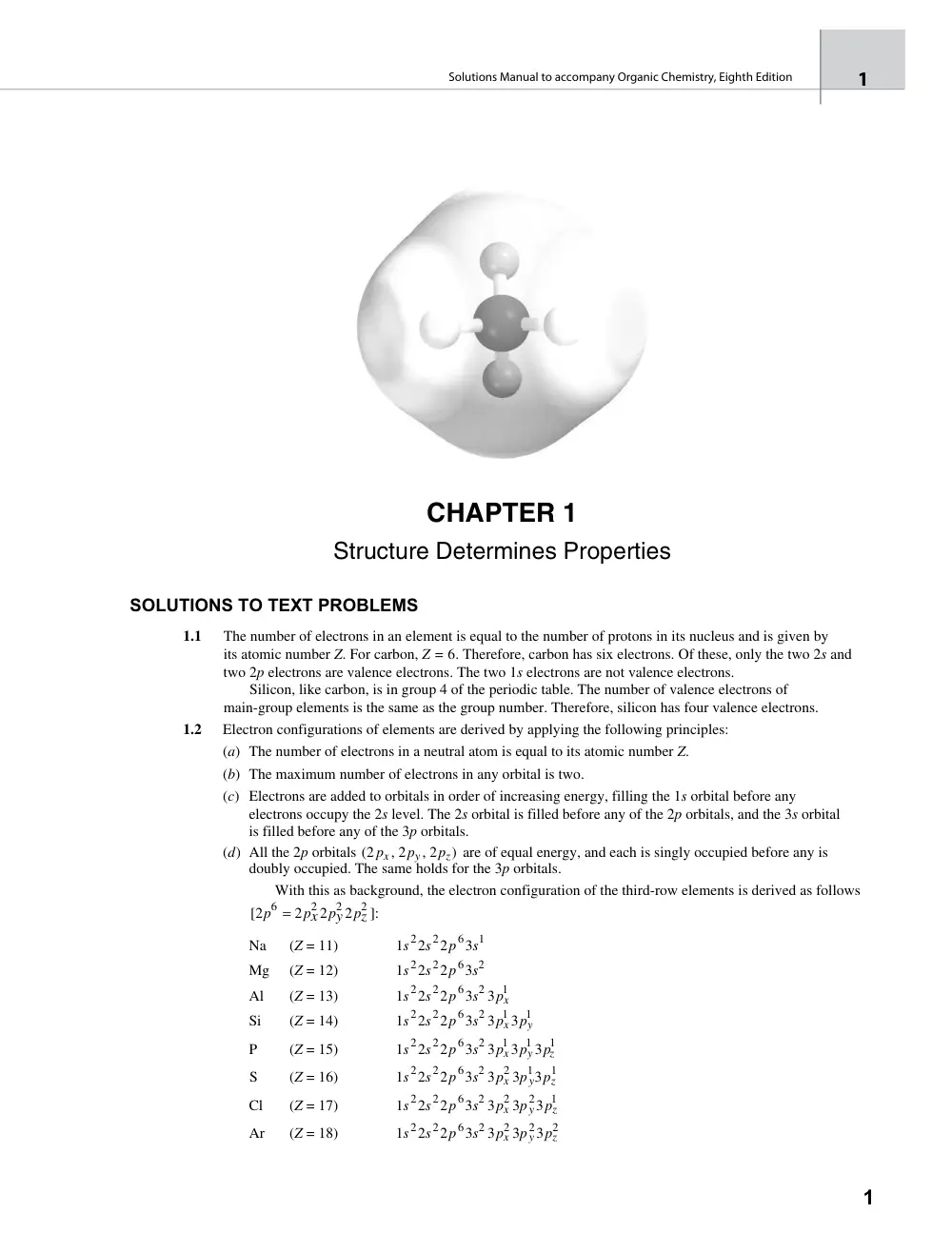
The number of electrons in an element is equal to the number of protons in its nucleus and is given by
its atomic number Z. For carbon, Z = 6. Therefore, carbon has six electrons. Of these, only the two 2s and
two 2p electrons are valence electrons. The two 1s electrons are not valence electrons.
Silicon, like carbon, is in group 4 of the periodic table. The number of valence electrons of
main-group elements is the same as the group number. Therefore, silicon has four valence electrons.
1.2
Electron configurations of elements are derived by applying the following principles:
(a) The number of electrons in a neutral atom is equal to its atomic number Z.
(b) The maximum number of electrons in any orbital is two.
(c) Electrons are added to orbitals in order of increasing energy, filling the 1s orbital before any
electrons occupy the 2s level. The 2s orbital is filled before any of the 2p orbitals, and the 3s orbital
is filled before any of the 3p orbitals.
(d) All the 2p orbitals (2 px, 2py, 2pz) are of equal energy, and each is singly occupied before any is
doubly occupied. The same holds for the 3p orbitals.
With this as background, the electron configuration of the third-row elements is derived as follows
[2p6 = 2px
2 2py
2 2pz
2 ]:
Na
(Z = 11)
1s22s22p63s1
Mg
(Z = 12)
1s22s22p63s2
Al
(Z = 13)
1s22s22p63s2 3px
1
Si
(Z = 14)
1s22s22p63s2 3px
1 3py
1
P
(Z = 15)
1s22s22p63s2 3px
1 3py
1 3pz
1
S
(Z = 16)
1s22s22p63s2 3px
2 3py
13pz
1
Cl
(Z = 17)
1s22s22p63s2 3px
2 3py
23pz
1
Ar
(Z = 18)
1s22s22p63s2 3px
2 3py
23pz
2
Solutions Manual to accompany Organic Chemistry, Eighth Edition
1
Carey−Giuliano: Solutions
Manual to accompany
Organic Chemistry, Eighth
Edition
1. Structure Determines
Properties
Text
© The McGraw−Hill
Companies, 2011
2
CHAPTER 1: Structure Determines Properties
1.3
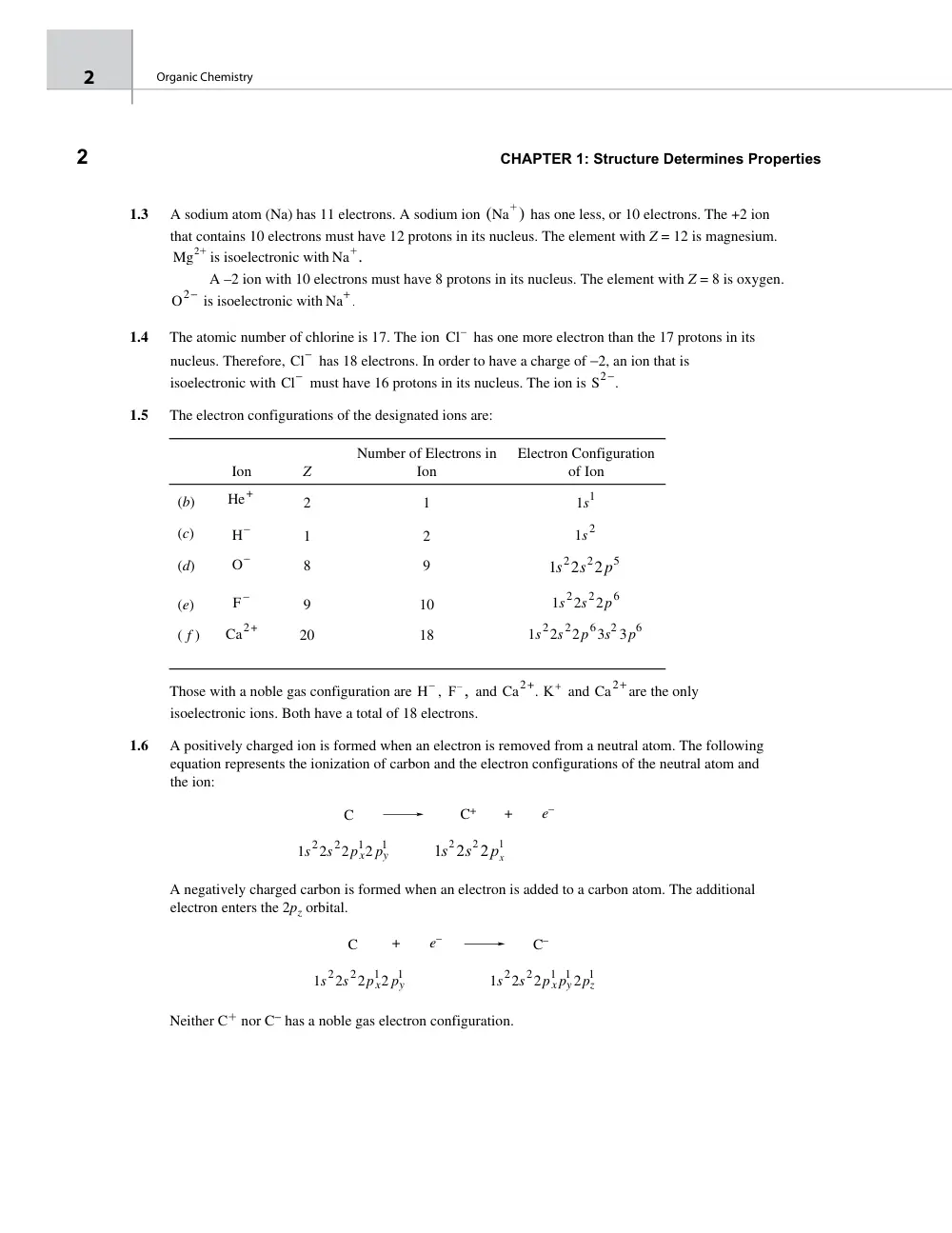
A sodium atom (Na) has 11 electrons. A sodium ion
(Na�
) has one less, or 10 electrons. The +2 ion
that contains 10 electrons must have 12 protons in its nucleus. The element with Z = 12 is magnesium.
Mg2�
is isoelectronic with
�
Na .
A –2 ion with 10 electrons must have 8 protons in its nucleus. The element with Z = 8 is oxygen.
O2− is isoelectronic with Na+ .
1.4
The atomic number of chlorine is 17. The ion
−
Cl has one more electron than the 17 protons in its
nucleus. Therefore, Cl− has 18 electrons. In order to have a charge of −2, an ion that is
isoelectronic with Cl− must have 16 protons in its nucleus. The ion is S2−.
1.5
The electron configurations of the designated ions are:
Ion
Z
Number of Electrons in
Ion
Electron Configuration
of Ion
(b)
He+
2
1
1s1
(c)
H–
1
2
1s2
(d)
O–
8
9
1s22s22p5
(e)
F –
9
10
1s22s22p6
( f )
Ca2+
20
18
1s22s22p63s2 3p6
Those with a noble gas configuration are H– ,
–
F , and Ca2+. K+ and Ca2+ are the only
isoelectronic ions. Both have a total of 18 electrons.
1.6
A positively charged ion is formed when an electron is removed from a neutral atom. The following
equation represents the ionization of carbon and the electron configurations of the neutral atom and
the ion:
C+
+
e–
C
1s22s22px
12 py
1
2
2
1
1
2
2
x
s
s
p
A negatively charged carbon is formed when an electron is added to a carbon atom. The additional
electron enters the 2pz orbital.
C
+
e–
C–
1s22s22px
12 py
1
1s22s22px
1 py
1 2pz
1
Neither C� nor C− has a noble gas electron configuration.
2
Organic Chemistry
Carey−Giuliano: Solutions
Manual to accompany
Organic Chemistry, Eighth
Edition
1. Structure Determines
Properties
Text
© The McGraw−Hill
Companies, 2011
CHAPTER 1: Structure Determines Properties
3
1.7
(b) In order to have four bonds to carbon, CH4O must have a carbon–oxygen bond.
C
H
H
H
O
H
H
H
H
H
O O
or
H
H
H
H
C
O
Combine carbon,
oxygen, and
four hydrogens
to write a
Lewis structure
for methanol
The 14 valence electrons of CH4O are distributed among five covalent bonds and two unshared
pairs of oxygen.
(c) Three of the four bonds involving carbon are to hydrogen atoms; the fourth is to fluorine. Carbon
contributes four electrons, fluorine seven, and the three hydrogens contribute one each. The total number
of valence electrons in CH3F is 14.
C
H
H
H
F
H
H
H
C
or
H
H
H
C
F
to write a
Lewis structure
for methyl fluoride
Combine carbon,
fluorine, and
three hydrogens
F
The 14 valence electrons of CH3F are distributed among four covalent bonds and three unshared
pairs of fluorine.
(d ) The only possible structure for C2H5F in which each carbon has four bonds must contain a
carbon–carbon bond.
The number of valence electrons in C2H5F is 20; eight contributed by two carbons, seven by
fluorine, and a total of five by the hydrogens. These 20 valence electrons are distributed among
7 covalent bonds plus three unshared electron pairs of fluorine in C2H5F.
1.8
(b) Hydrogen cyanide (HCN) has 10 valence electrons; one from hydrogen, four from carbon, and five
from nitrogen.
C
H
N
to give
Combine
N
C
H
In order to satisfy the octet rule, pair the remaining unpaired electrons of carbon with those of
nitrogen so as to give a triple bond in:
H
or
C
N
C
H
N
1.9
The partial positive charge of hydrogen is greatest when the atom it is attached to is most
electronegative. Among the atoms to which hydrogen is bonded in the compounds CH4, NH3, H2O,
SiH4, and H2S, oxygen is the most electronegative. Therefore, δ+ is largest for hydrogen in H2O.
Hydrogen will bear a partial negative charge when the atom to which it is bonded is less
electronegative than hydrogen. The electronegativity of hydrogen is 2.1 versus 1.8 for silicon
(text Table 1.3). Therefore, hydrogen bears a partial negative charge in SiH4.
Solutions Manual to accompany Organic Chemistry, Eighth Edition
3
Carey−Giuliano: Solutions
Manual to accompany
Organic Chemistry, Eighth
Edition
1. Structure Determines
Properties
Text
© The McGraw−Hill
Companies, 2011
4
CHAPTER 1: Structure Determines Properties
1.10 The Pauling electronegativity scale (text Table 1.3) may be used to solve this problem. For instance, for the
bond
H
O, hydrogen is 2.1 and oxygen has a higher value of 3.5. This can be qualitatively represented
two different ways as shown in the first answer in (a) and (b). The � part of the arrow indicates the
electropositive atom in (a).
Alternatively, for (b), the δ+ symbol indicates the electropositive atom whereas the δ− indicates the
electronegative atom.
The periodic table may also be helpful in assigning electronegativity. Electronegativity increases from left to
right across a row. It decreases down a column or group. For instance, for the third entry in (a) and (b),
C
O, carbon is to the left of oxygen on the periodic table; thus, carbon is less electronegative as indicated.
H
O
H
N
C
O
C
O
C
N
C
N
(a)
H
O
H
N
C
O
C
O
C
N
C
N
C
N
C
N
(b)
1.11 (b) The formal charges in sulfuric acid are calculated as follows:
Valence Electrons in
Neutral Atom
Electron Count
Formal Charge
Hydrogen:
1
1
2 (2)=1
0
Oxygen (of OH):
6
1
2 (4)
4
+ = 6
0
Oxygen:
6
1
2 (2)
6
+ = 7
−1
Sulfur:
6
1
2 (8)
0
+ = 4
+2
S
O
O
O
O
H
H
2+
(c) The formal charges in nitrous acid are calculated as follows:
Valence Electrons in
Neutral Atom
Electron Count
Formal Charge
Hydrogen:
1
1
2 (2)
=1
0
Oxygen (of OH):
6
1
2 (4)
4
+ = 6
0
Oxygen:
6
1
2 (4) + 4 = 6
0
Nitrogen:
5
1
2 (6) + 2 = 5
0
N
O
O
H
4
Organic Chemistry
Carey−Giuliano: Solutions
Manual to accompany
Organic Chemistry, Eighth
Edition
1. Structure Determines
Properties
Text
© The McGraw−Hill
Companies, 2011
CHAPTER 1: Structure Determines Properties
5
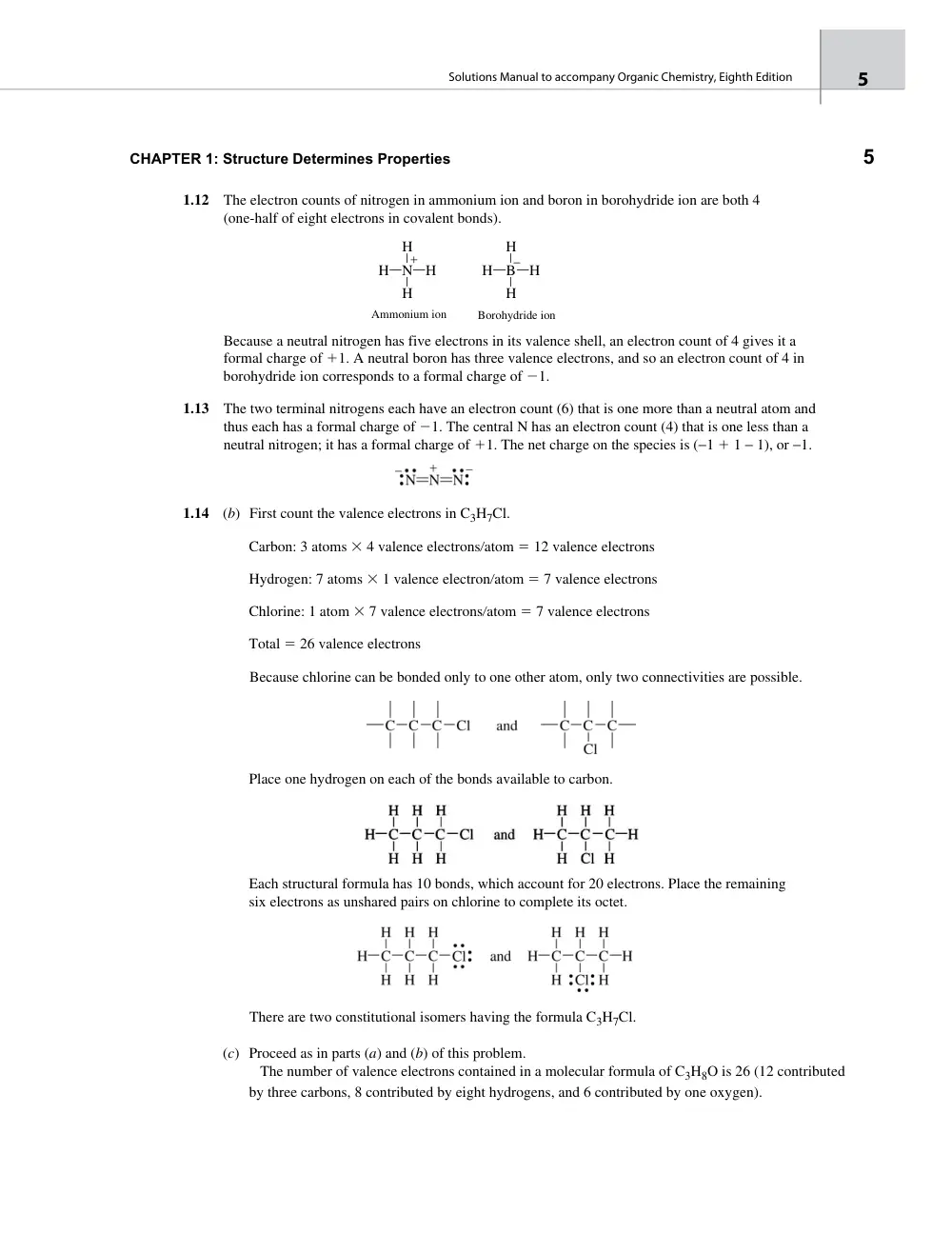
1.12 The electron counts of nitrogen in ammonium ion and boron in borohydride ion are both 4
(one-half of eight electrons in covalent bonds).
N
H
H
H
H
B
H
H
H
H
Ammonium ion
Borohydride ion
Because a neutral nitrogen has five electrons in its valence shell, an electron count of 4 gives it a
formal charge of �1. A neutral boron has three valence electrons, and so an electron count of 4 in
borohydride ion corresponds to a formal charge of �1.
1.13 The two terminal nitrogens each have an electron count (6) that is one more than a neutral atom and
thus each has a formal charge of �1. The central N has an electron count (4) that is one less than a
neutral nitrogen; it has a formal charge of �1. The net charge on the species is (−1 � 1 − 1), or −1.
1.14 (b) First count the valence electrons in C3H7Cl.
Carbon: 3 atoms � 4 valence electrons�atom � 12 valence electrons
Hydrogen: 7 atoms � 1 valence electron�atom � 7 valence electrons
Chlorine: 1 atom � 7 valence electrons�atom � 7 valence electrons
Total � 26 valence electrons
Because chlorine can be bonded only to one other atom, only two connectivities are possible.
Place one hydrogen on each of the bonds available to carbon.
Each structural formula has 10 bonds, which account for 20 electrons. Place the remaining
six electrons as unshared pairs on chlorine to complete its octet.
There are two constitutional isomers having the formula C3H7Cl.
(c) Proceed as in parts (a) and (b) of this problem.
The number of valence electrons contained in a molecular formula of C3H8O is 26 (12 contributed
by three carbons, 8 contributed by eight hydrogens, and 6 contributed by one oxygen).
Solutions Manual to accompany Organic Chemistry, Eighth Edition
5
Carey−Giuliano: Solutions
Manual to accompany
Organic Chemistry, Eighth
Edition
1. Structure Determines
Properties
Text
© The McGraw−Hill
Companies, 2011
6
CHAPTER 1: Structure Determines Properties
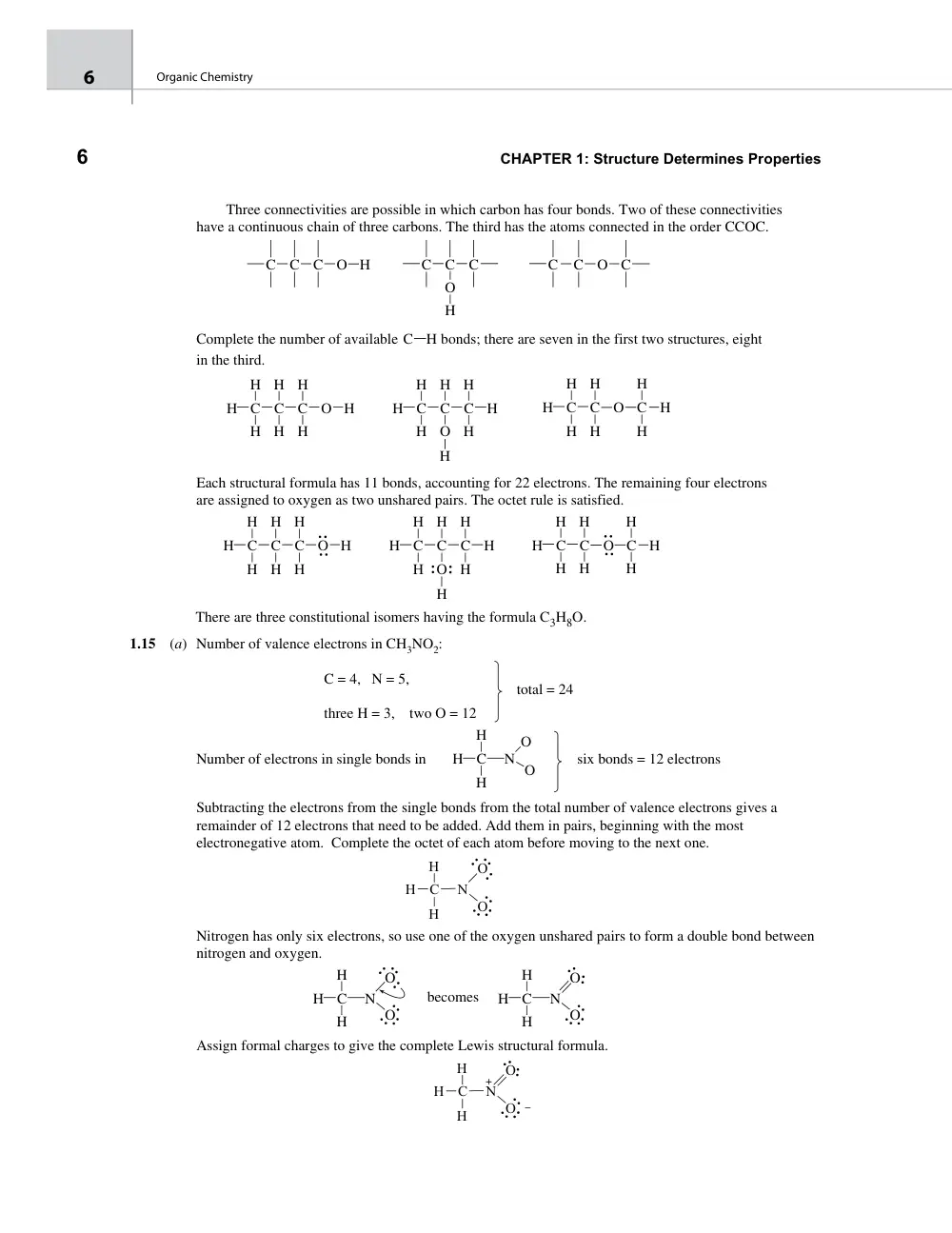
Three connectivities are possible in which carbon has four bonds. Two of these connectivities
have a continuous chain of three carbons. The third has the atoms connected in the order CCOC.
C
C
C
O
O
C
H
C
C
C
O
H
C
C
Complete the number of available C H bonds; there are seven in the first two structures, eight
in the third.
C
H
H
H
C
C
H
H
H
H
O
C
H
H
H
C
C
H
O
H
H
H
H
H
C
H
H
H
C
H
H
H
O
C
H
H
Each structural formula has 11 bonds, accounting for 22 electrons. The remaining four electrons
are assigned to oxygen as two unshared pairs. The octet rule is satisfied.
C
H
H
H
C
C
H
H
H
H
O
C
H
H
H
C
C
H
O
H
H
H
H
H
C
H
H
H
C
H
H
H
C
H
H
O
There are three constitutional isomers having the formula C3H8O.
1.15 (a) Number of valence electrons in CH3NO2:
C = 4, N = 5,
three H = 3, two O = 12
total = 24
C
H
H
H
N O
O
Number of electrons in single bonds in
six bonds = 12 electrons
Subtracting the electrons from the single bonds from the total number of valence electrons gives a
remainder of 12 electrons that need to be added. Add them in pairs, beginning with the most
electronegative atom. Complete the octet of each atom before moving to the next one.
C
H
H
H
N
O
O
Nitrogen has only six electrons, so use one of the oxygen unshared pairs to form a double bond between
nitrogen and oxygen.
C
H
H
H
N
O
O
C
H
H
H
N
O
O
becomes
Assign formal charges to give the complete Lewis structural formula.
C
H
H
H
N
O
O
6
Organic Chemistry
Carey−Giuliano: Solutions
Manual to accompany
Organic Chemistry, Eighth
Edition
1. Structure Determines
Properties
Text
© The McGraw−Hill
Companies, 2011
CHAPTER 1: Structure Determines Properties
7
(b) Number of valence electrons in C2H5NO:
Two C = 8, N = 5,
five H = 5, O = 6
total = 24
H
C
H
H
C
O
N
H
H
eight bonds = 16 electrons
Number of electrons in single bonds in
Subtracting the electrons from the single bonds from the total number of valence electrons gives a
remainder of eight electrons that need to be added. Add them in pairs, beginning with the most
electronegative atom. Complete the octet of each atom before moving to the next one.
C
O
C
H
H
H
N
H
H
Carbon has only six electrons, so use one of the oxygen unshared pairs to form a double bond between
carbon and oxygen. In this compound, there are no formal charges.
becomes
C
O
C
H
H
H
N
H
H
C
O
C
H
H
H
N
H
H
(c) Number of valence electrons in C2H5NO:
Two C = 8, N = 5,
five H = 5, O = 6
total = 24
H
C
H
H
C
N
H
O
H
Number of electrons in single bonds in
eight bonds = 16 electrons
Subtracting the electrons from the single bonds from the total number of valence electrons gives a
remainder of eight electrons that need to be added.
Solutions Manual to accompany Organic Chemistry, Eighth Edition
7
Carey−Giuliano: Solutions
Manual to accompany
Organic Chemistry, Eighth
Edition
1. Structure Determines
Properties
Text
© The McGraw−Hill
Companies, 2011
8
CHAPTER 1: Structure Determines Properties
Add them in pairs, beginning with the most electronegative atom. Complete the octet of each atom
before moving to the next one.
H
C
H
H
C
N
H
O
H
Carbon has only six electrons, so use one of the nitrogen unshared pairs to form a double bond
between nitrogen and carbon. In this compound, there are no formal charges.
H
C
H
H
C
N
H
O
H
H
C
H
H
C
N
H
O
H
becomes
1.16
The resonance structures for carbonate are shown here. If one considers the top carbon–oxygen bond in each
of the resonance structures, the left structure has a double bond whereas the other two structures have single
bonds. If one considers the remaining two carbon–oxygen bonds in each structure, each has the same count:
one double and two single bonds. Thus, all three carbon–oxygen bonds would be predicted to have
equivalent lengths.
O
O C
O
O
O C
O
O
C O
O
1.17 (b) Carbon has only six valence electrons and is positively charged in the original structural formula.
Move the unshared electron pair from nitrogen to a shared position between nitrogen and carbon.
The double bond becomes a triple bond.
C
N
H
H
C
N
H
H
The new structure has one more bond than the original structure so is more stable and makes a
greater contribution to the resonance hybrid. The octet rule is satisfied for both carbon and nitrogen
in the new Lewis structure.
(c) Moving an unshared pair from oxygen to between carbon and oxygen converts C
O to C O.
Moving a pair of electrons to nitrogen converts C
N to C
N.
H
C
O
N
H
H
C
O
N
H
The number of bonds is the same in both the original and final structural formulas. The original
structure, which has its negative charge on oxygen, is more stable than the second one, which has
its negative charge on nitrogen. Oxygen is more electronegative than nitrogen and can bear a
negative charge better.
(d) Reorganizing the electrons as indicated by the curved arrows changes the electron counts and
formal charges of the two oxygens.
H
O
N
O
O
N
H
O
8
Organic Chemistry
Carey−Giuliano: Solutions
Manual to accompany
Organic Chemistry, Eighth
Edition
1. Structure Determines
Properties
Text
© The McGraw−Hill
Companies, 2011
CHAPTER 1: Structure Determines Properties
9
Positively and negatively charged atoms are separated from each other in the new structure. The original
structure is more stable because it has no charge separation.
1.18 (b) The compound (CH3)3 CH has a central carbon to which are attached three CH3 groups and a hydrogen.
C
H
H
H
C
H
C
H
H
H
C
H
H
H
Four carbons and ten hydrogens contribute 26 valence electrons. The structure shown has 13 covalent
bonds, and so all the valence electrons are accounted for. The molecule has no unshared electron pairs.
(c) The number of valence electrons in ClCH2CH2Cl is 26 (2Cl � 14; 4H � 4; 2C � 8). The constitution at
the left shows seven covalent bonds accounting for 14 electrons. The remaining 12 electrons are divided
equally between the two chlorines as unshared electron pairs. The octet rule is satisfied for both carbon
and chlorine in the structure at the right.
C
Cl
H
H
C
H
H
Cl
C
Cl
H
H
C
H
H
Cl
(d) This compound has the same molecular formula as the compound in part (c) but a different structure. It
is a constitutional isomer of the compound in part (c). It, too, has 26 valence electrons, and again only
chlorine has unshared pairs.
C
H
H
H
C
Cl
H
Cl
(e) The connectivity of CH3NHCH2CH3 is shown (on the left). There are 26 valence electrons, and 24 of
them are accounted for by the covalent bonds in the structural formula. The remaining two electrons
complete the octet of nitrogen as an unshared pair (on the right).
C
H
H
H
N
H
C
H
H
C
H
H
H
C
H
H
H
N
H
C
H
H
C
H
H
H
( f ) Oxygen has two unshared pairs in (CH3)2CHCH
O.
C
H
H
H
C
H
C
H
C
H
H
H
O
Solutions Manual to accompany Organic Chemistry, Eighth Edition
9
Carey−Giuliano: Solutions
Manual to accompany
Organic Chemistry, Eighth
Edition
1. Structure Determines
Properties
Text
© The McGraw−Hill
Companies, 2011
10
CHAPTER 1: Structure Determines Properties
1.19 (b) This compound has a four-carbon chain to which two other carbons are attached.
is equivalent to
C
H3C
CH3
H
C
CH3
CH3
H
which may be rewritten as (CH3)2 CHCH(CH3 )2
(c) The carbon skeleton is the same as that of the compound in part (b), but one of the terminal carbons
bears an OH group in place of one of its hydrogens.
O
H
is equivalent to
C
H
C
CH3
C
H
H
HO
H3C
H
CH3
which may be rewritten as
CH2OH
CHCH(CH3)2
CH3
(d) The compound is a six-membered ring that bears a
C(CH3)3 substituent.
is
equivalent
to
C
C
C
C
C
C
H
H
H
H
H
H
H H
H H
H
C
CH3
CH3
CH3
which may be
rewritten as
C(CH3)3
1.20 (a) Writing out the bond-line formula or carbon skeletal diagram to show all of the hydrogen and carbon
atoms as shown in Problem 1.19 allows for the counting of each atom. In the case of the first molecule,
the diagram
C C C C C C C C C C
H
H
H H
H
H
H
H
H
H
H
H
H
H
H
H
H
H
H
H
H
H
Molecular formula: C10H22
is equivalent to
This conversion clearly shows that 10 carbon atoms and 22 hydrogen atoms are present. Thus, the
formula C10H22 can be determined by counting the number of carbons and hydrogens.
Refer to Problem 1.19 to see the expanded formulas for the remaining structures (b) through (d). By
counting the individual atoms, the remaining problems are solved similarly.
HO
Molecular formula: C6H14O
Molecular formula: C6H14
Molecular formula: C10H20
10
Organic Chemistry
Carey−Giuliano: Solutions
Manual to accompany
Organic Chemistry, Eighth
Edition
1. Structure Determines
Properties
Text
© The McGraw−Hill
Companies, 2011
CHAPTER 1: Structure Determines Properties
11
(b) For cholesterol, the molecular formula can be determined as before, drawing out all of the carbon,
hydrogen, and oxygen atoms as shown here.
CH3
CH3
HO
CH3
CH3
C
C C C
C
C
C C
C C
C
C C
C
C
C
C
C
C
HO
C
C
C
C C
C CH3
CH3
H
H
H
H
H
H
H
H
H H
H
H
H H
H H
HH
H
H
H
H
H
H
H
H
H
H
H
H
H
H
H
H
H
H
H H
H
Molecular formula: C27H46O
is equivalent to
1.21 There are four B
H bonds in BH4−. The four electron pairs surround boron in a tetrahedral orientation.
The
B
H
H angles are 109.5°.
1.22 (b) Nitrogen in ammonium ion is surrounded by eight electrons in four covalent bonds. These four
bonds are directed toward the corners of a tetrahedron.
H
N+
H
H
Each HNH angle is 109.5°.
.
H
(c) Double bonds are treated as a single unit when deducing the shape of a molecule using the
VSEPR model. Thus azide ion is linear.
N
N
The NNN angle is 180°.
+
N
(d) Because the double bond in carbonate ion is treated as if it were a single unit, the three sets of
electrons are arranged in a trigonal planar arrangement around carbon.
The OCO angle is 120°.
C
O
O
O
1.23 (b) Water is a bent molecule, and so the individual O
H bond dipole moments do not
cancel. Water has a dipole moment.
O
Individual OH bond
moments in water
H O
H
H
H
Direction of net
dipole moment
(c) Methane, CH4, is perfectly tetrahedral, and so the individual (small) C
H bond dipole
moments cancel. Methane has no dipole moment.
(d) Methyl chloride has a dipole moment.
Solutions Manual to accompany Organic Chemistry, Eighth Edition
11
Carey−Giuliano: Solutions
Manual to accompany
Organic Chemistry, Eighth
Edition
1. Structure Determines
Properties
Text
© The McGraw−Hill
Companies, 2011
12
CHAPTER 1: Structure Determines Properties
H
C
H
H
Cl
H
C
H
H
Cl
Directions of bond dipole
moments in CH3Cl
Direction of molecular
dipole moment
(e) Oxygen is more electronegative than carbon and attracts electrons from it. Formaldehyde
has a dipole moment.
C
H
O
C
H
O
Direction of bond dipole
moments in formaldehyde
Direction of molecular
dipole moment
H
H
(f) Nitrogen is more electronegative than carbon. Hydrogen cyanide has a dipole moment.
Directions of bond dipole
moments in HCN
Direction of molecular
dipole moment
H
C
N
H
C
N
1.24 (b) The carbon–bromine bond breaks. The pair of electrons in that bond is retained by bromine,
which becomes a bromide ion in the product. The organic product is a cation, having a formal
charge of �1 on the central carbon.
C
CH3
CH3
H3C
Br
Br
C
H3C
CH3
CH3
Charge is conserved. A neutral molecule dissociates to a �1 ion and a �1 ion.
1.25 (b) In the reverse process, an unshared pair of bromide ions becomes the pair of electrons in a C–Br bond.
C
CH3
CH3
H3C
Br
Br
C
H3C
CH3
CH3
1.26 The problem states that NaSH is converted to H2S. Therefore, a bond must form between the sulfur of HS�
and a hydrogen of H3O�. Electrons flow from the negatively charged sulfur to one of the hydrogens. The
pair of electrons in the O–H bond that is broken becomes an unshared pair of oxygens.
O
H
H
H
S
H
O
H
H
S
H
H
The net charge is zero on both sides of the equation.
1.27 The strength of an acid can be expressed by its pKa, given by the expression:
K
K
a =
a
p
log
�
The Ka of salicylic acid is
3
1.06 10 ;
�
�
its pKa is 2.97.
12
Organic Chemistry
Carey−Giuliano: Solutions
Manual to accompany
Organic Chemistry, Eighth
Edition
1. Structure Determines
Properties
Text
© The McGraw−Hill
Companies, 2011
CHAPTER 1: Structure Determines Properties
13
1.28 Because the pKa of HCN is given as 9.1, its Ka � 10−9.1. In more conventional notation,
Ka � 8 � 10−10.
1.29 (b) In an acid–base reaction, a proton is transferred from the Brønsted acid, in this case HCl, to the
Brønsted base, in this case (CH3)3N . Remember to use curved arrows to track the movement
of electrons, not atoms.
(CH3)3N
H
Cl
(CH3)3N H
Cl
+
Trimethylamine
Hydrogen chloride
Trimethylammonium
ion
(base)
(acid)
(conjugate acid)
Chloride ion
+
(conjugate base)
+
1.30 Hydride ion is a strong base and will remove a proton from water. The conjugate acid of hydride ion is
hydrogen (H2).
H
O
H
H
H
H
+
O
H
Hydrogen
(conjugate acid)
Hydroxide ion
(conjugate base)
Hydride ion
(base)
Water
(acid)
1.31 (b, c) You can determine the relative strength of two bases by comparing the pKa’s of their respective
conjugate acids. Remember that the stronger base is derived from the weaker conjugate acid.
HC
C
CH3CH2O
CH
HC
NH3
CH3CH2OH
H2N
Base:
Conjugate acid:
pKa of conjugate acid:
26
36
16
Recall that the smaller pKa is associated with the stronger acid. Ammonia is a weaker acid than
acetylene (HC
CH); therefore, amide ion H2N
(
) is a stronger base than acetylide ion ( HC
C
).
Similar reasoning leads to the conclusion that because acetylene is a weaker acid than ethanol
(CH3CH2OH), acetylide ion is a stronger base than ethoxide ion CH3CH2O
(
).
1.32 Bond strength weakens going down a group in the periodic table. Because sulfur lies below
oxygen, the H
S bond is weaker than the H
O bond. We would expect
2
H S to be a stronger
acid than H2O, and this prediction is borne out by their respective pKa’s:
H2S
H2O
pKa
9
15.7
Because the stronger acid forms the weaker conjugate base, HS– is a weaker base than HO– .
Solutions Manual to accompany Organic Chemistry, Eighth Edition
13
Carey−Giuliano: Solutions
Manual to accompany
Organic Chemistry, Eighth
Edition
1. Structure Determines
Properties
Text
© The McGraw−Hill
Companies, 2011
14
CHAPTER 1: Structure Determines Properties
1.33 (b) In part (a) of the problem, you determined that (CH3)2OH is a stronger acid than (CH3)3NH.
Recalling that the weaker acid forms the stronger conjugate base, (CH3)3N
is a stronger base
than (CH3)2O .
1.34 To compare the strength of bases, look up the pKa’s of their conjugate acids. Ethanol has a pKa of 16;
tert-butyl alcohol has a pKa of 18. Ethanol is a stronger acid than tert-butyl alcohol. Therefore
tert-butoxide ion is a stronger base than ethoxide.
1.35 The Brønsted acid–base equilibria for the ionization of hypochlorous and hypobromous acid are
The positive character (δ�) of the proton in HOCl is greater than the proton in HOBr because Cl is
more electronegative than Br. The greater electronegativity of Cl compared to Br also stabilizes ClO�
compared to BrO� and makes the equilibrium for the ionization of HOCl more favorable. Therefore,
hypochlorous acid is a stronger acid than hypobromous acid. (This prediction is borne out by the
measured pKa’s: HOCl = 7.5; HOBr = 8.7. The trend continues with HOI, which has a pKa of 10.6.)
1.36 The three oxygens in nitrate ion share a total charge of −2. The average formal charge on each oxygen
atom is −2/3 = −0.67.
1.37 Writing the two resonance forms of each conjugate base reveals that they are equivalent.
CH3C
O
S
H
H
CH3C
O
S
CH3C
S
O
H
H
CH3C
S
O
CH3C
O
S
CH3C
S
O
+
+
Oxygen is more electronegative than sulfur and will bear a greater share of the negative charge.
14
Organic Chemistry
Carey−Giuliano: Solutions
Manual to accompany
Organic Chemistry, Eighth
Edition
1. Structure Determines
Properties
Text
© The McGraw−Hill
Companies, 2011
CHAPTER 1: Structure Determines Properties
15
1.38 (b) Begin by writing the equation for the acid–base reaction between acetic acid and fluoride ion.
Acetic acid will donate a proton to fluoride ion, converting acetic acid to its conjugate base
(acetate ion) and fluoride ion to its conjugate acid, (hydrogen fluoride).
From the respective pKa’s of the acids, you can see that the weaker acid (acetic acid) is on the left
and the stronger acid (hydrogen fluoride) is on the right. Therefore, the equilibrium lies to the left.
The equilibrium constant for the process is
Keq =
10�pKa of hydrogen fluoride (product)
10�pKa of acetic acid (reactant)
= 10�4.7
10�3.1 =10�1.6
1.39 Sulfuric acid is a strong acid; the
a
pK of the first ionization of H2SO4 is −4.8. In an aqueous solution of
a strong acid, the predominant acid species is
+
3
H O . Hydrogen sulfate ion is a weak acid (pKa =2.0)
and will only undergo ionization to a small extent. The relative amounts of the species present will be
2
3
4
4
2
4
[H O ]
[HSO
]
[SO
]
[H SO ]
+
−
−
>
>
>
1.40 Comparing the pKa’s of phenol and water reveals that, indeed, the stronger acid (phenol) is on the left
in the acid–base equation and the equilibrium constant is greater than 1.
C6H5OH
HO
C6H5O
H2O
+
+
Phenol
Water
pKa = 10
(stronger acid)
pKa = 15.7
(weaker acid)
The same comparison for the reaction of phenol and hydrogen carbonate ion reveals that the stronger
acid (carbonic acid) is on the right and the equilibrium constant is less than one.
C6H5OH
HOCO
O
C6H5O
HOCOH
O
+
+
Phenol
Carbonic acid
pKa = 10
(weaker acid)
pKa = 6.4
(stronger acid)
1.41 Boron trifluoride is a Lewis acid and will accept a pair of electrons from dimethyl sulfide to form a
Lewis acid–Lewis base complex.
(CH3)2S
BF3
(CH3)2S
BF3
+
Solutions Manual to accompany Organic Chemistry, Eighth Edition
15
Carey−Giuliano: Solutions
Manual to accompany
Organic Chemistry, Eighth
Edition
1. Structure Determines
Properties
Text
© The McGraw−Hill
Companies, 2011
16
CHAPTER 1: Structure Determines Properties
1.42
All these species are characterized by the formula
X
Y , and each atom has an electron count of 5.
X
Y
Unshared electron pair
contributes two electrons
to electron count of X.
Triple bond contributes half of its six
electrons, or three electrons each, to
separate electron counts of X and Y.
Unshared electron pair
contributes two electrons
to electron count of Y.
Electron count X � electron count Y � 2 � 3 � 5.
(a)
N
N
A neutral nitrogen atom has five valence electrons: therefore, each atom is
electrically neutral in molecular nitrogen.
(b)
C
N
Nitrogen, as before, is electrically neutral. A neutral carbon has four valence
electrons, and so carbon in this species, with an electron count of 5, has a unit
negative charge. The species is cyanide anion; its net charge is −1.
(c)
C
C
There are two negatively charged carbon atoms in this species. It is a dianion;
its net charge is −2.
(d)
N
O
Here again is a species with a neutral nitrogen atom. Oxygen, with an electron
count of 5, has one less electron in its valence shell than a neutral oxygen atom.
Oxygen has a formal charge of +1; the net charge is +1.
(e)
C
O
Carbon has a formal charge of −1; oxygen has a formal charge of +1. Carbon
monoxide is a neutral molecule.
1.43
(a, b) The problem specifies that ionic bonding is present and that the anion is tetrahedral. The cations
are the group 1 metals Na+ and Li+. Both boron and aluminum are group 3 elements and, thus,
have a formal charge of −1 in the tetrahedral anions BF4
– and AlH4
– , respectively.
Na
F
B
F
F
F
Sodium tetrafl