
CHEM 313 Final, Spring 1997
American University of Beirut · Physical Organic Chemistry · 9 pages

Show the text of this final exam
Chem 313
Final Exam, June 24, 1997
Prof D. Naud
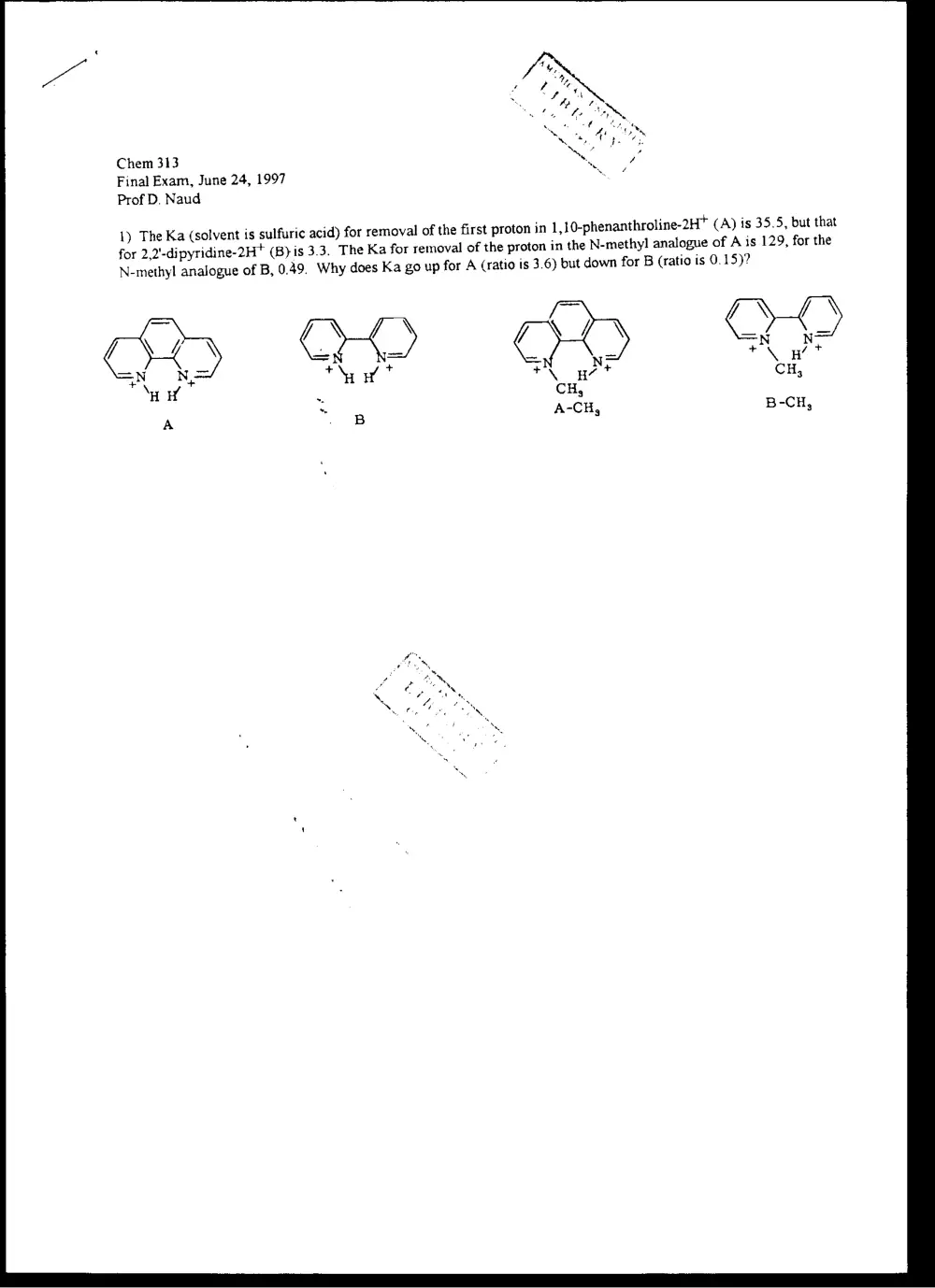
1) The Ka (solvent is sulfuric acid) for removal of the first proton in 1,10-phenanthroline-2H* (A) is 35.5, but that
for 2,2'-dipyridine-2H* (B) is 3.3. The Ka for removal of the proton in the N-methyl analogue of A is 129, for the
N-methyl analogue of B, 0.49. Why does Ka go up for A (ratio is 3.6) but down for B (ratio is 0.15)?
ave Qe
“a * Not’
A ~ B B-CH,
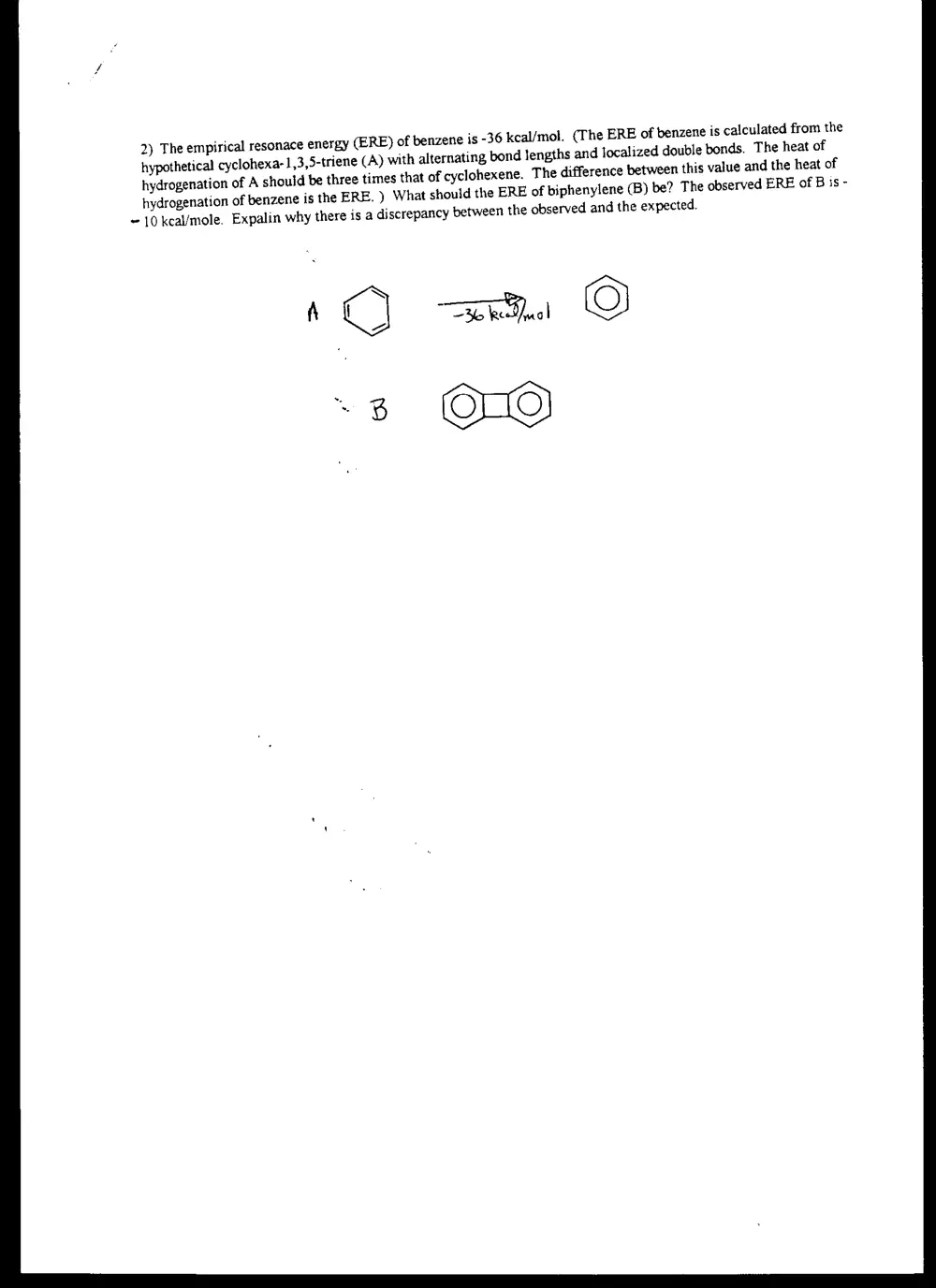
2) The empirical resonace energy (ERE) of benzene is -36 kcal/mol, (The ERE of benzene is calculated from the
hypothetical cyclohexa- 1,3,5-triene (A) with alternating bond lengths and localized double bonds. The heat of
hydrogenation of A should be three times that of cyclohexene. The difference between this value and the heat of
hydrogenation of benzene is the ERE. ) What should the ERE of biphenylene (B) be? The observed ERE of B is -
~ 10 kcal/mole, Expalin why there is a discrepancy between the observed and the expected.
A OC Ta Teal Oo
-s GO
3) In order for AAG® (or AAG*) of a series of reactants to be linearly proportional to the AA
G° of another series of
reactants, one of three conditions must be met. What are these three conditions?
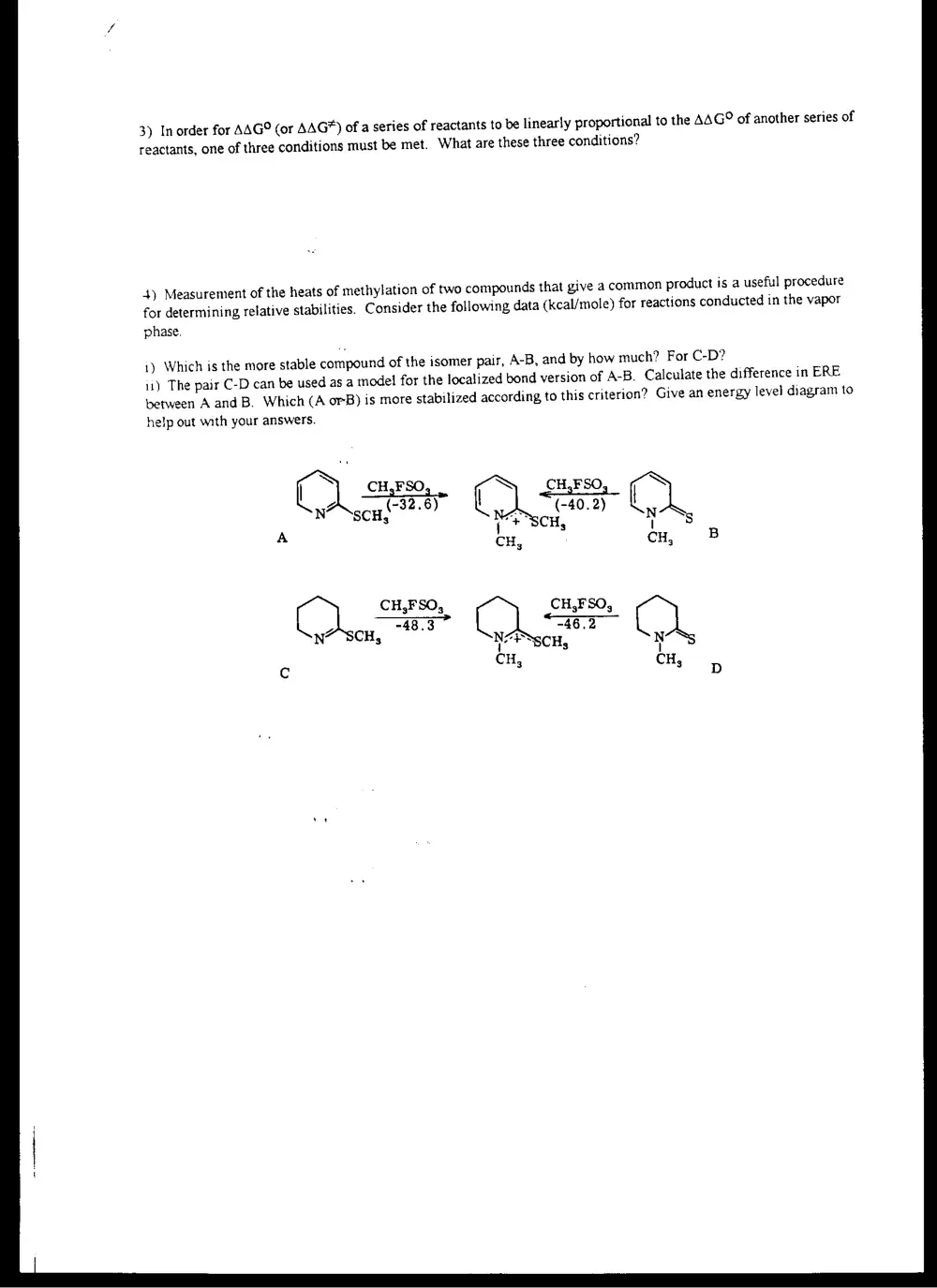
4) Measurement of the heats of methylation of two compounds that give a common product is a useful procedure
for determining relative stabilities. Consider the following data (kcal/mole) for reactions conducted in the vapor
phase.
1) Which is the more stable compound of the isomer pair, A-B, and by how much? For C-D?
ii) The pair C-D can be used as a model for the localized bond version of A-B. Calculate the difference in ERE
between A and B. Which (A orB) is more stabilized according to this criterion? Give an energy level diagram to
help out with your answers.
Ss
CL CH,FSO, SS) LHS | ~
n7 scu3?-®) (-40.2)
3 oe CH, N
A CH, cH, 8B
or CH,FSO, CH,FSO,
paul alata ee
n>scn, 23 . ~46.2 .
|
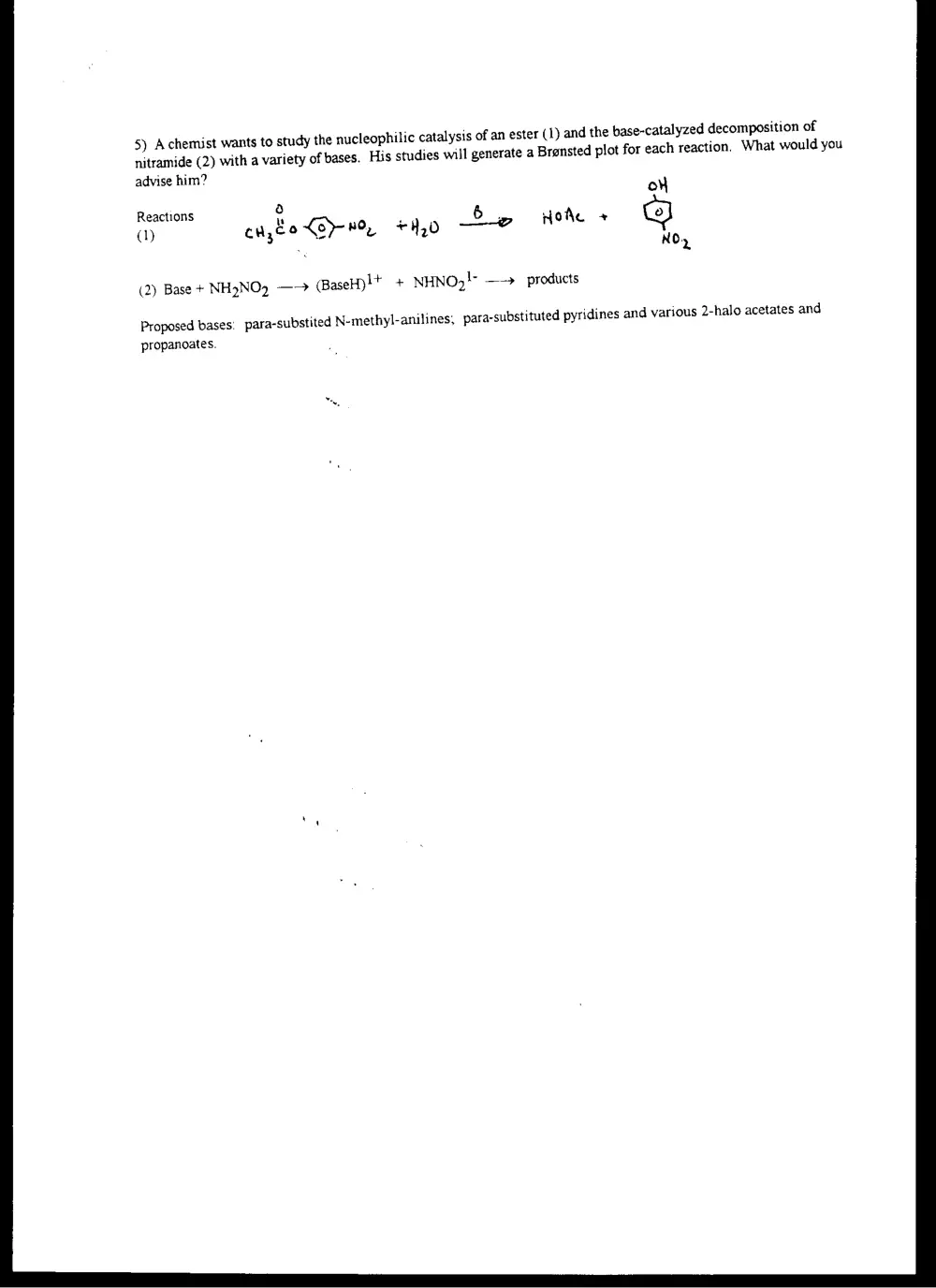
5) A chemist wants to study the nucleophilic catalysis of an ester ()) and the base-catalyzed decomposition of
nitramide (2) with a variety of bases. His studies will generate a Bronsted plot for each reaction. What would you
advise him?
oW
Reactions 8 6 son
a cube Crm, +H, ——e HONe *
: NO.
. 2
(2) Base + NH2NO2 —~ (BaseH)!* + NHNO}!- —-»> products
Proposed bases: para-substited N-methyl-anilines, para-substituted pyridines and various 2-halo acetates and
propanoates.
6) Pyridinium ion, pyr-Ht, has similar acidities in water and methanol. Acetic acid is three times more acidic
than pyr-H* when in water, but is 10,000 times less acidic when in methanol, Explain this observation.
Acid Solvent Ka
Acetic Acid water 18x 1075
_ methanol 2.2 x 10°10
pyr-H* water 6.2x 10°6
methanol 2.8x 10°
d. Write the rate law expression for the
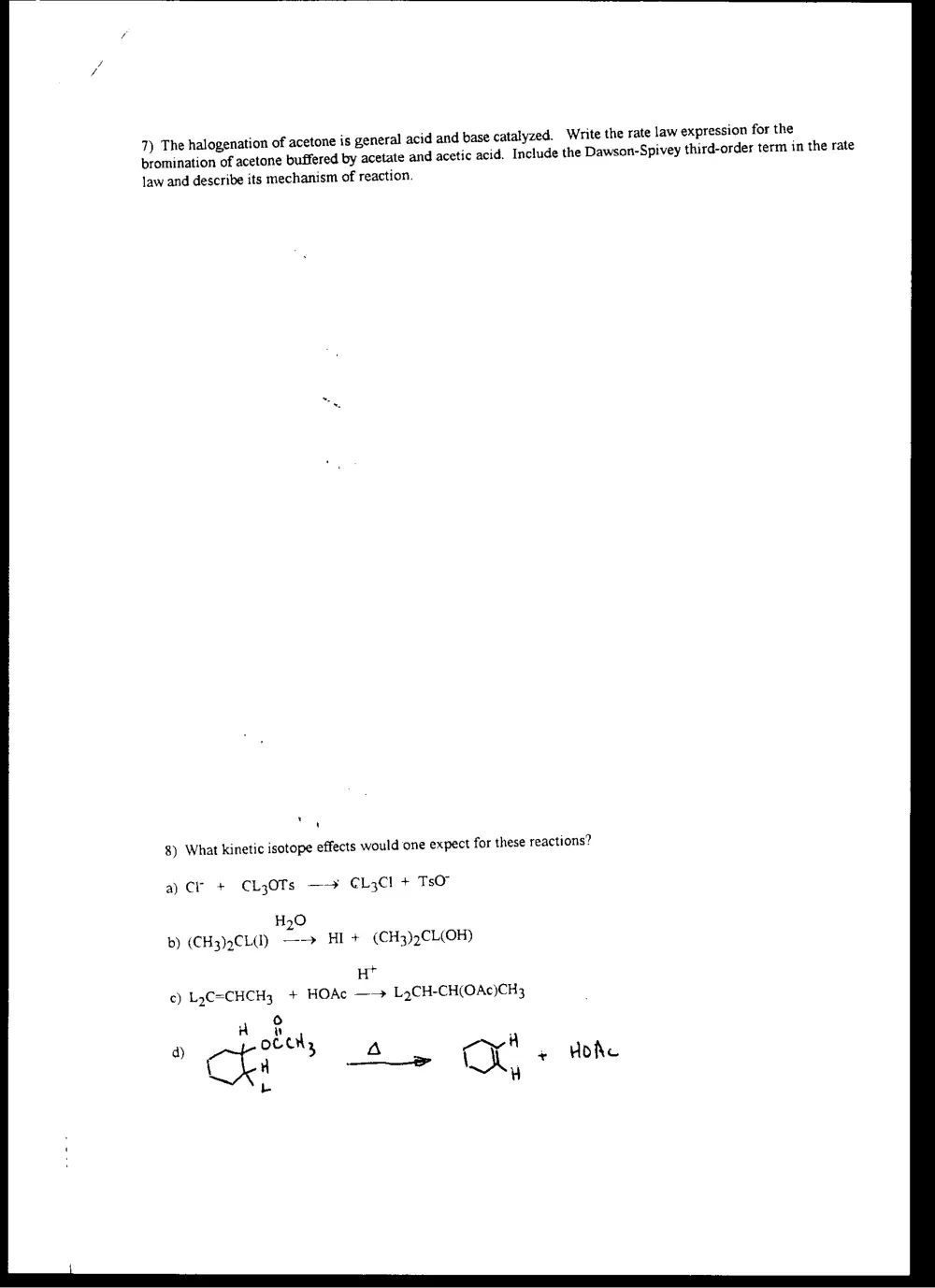
7) The halogenation of acetone is general acid and base catalyze
Spivey third-order term in the rate
bromination of acetone buffered by acetate and acetic acid. Include the Dawson-
law and describe its mechanism of reaction.
8) What kinetic isotope effects would one expect for these reactions?
a) Cr + CL30Ts —-¥ CL3Cl + TsO”
H20
b) (CH3)9CL0) ——> HI + (CH3)2CL(OH)
Ht
¢) LyC=CHCHy + HOAc ——> L2CH-CH(OAc)CH3
ry
oltns A
4 _—_—_
L
a
dy
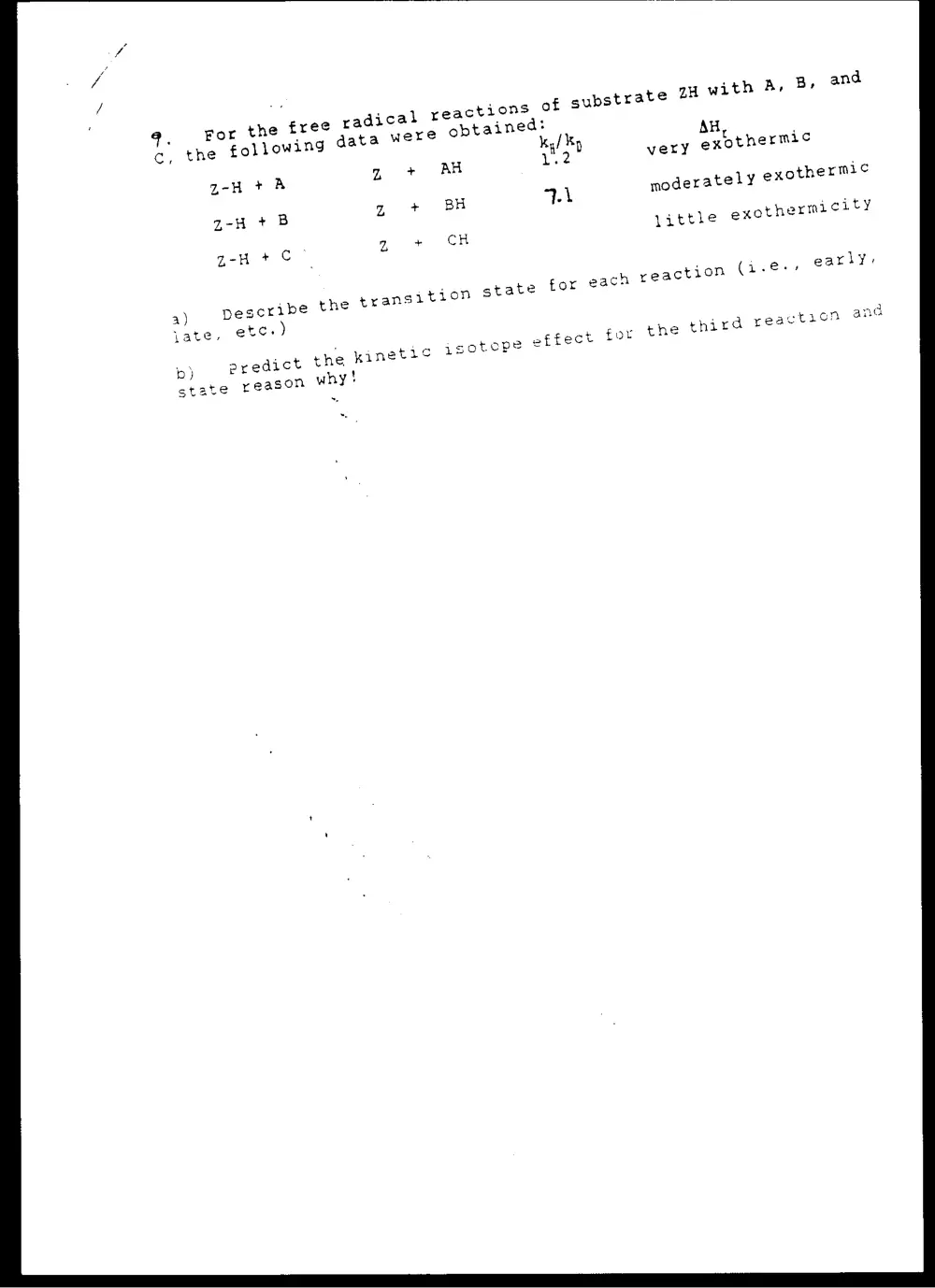
pstrate gH with A, B, and
ical reactions of su
4. For the free radi
c, the following data were obtained:
Xy/ Ky AH,
Z-H+A Z + AH 1.2 very exothermic
z-H + B z + BH 7.1 moderately exothermic
Z-H + C z + CH yittrle exothermicity
a) Describe the transition state for each reaction (1.€+% early,
jate etc.)
b) predict the kinetic psotope effect for the third yeaction and
'
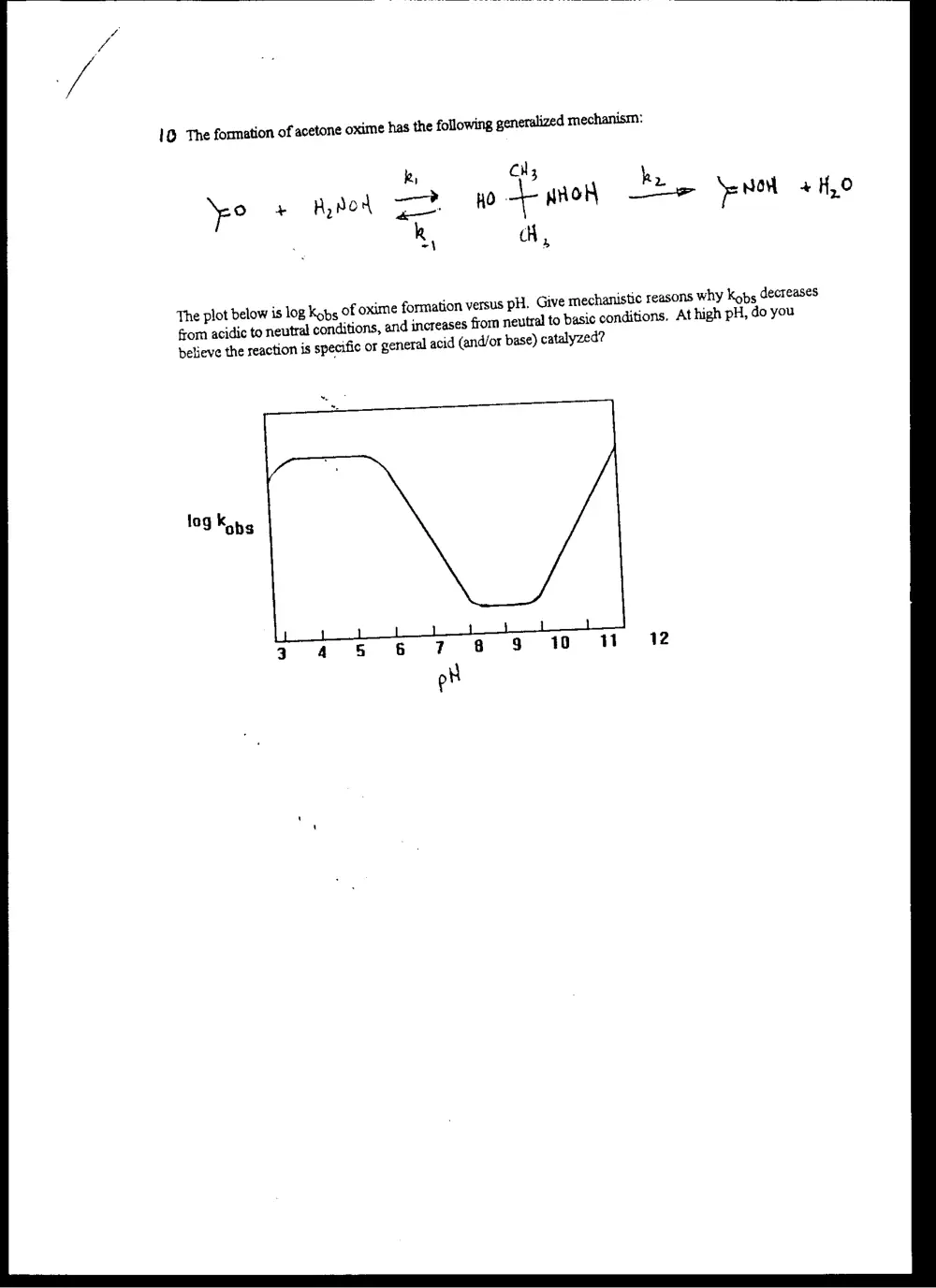
1G The formation of acetone oxime has the following generalized mechanism:
k
— + WON, te Se NOH 4 H,0
cH,
e mechanistic reasons why Kops decreases
ditions. At high pH, do you
of oxime formation versus pH. Giv
tions, and increases from neutral to basic con
general acid (and/or base) catalyzed?
The plot below is log kobs
from acidic to neutral condi
believe the reaction is specific or
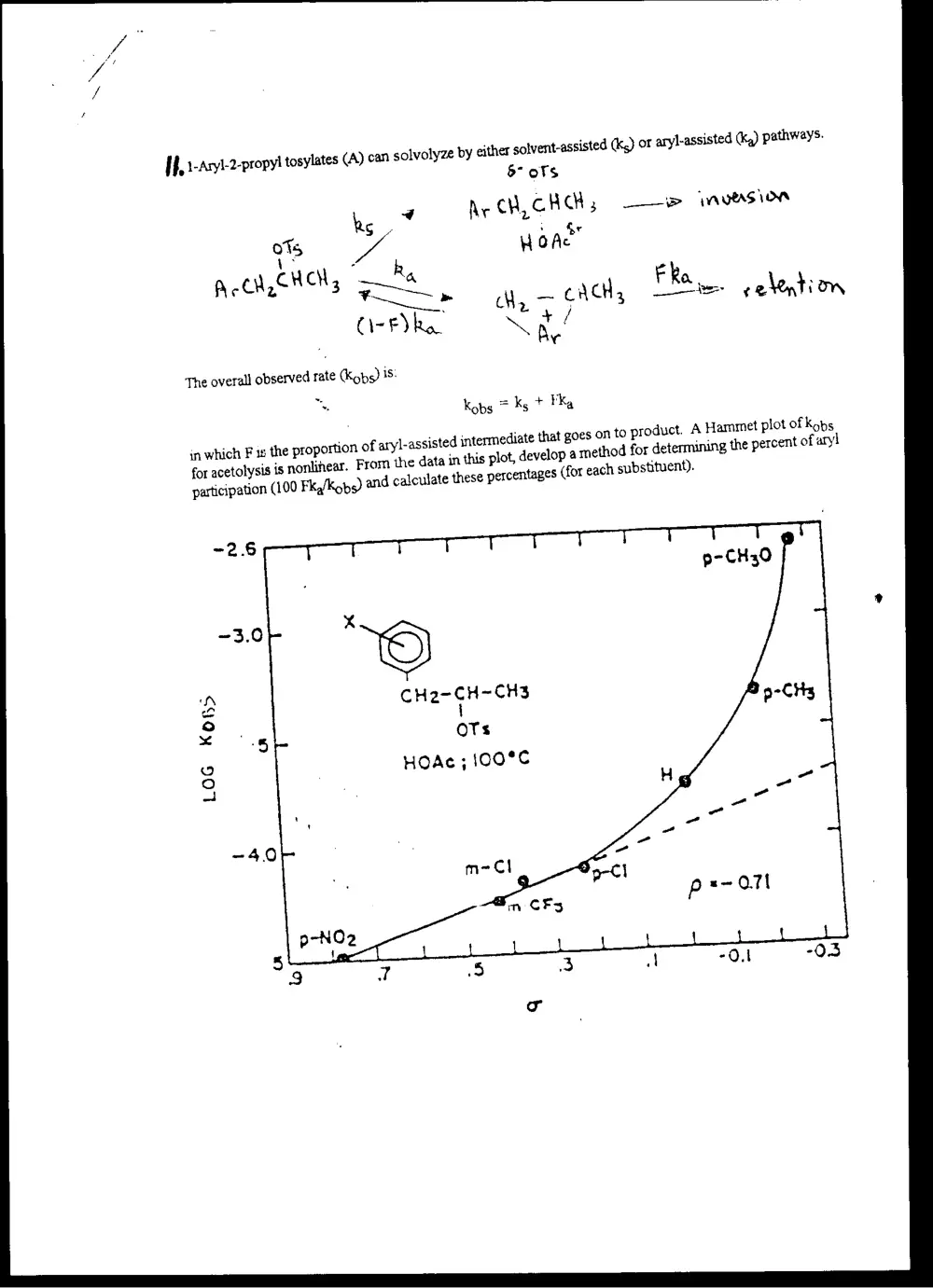
| f. 1-Aryl-2-propyl tosylates (A) can solvolyze by either solvent-assisted (kg) OF aryl-assisted (k,) pathways.
&- oTs
bs 7%
OY
Ac cn 2 Hon 3 4
C-F ko.
The overall observed rate (Kops) is:
” Kops = ks * FKa
n of aryl-assisted intermediate that goes on to product. A Hammet plot of kobs
From the data in this plot, develop a method for determining the percent of ary!
5) and calculate these percentages (for each substituent).
in which F is the proportio:
for acetolysis is nonlinear.
participation (100 Fk,/Kob:
N
Pal
o
x
°
fo}
4