
CHEN 511 Midterm Sample, Fall 2012
American University of Beirut · Transport Phenomena · 5 pages


More CHEN 511 files
Show the text of this exam
CHEN 511
Transport Phenomena
Chemical Engineering
Faculty of Engineering and Architecture
American University of Beirut
Tuesday, November, 20th, 2012
17.00-19.00
This exam paper has 4 questions
Answer all questions
You have two hours to complete this exam
GOOD LUCK
Q1.
(a) Are the following true (T) or False (F)?
(6 marks)
I.
The overall approach in transport phenomena describes the system in terms of
the properties of the inlet and outlet streams, and the exchange of energy for
example.
II.
The basic equations of momentum, heat and mass transfer are similar in nature
and the kinds of mathematical expressions that describe them.
III.
There are mainly two types of fluids. These are Newtonian and Non-Newtonian
fluids.
IV.
Non-Newtonian fluids cannot be described by the Newton Law of Viscosity.
V.
Viscosity of gases and low density liquids can be determined graphically by using
the critical conditions concept.
VI.
Momentum per unit area per unit time has the same units as force per unit area.
(b) For each of the following velocity distributions, find all the components of shear
stress, τij, for the Newtonian fluid. The parameter b is a constant.
I.
vx = by, vy = vz = 0
II.
vx = by, vy = bx, vz = 0
III.
vx = -by, vy = bx, vz = 0
IV.
vx = -bx/2, vy = -by/2, vz = bz
(12 marks)
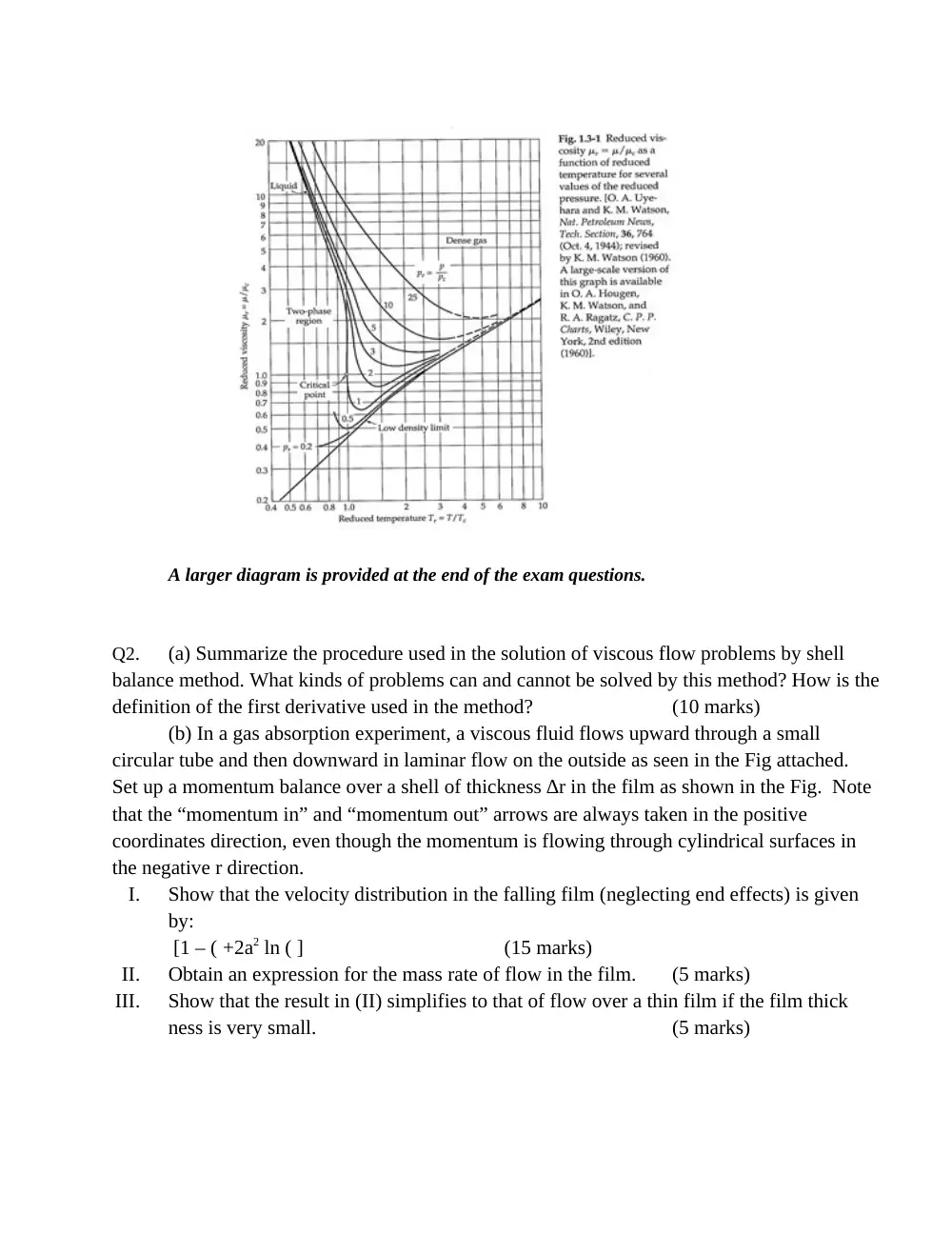
(c) Determine the viscosity of CH3F at 300 o C and 110 atm given the following critical
conditions.
(7 marks)
Critical temperature = 4.55 o C
Critical pressure = 58.0 atm
Critical density = 0.300 g/cm3.
µc = 61.6 (M Tc) 1/2 (Vc) -2/3
Where:
µc = critical viscosity in micropoise
Vc = Critical molar volume in cm3/gmole
M = Molecular weight in g/gmole.
A larger diagram is provided at the end of the exam questions.
Q2.
(a) Summarize the procedure used in the solution of viscous flow problems by shell
balance method. What kinds of problems can and cannot be solved by this method? How is the
definition of the first derivative used in the method?
(10 marks)
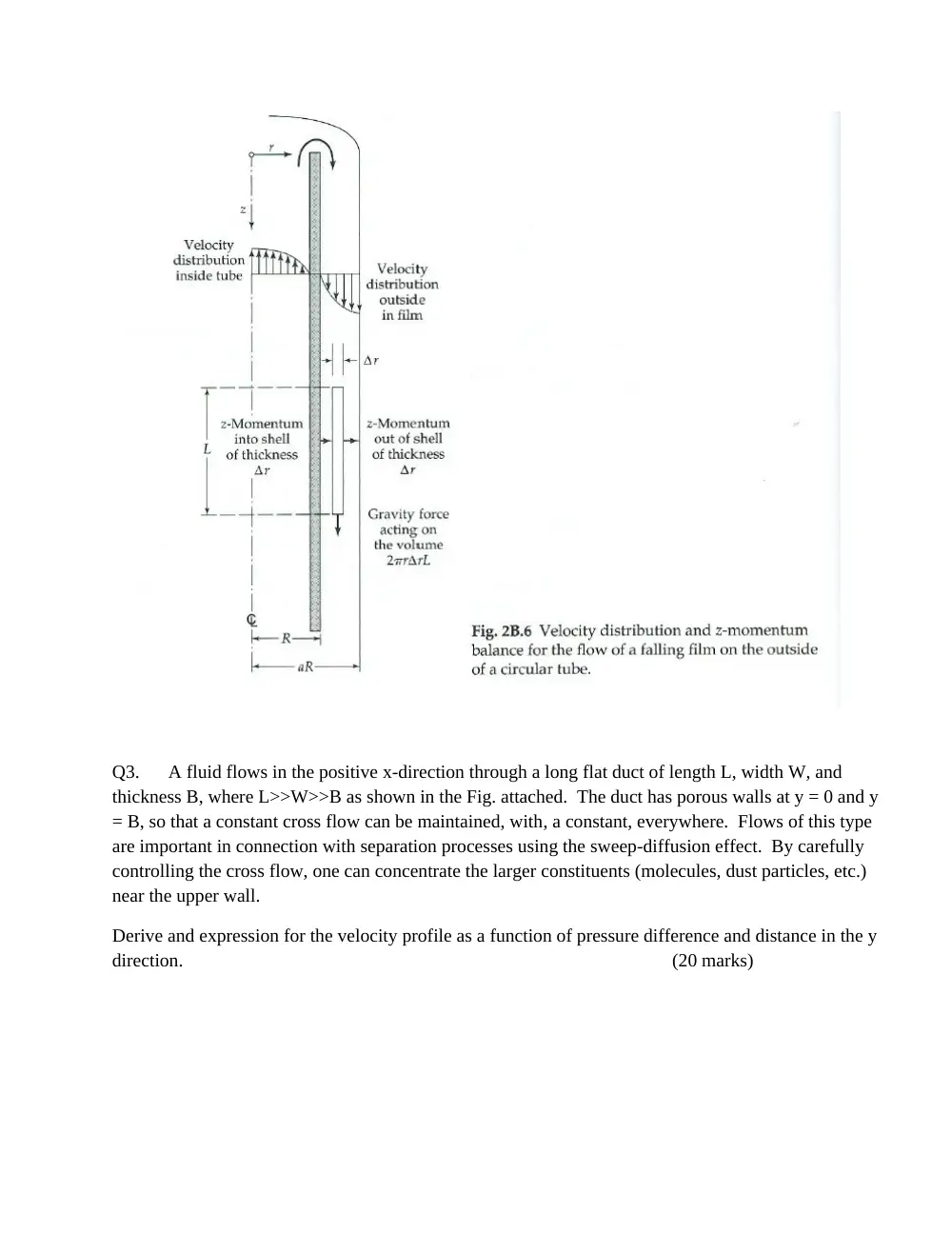
(b) In a gas absorption experiment, a viscous fluid flows upward through a small
circular tube and then downward in laminar flow on the outside as seen in the Fig attached.
Set up a momentum balance over a shell of thickness ∆r in the film as shown in the Fig. Note
that the “momentum in” and “momentum out” arrows are always taken in the positive
coordinates direction, even though the momentum is flowing through cylindrical surfaces in
the negative r direction.
I.
Show that the velocity distribution in the falling film (neglecting end effects) is given
by:
[1 – ( +2a2 ln ( ]
(15 marks)
II.
Obtain an expression for the mass rate of flow in the film.
(5 marks)
III.
Show that the result in (II) simplifies to that of flow over a thin film if the film thick
ness is very small.
(5 marks)
Q3.
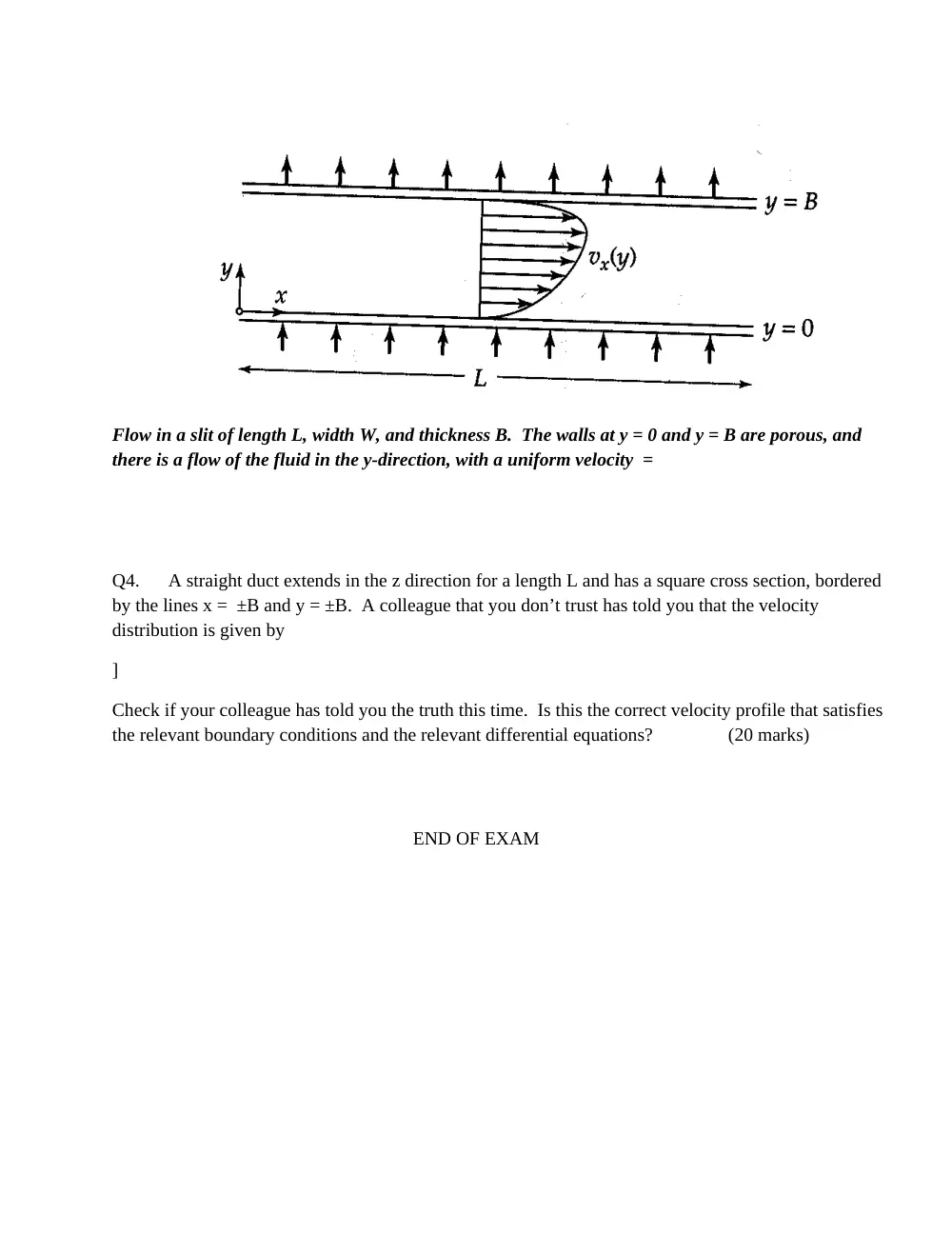
A fluid flows in the positive x-direction through a long flat duct of length L, width W, and
thickness B, where L>>W>>B as shown in the Fig. attached. The duct has porous walls at y = 0 and y
= B, so that a constant cross flow can be maintained, with, a constant, everywhere. Flows of this type
are important in connection with separation processes using the sweep-diffusion effect. By carefully
controlling the cross flow, one can concentrate the larger constituents (molecules, dust particles, etc.)
near the upper wall.
Derive and expression for the velocity profile as a function of pressure difference and distance in the y
direction.
(20 marks)
Flow in a slit of length L, width W, and thickness B. The walls at y = 0 and y = B are porous, and
there is a flow of the fluid in the y-direction, with a uniform velocity =
Q4.
A straight duct extends in the z direction for a length L and has a square cross section, bordered
by the lines x = ±B and y = ±B. A colleague that you don’t trust has told you that the velocity
distribution is given by
]
Check if your colleague has told you the truth this time. Is this the correct velocity profile that satisfies
the relevant boundary conditions and the relevant differential equations?
(20 marks)
END OF EXAM