
CHEN 531 Final, Fall 2012
American University of Beirut · Principles of Corrosion · 6 pages


More CHEN 531 files
Show the text of this final exam
CHEN 531
Corrosion
Chemical Engineering
Faculty of Engineering and Architecture
American University of Beirut
Friday, February, 1st, 2013
10.00-13.00
This exam paper has 8 questions
Answer all questions
You have 3 hours to complete this exam
GOOD LUCK
Q1.
Cavitation damage is a special form of erosion corrosion type. Explain in details its
mechanism over protective surface films and conditions to occur.
(8 marks)
Q2.
What is passivity? Draw a sketch showing all regions for an active-passive metal. Give
example for each region.
(15 marks)
Q3.
Write down five possible cathodic reactions that may occur in case of metal corrosion.
(5 marks)
Q4.
Are the following statements true (T) or false (F)?
1. In general, "organic" materials are more corrosive than the "inorganic".
2. Corrosion in the petroleum industry is due more to sodium chloride and sulfur, than to the
oil or gasoline.
3. Dry chlorine is practically non-corrosive to ordinary steel, but moist chlorine, or chlorine
dissolved in water, is extremely corrosive and attacks most of the common metals and
alloys.
4. When zinc is placed in dilute HCl, a vigorous reaction occurs while the chloride ion is
not involved in the reaction.
5. The cathodic reaction that is frequently encountered in metallic corrosion in neutral
solutions is O2 + 2H2O + 4e- = 4OH-
6. Concentration polarization usually is the controlling factor during corrosion in media
containing a high concentration of active species (i.e., concentrated acids).
7. Concentration polarization is only important during reduction reactions.
8. Many of the common acids, such as sulfuric, acetic, hydrofluoric and others, are virtually
inert when in the pure state, or 100% concentration.
9. There is no theoretical way of precisely determining the exchange current density for any
given system; it must be determined experimentally.
10. The limiting diffusion current density iL, represents the maximum rate of reduction
possible for a given system.
11. The diffusion layer thickness is influenced by the shape of the particular electrode, the
geometry of the system, and by agitation.
12. Concentration polarization does not become apparent until the net reduction current
density approaches the limiting diffusion current density.
13. Although the free-energy change for corrosion of zinc is negative and greater than that
for iron, the corrosion rate of zinc is less than that of iron.
14. In the uniform attack corrosion, a chemical or electrochemical reaction proceeds
uniformly over the entire exposed surface and the metal becomes thinner and eventually
fails.
15. In the galvanic corrosion, usually the cathode or cathodic metal corrodes very little or not
at all in this type of couple.
16. Pitting is described as corrosion occurring at contact areas between materials under load
subjected to vibrating and slip. It appears as pits or grooves in the metal surrounded by
corrosion products.
17. If iron is corroding in air-free acid at an electrochemical corrosion rate of 1 μA/cm2, it
dissolves as ferrous ions (Fe2+). Then the corrosion rate is 0.46 mpy.
(25 marks)
Q5.
Write all the possible reactions for the following cases.
(4 marks)
1. Iron is immersed in neutral water
2. Iron is immersed in H2SO4 solution
Q6.
Given that
Cu = Cu2+ + 2e-
- 0.337 V
Ni = Ni2+ + 2e-
+ 0.25 V
(The indicated redox potentials are at standard conditions)
These two metals were immersed in electrolytic solutions and connected to form a cell.
a) Which one of them will be the anode and which one is the cathode?
b) What will be the potential between them at standard conditions?
c) Which metal undergoes oxidation? Write a balance equation for that.
d) Which metal undergoes reduction? Write a balance equation for that
e) What is the free energy change (in jouls/mole) for the cell?
(15 marks)
Q7.
Consider the following polarization data. The measurements were made on a pure Ni electrode
in a deaerated acidic solution of NiSO4 in which both activities of Ni2+ and H+ are unity. Hydrogen gas
at 1 atm pressure was continuously bubbled through the solution.
E (V)
ic (A/cm2)
ia (A/cm2)
-0.123
2.0 E -04
1.8 E -04
-0.130
2.6 E -04
1.5 E -04
-0.146
4.0 E -04
9.6 E -05
-0.157
5.0 E -04
6.8 E -05
-0.209
1.0 E -03
---
-0.290
2.7 E -03
---
-0.374
7.1 E -03
---
Construct the Evans diagram for this system and determine the following quantities. (20 marks)
a. Tafel slopes for cathode (bc) and for anode (ba)
b. Ecorr and icorr
c.
Exchange current densities of anode (io,c) and for cathode (io,a)
d. Overpotentials for Ni oxidation (ηA) and for H+ reduction (ηC).
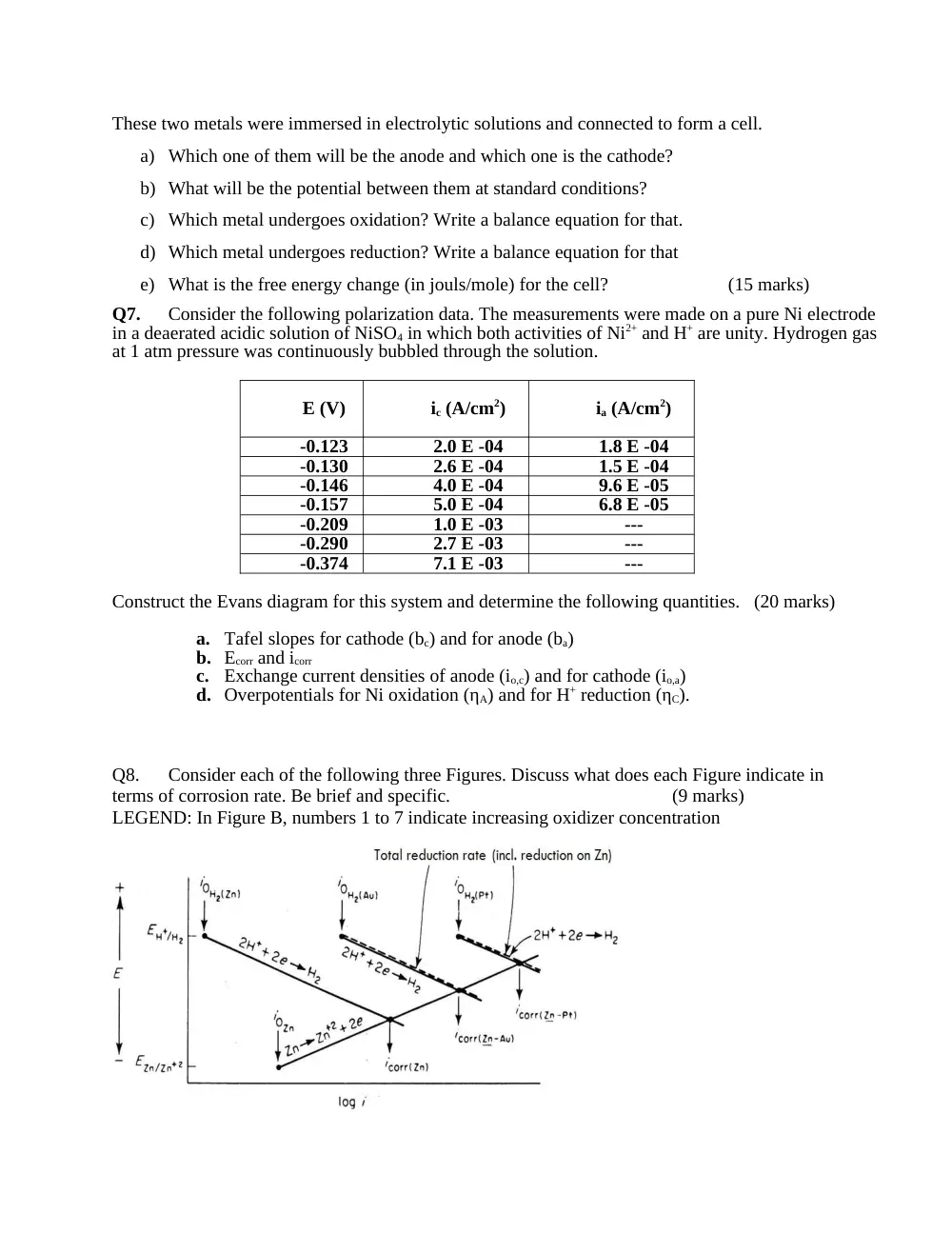
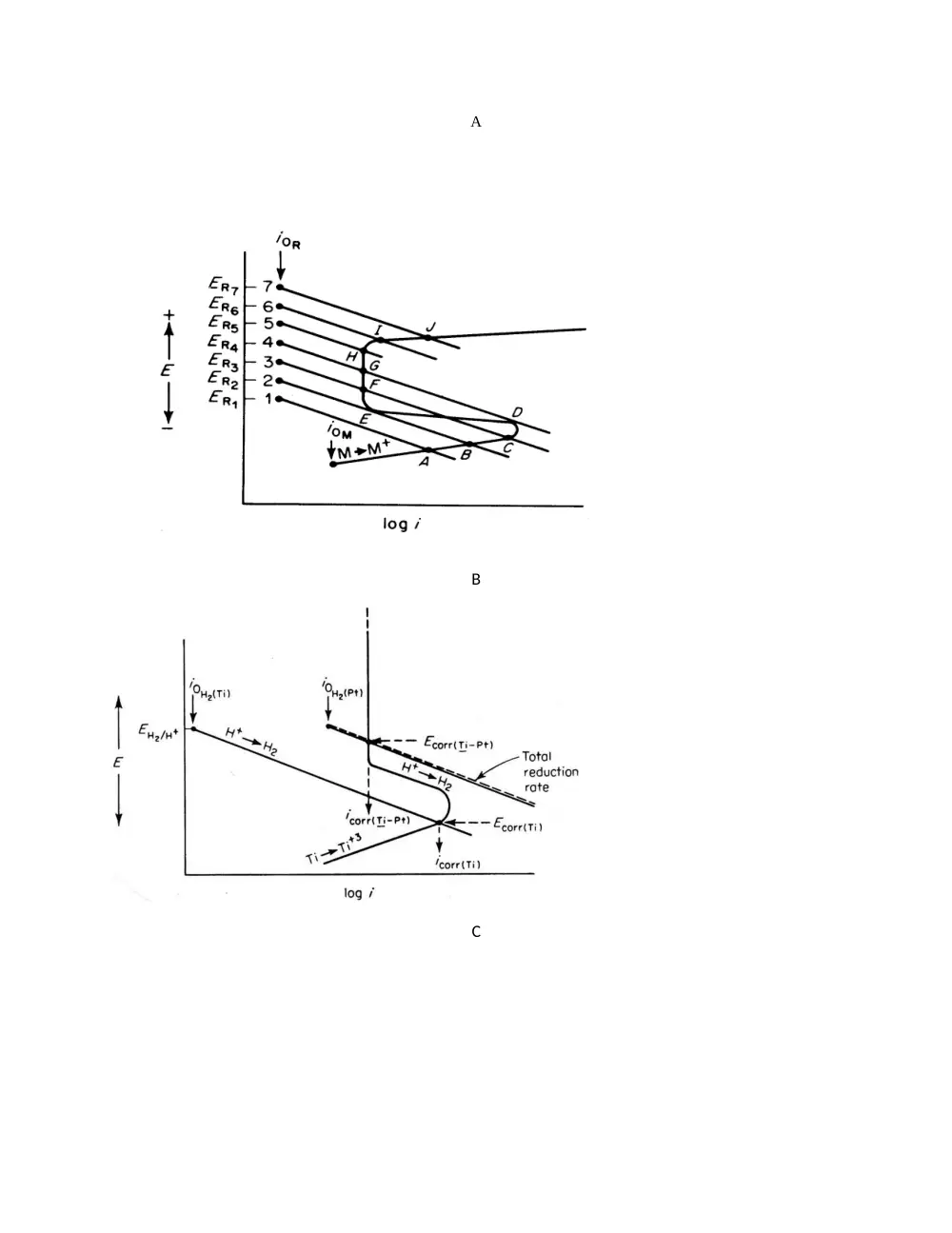
Q8.
Consider each of the following three Figures. Discuss what does each Figure indicate in
terms of corrosion rate. Be brief and specific.
(9 marks)
LEGEND: In Figure B, numbers 1 to 7 indicate increasing oxidizer concentration
A
B
C
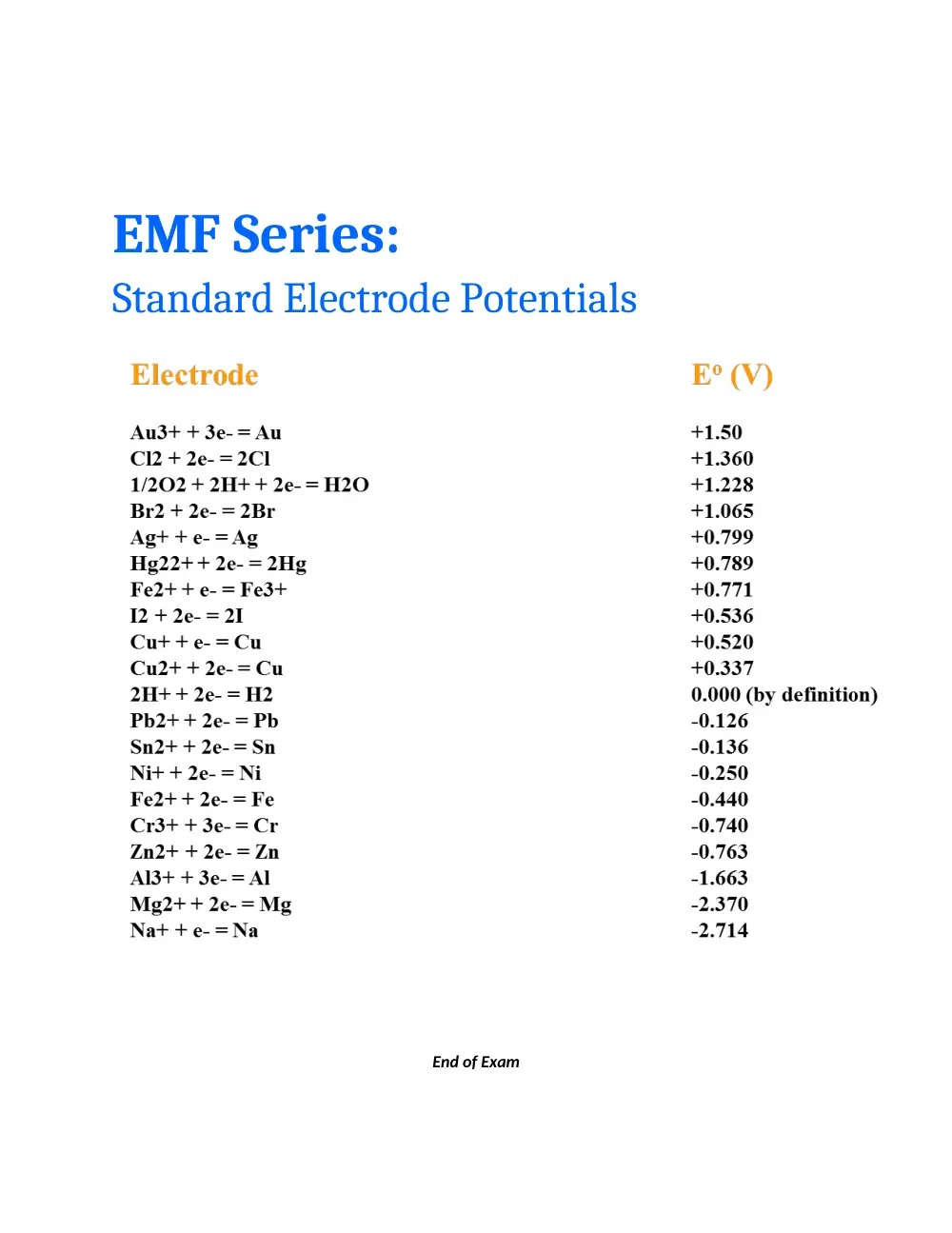
EMF Series:
Standard Electrode Potentials
End of Exam