
CIVE 210 Exam 2 with Solution, Fall 2011
American University of Beirut · Statics · 9 pages · Dr. Amer El Souri · with solution
More CIVE 210 files
Show the text of this exam
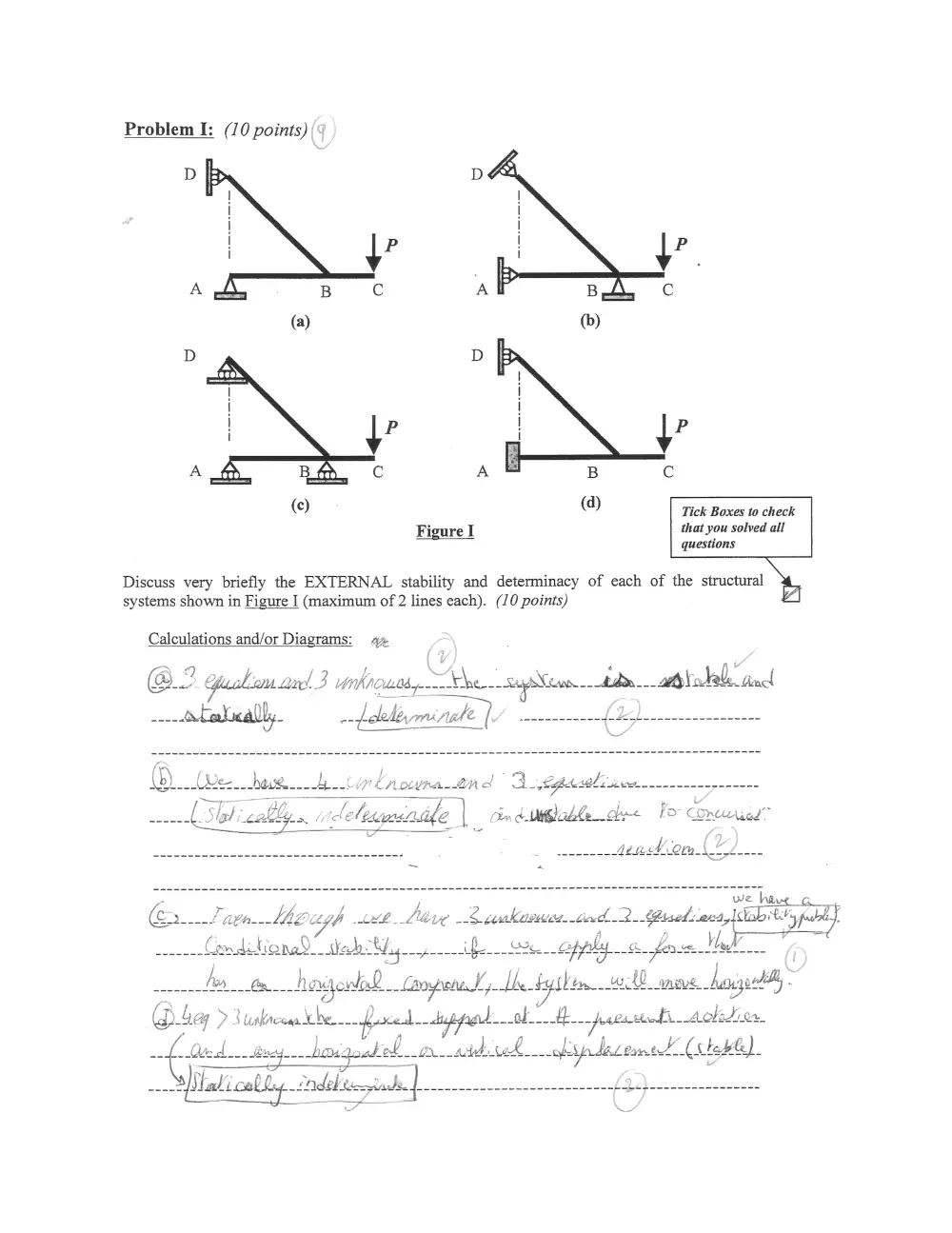
Problem I: (10 points) (4
Tick Boxes to check
Figure I that you solved all
questions
Discuss very briefly the EXTERNAL stability and determinacy of each of the seuctual A,
systems shown in Figure I (maximum of 2 lines each). (/0 points)
Calculations and/or Diagrams: 4%
4
late S$ cenknswes. enc 2 sed an fo
lpn... LbD Ce. of Axe _£
CIVE210 — Fall 2011-12 Quiz 2
M. Mabsout & A. El-Souri
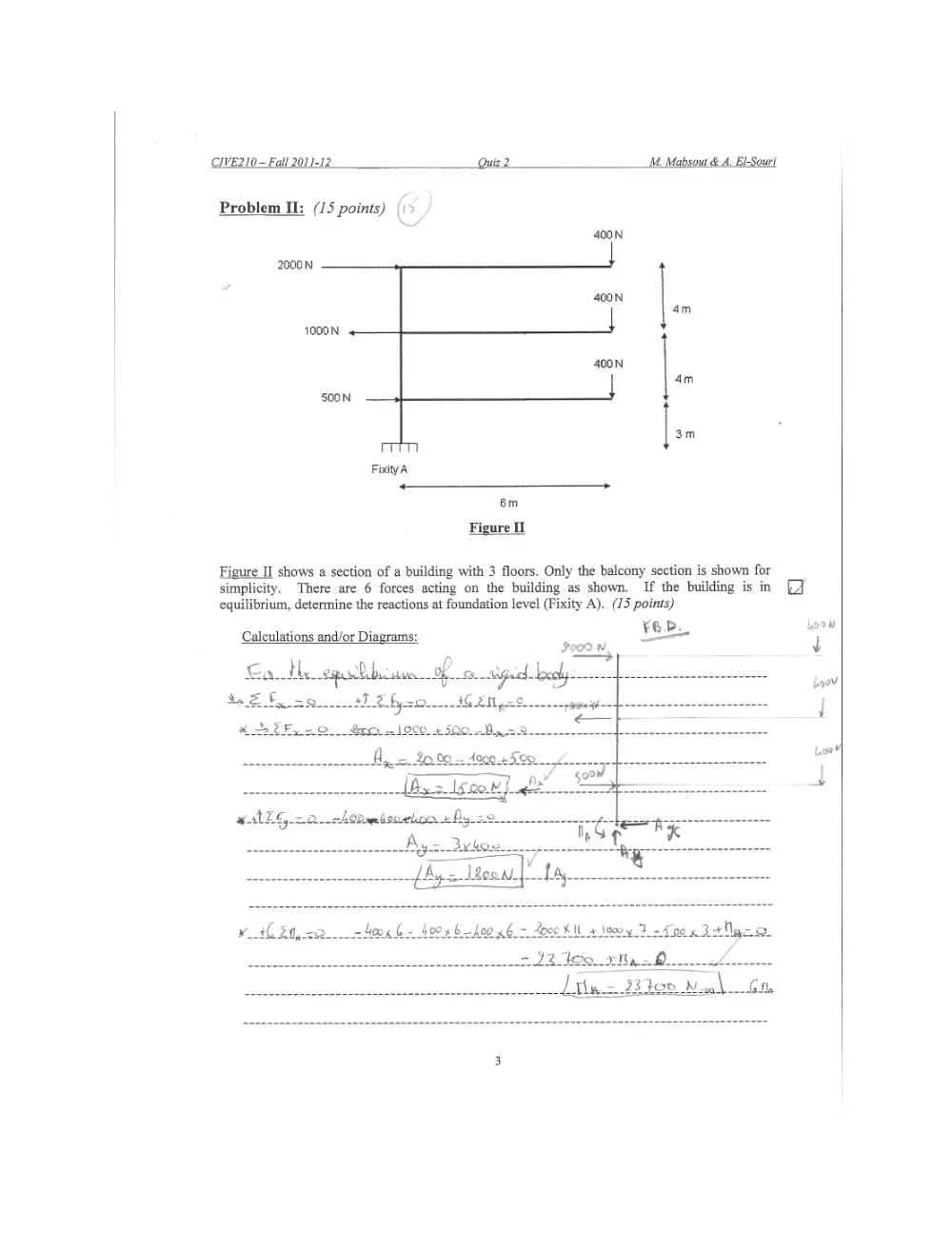
Problem II: (15 points)
400N
2000N
400N
1000 N
400N
SOON
Fixity A
« ~
6m
Figure I
4am
4m
3m
Figure II shows a section of a building with 3 floors. Only the balcony section is shown for
simplicity. There are 6 forces acting on the building as shown.
If the building is in
equilibrium, determine the reactions at foundation level (Fixity A). (15 points)
Calculations and/or Diagrams:
_ 06
ae) v
wee ee nna - eee +--+ +--+. Boxe IS 00M) ag
CIVE210 — Fall 2011-12 Quiz 2 M. Mabsout & A, El-Souri
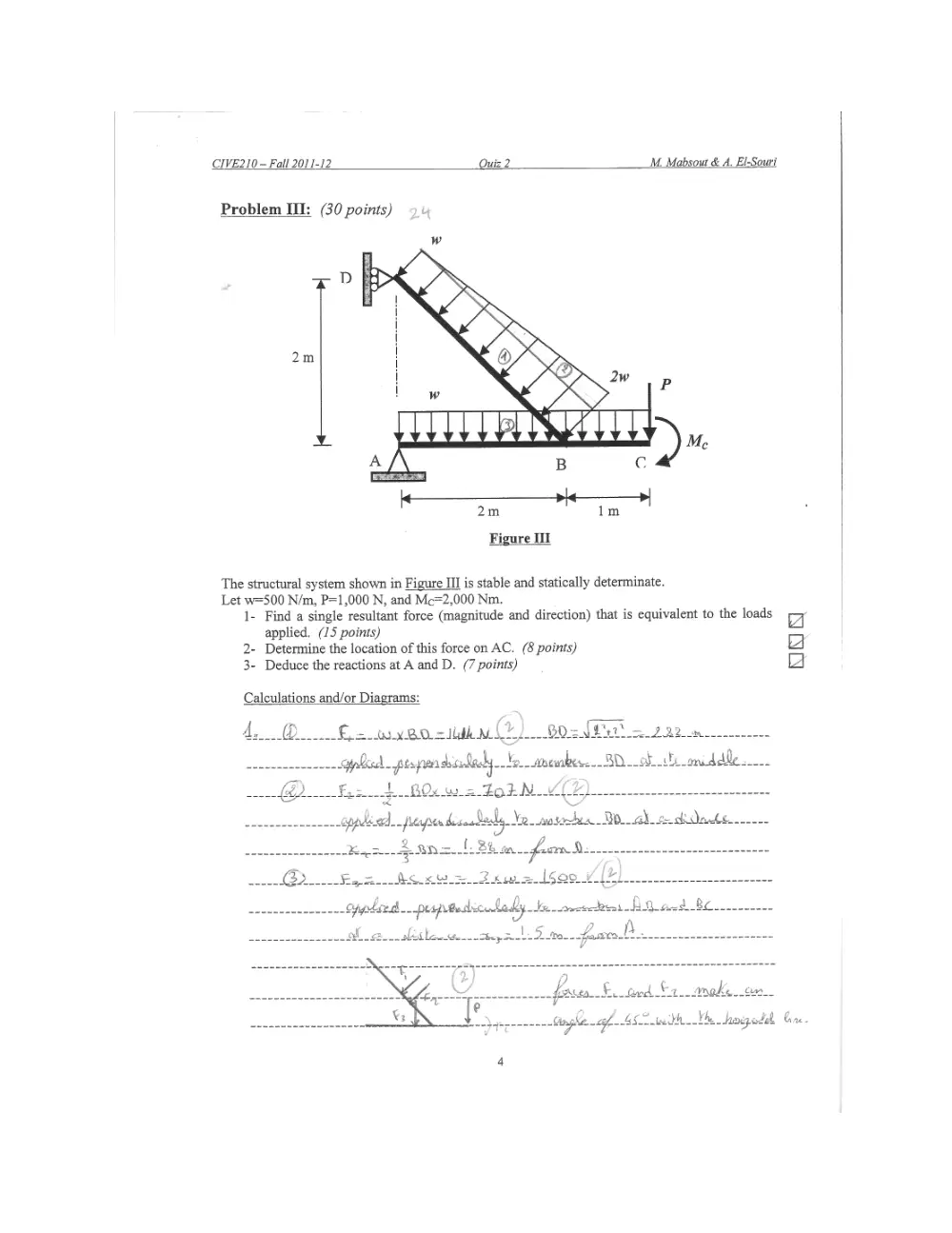
Problem III: (30 points)
2m
Figure II
The structural system shown in Figure III is stable and statically determinate.
Let w=500 N/m, P=1,000 N, and Mc=2,000 Nm.
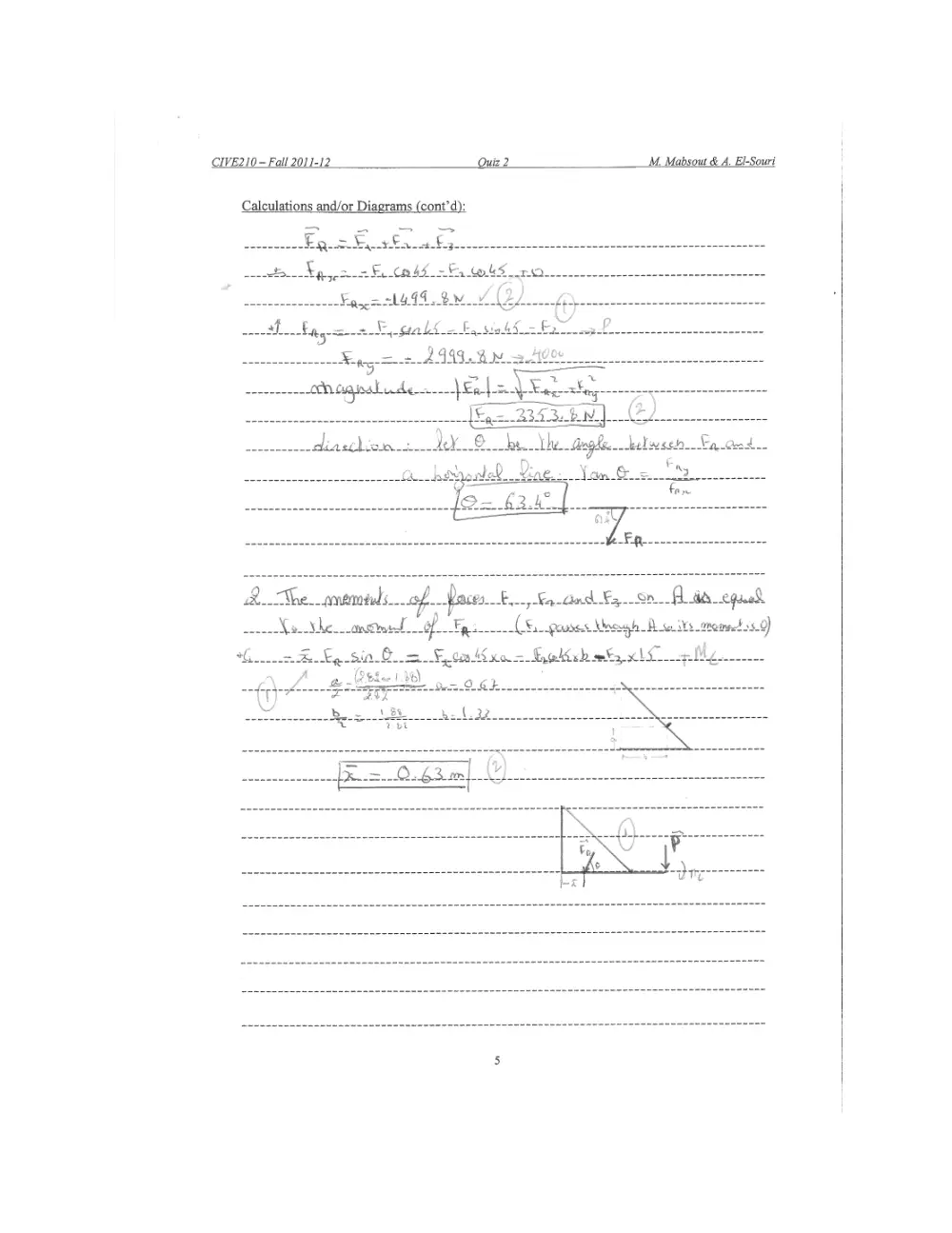
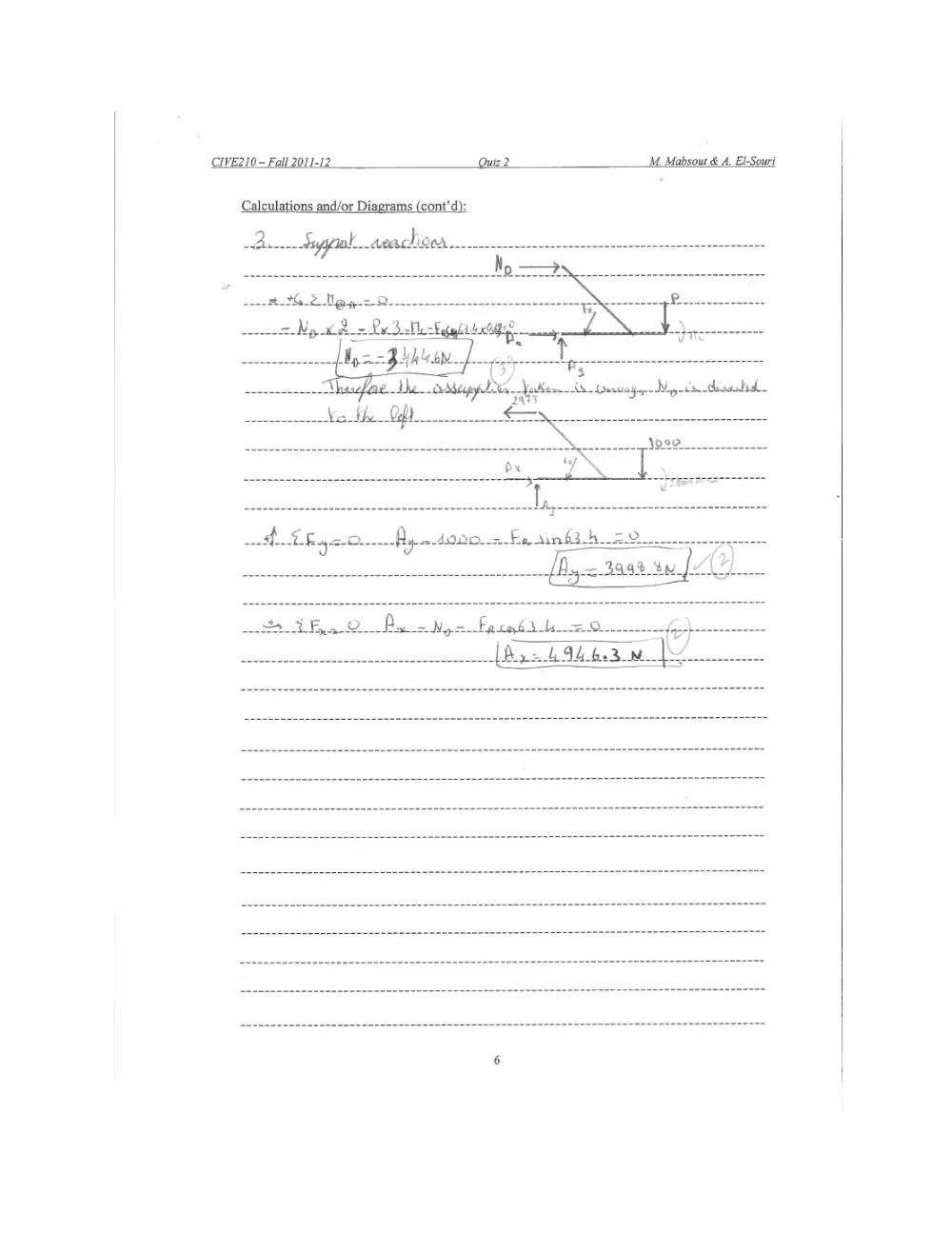
1- Find a single resultant force (magnitude and direction) that is equivalent to the loads
applied. (5 points)
2- Determine the location of this force on AC. (8 points)
3- Deduce the reactions at A and D. (7 points)
Calculations and/or Diagrams:
\ A
sc y
SEA § Pane Se SR AN
a
iz
Z|
CIVE210 ~ Fall 2011-12 Quiz 2 M. Mabsout & A. El-Souri
Calculations and/or Diagrams (cont’d):
— - - >
cob a ein bs pone
eet eee Gage Bink batt vt ee enn
“ BN 9 H170
7)
wneecenneee conaaginal ade} Ea-| 5 =) Eaaty- ee
socenecnncenecenecnnnecenecnnennnns Es Kg=- ee SiN Ao.
CIVE210 ~ Fall 2011-12
Quiz 2 M. Mabsout & A. El-Souri
Calculations and/or Diagrams (cont’d):
b
CIVE210 - Fall 2011-12 Quiz 2 M. Mabsout & A. El-Souri
Problem IV: (30 points)
2m
D b
\
2m .
ie
2m 8 kN
Bi
M
2m
+ N
Figure IV
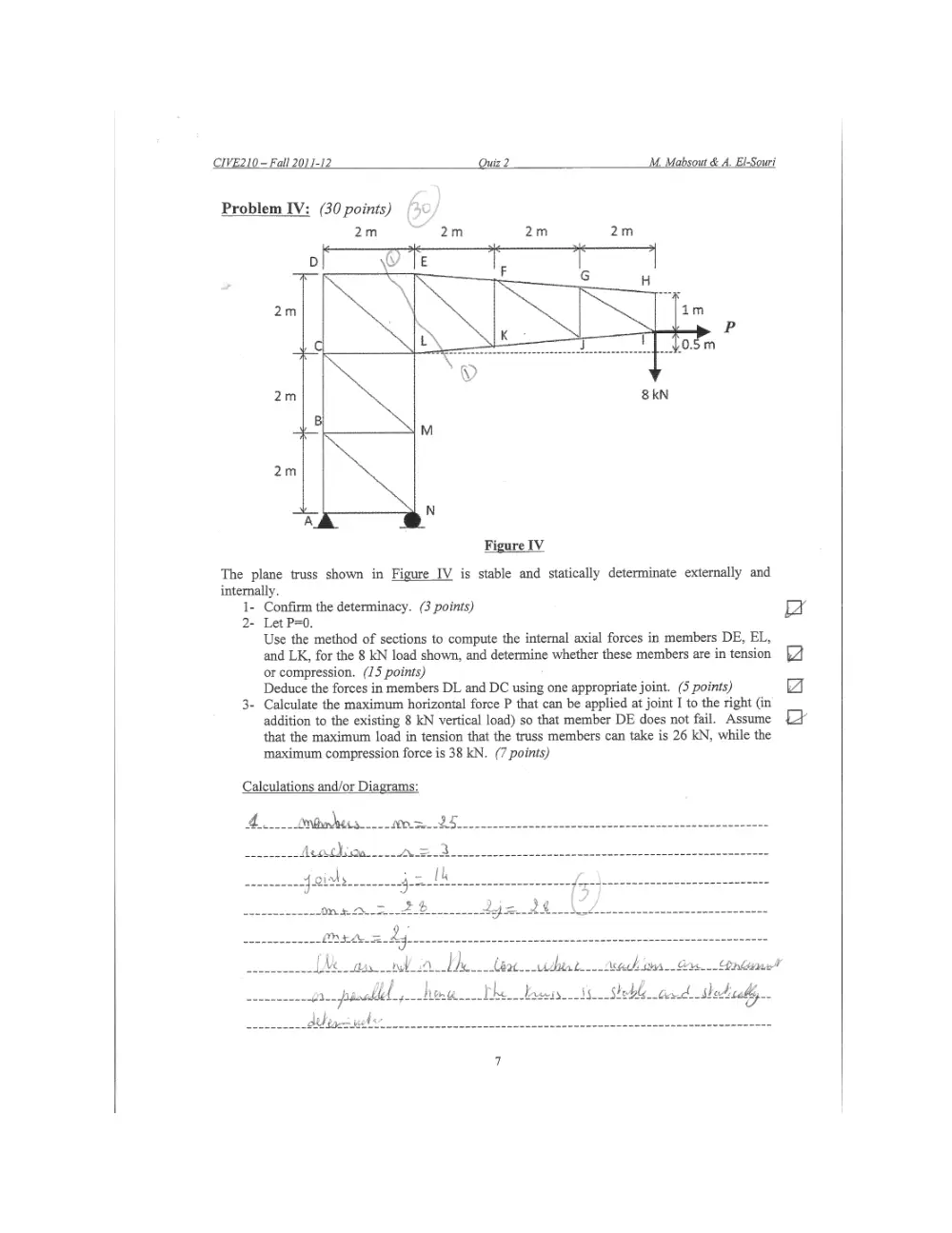
The plane truss shown in Figure IV is stable and statically determinate externally and
internally.
1- Confirm the determinacy. (3 points)
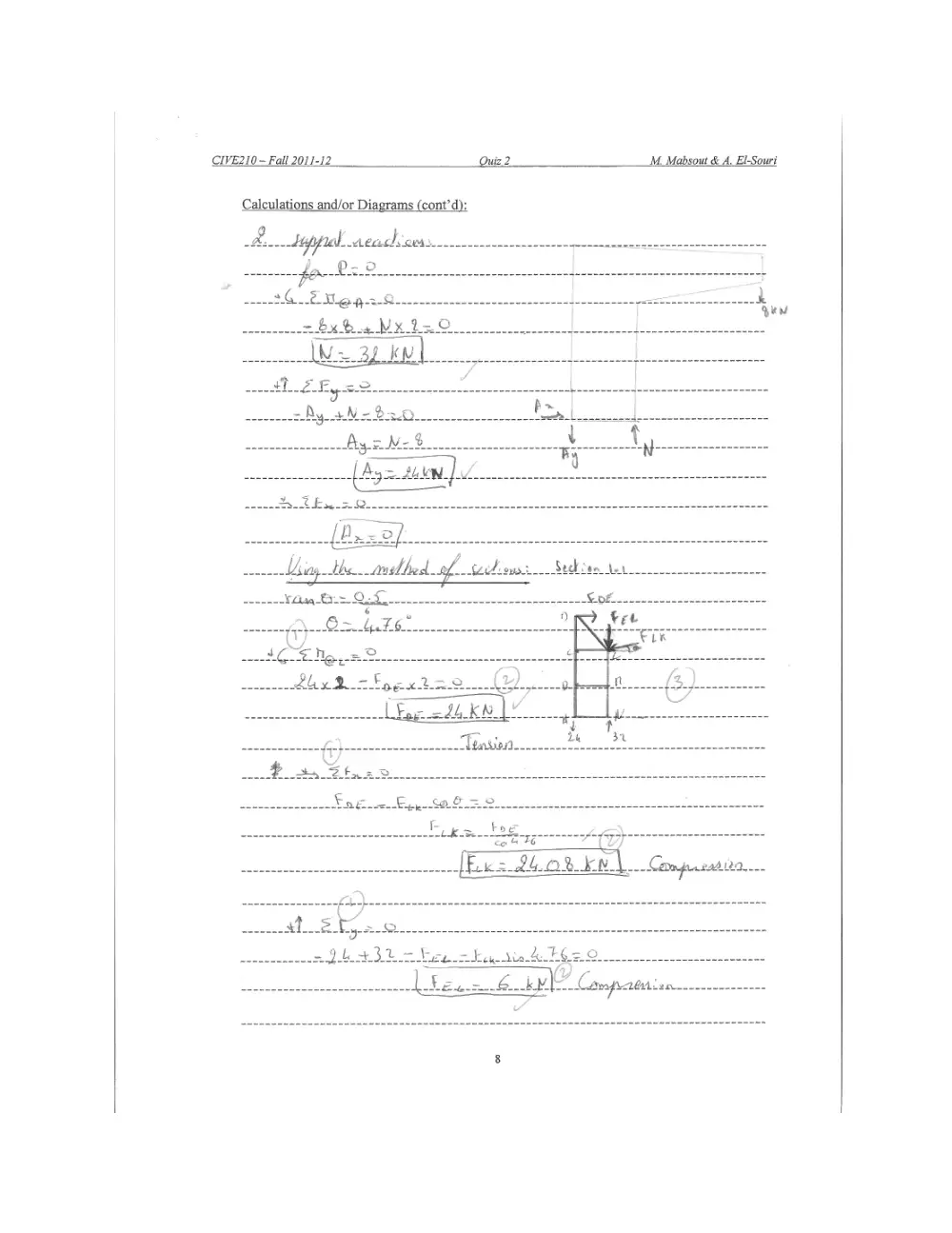
2- Let P=0.
Use the method of sections to compute the internal axial forces in members DE, EL,
and LK, for the 8 kN load shown, and determine whether these members are in tension wi
or compression. (J5 points)
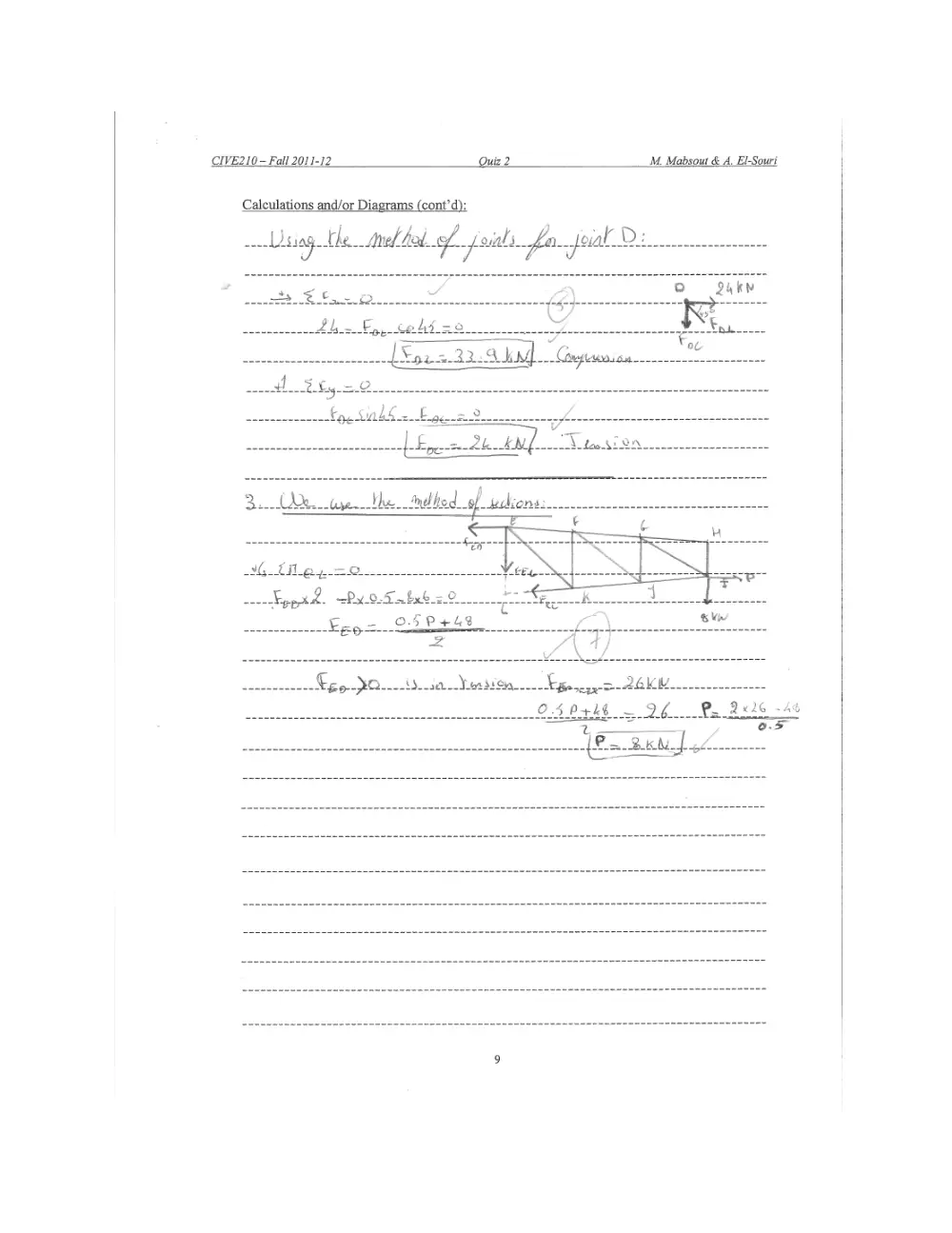
Deduce the forces in members DL and DC using one appropriate joint. (5 points)
3- Calculate the maximum horizontal force P that can be applied at joint I to the right (in
addition to the existing 8 KN vertical load) so that member DE does not fail. Assume
that the maximum load in tension that the truss members can take is 26 kN, while the
maximum compression force is 38 kN. (7 points)
Calculations and/or Diagrams:
CIVE210 — Fall 201]-12 Quiz 2 M. Mabsout & A. El-Souri
Calculations and/or Diagrams (cont'd):
seeueee ee ee
CIVE2 10 — Fall 2011-12 Quiz 2 M. Mabsout & A. El-Souri
Calculations and/or Diagrams (cont’d):
one Kegphite Py 0. Tabb =O t a enn Cece
Feo c--C2 P+ hs / hw
CIVE210 — Fall 2011-12 Quiz 2 M. Mabsout & A. El-Souri
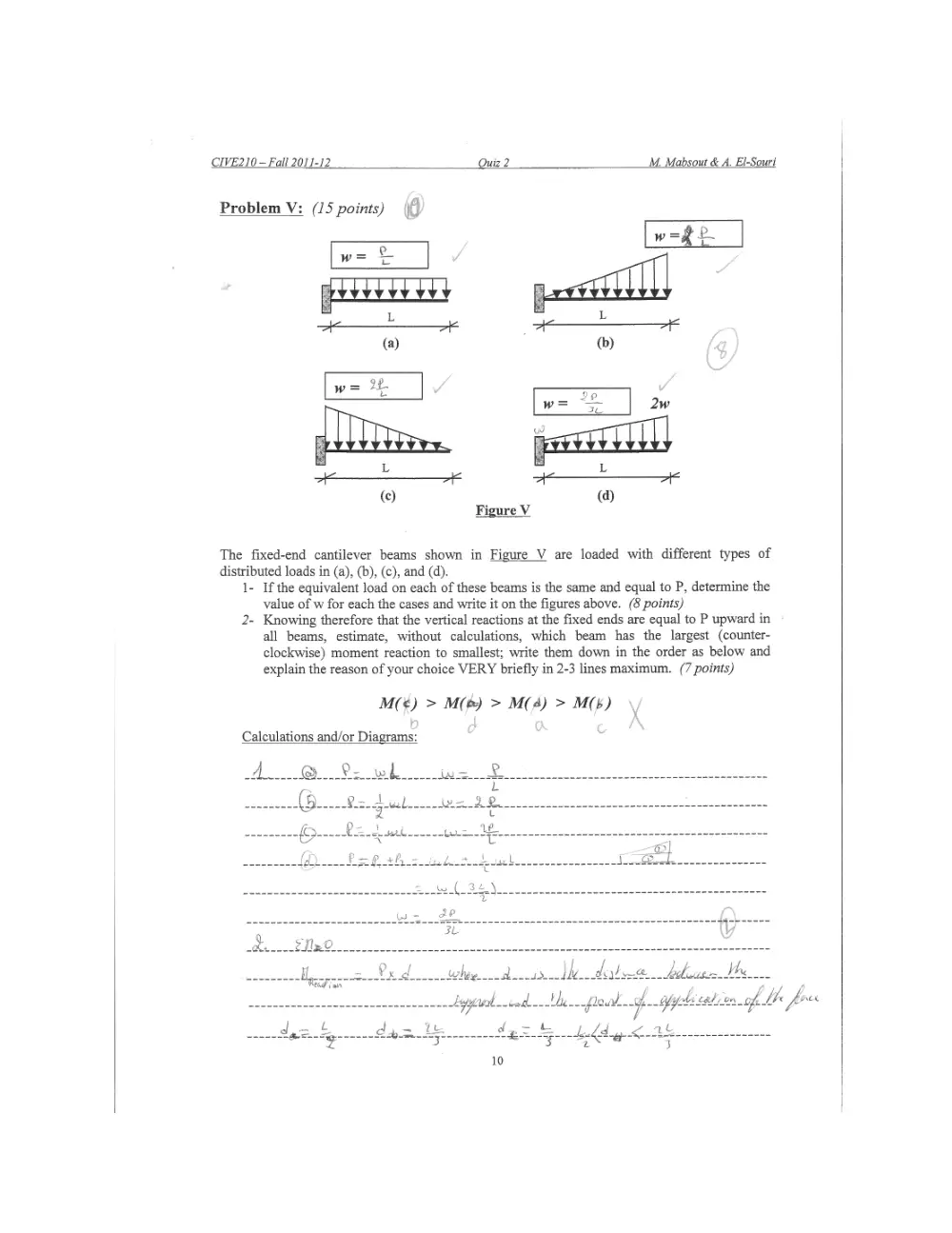
Problem V: (15 points) (\()
we &
f L L
(a) (b)
we 2 -
w= ss 2w
L E L
i nn
(© @
Figure V
The fixed-end cantilever beams shown in Figure V are loaded with different types of
distributed loads in (a), (b), (c), and (d).
1- If the equivalent load on each of these beams is the same and equal to P, determine the
value of w for each the cases and write it on the figures above. (8 points)
2- Knowing therefore that the vertical reactions at the fixed ends are equal to P upward in
all beams, estimate, without calculations, which beam has the largest (counter-
clockwise) moment reaction to smallest; write them down in the order as below and
explain the reason of your choice VERY briefly in 2-3 lines maximum. (7 points)
M(¢) > M(t) > M(4) > M(s)
Calculations and/or Diagrams: