
CIVE 210 Exam, Spring 2002
American University of Beirut · Statics · 12 pages

Showing the first 10 of 12 pages. Download the PDF to see all of it.
More CIVE 210 files
Show the text of this exam
American University of Beirut
Department of Civil and Environmental Engineering
Spring 2002-2003 Instructor: Professor Fouad Kasti
CIVE 210| Statics | Exam#1 Sat Mar 22,03 | 1/1
«
" Problem #1: (50%)
A 50 Kg mass Mis attached at B to a single weightless cable AB, length = 10cm and hinged at A.
The cable is in equilibrium at the position shown (angle o with the vertical) when subjected to a
force F making an angle B with the horizontal.
a- What is the minimum possible force in cable AB? Determine a, 8 and the magnitude of the
force F.
b- Ifa = 30° and B = 0, determine the magnitude of the force F and cable tension.
c- If a =.30°, determine the minimum magnitude of force F. What is the corresponding cable
AB tension and angle B. .
Problem #2: (50%)
A 20cm, 10 Kg homogeneous uniform bar is roller supported at A and B. The inclined plane
makes 60° with the horizontal while bar AB makes a 30° angle with the horizontal. Spring BD has
stiffness K=10 Kg/cm. Bar AB is supported at A and B by cables AC and BC hinged at C. Bar AB
is in equilibrium and barely touching the horizontal and inclined planes. Bar AC is vertical. Bar
BC makes a 60° angle with AC. Assume frictionless surfaces.
a- Find tension in cable AC.
Arch. Lipeaty
b- Find force in spring BD. Specify tension or compression. Eng, &
c- Compute deformation in spring BD.
Specify shortening or elongation. Cc
fo¥y
T
Find tension in cable BC.
ExlSpr0203 Vi
American University of Beirut
Department of Civil and Environmental Engineering
Fall 2000-2001 Instructor: Professor Fouad Kasti
Problem #1: (30%) Concerr Ennon =- 10, Carcomnon Entel a. 5. Note dove QO
1v
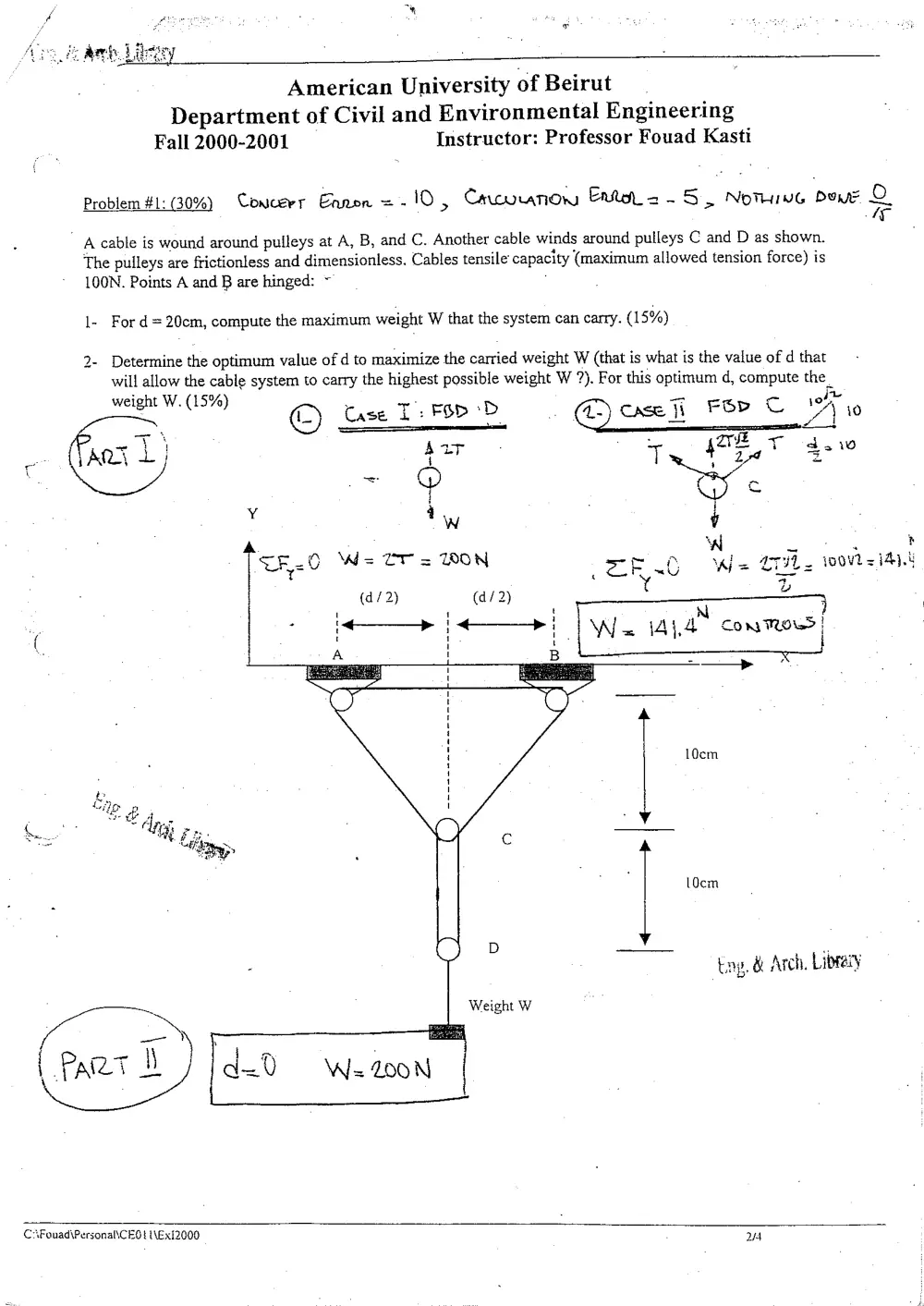
, A cable is wound around pulleys at A, B, and C. Another cable winds around pulleys C and D as shown.
The pulleys are frictionless and dimensionless. Cables tensile capacity (maximum allowed tension force) is
1OON. Points A and B are hinged: ~ ;
l- For d=20cm, compute the maximum weight W that the system can carry. (15%)
2- Determine the optimum value of d to maximize the carried weight W (that is what is the value of d that
will allow the cable system to carry the highest possible weight W ?). For this optimum d, compute the
weight W. (15% , . _ - iv
WOO) tase TROD @eesei FPL 0
. == io —— Aas
+ : WE TT dow
- é Tv T “ay a) 32)
y t
tw i
wl _ : P
wA= 0 is TT = WON ‘ja ETIL] wovt= i414
(4/2) (4/2) a
N ?
¢ ° j\4j4,4 CONT |
———
10cm
lOcm
tang, & Arch. Libraiy
Weight W
C:AFouad\Personal\CE0t \\Ex12000 2A
\
-American University of Beirut
Department of Civil and Environmental Engineering
Fall 2000-2001 Instructor: Professor Fouad Kasti
Problem #1: (30%)
Eng, & Arch Li
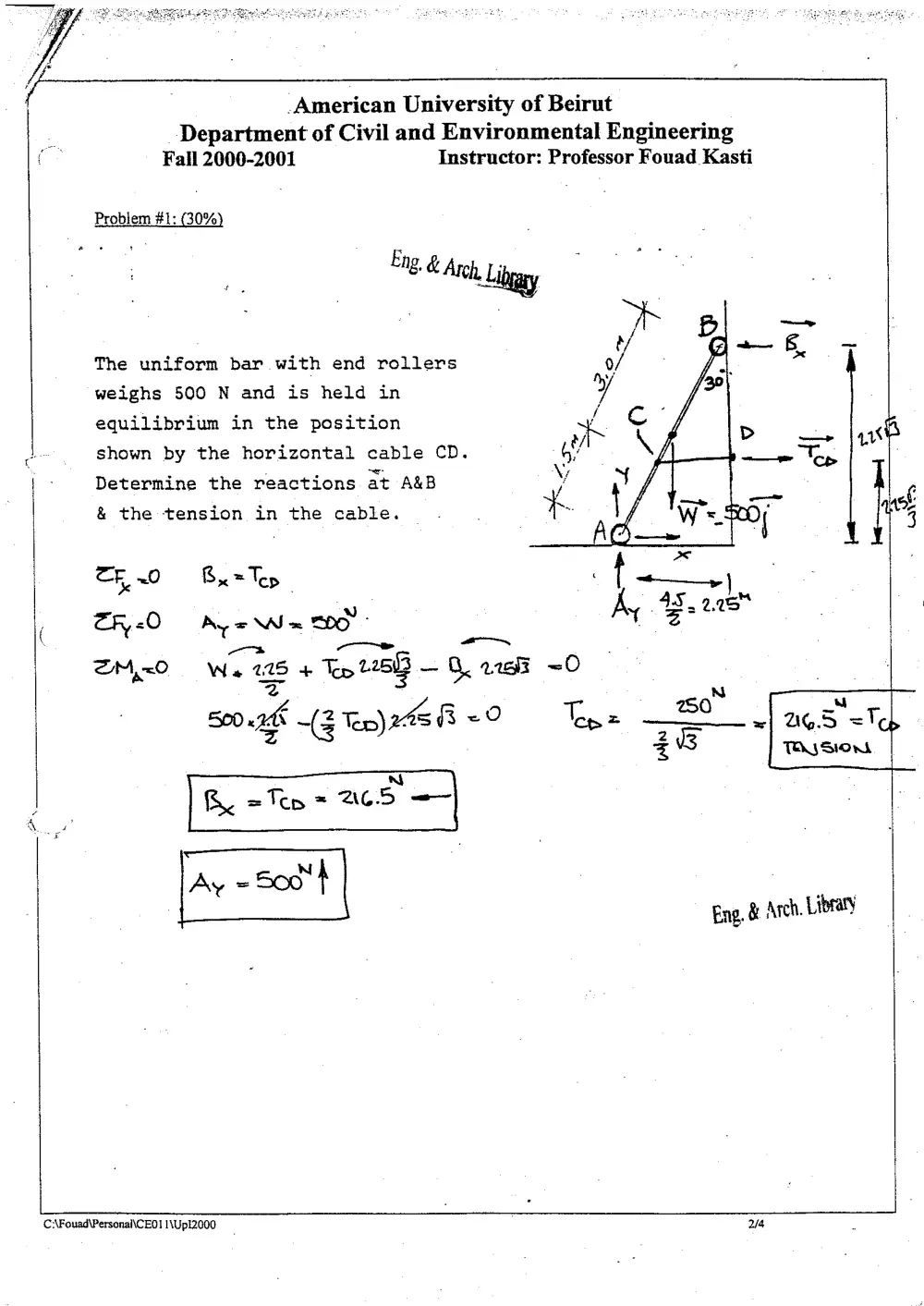
The uniform bar with end rollers
weighs 500 N and is held in
equilibrium in the position
shown by the horizontal cable CD.
Determine the reactions at A&B
& the tension in the cable.
0) A =W-= 20’:
cy ve —~» _—,
ZM,<0 We 225 + Teo 2253 — Q. a0 ~O
Z
so. (2 tn) 2B <0 Tepe
=)
Ay = 500"}
C:\Fouad\Personal\CEO! 1\Upi2000
2/4
American University of Beirut
Department of Civil and Environmental Engineering
Fall 1999-2000 Instructor: Professor Fouad Kasti
Problem #1: (30%)
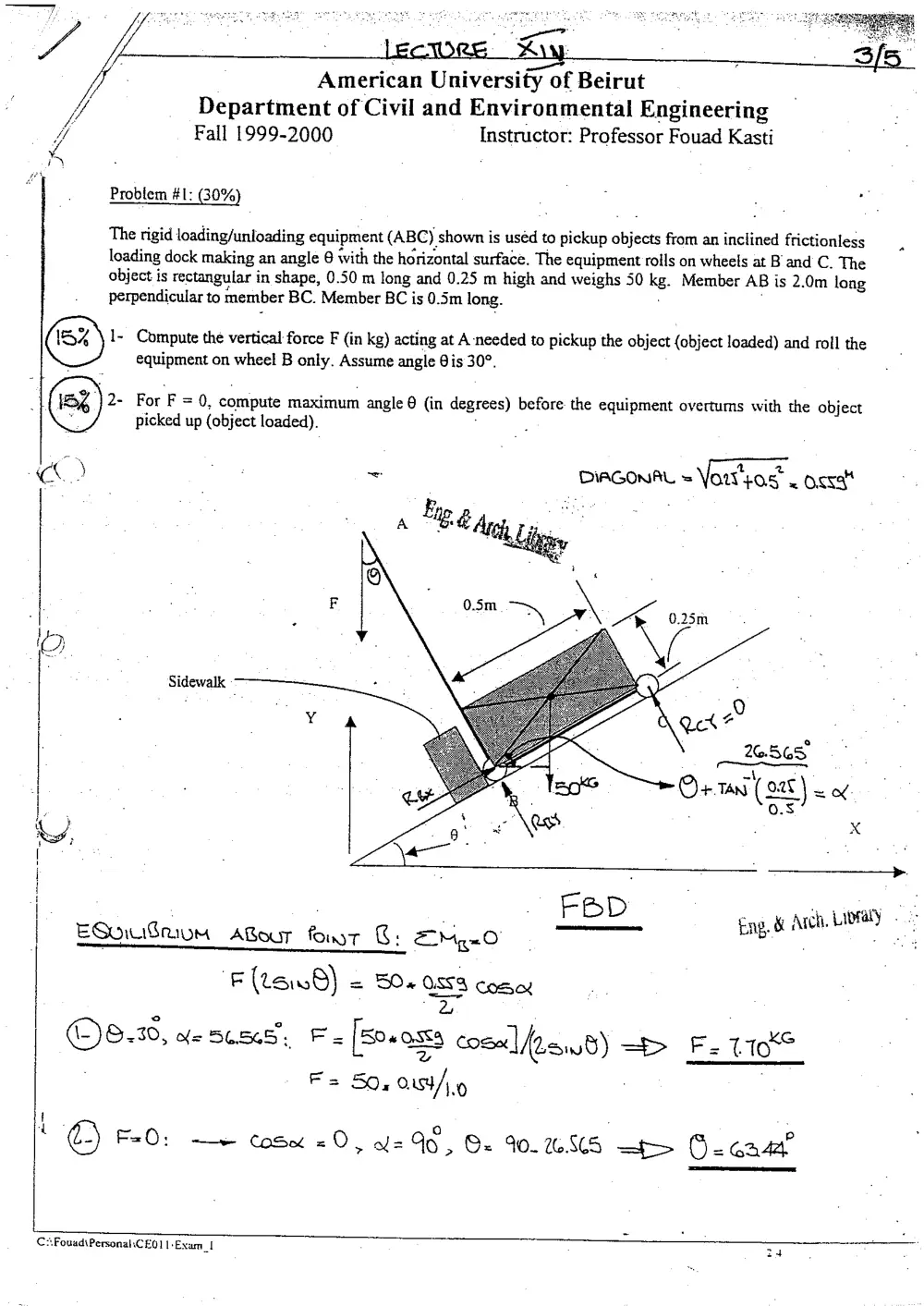
The rigid loading/unloading equipment (ABC) shown is uséd to pickup objects from an inclined frictionless
loading dock making an angle with the horizontal surface. The equipment rolls on wheels at B and C. The
object is rectangular in shape, 0.50 m long and 0.25 m high and weighs 50 kg. Member AB is 2.0m long
perpendicular to member BC. Member BC is 0.5m long. : :
(8%) 1- Compute the vertical force F (in kg) acting at A needed to pickup the object (object loaded) and roll the
equipment on wheel B only. Assume angle @ is 30°.
4 2- For F = 0, compute maximum angle ® (in degrees) before the equipment overtums with the object
- picked up (object loaded). . .
. a ) oo ~~ DIAGONAL = Votes. ossat
Sidewalk
po .
:
7 . . e: oe
| 7 FED Eng. & Arch. LiDfaly
ESowiSaomM ABour forst ©: AMO :
aaa RRR een
O81, ve Seses', F = [Sososts cose foeu8) => F- T10%¢
Fs So, oist/) 9
—
©) FeO: —e cose 0, y= 96, 8. 9. 65S =t> O-cae
C2\Fouad\PersonaliCEO1 1 *Exam_[
So /-- “\ecrore | Ay |
Y -
7 fo. American University of Beirut .
va Department of Civil and Environmental Engineering
J! Fall 1999-2000 Instructor: Professor Fouad Kasti
cn. & asvin, LADY
ayy:
Problem #2: (30%) Cee . .. ..
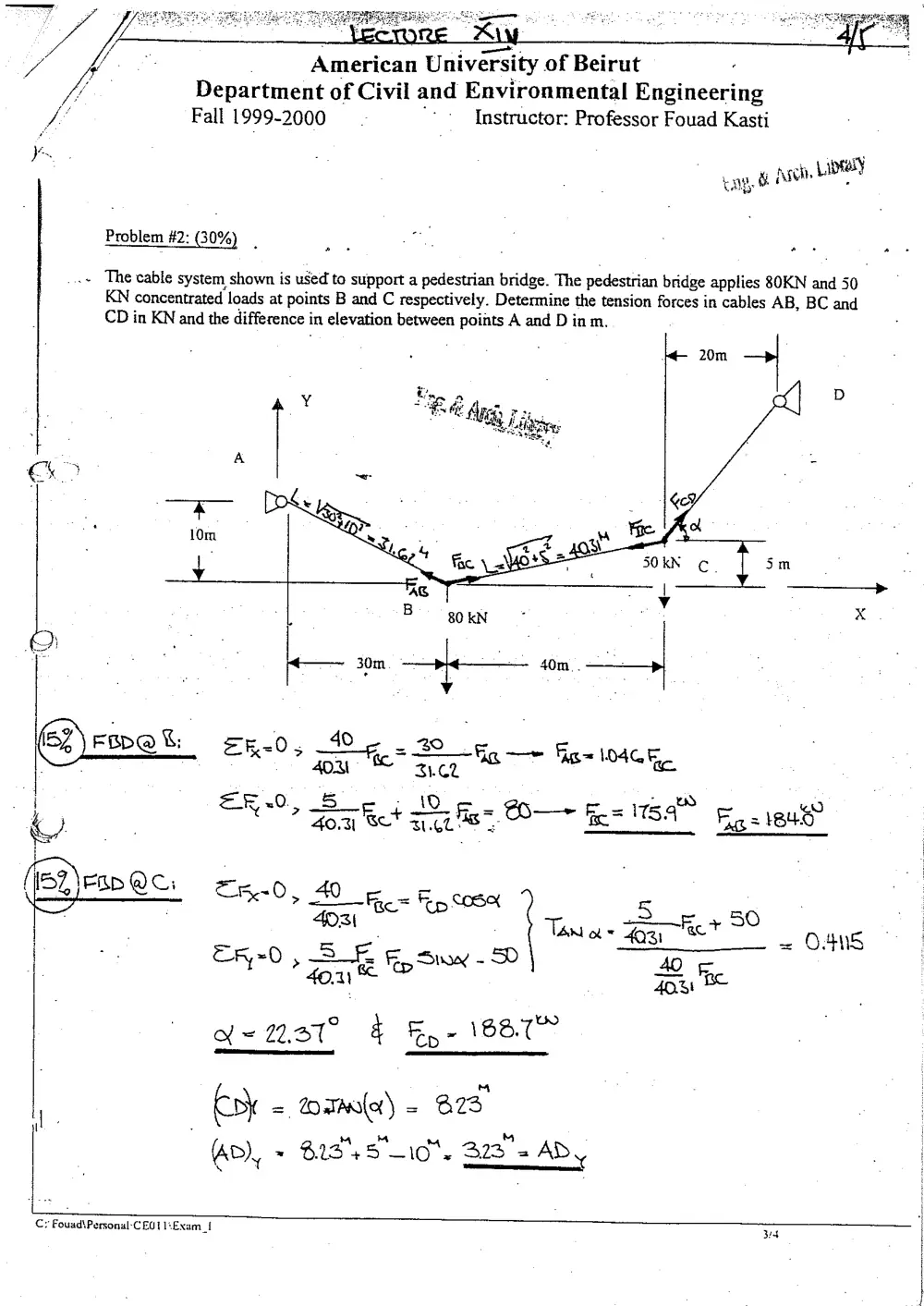
...+ The cable system shown is used to support a pedestrian bridge. The pedestrian bridge applies 80KN and 50.
KN concentrated loads at points B and C respectively. Determine the tension forces in cables AB, BC and
CD in KN and the difference i in elevation between points A and D in m.
+t 20m +
D
Co A _
x
10m
+ . sm
—>
v ,
a Bo 80kN x
i. So it 30m —- 40m.. :
Ere FOp@ 2&0; Mg 229 ey igs oder:
— . 4021 BCL <
| ELE «0 5 Ee 1D. = ~- b= 17 es KO
‘Se; * ? 40. ect Sl us -& iS 34 yee 164.
(i
ISZ, Fap@C; ERO, 40 E.=& cosy
— 4031 Gc™ CD 50
i _( Tee" Loans
CR =0 »—=_E Rp Sw - SO 40 &
fou & Fou wt
Xx 22.37 4 Gy- 1680
Crk = comme) = 823"
Av), » 823% S"_id*. 373"= ADY
‘neem
Cy Fouad\Personal-CE0t 1:Exam_{ Be
Eng. & Arch. Library
\Fouad\e
any
>. 2
hee
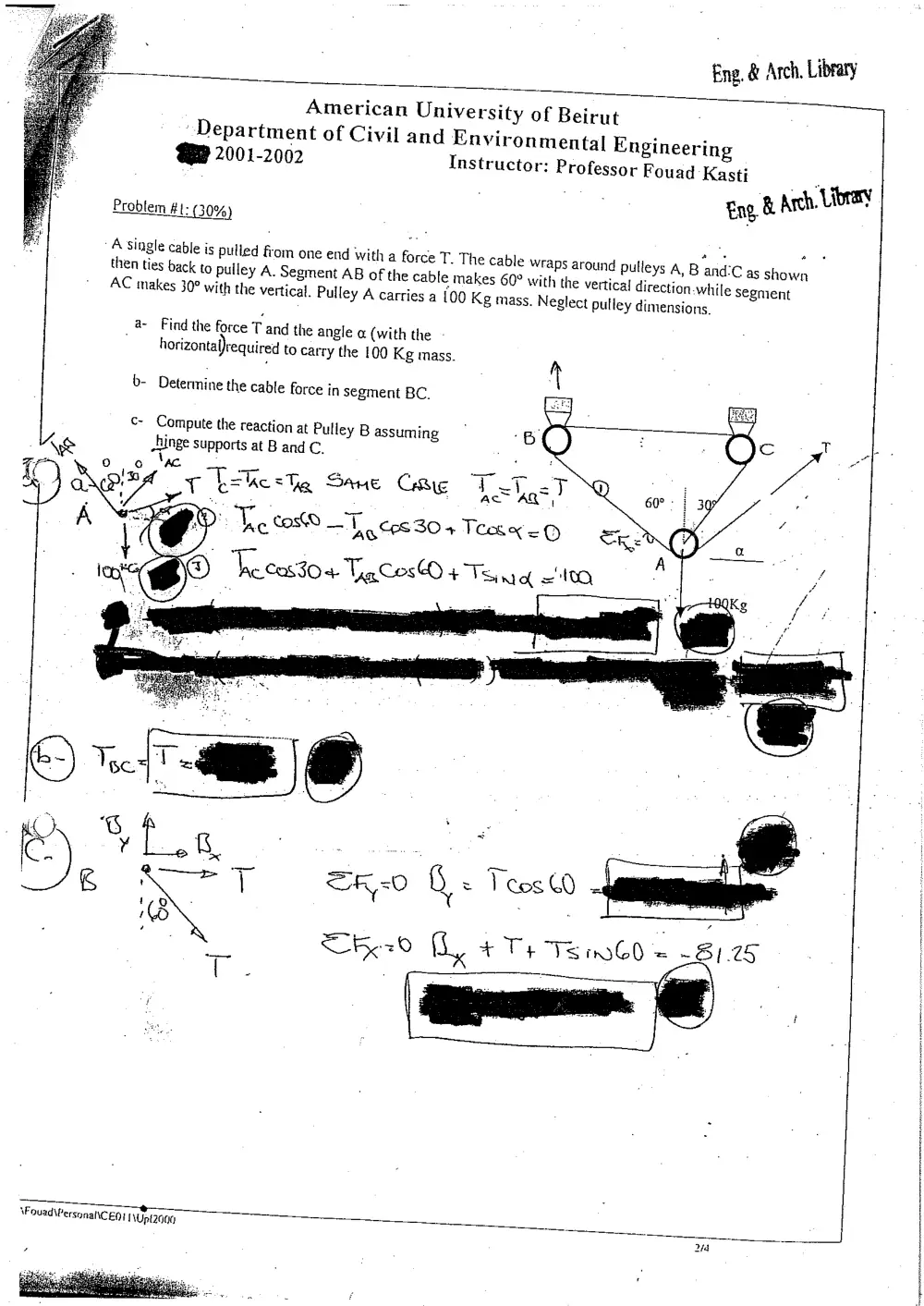
BP 2001-2002
Problem #1: (30%
American University of Beirut
AC makes 30° with the vertical. Pulley A carries a [00 Kg mass. Neglect pulley dimensions
a- Find the force T and t
horizontal)required to
b- Determine the cable force in segment BC.
c- Compute the reaction
he angle « (with the -
carry the 100 Kg mass. h
hile segment
Department of Civil and Environmental Engineering
Instructor: Professor Fouad Kasti
tng & Arch. Library
at Pulley B assuming B
-hinge supports at B and C.
i
ax
——e-
ersonal\CEOt I\Upt2a0g
24
Lag: OC ARCH. LADEATY
. American University of Beirut
{Department of Civil and Environmental Engineering
2001- 2002 Instructor: Professor Fouad Kasti
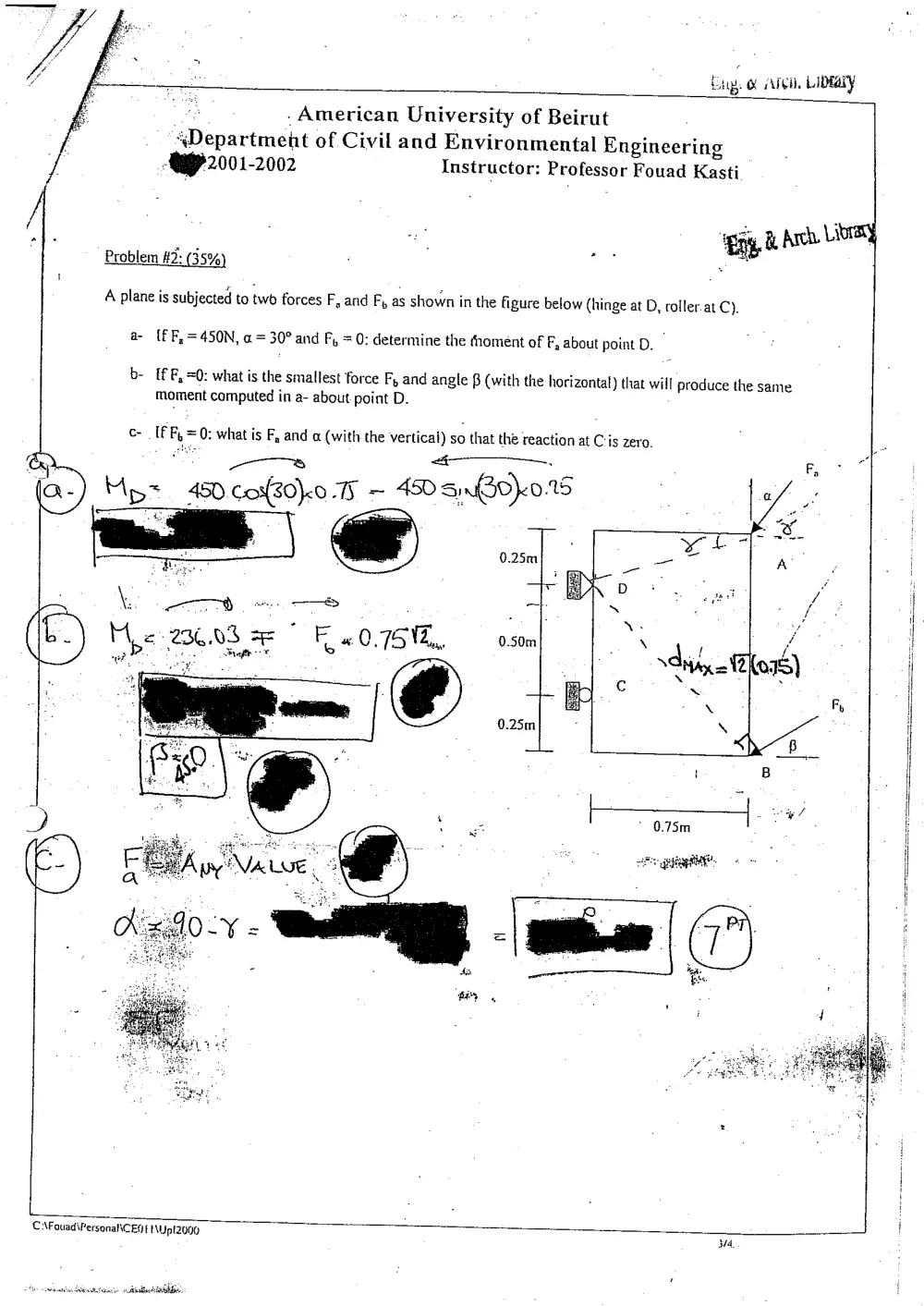
Problem #2: (35%)
A plane is subjected to two forces F, and F, as shown in the figure below (hinge at D, roller-at C).
a- (fF, =450N, a = 30° and F, = 0: determine the thoment of F, about point D. ,
b- [€F, =0: what is the smallest force F, and angle B (with the horizontal) that will produce the same
moment computed in a- about point D.
c- (fF, =0: what is F, and a (with the vertical) so that the reaction at C:is zero.
wots ——_——__. Los
a; . F,
450 Cof3O}c0 TK ~ 450 SinO)e0.15 | .
|
i
|
CAFouadPersonahCEGt \Upt2000 Ja,
— . . Eng-ar-Arch-cibeary
American University of Beirut
Department of Civil and Environmental Engineering
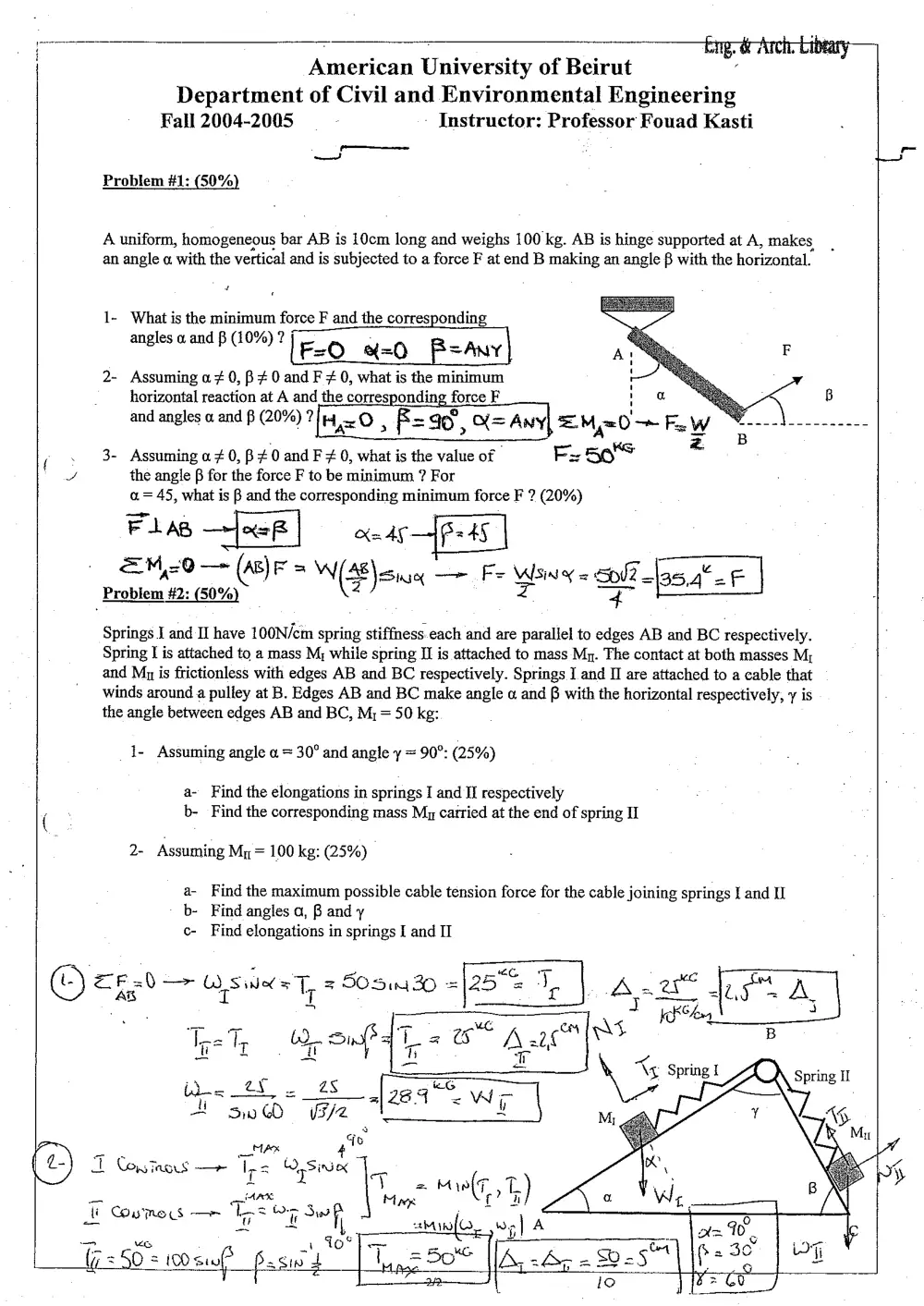
Fall 2004-2005 - Instructor: Professor Fouad Kasti
Problem #1: (50%)
A uniform, homogeneous bar AB is 10cm long and weighs 100 kg. AB is hinge supported at A, makes.
an angle o with the vertical and is subjected to a force F at end B making an angle f with the horizontal.
+
1- What is the minimum force F and the corresponding
angles a and B (10%) ? | F=0 &=0 B=Any
2- Assuming «#0, B 4 0 and F 4 0, what is the minimum
horizontal reaction at A and the corresponding force F 8
and angles and (20%) frye 0, F=90', X= Any| EMO FW ©----1----------
B
z
3- Assuming a # 0, BF OandF #0, what is the value of Fy ao
7 the angle B for the force F to be minimum ? For
a= a7, what is Ine and the corresponding minimum force F ? (20%)
=e <0 — (A nel eh Siiq — ea Wows = olf [35.44 - af |
Problem: #2: (50%) 4
Springs J and II have 100N/cm spring stiffness.each and are parallel to edges AB and BC respectively.
Spring I is attached to a mass M; while spring I is attached to mass Mg. The contact at both masses My
and Mr is frictionless with edges AB and BC respectively. Springs I and II are attached to a cable that
winds around a pulley at B. Edges AB and BC make angle o and B with the horizontal respectively, y is
the angle between edges AB and BC, M; = 50 kg:
1- Assuming angle a = 30° and angle y = 90°: (25%)
a- Find the elongations in springs I and II respectively
b- Find the corresponding mass My carried at the end of spring
2- Assuming My = 100 kg: (25%)
a- Find the maximum possible cable tension force for the cable joining springs Land
b- Find angles a, B and y
c- Find elongations in springs I and II
i Eph Wy sue eT, = 505430 =|25°S ‘J }p a juss A
. A,
sO T Xa
ea
American University of Beirut
Department of Civil and Environmental Engineering
Fall 2005-2006 Instructor: Professor Fouad Kasti
CIVE 210| Statics Exam #1 Sat Nov 12,05 | 1/1
1% Hour Exam, Closed Books
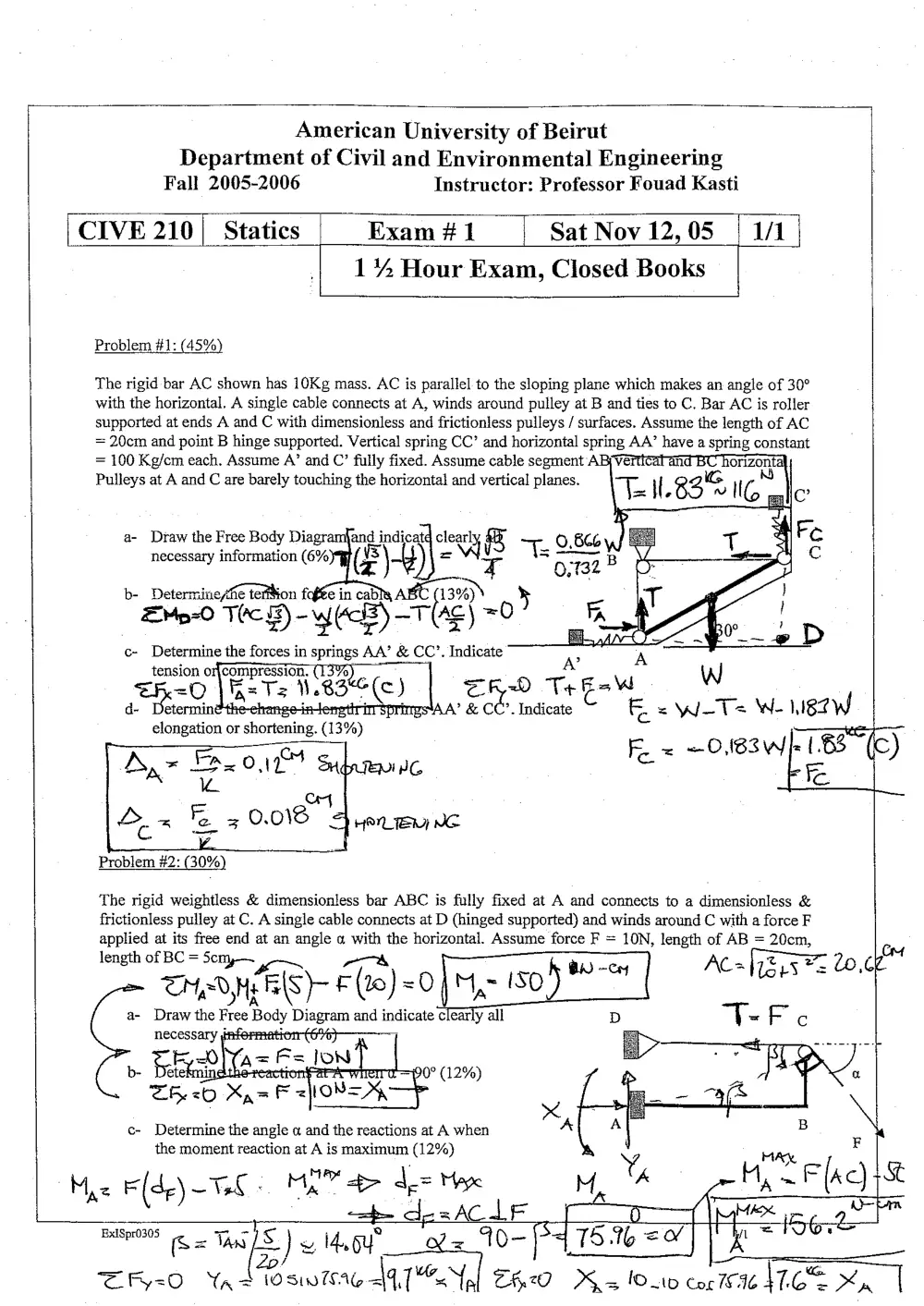
Problem #1: (45%)
The rigid bar AC shown has 10Kg mass. AC is parallel to the sloping plane which makes an angle of 30°
with the horizontal. A single cable connects at A, winds around pulley at B and ties to C. Bar AC is roller
supported at ends A and C with dimensionless and frictionless pulleys / surfaces. Assume the length of AC
= 20cm and point B hinge supported. Vertical spring CC’ and horizontal spring AA’ have a spring constant
= 100 Kg/cm each. Assume A’ and C’ fully fixed. Assume cable segment 'A
Pulleys at A and C are barely touching the horizontal and vertical planes.
a- Draw the Free Body Diagramland aye & T. 0.866
necessary information (6% 0.13 28 ey
b- Determine/fe terion foffe in cab ati <0 s
= - —~T(AG
Ep=0 The ®)- wécl3) —T (4g) =
c- Determine the forces in springs AA’ & CC’. Indicate
tension o: Pompression: %
A= = Vs W685 ©)
d- etermin et
= +0183 W) 1.88 (©)
if
Problem #2: (30%)
The rigid weightless & dimensionless bar ABC is fully fixed at A and connects to a dimensionless &
frictionless pulley at C. A single cable connects at D (hinged supported) and winds around C with a force F
applied at its free end at an angle a with the horizontal. Assume force F = 10N, length of AB = 20cm,
length of BC = Scmy—.
c- Determine the angle « and the reactions at A when
the moment reaction at A is maximum (12%)
Me Eld-\ Tf - Mi” > d= Maye
he F(%e) wate des AC LE
ExiSpr0305 R= Toi) w )e j 4, pu 4O-
TR=0 Yas Pr steve 14] 41 oN Tht Ks lo coc 256 lic Dar
Eng, & Arch. Library
American University of Beirut
Department of Civil and Environmental Engineering .
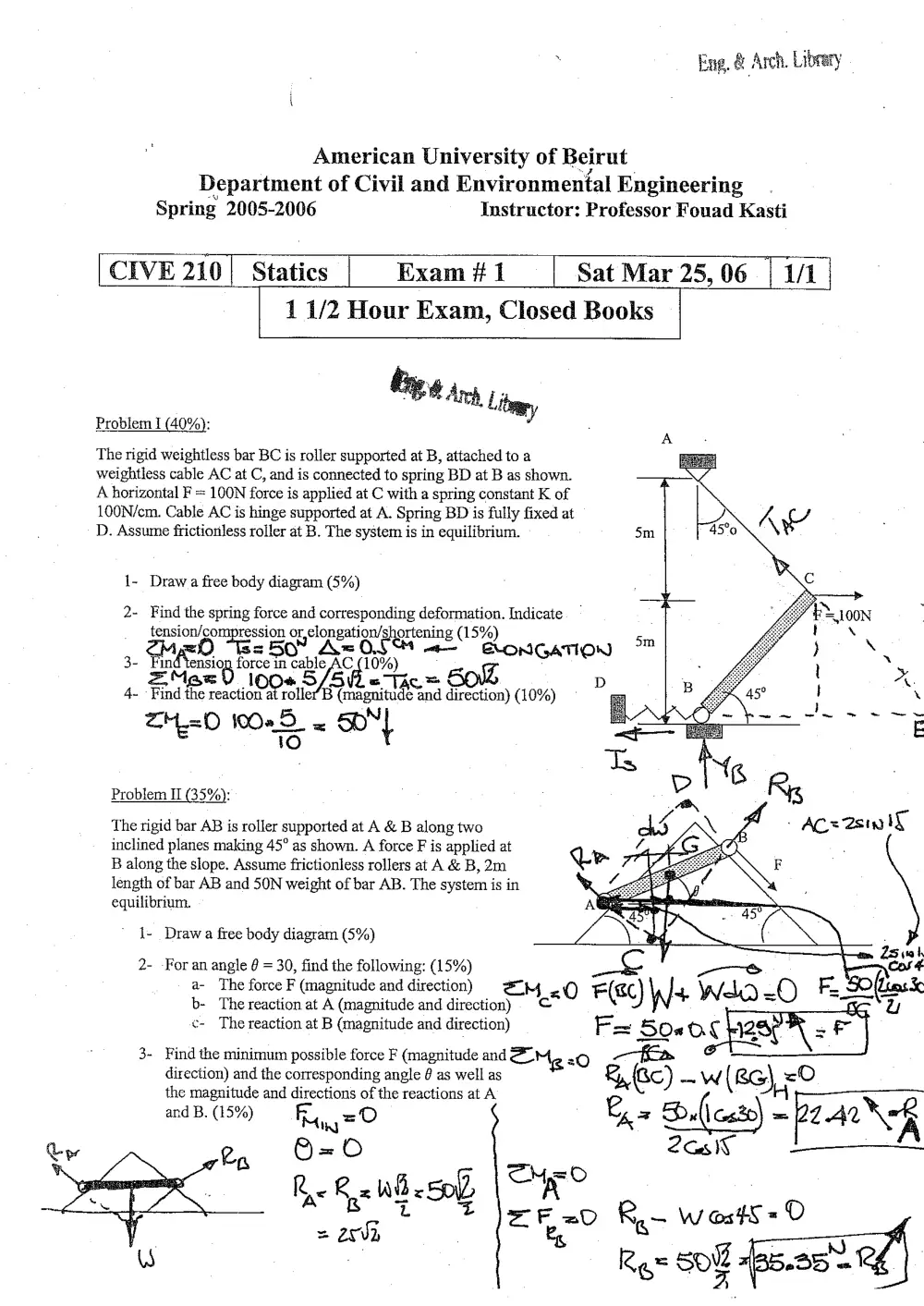
Spring 2005-2006 Instructor: Professor Fouad Kasti
CIVE 210] Statics Exam #1 Sat Mar 25,06 | 1/1
1 1/2 Hour Exam, Closed Books
P44 Lig
Problem I (40%):
A
The rigid weightless bar BC is roller supported at B, attached to a
weightless cable AC at C, and is connected to spring BD at B as shown.
A horizontal F = 100N force is applied at C with a spring constant K of
100N/cm. Cable AC is hinge supported at A. Spring BD is fully fixed at
D. Assume frictionless roller at B. The system is in equilibrium. 5m
1- Draw a free body diagram (5%)
2- Find the spring force and corresponding deformation. Indicate. © : =,100N
ve te aN or, akan ha ee (15%)
5m
ra A AG sok SATION)
3- Fin =O Tice im ey oS °
=a =
4- Find the reactice. at roller’ B Bit = tae. SO direction) (10%)
B
N Fl a ar
SHO MOLE, = = D| eS
XG
Problem H (35%): Bo Rs
The rigid bar AB is roller supported at A & B along two
inclined planes making 45° as shown. A force F is applied at ~
B along the slope. Assume frictionless rollers at A & B, 2m tL
length of bar AB and 50N weight of bar AB. The system is in
equilibrium.
l- Draw a free body diagram (5%)
ee 4
2- -For an angle @ = 30, find the following: (15%) _& Cos 4
a- The force F (magnitude and direction) M20 F(C) W a W. Weep 9) FL ae
b- The reaction at A (magnitude and direction c
c- The reaction at B (magnitude and direction) F= 5040 Jaane ‘
3- Find the minimum possible force F (magnitude and omg 20 — Ke
direction) and the corresponding angle @ as well as ees) ~ w{ CE
the magnitude and directions of the reactions at A
and B. (15%) Fayy=O qs = 240\-6
Cw 7&a _
- chk ZERO Ry- wes ;
ir » Rex sod sans