
CIVE 431 Final, Fall 2006
American University of Beirut · Soil Mechanics and Laboratory · 5 pages · Prof. Salah Sadek
More CIVE 431 files
Show the text of this final exam
FINAL
CIVE 431
Soil Mechanics and Laboratory
SPRING 2006
Professor: Salah Sadek
CLOSED BOOK/NOTES, 2 ½ HOURS
Programmable calculators are not allowed. Question sheets must be returned with
the answer booklet.
Name :
ID #:
Manage your time carefully (quickly read through all the problems before starting
the exam, & do not spend an hour on one problem!).
Good Luck!
NOTE:
The following might be of help:
Unit weight of water, γw = 9.81 kN/m3 = 62.4 lb/ft3
Seepage Force/Volume = i . γw
γsat = (Gs+e).γw/(1+e)
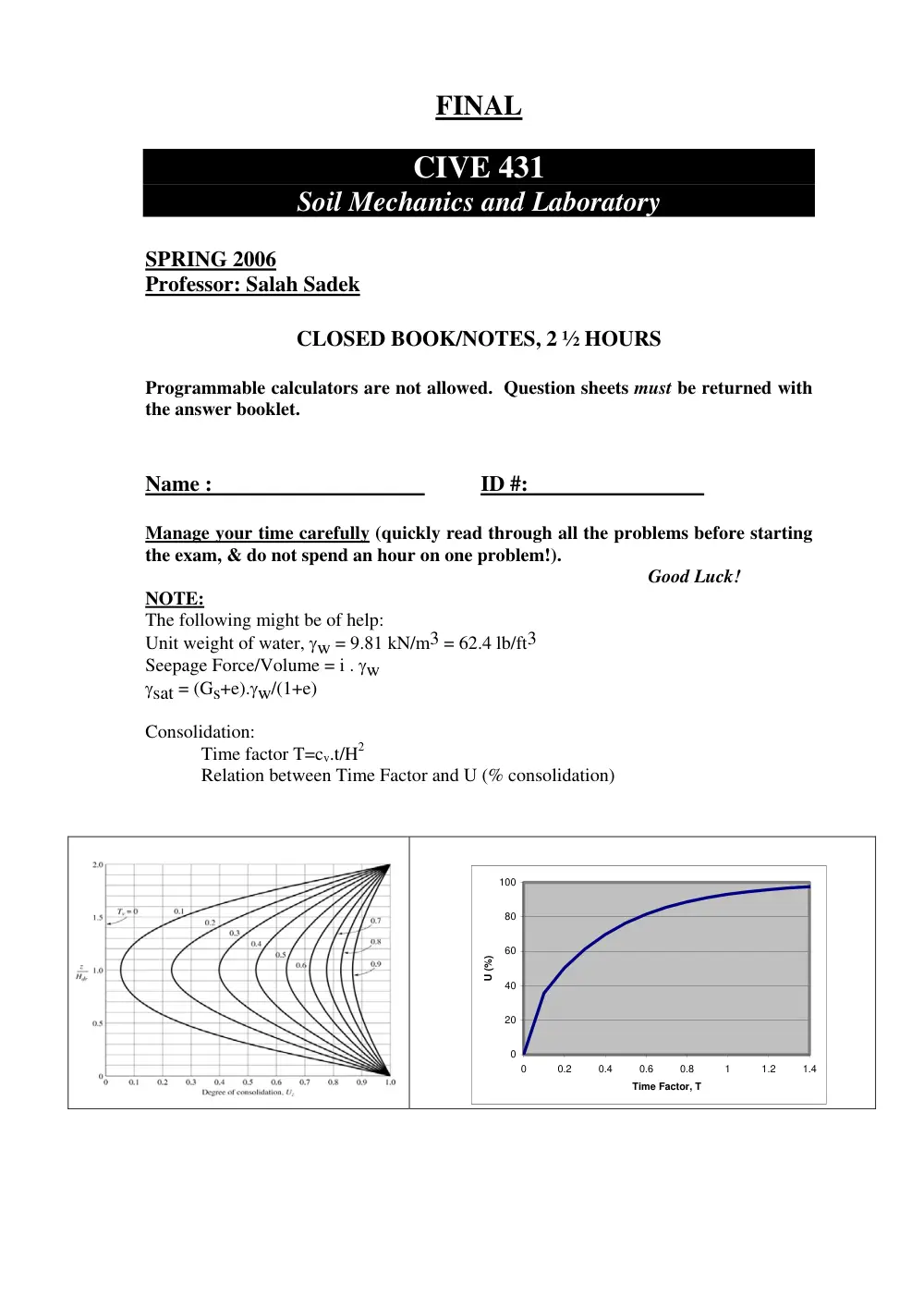
Consolidation:
Time factor T=cv.t/H2
Relation between Time Factor and U (% consolidation)
0
20
40
60
80
100
0
0.2
0.4
0.6
0.8
1
1.2
1.4
Time Factor, T
U (%)
2/4
Final CIVE 431 SOIL MECHANICS – Spring 2006
PROBLEM -1 (10 Points)
A soil sample is taken from the field and brought to the laboratory for testing. In the lab,
the “natural” dry density of the sample is determined to be 15.0 kN/m3.
Further tests allow the determination of the maximum and minimum possible dry
densities. The obtained values are 17.0 kN/m3 and 13.0 kN/m3, respectively. Gs is
measured at 2.65.
(a) What is the relative density, DR, of the sample as obtained from the field?
(b) Assuming the sample was disturbed while being transported from the site to the lab,
and that its volume decreased by ~ 4% during transport. What is the error in DR
calculated in (a) as a result of the sample disturbance
Problem #2: (25 Points)
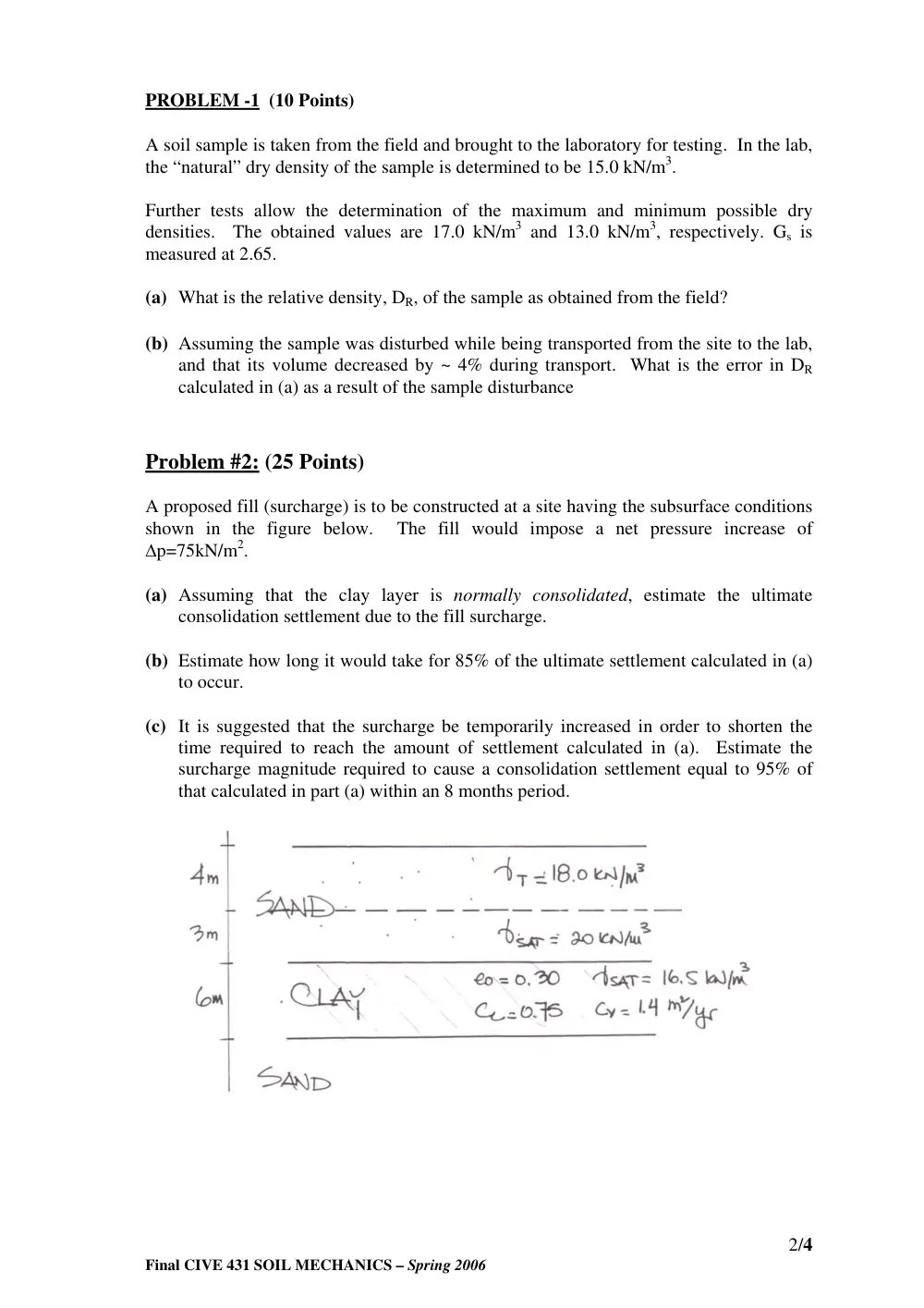
A proposed fill (surcharge) is to be constructed at a site having the subsurface conditions
shown in the figure below. The fill would impose a net pressure increase of
Δp=75kN/m2.
(a) Assuming that the clay layer is normally consolidated, estimate the ultimate
consolidation settlement due to the fill surcharge.
(b) Estimate how long it would take for 85% of the ultimate settlement calculated in (a)
to occur.
(c) It is suggested that the surcharge be temporarily increased in order to shorten the
time required to reach the amount of settlement calculated in (a). Estimate the
surcharge magnitude required to cause a consolidation settlement equal to 95% of
that calculated in part (a) within an 8 months period.
3/4
Final CIVE 431 SOIL MECHANICS – Spring 2006
Problem #3: ( 15 Points)
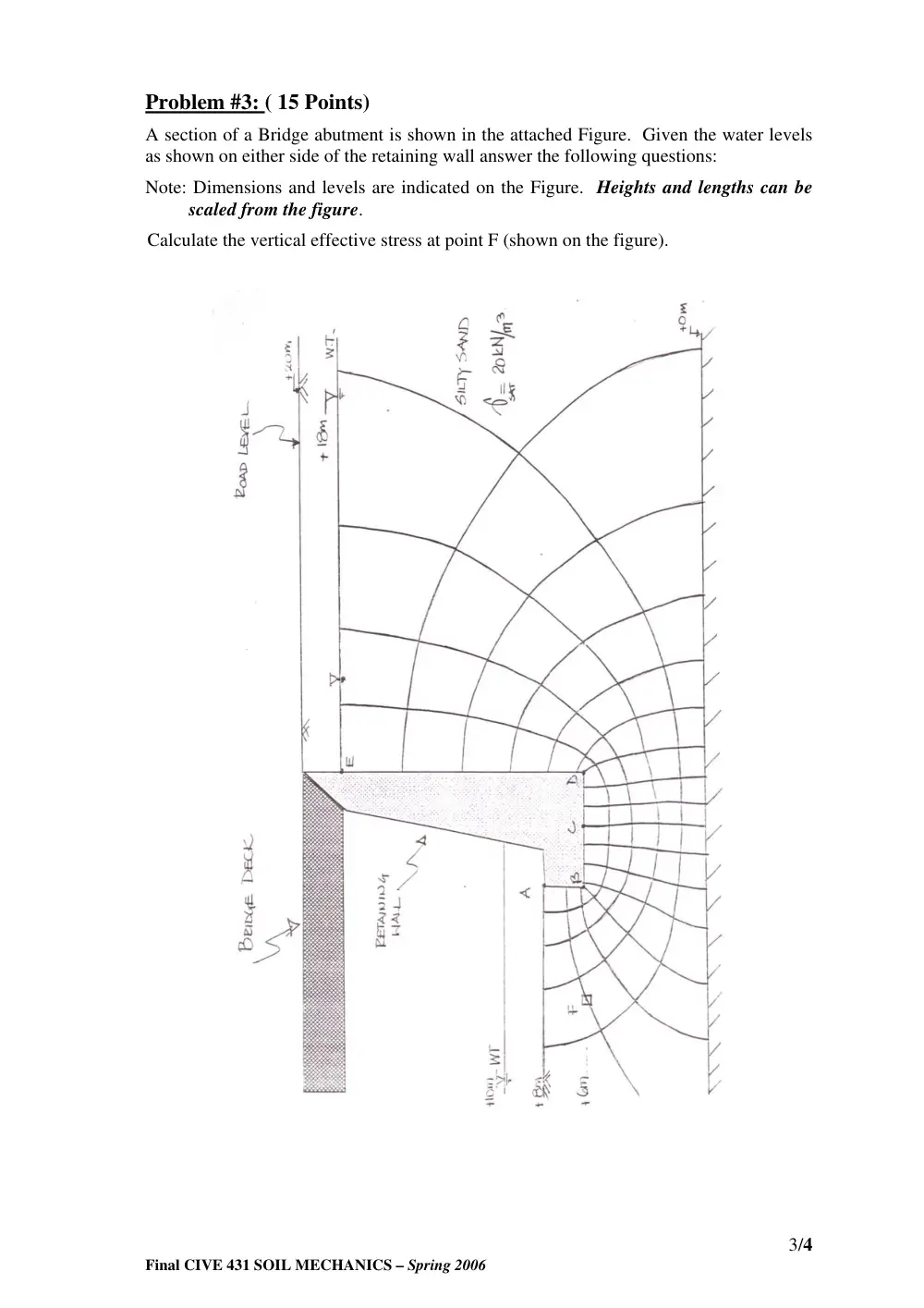
A section of a Bridge abutment is shown in the attached Figure. Given the water levels
as shown on either side of the retaining wall answer the following questions:
Note: Dimensions and levels are indicated on the Figure. Heights and lengths can be
scaled from the figure.
Calculate the vertical effective stress at point F (shown on the figure).
4/4
Final CIVE 431 SOIL MECHANICS – Spring 2006
Problem #4: (20 Points)
A compacted soil specimen is 75mm in diameter and 150mm long. It is to be prepared
from oven dry soil (Gs = 2.67), and water. The specimen is to have a water content of
15% and air content of 17%.
(Note: air content = volume of air x100% / total volume).
Calculate:
(a) The mass of soils and volume of water required for the preparation of the specimen.
(b) The bulk unit weight γΤ, the dry unit weight γd, the void ratio e, the degree of
saturation S and the porosity n, of the compacted specimen.
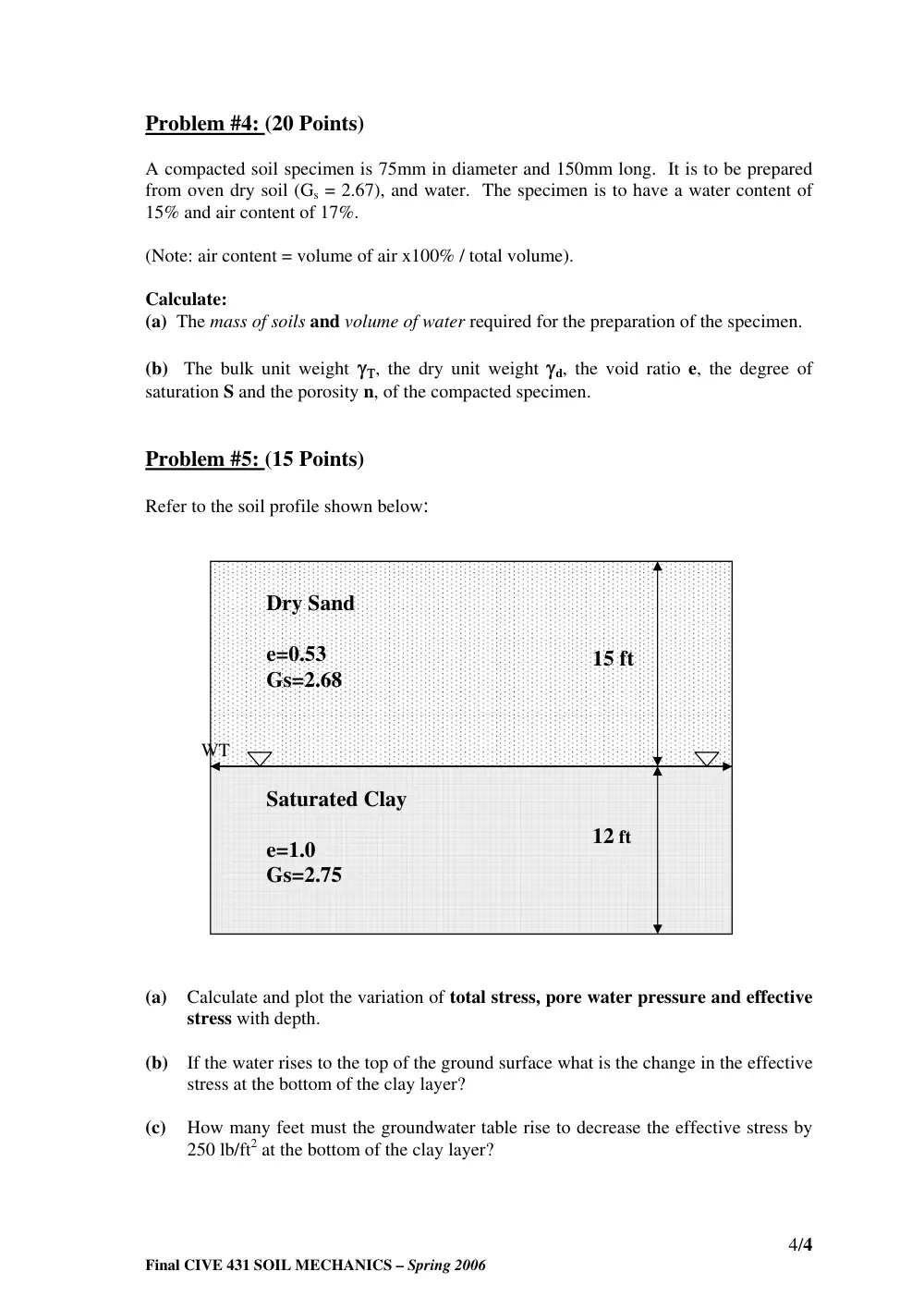
Problem #5: (15 Points)
Refer to the soil profile shown below:
(a)
Calculate and plot the variation of total stress, pore water pressure and effective
stress with depth.
(b) If the water rises to the top of the ground surface what is the change in the effective
stress at the bottom of the clay layer?
(c)
How many feet must the groundwater table rise to decrease the effective stress by
250 lb/ft2 at the bottom of the clay layer?
WT
Dry Sand
e=0.53
Gs=2.68
Saturated Clay
e=1.0
Gs=2.75
15 ft
12 ft
5/4
Final CIVE 431 SOIL MECHANICS – Spring 2006
Problem #6: (15 Points)
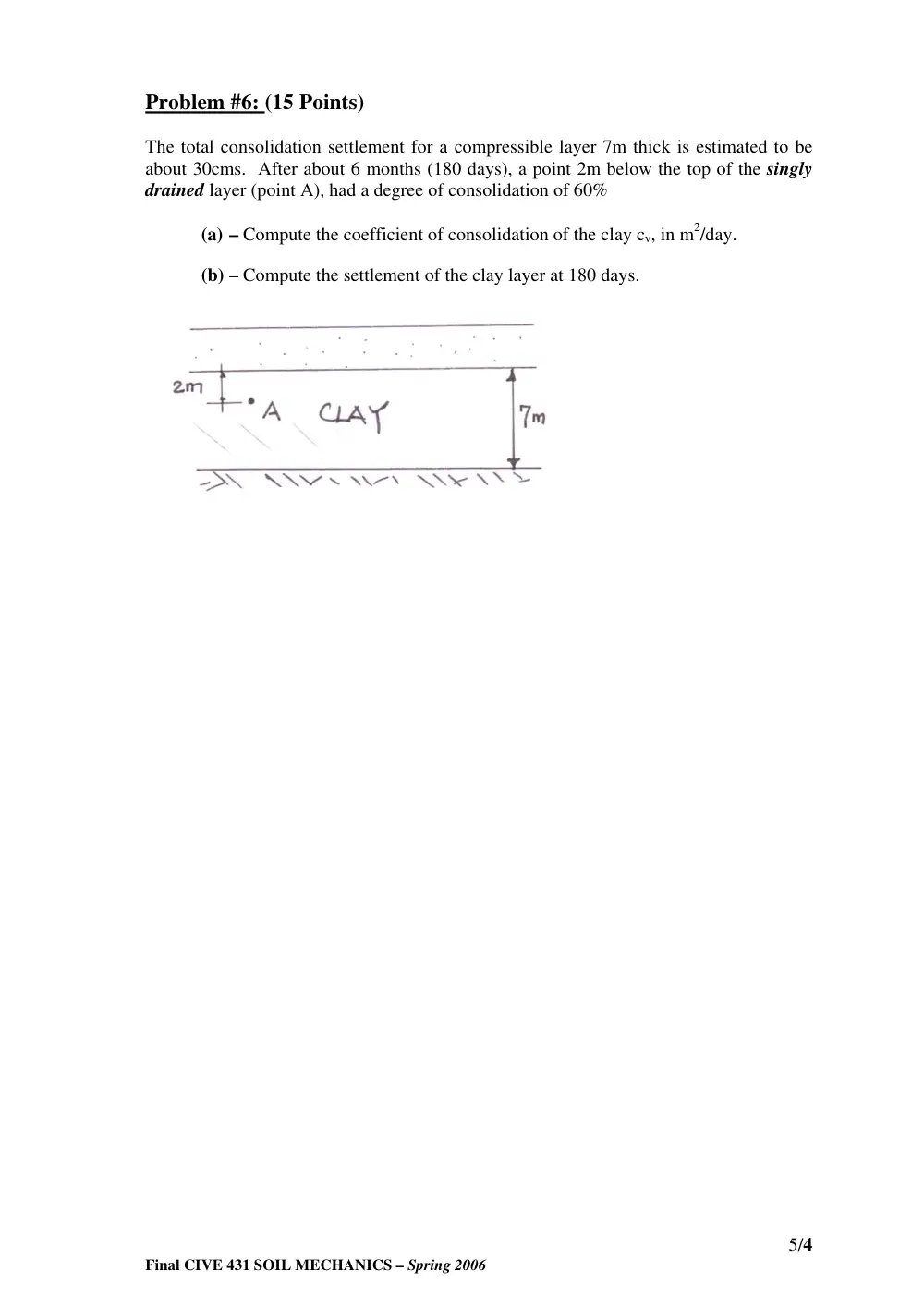
The total consolidation settlement for a compressible layer 7m thick is estimated to be
about 30cms. After about 6 months (180 days), a point 2m below the top of the singly
drained layer (point A), had a degree of consolidation of 60%
(a) – Compute the coefficient of consolidation of the clay cv, in m2/day.
(b) – Compute the settlement of the clay layer at 180 days.