
CIVE 450 Problems Page 2, Spring 2014
American University of Beirut · Water and Wastewater Treatment and Laboratory · 1 page
Stuck on a question? A tutor can walk you through it.
More CIVE 450 files
- Problems Page 1 · Spring 2014ProblemsView
- Problems Page 3 · Spring 2014ProblemsView
- Problems Page 4 · Spring 2014ProblemsView
- Problems Page 5 · Spring 2014ProblemsView
- Problems · Fall 2010ProblemsView
- Problems · Fall 2010ProblemsView
- Homework Problems · Fall 2015HomeworkView
- Lab Report 1 · Spring 2014LabView
Show the text of this problems
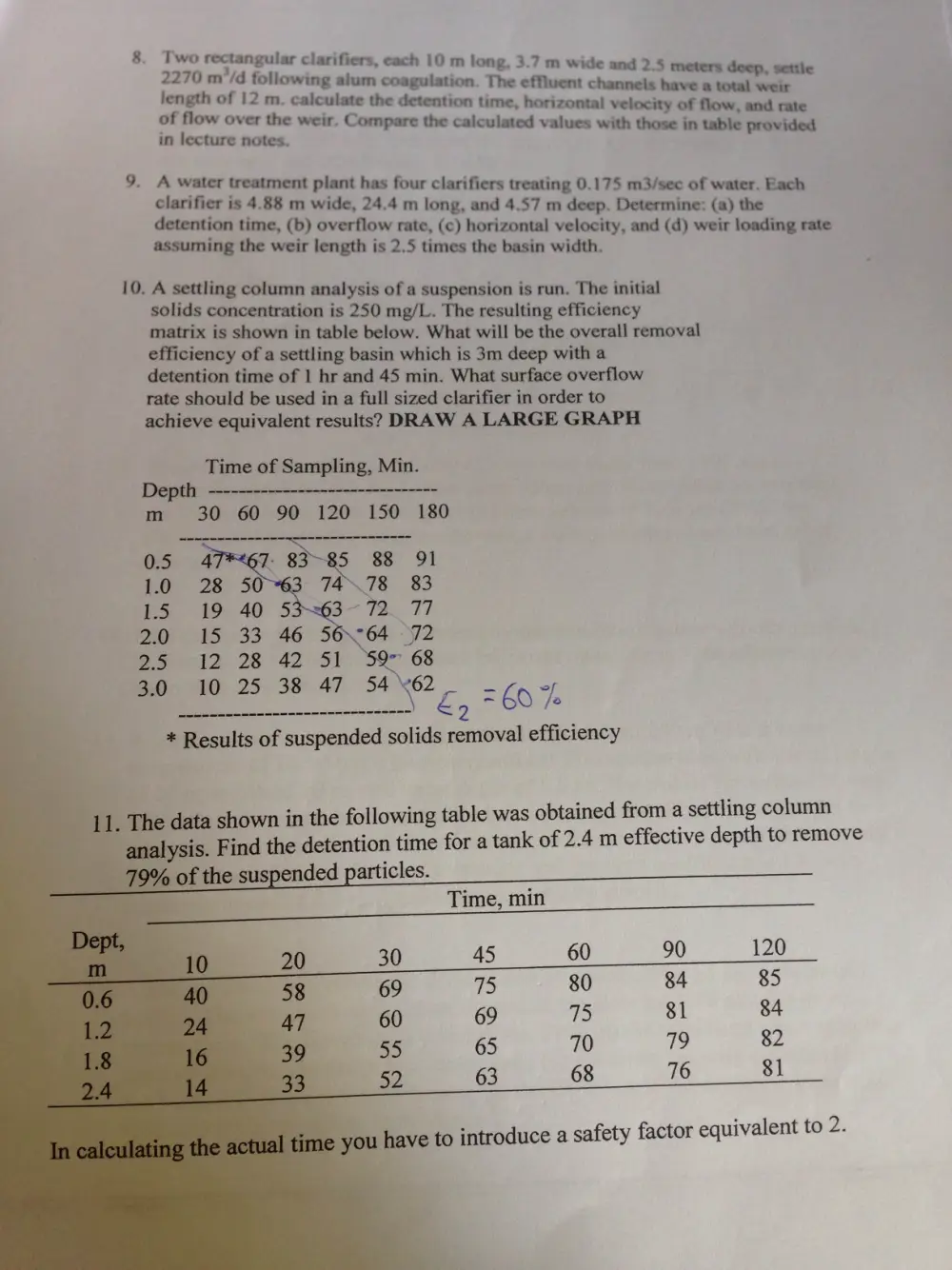
8. Two rectangular clarifiers, each 10 m long, 3.7 m wide and 2.5 tneters d
2270 m’*/d following alum i total weir
coagulation. The effluent channels ha’
length of 12 m. calculate the detention time, horizontal velocity pre and rate
of flow over the weir. Com the calculated val i ;
i saline pare cu values with those in table provided
9. A water treatment plant has four clarifiers treating 0.175 m3/sec of water. Each
clarifier is 4.88 m wide, 24.4 m long, and 4.57 m deep. Determine: (a) the
detention time, (b) overflow rate, (c) horizontal velocity, and (d) weir loading rate
assuming the weir length is 2.5 times the basin width.
10.A settling column analysis of a suspension is run. The initial
solids concentration is 250 mg/L. The resulting efficiency
matrix is shown in table below. What will be the overall removal
efficiency of a settling basin which is 3m deep with a
detention time of 1 hr and 45 min. What surface overflow
rate should be used in a full sized clarifier in order to
achieve equivalent results? DRAW A LARGE GRAPH
Time of Sampling, Min.
Depth -------------------------------
m 30 60 90 120 150 180
12 28° 42::51
30- 10 25 38 47 5462 ay
NE, OF
* Results of suspended solids removal efficiency
11. The data shown in the following table was obtained from a settling column
analysis. Find the detention time for a tank of 2.4 m effective depth to remove
of the suspended particles.
Time, min
45 60 90 120
75 80 84 85
69 jie) $1 84
65 70 79 82
63 68 76 81
you have to introduce a safety factor equivalent to 2.