
CMPS 200 Problems Extra Problems, Fall 2016
American University of Beirut · Introduction to Programming · 4 pages

More CMPS 200 files
Show the text of this problems
Music Collection
Class CD
Implement the CD class which defines the properties of objects that we will use later to represent CDs.
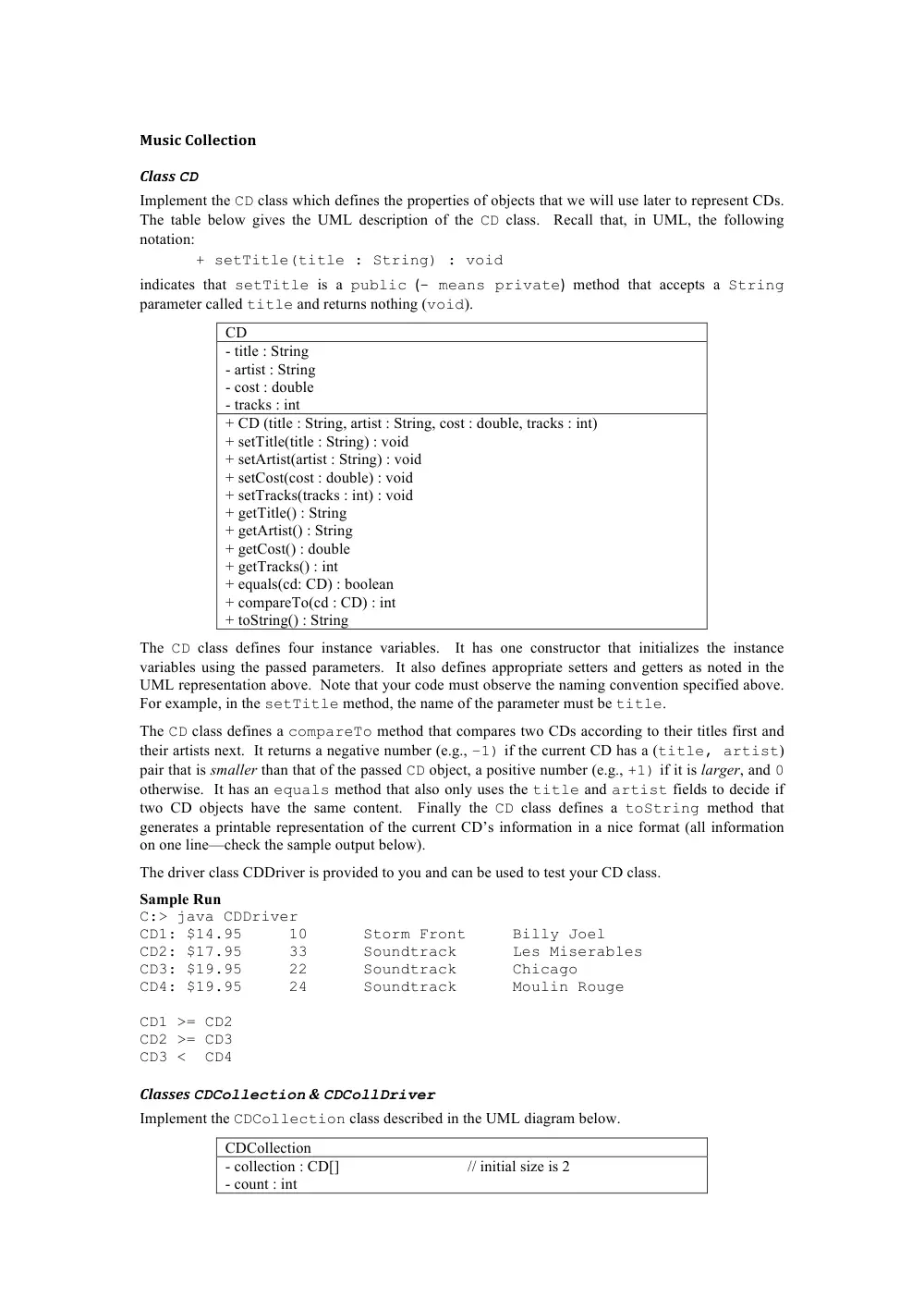
The table below gives the UML description of the CD class. Recall that, in UML, the following
notation:
+ setTitle(title : String) : void
indicates that setTitle is a public (- means private) method that accepts a String
parameter called title and returns nothing (void).
CD
- title : String
- artist : String
- cost : double
- tracks : int
+ CD (title : String, artist : String, cost : double, tracks : int)
+ setTitle(title : String) : void
+ setArtist(artist : String) : void
+ setCost(cost : double) : void
+ setTracks(tracks : int) : void
+ getTitle() : String
+ getArtist() : String
+ getCost() : double
+ getTracks() : int
+ equals(cd: CD) : boolean
+ compareTo(cd : CD) : int
+ toString() : String
The CD class defines four instance variables. It has one constructor that initializes the instance
variables using the passed parameters. It also defines appropriate setters and getters as noted in the
UML representation above. Note that your code must observe the naming convention specified above.
For example, in the setTitle method, the name of the parameter must be title.
The CD class defines a compareTo method that compares two CDs according to their titles first and
their artists next. It returns a negative number (e.g., –1) if the current CD has a (title, artist)
pair that is smaller than that of the passed CD object, a positive number (e.g., +1) if it is larger, and 0
otherwise. It has an equals method that also only uses the title and artist fields to decide if
two CD objects have the same content. Finally the CD class defines a toString method that
generates a printable representation of the current CD’s information in a nice format (all information
on one line—check the sample output below).
The driver class CDDriver is provided to you and can be used to test your CD class.
Sample Run
C:> java CDDriver
CD1: $14.95 10 Storm Front Billy Joel
CD2: $17.95 33 Soundtrack Les Miserables
CD3: $19.95 22 Soundtrack Chicago
CD4: $19.95 24 Soundtrack Moulin Rouge
CD1 >= CD2
CD2 >= CD3
CD3 < CD4
Classes CDCollection & CDCollDriver
Implement the CDCollection class described in the UML diagram below.
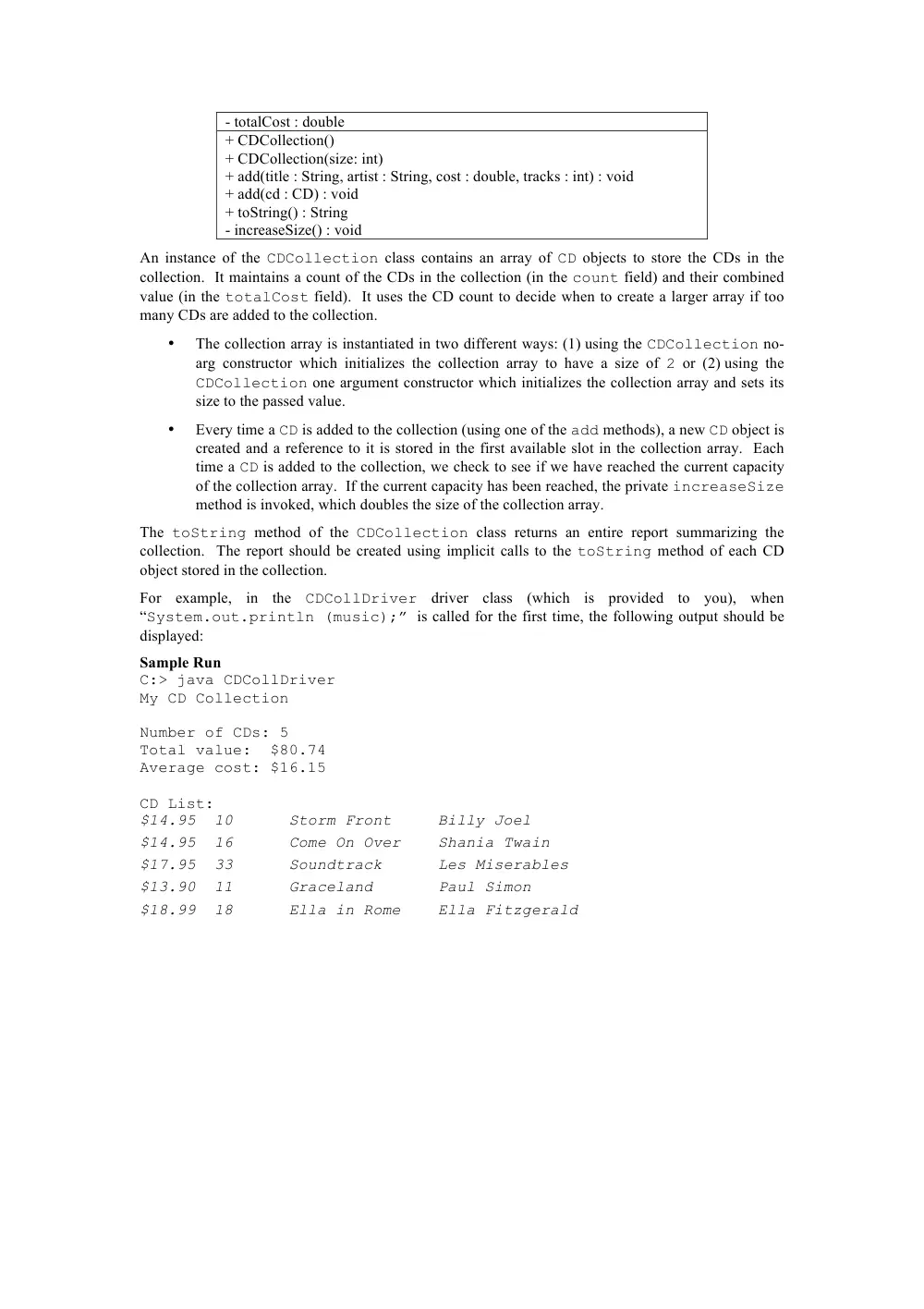
CDCollection
- collection : CD[] // initial size is 2
- count : int
- totalCost : double
+ CDCollection()
+ CDCollection(size: int)
+ add(title : String, artist : String, cost : double, tracks : int) : void
+ add(cd : CD) : void
+ toString() : String
- increaseSize() : void
An instance of the CDCollection class contains an array of CD objects to store the CDs in the
collection. It maintains a count of the CDs in the collection (in the count field) and their combined
value (in the totalCost field). It uses the CD count to decide when to create a larger array if too
many CDs are added to the collection.
•
The collection array is instantiated in two different ways: (1) using the CDCollection no-
arg constructor which initializes the collection array to have a size of 2 or (2) using the
CDCollection one argument constructor which initializes the collection array and sets its
size to the passed value.
•
Every time a CD is added to the collection (using one of the add methods), a new CD object is
created and a reference to it is stored in the first available slot in the collection array. Each
time a CD is added to the collection, we check to see if we have reached the current capacity
of the collection array. If the current capacity has been reached, the private increaseSize
method is invoked, which doubles the size of the collection array.
The toString method of the CDCollection class returns an entire report summarizing the
collection. The report should be created using implicit calls to the toString method of each CD
object stored in the collection.
For example, in the CDCollDriver driver class (which is provided to you), when
“System.out.println (music);” is called for the first time, the following output should be
displayed:
Sample Run
C:> java CDCollDriver
My CD Collection
Number of CDs: 5
Total value: $80.74
Average cost: $16.15
CD List:
$14.95 10 Storm Front Billy Joel
$14.95 16 Come On Over Shania Twain
$17.95 33 Soundtrack Les Miserables
$13.90 11 Graceland Paul Simon
$18.99 18 Ella in Rome Ella Fitzgerald
Classes CDUniqCollection & Tunes
Implement the CDUniqCollection class described in the UML diagram below.
CDUniqCollection
- collection : CD[] // initial size is 2
- count : int
- totalCost : double
+ CDUniqCollection()
+ CDUniqCollection(size: int)
+ add(title : String, artist : String, cost : double, tracks : int) : void
+ add(cd : CD) : void
+ sort() : void
+ remove(title : String, artist : String) : CD
+ toString() : String
- findIndex(title : String, artist : String) : int
- increaseSize() : void
The CDUniqCollection class is very similar to the CDCollection class and differs from it as
follows:
•
It does not add a CD to the collection if it already has one with the same title and artist. The
private method findIndex can be used for this purpose.
•
It has a private method findIndex that can be used to check if the CD already exists in the
collection. It accepts as parameters a CD title and artist and then searches the
collection array looking for a CD with the same title and artist. If such a CD were to
exist, it returns the index of that CD in the collection array, otherwise it returns –1.
•
The sort method of the CDCollection class sorts all the CDs in the collection according
to their (title, artist) fields in ascending order.
•
The remove method of the CDCollection class accepts the title and author of a
certain CD, removes the corresponding CD from the collection, and returns the removed CD.
Before removing the CD, you need to make sure that the CD exists in the collection. The
private method findIndex can be used for this purpose (similar to what was described in
the add method). Note that when you remove a CD from the collection array, all CDs that
are to its right must be shifted one place to left. Also, the current size of the collection array
must be decreased by 1.
The Tunes driver class is provided to you. Its sample run is shown below.
Sample Run
C:> java Tunes
My Unique CD Collection
Number of CDs: 4
Total value: $61.75
Average cost: $15.44
CD List:
$14.95 16 Come On Over Shania Twain
$13.90 11 Graceland Paul Simon
$17.95 33 Soundtrack Les Miserables
$14.95 10 Storm Front Billy Joel
Remove 1 CD: $14.95 10 Storm Front Billy Joel
Add 3 CDs
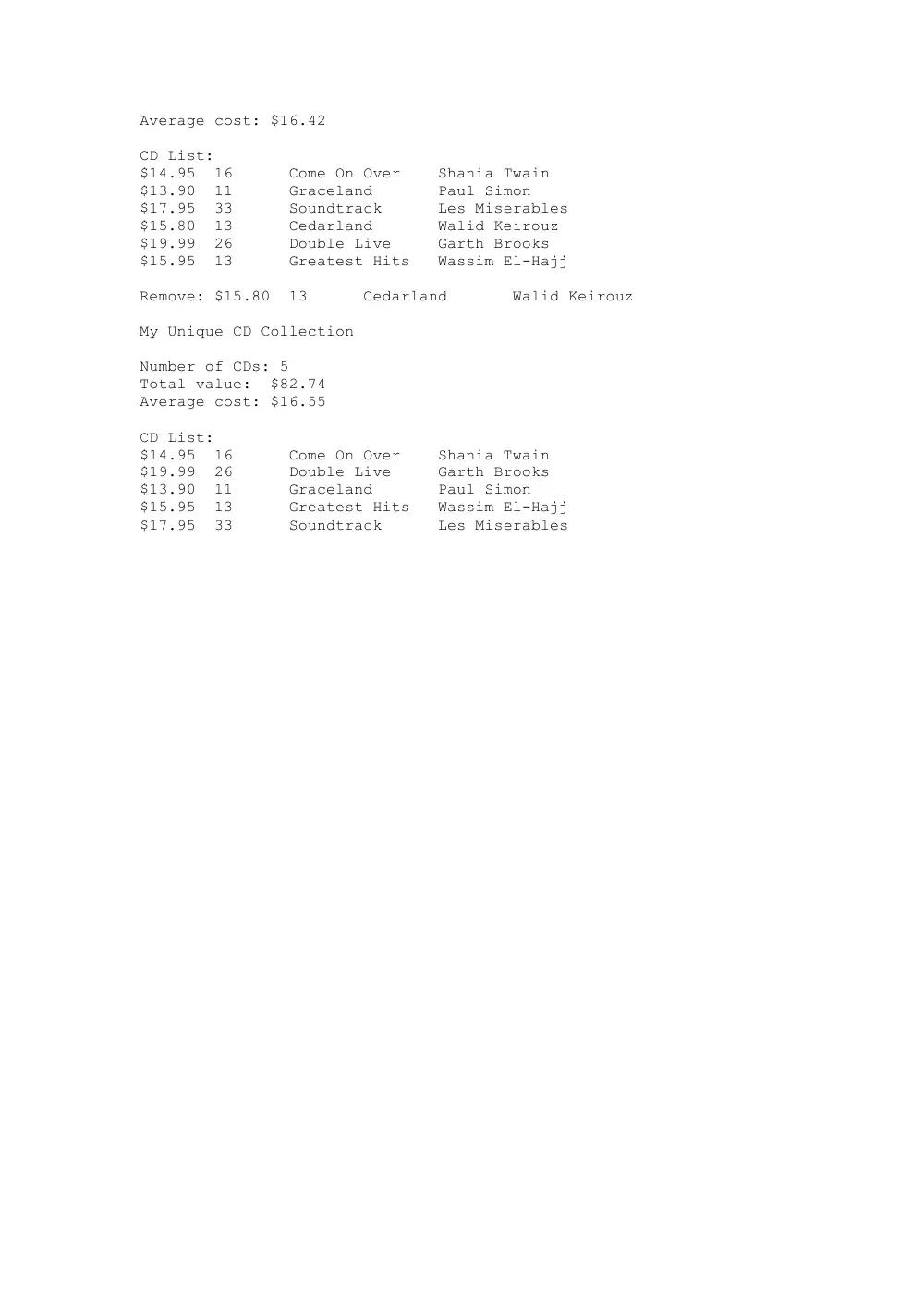
My Unique CD Collection
Number of CDs: 6
Total value: $98.54
Average cost: $16.42
CD List:
$14.95 16 Come On Over Shania Twain
$13.90 11 Graceland Paul Simon
$17.95 33 Soundtrack Les Miserables
$15.80 13 Cedarland Walid Keirouz
$19.99 26 Double Live Garth Brooks
$15.95 13 Greatest Hits Wassim El-Hajj
Remove: $15.80 13 Cedarland Walid Keirouz
My Unique CD Collection
Number of CDs: 5
Total value: $82.74
Average cost: $16.55
CD List:
$14.95 16 Come On Over Shania Twain
$19.99 26 Double Live Garth Brooks
$13.90 11 Graceland Paul Simon
$15.95 13 Greatest Hits Wassim El-Hajj
$17.95 33 Soundtrack Les Miserables