
CMPS 209 Homework Assignment 1, Fall 2014
American University of Beirut · Computers and Programming for the Sciences · 13 pages

Showing the first 10 of 13 pages. Download the PDF to see all of it.
More CMPS 209 files
- Homework Assignment 5 Solution · Spring 2015Homework · with solutionView
- Homework Assignmnet 3 · Fall 2015HomeworkView
- Homework Assignmnet 6 · Fall 2015HomeworkView
- Homework Assignmnet 5 · Fall 2015HomeworkView
- Homework Assignmnet 2 · Fall 2015HomeworkView
- Homework Assignmnet 8 · Fall 2015HomeworkView
- Homework Assignmnet 7 · Fall 2015HomeworkView
- Homework Assignmnet 4 · Fall 2015HomeworkView
Show the text of this homework
Introduction
Chocolate comprises a number of raw and
processed foods produced from the seed of the
tropical Theobroma cacao tree. Cacao has been
cultivated for at least three millennia in Mexico,
Central and South America, with its earliest
documented use around 1100 BC.
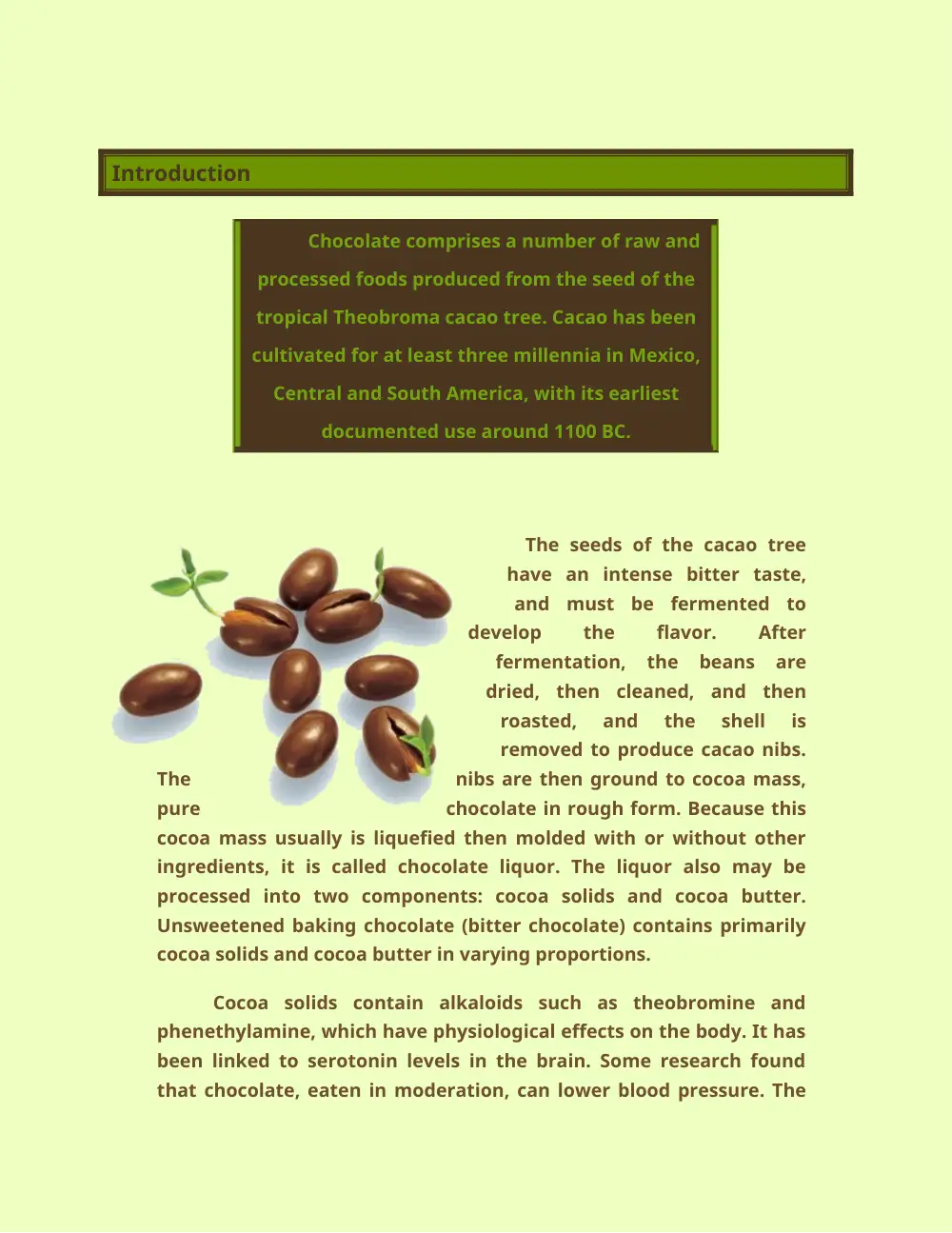
The seeds of the cacao tree
have an intense bitter taste,
and must be fermented to
develop
the
flavor.
After
fermentation, the beans are
dried, then cleaned, and then
roasted, and the shell is
removed to produce cacao nibs.
The
nibs are then ground to cocoa mass,
pure
chocolate in rough form. Because this
cocoa mass usually is liquefied then molded with or without other
ingredients, it is called chocolate liquor. The liquor also may be
processed into two components: cocoa solids and cocoa butter.
Unsweetened baking chocolate (bitter chocolate) contains primarily
cocoa solids and cocoa butter in varying proportions.
Cocoa solids contain alkaloids such as theobromine and
phenethylamine, which have physiological effects on the body. It has
been linked to serotonin levels in the brain. Some research found
that chocolate, eaten in moderation, can lower blood pressure. The
presence of theobromine renders it toxic to some animals, especially
dogs and cats.
Chocolate has become one of the most popular food types and
flavors in the world. Gifts of chocolate molded into different shapes
have become traditional on certain holidays: chocolate bunnies and
eggs are popular on Easter, chocolate coins on Hanukkah, Santa
Claus and other holiday symbols on Christmas, and chocolate hearts
or chocolate in heart-shaped boxes on Valentine's Day. Chocolate is
also used in cold and hot beverages, to produce chocolate milk and
hot chocolate. Around three quarters of the world's cacao bean
production takes place in West Africa.
Etymology
he word "chocolate" entered the English language from
Spanish. How the word came into Spanish is less certain,
and there are multiple competing explanations. Perhaps
the most cited explanation is that "chocolate" comes from
Nahuatl, the language of the Aztecs, from the word "chocolātl.
However, as William Bright noted the word "chocolatl" doesn't
occur in central Mexican colonial sources making this an unlikely
derivation. Santamaria gives a derivation from the Yucatec Maya
word "chokol" meaning hot, and the Nahuatl "atl" meaning
water. More recently Dakin and Wichmann derive it from another
Nahuatl term, "chicolatl" from Eastern Nahuatl meaning "beaten
drink. They derive this term from the word for the frothing stick,
"chicoli".
T
History
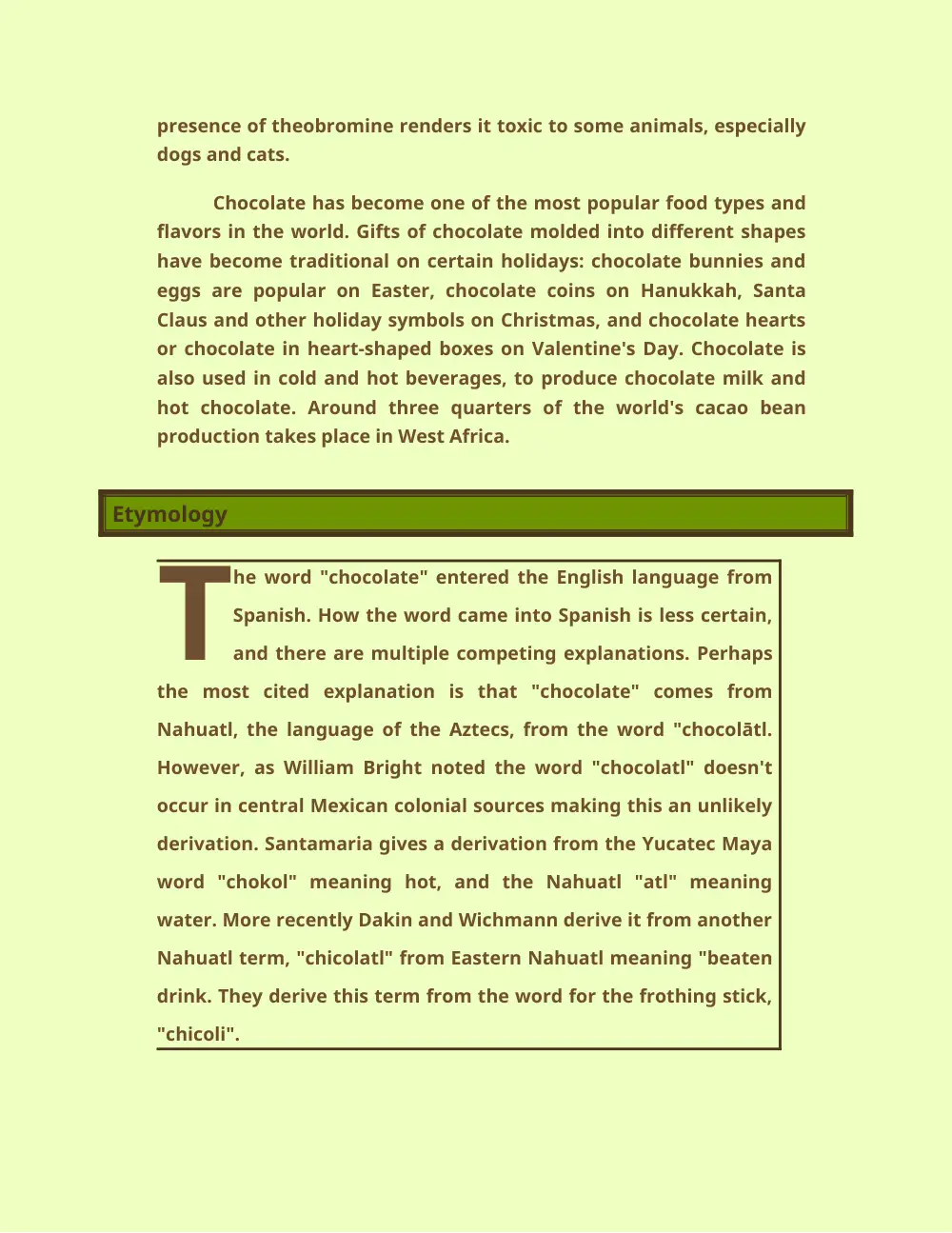
Chocolate has been used as a drink for nearly all of its history.
The earliest record of using chocolate dates back before the Olmec.
In November 2007, archaeologists reported finding evidence of the
oldest known cultivation and use of cacao at a site in Puerto
Escondido, Honduras, dating from about 1100 to 1400 BC. The
residues found and the kind of vessel they were found in indicate
that the initial use of cacao was not simply as a beverage, but the
white pulp around the cacao beans was likely used as a source of
fermentable sugars for an alcoholic drink.
The Maya civilization grew cacao trees in their backyard, and
used the cacao seeds it produced to make a frothy, bitter drink.
Documents in Maya hieroglyphs
stated that chocolate was used
for ceremonial purposes, in
addition to everyday life. The
chocolate residue found in an
early ancient Maya pot in Río
Azul, Guatemala, suggests that
Maya were drinking chocolate
around 400 AD. In the New World,
chocolate was consumed in a
bitter, spicy drink called xocoatl,
and was often flavored with
vanilla, chili pepper, and achiote
(known today as annatto).
Xocoatl was believed to fight
fatigue, a belief that is probably attributable to the theobromine
content. Chocolate was also an important luxury good throughout
pre-Columbian Mesoamerica, and cacao beans were often used as
currency. All of the areas that were conquered by the Aztecs that
grew cacao beans were ordered to pay them as a tax, or as the Aztecs
called it, a "tribute".
Types
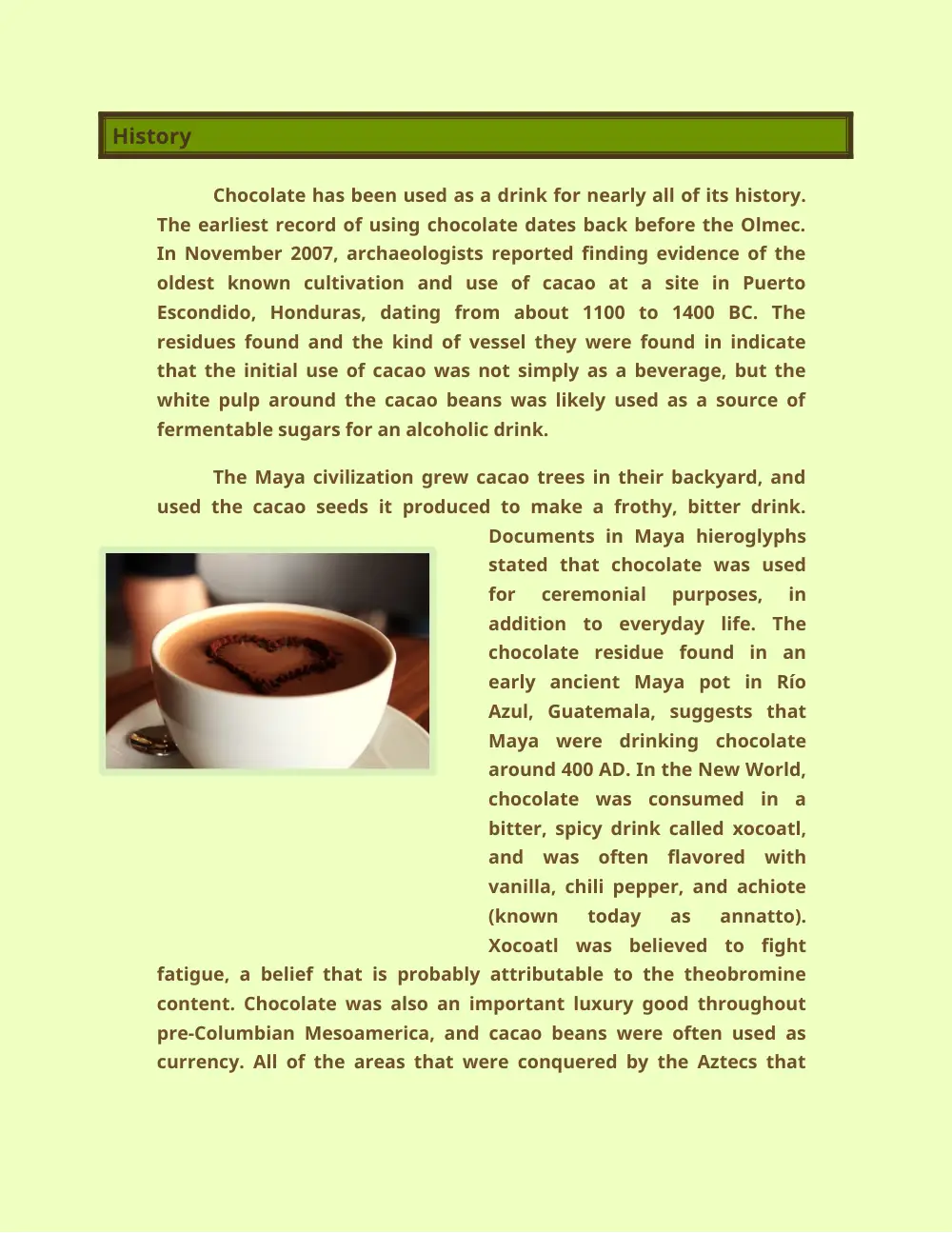
Several types of chocolate can be distinguished. Pure,
unsweetened
chocolate
contains
primarily
cocoa
solids
and cocoa
butter
in
varying
proportions.
Milk
chocolate
is
sweet
chocolate that
additionally
contains
milk powder or
condensed
milk.
White
chocolate"
contains cocoa butter, sugar, and milk but no cocoa solids. Dark
chocolate has been promoted for its health benefits, as it seems to
possess substantial amount of antioxidants that reduce the
formation of free radicals.
White chocolate is formed from a mixture of sugar, cocoa
butter and milk solids. Although its texture is similar to milk and
dark chocolate, it does not contain any cocoa solids. Because of this,
many countries do not consider white chocolate as chocolate at all.
Although first introduced by Hebert Candies in 1955, Mars,
Incorporated was the first to produce white chocolate within the
United States. Because it does not contain any cocoa solids, white
chocolate does not contain any theobromine, meaning it can be
consumed by animals.
Dark chocolate is produced by adding fat and sugar to the
cacao mixture. The U.S. Government calls this "sweet chocolate", and
requires a 15% concentration of chocolate liquor. European rules
specify a minimum of 35% cocoa solids. Dark chocolate, with its high
cocoa content, is a rich source of epicatechin and gallic acid, which
are thought to possess cardioprotective properties. Dark chocolate
has also been said to reduce the possibility of a heart attack when
consumed regularly in small amounts. Semisweet chocolate is a dark
chocolate with a low sugar content. Bittersweet chocolate is
chocolate liquor to which some sugar (typically a third), more cocoa
butter, vanilla and sometimes lecithin have been added. It has less
sugar and more liquor than semisweet chocolate, but the two are
interchangeable in baking.
Unsweetened chocolate is pure chocolate liquor, also known as
bitter or baking chocolate. It is unadulterated chocolate: the pure,
ground, roasted chocolate beans impart a strong, deep chocolate
flavor.
Production
Roughly two-thirds of the entire world's cocoa is produced in
Western Africa, with 43% sourced from Côte d'Ivoire, where child
labor is a common practice to obtain the product. See the Wikipedia
article children in cocoa production for a description of this and
proposed solutions. According to the World Cocoa Foundation, some
50 million people around the world depend on cocoa as a source of
livelihood.[31] In the UK, most chocolatiers purchase their chocolate
from them, to melt, mold and package to their own design. Despite
some disagreement in the EU about the definition,[clarification
needed] chocolate is any product made primarily of cocoa solids and
cocoa butter.
Production costs can be decreased by reducing cocoa solid
content or by substituting cocoa butter with another fat. Cocoa
growers object to allowing the resulting food to be called
"chocolate", due to the risk of lower demand for their crops.
There are two main jobs associated with creating chocolate
candy, chocolate makers and chocolatiers. Chocolate makers use
harvested cacao beans and other ingredients to produce couverture
chocolate. Chocolatiers use the finished couverture to make
chocolate candies (bars, truffles, etc.).
Cacao varieties
Cacao trees are small, understory trees that need rich, well-
drained soils. They naturally grow within 20 degrees of either side of
the equator because they need about 2000 millimeters of rainfall a
year, and temperatures in the range of 21 to 32 degrees Celsius.
Cacao trees cannot tolerate a temperature lower than 15 degrees
Celsius (59 degrees Fahrenheit).
The three main varieties of cacao beans used in chocolate are
criollo, forastero and trinitario.
Representing only five percent of all cocoa beans grown, criollo
is the rarest and most expensive cocoa on the market and is native to
Central America, the Caribbean islands and the northern tier of
South American states. There is some dispute about the genetic
purity of cocoas sold today as Criollo, as most populations have been
exposed to the genetic influence of other varieties. Criollos are
particularly difficult to grow, as they are vulnerable to a variety of
environmental threats and produce low yields of cocoa per tree. The
flavor of Criollo is described as delicate yet complex, low in classic
chocolate flavor, but rich in "secondary" notes of long duration.
The most commonly grown bean is forastero, a large group of
wild and cultivated cacaos, most likely native to the Amazon basin.
The African cocoa crop is entirely of the Forastero variety. They are
significantly hardier and of higher yield than Criollo. The source of
most chocolate marketed, forastero cocoas are typically strong in
classic "chocolate" flavor, but have a short duration and are
unsupported by secondary flavors, producing "quite bland"
chocolate.
Trinitario is a natural hybrid of Criollo and Forastero. Trinitario
originated in Trinidad after an introduction of Forastero to the local
Criollo crop. Nearly all cacao produced over the past five decades is
of the Forastero or lower-grade Trinitario varieties.
Processing
Cacao pods are harvested by cutting the pods from the tree
using a machete, or by knocking them off the tree using a stick. The
beans with their surrounding pulp are removed from the pods and
placed in piles or bins to ferment. The fermentation process is what
gives the beans their familiar chocolate taste. It is important to
harvest the pods when they are fully ripe because if the pod is
unripe, the beans will have low cocoa butter content, or there will be
insufficient sugars in the white pulp for fermentation, resulting in a
weak flavor. After fermentation, the beans must be quickly dried to
prevent mold growth. Climate and weather permitting, this is done
by spreading the beans out in the sun from 5 to 7 days.
The dried beans are then transported to a chocolate
manufacturing facility. The beans are cleaned (removing twigs,
stones, and other debris), roasted, and graded. Next the shells are
removed to extract the nib. Finally, the nibs are ground and liquefied,
resulting in pure chocolate in fluid form: chocolate liquor. The liquor
can be further processed into two components: cocoa solids and
cocoa butter.
Blending
Chocolate liquor is blended with the cocoa butter in varying
quantities to make different types of chocolate or covertures. The
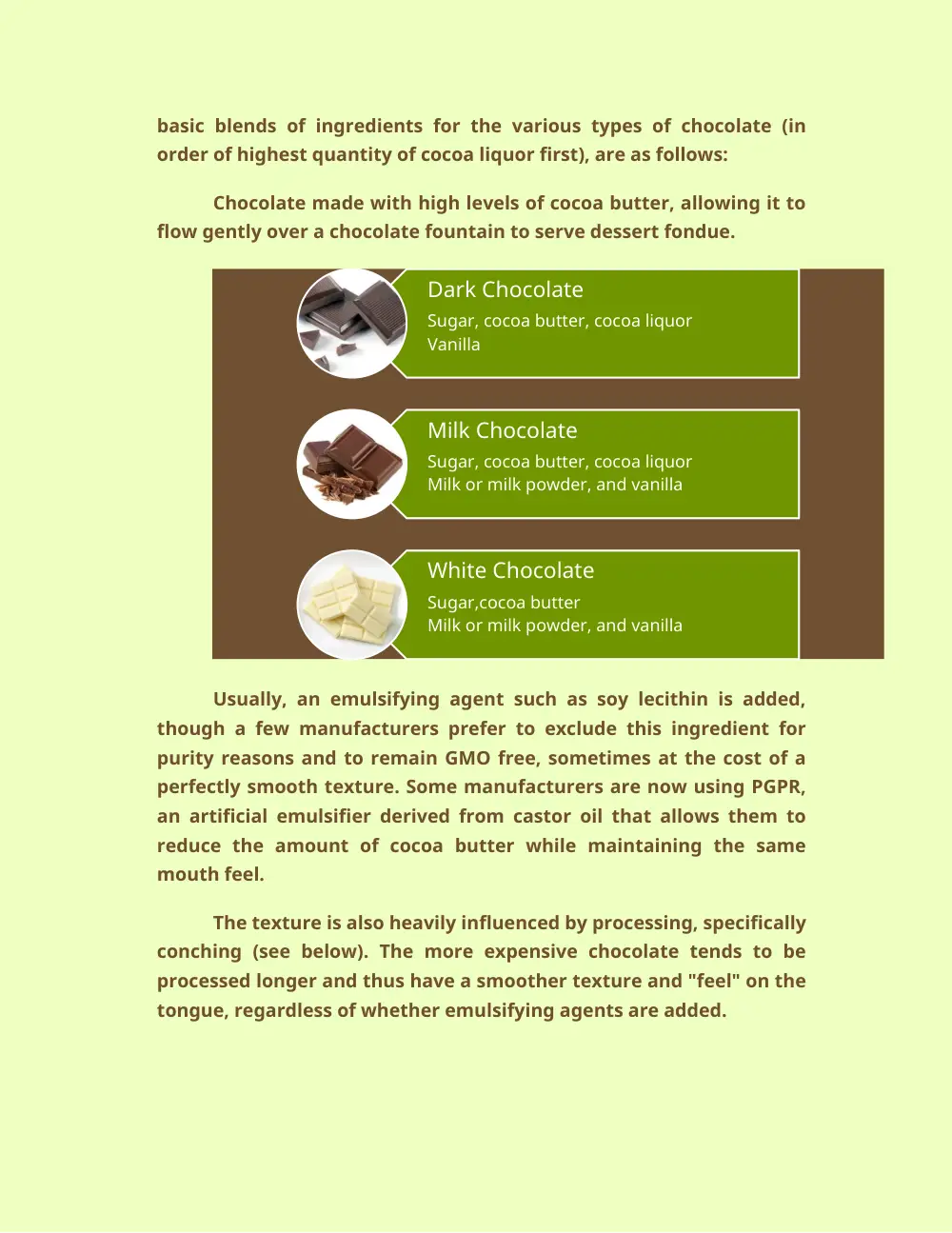
basic blends of ingredients for the various types of chocolate (in
order of highest quantity of cocoa liquor first), are as follows:
Chocolate made with high levels of cocoa butter, allowing it to
flow gently over a chocolate fountain to serve dessert fondue.
Usually, an emulsifying agent such as soy lecithin is added,
though a few manufacturers prefer to exclude this ingredient for
purity reasons and to remain GMO free, sometimes at the cost of a
perfectly smooth texture. Some manufacturers are now using PGPR,
an artificial emulsifier derived from castor oil that allows them to
reduce the amount of cocoa butter while maintaining the same
mouth feel.
The texture is also heavily influenced by processing, specifically
conching (see below). The more expensive chocolate tends to be
processed longer and thus have a smoother texture and "feel" on the
tongue, regardless of whether emulsifying agents are added.
Dark Chocolate
Sugar, cocoa butter, cocoa liquor
Vanilla
Milk Chocolate
Sugar, cocoa butter, cocoa liquor
Milk or milk powder, and vanilla
White Chocolate
Sugar,cocoa butter
Milk or milk powder, and vanilla
Different manufacturers develop their own "signature" blends
based on the above formulas, but varying proportions of the
different constituents are used.
The finest, plain dark chocolate couvertures contain at least
70% cocoa (both solids and butter), whereas milk chocolate usually
contains up to 50%. High-quality white chocolate couvertures contain
only about 35% cocoa.
Producers of high quality, small batch chocolate argue that
mass production produces bad quality chocolate. Some mass-
produced chocolate contains much less cocoa (as low as 7% in many
cases) and fats other than cocoa butter. Vegetable oils and artificial
vanilla flavor are often used in cheaper chocolate to mask poorly
fermented and/or roasted beans.
In 2007, the Chocolate Manufacturers Association in the United
States, whose members include Hershey, Nestlé, and Archer Daniels
Midland, lobbied the Food and Drug Administration to change the
legal definition of chocolate to let them substitute partially
hydrogenated vegetable oils for cocoa butter in addition to using
artificial sweeteners and milk substitutes. Currently, the U.S. Food
and Drug Administration (FDA) does not allow a product to be
referred to as "chocolate" if the product contains any of these
ingredients.
Conching
The penultimate process is called conching. A conche is a
container filled with metal beads, which act as grinders. The refined
and blended chocolate mass is kept in a liquid state by frictional
heat. Chocolate prior to conching has an uneven and gritty texture.
The conching process produces cocoa and sugar particles smaller
than the tongue can detect, hence the smooth feel in the mouth. The
length of the conching process determines the final smoothness and
quality of the chocolate. High-quality chocolate is conched for about
72 hours, lesser grades about four to six hours. After the process is
complete, the chocolate mass is stored in tanks heated to
approximately 45–50 °C (113–122 °F) until final processing.
Tempering
The final process is called tempering. Uncontrolled
crystallization of cocoa butter typically results in crystals of varying
size, some or all large enough to be clearly seen with the naked eye.
This causes the surface of the chocolate to appear mottled and
matte, and causes the chocolate to crumble rather than snap when
broken. The uniform sheen and crisp bite of properly processed
chocolate are the result of consistently small cocoa butter crystals
produced by the tempering process.
The fats in cocoa butter can crystallize in six different forms
(polymorphous crystallization). The primary purpose of tempering is
to assure that only the best form is present. The six different crystal
forms have different properties.
Making chocolate considered "good" is about forming as many
type V crystals as possible. This provides the best appearance and
texture and creates the most stable crystals so the texture and
appearance will not degrade over time. To accomplish this, the
temperature is carefully manipulated during the crystallization.
Generally, the chocolate is first heated to 45 °C (113 °F) to melt
all six forms of crystals.[45] Next, the chocolate is cooled to about 27
°C (81 °F), which will allow crystal types IV and V to form. At this
temperature, the chocolate is agitated to create many small crystal
"seeds" which will serve as nuclei to create small crystals in the
chocolate. The chocolate is then heated to about 31 °C (88 °F) to
eliminate any type IV crystals, leaving just type V. After this point,
any excessive heating of the chocolate will destroy the temper and
this process will have to be repeated. However, there are other
methods of chocolate tempering used. The most common variant is
introducing already tempered, solid "seed" chocolate. The temper of
chocolate can be measured with a chocolate temper meter to ensure
accuracy and consistency. A sample cup is filled with the chocolate
and placed in the unit which then displays or prints the results.
Two classic ways of manually tempering chocolate are:
Working the molten chocolate on a heat-absorbing surface,
such as a stone slab, until thickening indicates the presence of
sufficient crystal "seeds"; the chocolate is then gently warmed to
working temperature.
Stirring solid chocolate into molten chocolate to "inoculate"
the liquid chocolate with crystals (this method uses the already
formed crystal of the solid chocolate to "seed" the molten chocolate).
Chocolate tempering machines (or temperers) with computer
controls can be used for producing consistently tempered chocolate,
particularly for large volume applications.
Storage
Chocolate is very sensitive to temperature and humidity. Ideal
storage temperatures are between 15 and 17 °C (59 and 63 °F), with a
relative humidity of less than 50%. Chocolate is generally stored
away from other foods as it can absorb different aromas. Ideally,
chocolates are packed or wrapped, and placed in proper storage with
the correct humidity and temperature. Additionally chocolate is
frequently stored in a dark place or protected from light by wrapping
paper. Various types of "blooming" effects can occur if chocolate is
stored or served improperly. If refrigerated or frozen without
containment, chocolate can absorb enough moisture to cause a
whitish discoloration, the result of fat or sugar crystals rising to the
All you need is
love. But a little
chocolate now and
then doesn’t hurt.
surface. Moving chocolate from one temperature extreme to another
such as from a refrigerator on a hot day can result in an oily texture.
Although visually unappealing, chocolate suffering from bloom is
perfectly safe for consumption.
Health
Health effects of chocolate include both positive and negative
effects. While chocolate is regularly eaten for pleasure, there are
potential beneficial health effects of eating chocolate. Cocoa or dark
chocolate benefits the circulatory system. Other beneficial effects
suggested include anticancer, brain stimulator, cough preventer and
antidiarrheal effects. An aphrodisiac effect is yet unproven.
On the other hand, the unconstrained consumption of large
quantities of any energy-rich food such as chocolate is thought to
increase the risk of obesity without a corresponding increase in
activity. Raw chocolate is high in cocoa butter, a fat which is
removed during chocolate refining, then added
back in in varying proportions during the
manufacturing process. Manufacturers
may add other fats, sugars, and milk as
well, all of which increase the caloric
content of chocolate.
Chocolate absorbs lead from the
environment during production and
there is a slight concern of mild lead
poisoning for some types of chocolate. The
average lead concentration of cocoa beans
was a very low
≤ 0.5 ng/g, one of the lowest
reported values for a natural food. Lead concentration of chocolate
was as high as 70 ng/g for chocolate products and 230 ng/g for
manufactured cocoa. 200,000 ng is the WHO tolerable daily limit for
lead consumption. Additionally, chocolate is toxic to many animals
because of insufficient capacity to metabolize theobromine.
A study reported by the BBC indicated that melting chocolate
in one's mouth produced an increase in brain activity and heart rate
that was more intense than that associated with passionate kissing,
and also lasted four times as long after the activity had ended.