
CMPS 209 Syllabus, Spring 2016
American University of Beirut · Computers and Programming for the Sciences · 4 pages


More CMPS 209 files
Show the text of this lab
Department of Computer Science
Computers and Programming for the Sciences
CMPS 209- Course Syllabus
Spring 2016
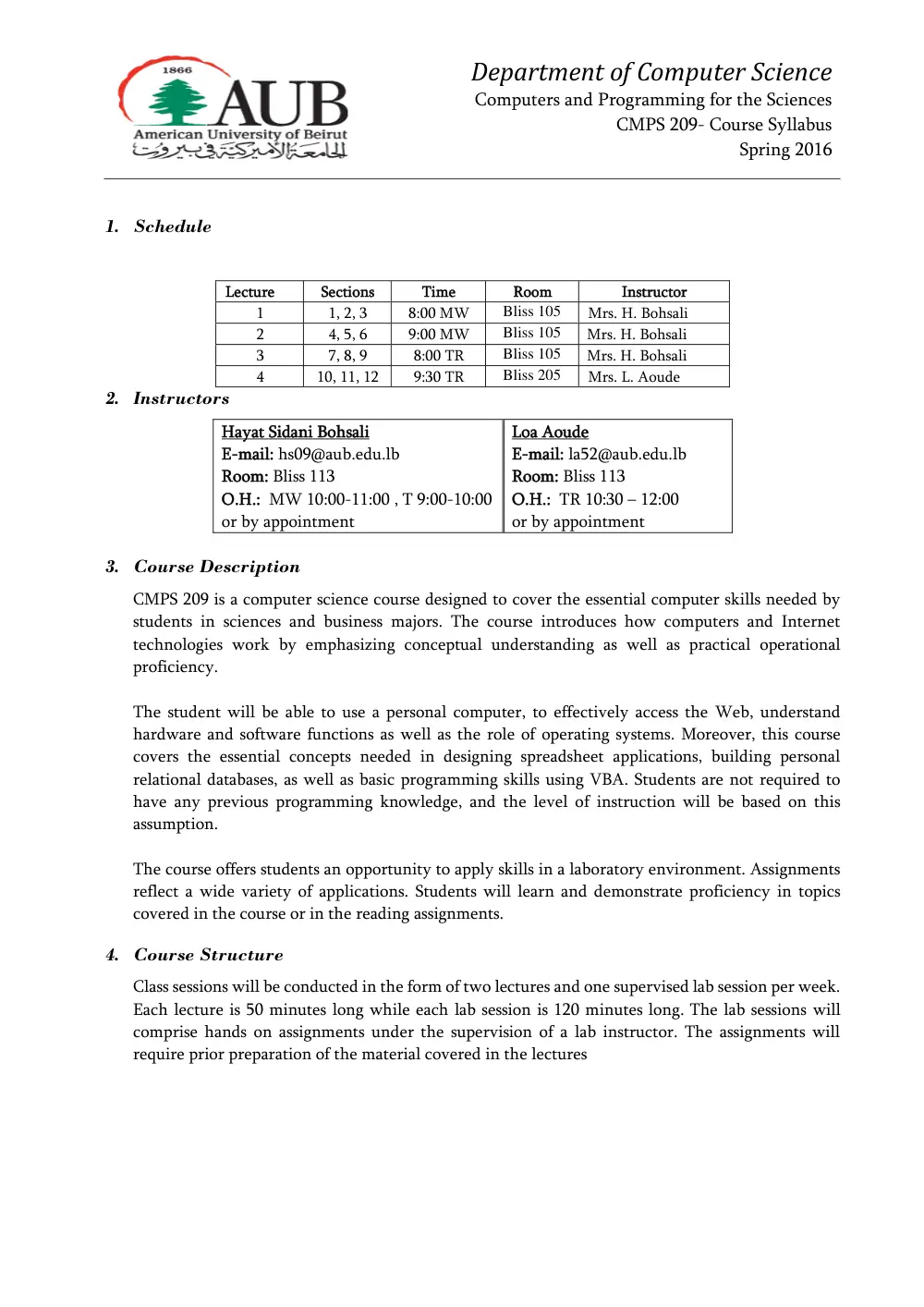
1. Schedule
2. Instructors
Hayat Sidani Bohsali
E-mail: hs09@aub.edu.lb
Room: Bliss 113
O.H.: MW 10:00-11:00 , T 9:00-10:00
or by appointment
Loa Aoude
E-mail: la52@aub.edu.lb
Room: Bliss 113
O.H.: TR 10:30 – 12:00
or by appointment
3. Course Description
CMPS 209 is a computer science course designed to cover the essential computer skills needed by
students in sciences and business majors. The course introduces how computers and Internet
technologies work by emphasizing conceptual understanding as well as practical operational
proficiency.
The student will be able to use a personal computer, to effectively access the Web, understand
hardware and software functions as well as the role of operating systems. Moreover, this course
covers the essential concepts needed in designing spreadsheet applications, building personal
relational databases, as well as basic programming skills using VBA. Students are not required to
have any previous programming knowledge, and the level of instruction will be based on this
assumption.
The course offers students an opportunity to apply skills in a laboratory environment. Assignments
reflect a wide variety of applications. Students will learn and demonstrate proficiency in topics
covered in the course or in the reading assignments.
4. Course Structure
Class sessions will be conducted in the form of two lectures and one supervised lab session per week.
Each lecture is 50 minutes long while each lab session is 120 minutes long. The lab sessions will
comprise hands on assignments under the supervision of a lab instructor. The assignments will
require prior preparation of the material covered in the lectures
Lecture
Sections
Time
Room
Instructor
1
1, 2, 3
8:00 MW
Bliss 105
Mrs. H. Bohsali
2
4, 5, 6
9:00 MW
Bliss 105
Mrs. H. Bohsali
3
7, 8, 9
8:00 TR
Bliss 105
Mrs. H. Bohsali
4
10, 11, 12
9:30 TR
Bliss 205
Mrs. L. Aoude
Page 2 of 4
5. Course Learning Outcomes
By the end of this course, the student will be able to:
gain fluency in IT Concepts related to software, hardware, networking, the Internet and the
web, privacy, crime, and security over the web
design workbooks, construct lists to which formatting, sorting and filtering can be applied,
work with formulas and functions, manipulate cells references, and plot charts
design, and write a solution to simple programming problems using VBA functions or
macros that include sequence, selection, or repetition logic
identify the elements of a database, basic relational terminology, and functional
dependencies, create personal databases consisting of a few tables, with relations, forms, and
reports using Access, and write basic SQL statements and queries
6. Textbook
“IT Concepts and Applications”, e-book, Pearson, First Edition, International Edition.
7. References
Online tutorials: “www.gcflearnfree.org/excel2013”
8. Grading Criteria
Lab Assignments and Attendance
15 %
Lab Quiz
12%
Midterm
30 %
Final Exam
43 %
These percentages are tentative.
9. Course Policies
General Policies:
The use of communication devices such as mobiles, hand held PCs, laptops, or blackberries,
is strictly forbidden during lectures and exams. The appropriate action will be taken for those
who violate of this rule.
Missed Exams:
Makeup exams will only be given to students who present a documented valid excuse within
one week from the exam date. Students who fail to do so will get a zero on the missed exam.
The University policy regarding incomplete work will be followed. Check university
catalogue for details.
Grading Policies:
Percentages are not shifted in lieu of missing any grading component.
Passing the course requires achieving a passing exam average (average of midterm and final
exam).
Remaining without a grade in any of the above mentioned grading components and/or
attaining a grade of zero on any of them might result in failing the course regardless of your
scores in all of the other components.
Academic Dishonesty:
Any violation of the University policies regarding individual academic integrity (cheating,
plagiarism, class disruption, dishonesty…) will be reported and the appropriate action will
be taken.
Page 3 of 4
The course includes several homework and programming assignments. You are free to
discuss these assignments with others. However, the programs and homework solutions you
submit are to be developed by you. Cheating is a very serious offense and will not be
tolerated. Supplying others with material is also against this rule. The policy is that both
the supplier and receiver of information will be punished. As a minimum both will get a
zero on the assignment in question. The case will also be referred to the Dean’s office and
could result in a failing grade for the course and suspension or expulsion from the University.
Course Learning Tools:
All the course material will be provided through Moodle.
It is the responsibility of the student to login regularly to Moodle and check for all course
updates and requirements.
In case a student has any learning disability, the student should provide the course instructor
with medical proof at the beginning of the semester so that necessary facilities and/or
arrangements can be made.
Lab Work:
Lab assignments will be posted on the course website every Friday.
Students are expected to download, read, and prepare the material needed to solve the
assignment before going to the lab session.
Students should solve the assignment during the lab session. Due dates are non-negotiable;
assignments are due by the end of the corresponding lab session.
As a general rule, assignments finished outside the lab session are not accepted. In
exceptional cases, justified late submission of assignments will be allowed with penalty.
It is the responsibility of the student to ensure that the activity due (assignment, lab quiz …)
is submitted correctly on Moodle.
Regular lab sessions will start as of Monday, February 1, 2016.
Attendance:
Attendance will be regularly attended in both classes and labs.
Coming in late is disruptive to the class. The instructor reserves the right of not allowing late
students to attend the lecture. Students are advised to be in class on time.
Students are responsible for all class work, lab work, programming assignments, and
announcements made in class even when absent.
Course withdrawal is the responsibility of the student.
Students should do the lab work with the section in which they are registered. Attending
with a different lab section is equivalent to missing the lab session unless a written
permission is granted from the course instructor.
Need for Assistance:
Students are encouraged to communicate with their instructors through emails.
Lab instructors can provide help only during the lab sessions.
Private tutoring with cmps 209 lab instructors is strictly forbidden.
Page 4 of 4
10. Tentative Schedule
Unit
Topic
Week
Material
Pages
Reading Assignment 1
Privacy, Crime, and Security
1
Spreadsheet
Applications
25/01-29/01
Introduction
Spreadsheets 1: Introduction and Conditional Formatting
222-228
01/02-05/02
Spreadsheets 2: Lists & Data Validation
204-209
Spreadsheets 3: Charts
133-168
8/02-12/02
Spreadsheets 4: Formulas & Functions
12-16
15/02-19/02
Spreadsheets 5: References in Formulas
75-78
Spreadsheets 6: Mathematical and Statistical Functions
84-92
339-342
22/02-26/02
Spreadsheets 7: Statistical cont. and Logical Functions
99-101
Spreadsheets 8: Logical Functions
296-300
29/02-04/03
Spreadsheets 9: Lookup & Reference Functions
102-104
Spreadsheets 10: Lookup & Reference Functions
300-302
2
IT Concepts
07/03-11/03
Software
Hardware
3
Programming
14/03-18/03
VBA1: Introduction to Macros & Subroutines
VBA2: Using Constants and Variables
Midterm and lab quiz date:
Friday, March 18th, 2016 from 5:00 to 7:30
21/03-25/03
VBA 3: Writing Custom Functions
VBA 4: Selection Structures
28/03-01/04
VBA 5: Repetition Structures
04/04-08/04
VBA 6: Repetition Structures
VBA 7: Repetition Structures
Reading Assignment 2
Networking: pages: 973-997
4
Databases
11/04-15/04
Database 1: Database Concepts
501-522
Database 2: The Relational Model
560-573
18/04-22/04
Database 3: Normalization
574-585
Database 4: SQL
638-677
25/04-28/04
Database 5: SQL
638-677
Database 6: Database Reports & Forms
545-551
Reading Assignment 3
Spotlight: Web 2.0 pages: 892-905
Final Exam: As set by the registrar’s office