
CMPS 211 Exam 2 Sample with Solution, Fall 2010
American University of Beirut · Discrete Structures · 10 pages · with solution

More CMPS 211 files
- Exam 1 · Fall 2017ExamView
- Exam 2 with Solution · Spring 2016Exam · with solutionView
- Exam 1 with Solution · Spring 2016Exam · with solutionView
- Exam 1 Quiz 1-Solution · Fall 2015Exam · with solutionView
- Exam Quiz 1 & Quiz 2 (With Solutions) · Fall 2015Exam · with solutionView
- Exam 2 · Fall 2013ExamView
- Exam 1 · Spring 2011ExamView
- Exam 1 with Solution · Fall 2010Exam · with solutionView
Show the text of this exam
1 | P a g e
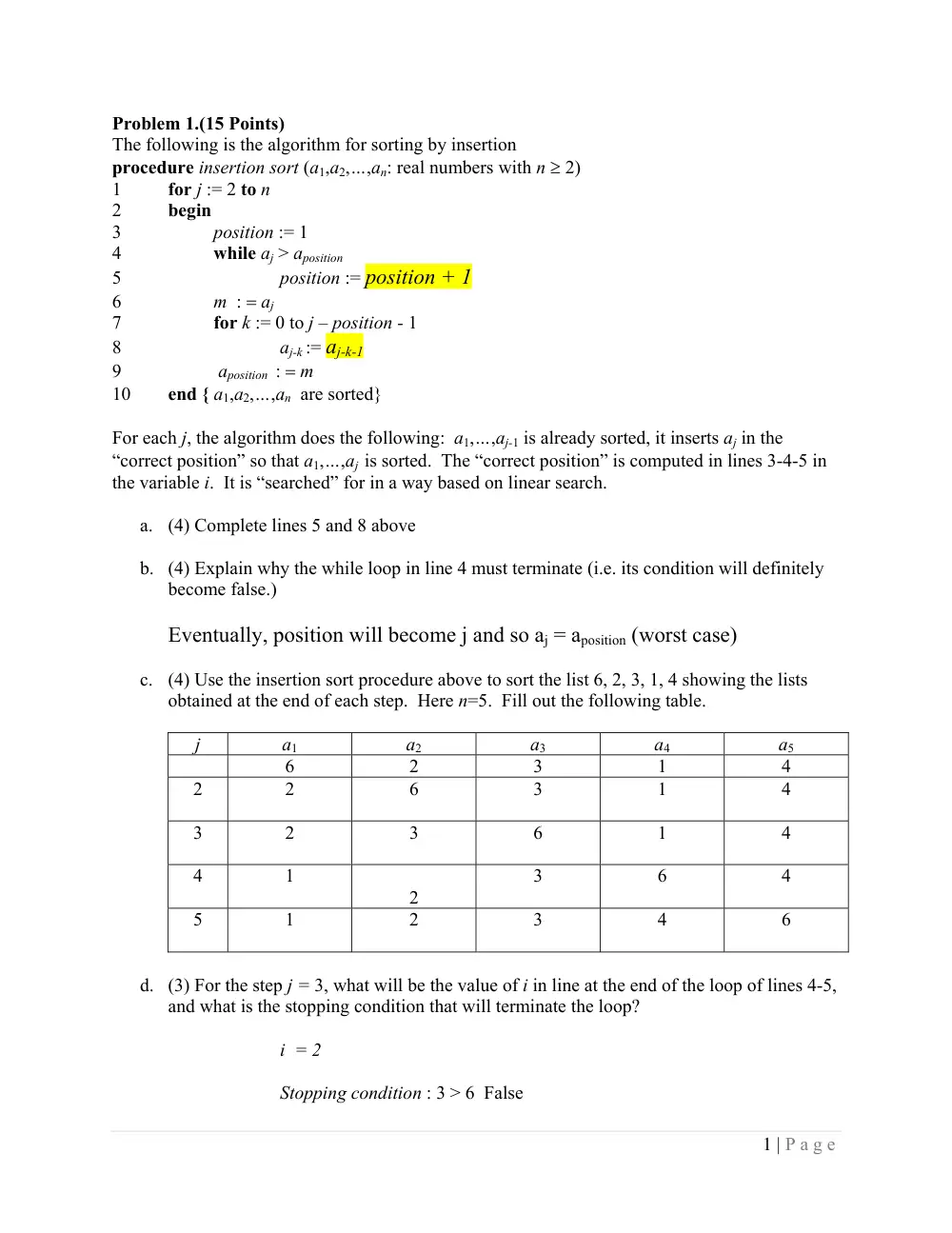
Problem 1.(15 Points)
The following is the algorithm for sorting by insertion
procedure insertion sort (a1,a2,…,an: real numbers with n ≥ 2)
1
for j := 2 to n
2
begin
3
position := 1
4
while aj > aposition
5
position := position + 1
6
m : = aj
7
for k := 0 to j – position - 1
8
aj-k := aj-k-1
9
aposition : = m
10
end { a1,a2,…,an are sorted}
For each j, the algorithm does the following: a1,…,aj-1 is already sorted, it inserts aj in the
“correct position” so that a1,…,aj is sorted. The “correct position” is computed in lines 3-4-5 in
the variable i. It is “searched” for in a way based on linear search.
a. (4) Complete lines 5 and 8 above
b. (4) Explain why the while loop in line 4 must terminate (i.e. its condition will definitely
become false.)
Eventually, position will become j and so aj = aposition (worst case)
c. (4) Use the insertion sort procedure above to sort the list 6, 2, 3, 1, 4 showing the lists
obtained at the end of each step. Here n=5. Fill out the following table.
j
a1
a2
a3
a4
a5
6
2
3
1
4
2
2
6
3
1
4
3
2
3
6
1
4
4
1
2
3
6
4
5
1
2
3
4
6
d. (3) For the step j = 3, what will be the value of i in line at the end of the loop of lines 4-5,
and what is the stopping condition that will terminate the loop?
i = 2
Stopping condition : 3 > 6 False
2 | P a g e
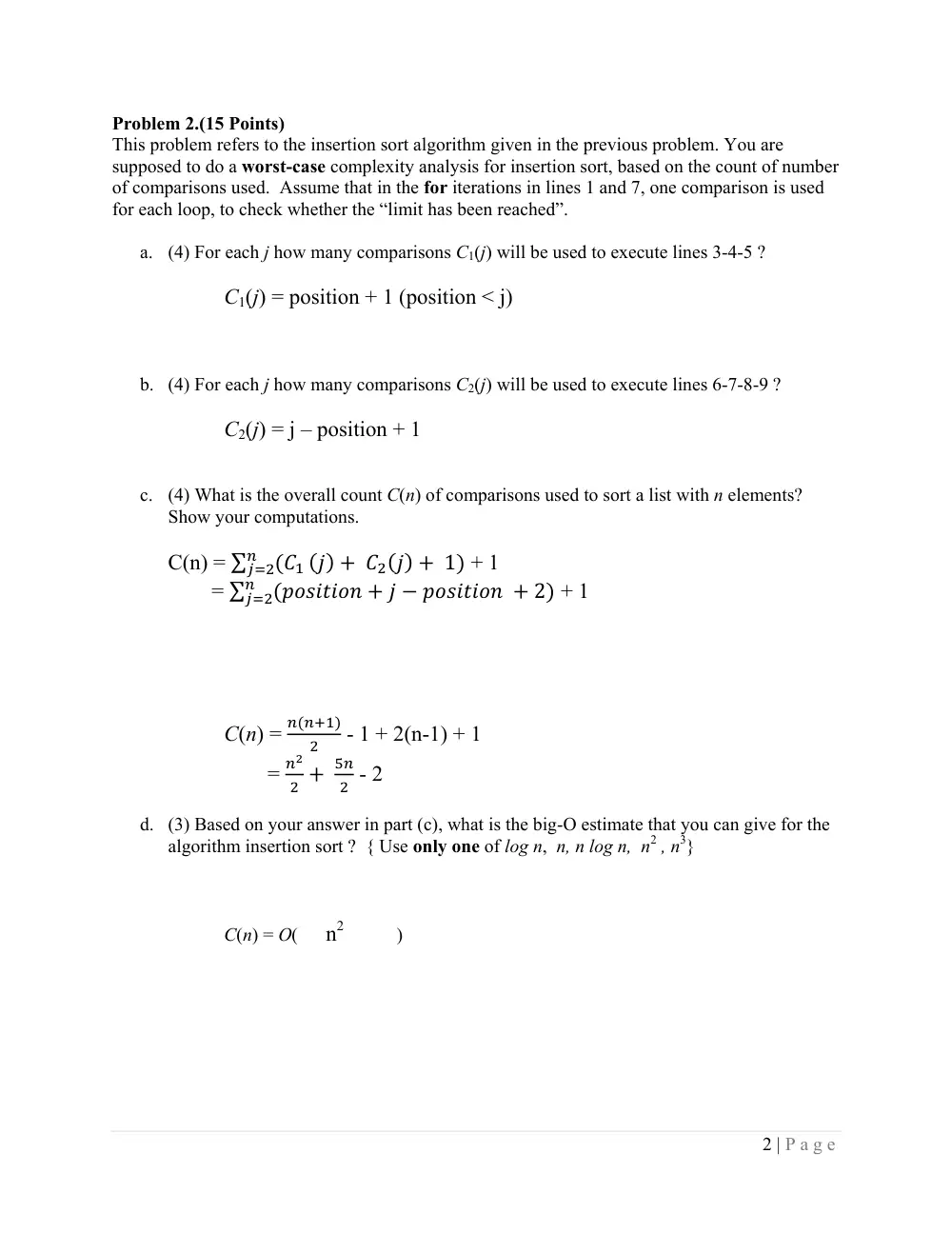
Problem 2.(15 Points)
This problem refers to the insertion sort algorithm given in the previous problem. You are
supposed to do a worst-case complexity analysis for insertion sort, based on the count of number
of comparisons used. Assume that in the for iterations in lines 1 and 7, one comparison is used
for each loop, to check whether the “limit has been reached”.
a. (4) For each j how many comparisons C1(j) will be used to execute lines 3-4-5 ?
C1(j) = position + 1 (position < j)
b. (4) For each j how many comparisons C2(j) will be used to execute lines 6-7-8-9 ?
C2(j) = j – position + 1
c. (4) What is the overall count C(n) of comparisons used to sort a list with n elements?
Show your computations.
C(n) = ∑
���
�
���
��� � ����� � 1� + 1
= ∑
��������� � �
�
���
� �������� � 2� + 1
C(n) =
������
�
- 1 + 2(n-1) + 1
=
��
� �
��
� - 2
d. (3) Based on your answer in part (c), what is the big-O estimate that you can give for the
algorithm insertion sort ? { Use only one of log n, n, n log n, n2 , n3}
C(n) = O( n2 )
3 | P a g e
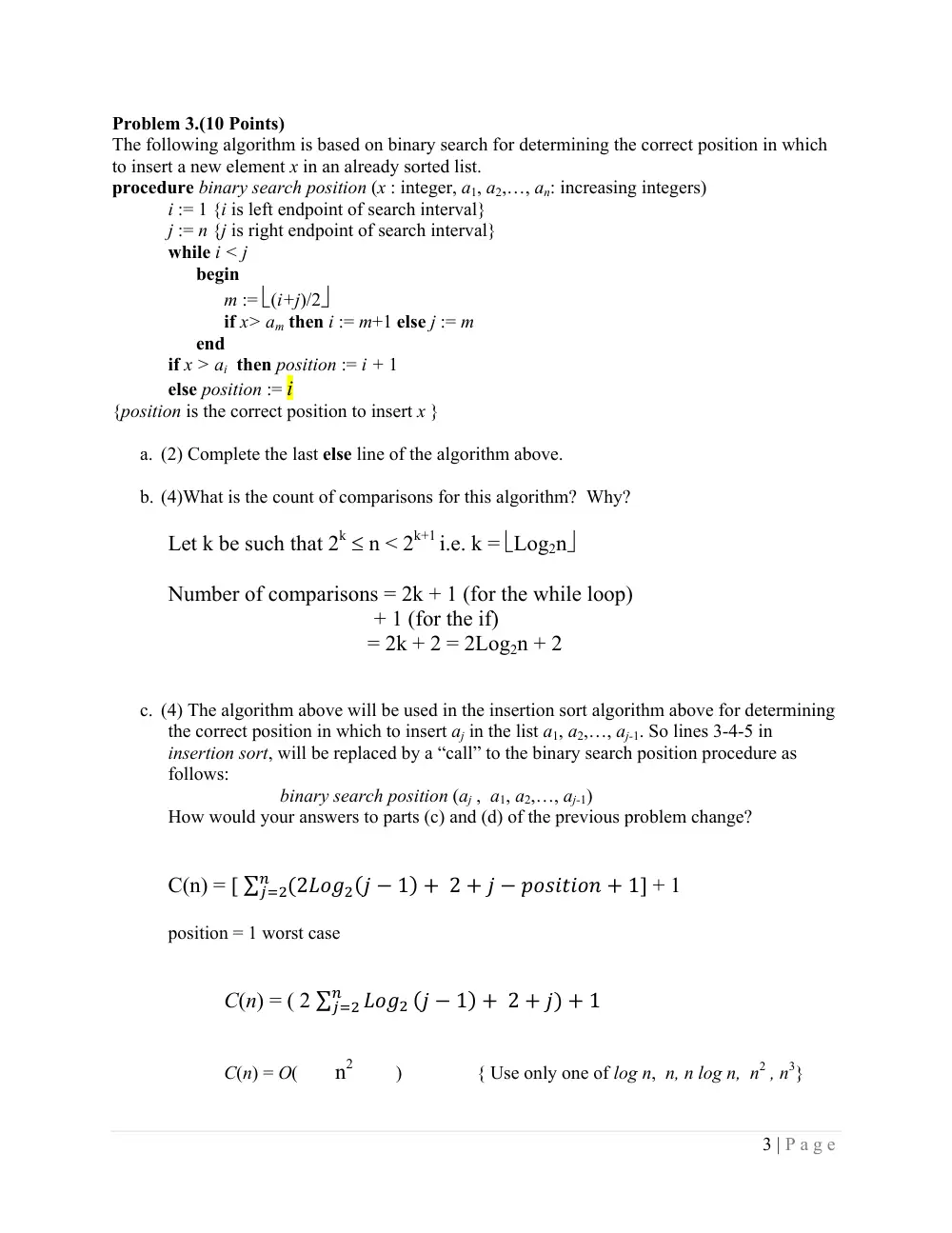
Problem 3.(10 Points)
The following algorithm is based on binary search for determining the correct position in which
to insert a new element x in an already sorted list.
procedure binary search position (x : integer, a1, a2,…, an: increasing integers)
i := 1 {i is left endpoint of search interval}
j := n {j is right endpoint of search interval}
while i < j
begin
m := (i+j)/2
if x> am then i := m+1 else j := m
end
if x > ai then position := i + 1
else position := i
{position is the correct position to insert x }
a. (2) Complete the last else line of the algorithm above.
b. (4)What is the count of comparisons for this algorithm? Why?
Let k be such that 2k ≤ n < 2k+1 i.e. k = Log2n
Number of comparisons = 2k + 1 (for the while loop)
+ 1 (for the if)
= 2k + 2 = 2Log2n + 2
c. (4) The algorithm above will be used in the insertion sort algorithm above for determining
the correct position in which to insert aj in the list a1, a2,…, aj-1. So lines 3-4-5 in
insertion sort, will be replaced by a “call” to the binary search position procedure as
follows:
binary search position (aj , a1, a2,…, aj-1)
How would your answers to parts (c) and (d) of the previous problem change?
C(n) = [ ∑
�2������ � 1� � 2 � � � �������� � 1
�
���
] + 1
position = 1 worst case
C(n) = ( 2 ∑
����
�
���
�� � 1� � 2 � �� � 1
C(n) = O( n2 ) { Use only one of log n, n, n log n, n2 , n3}
4 | P a g e
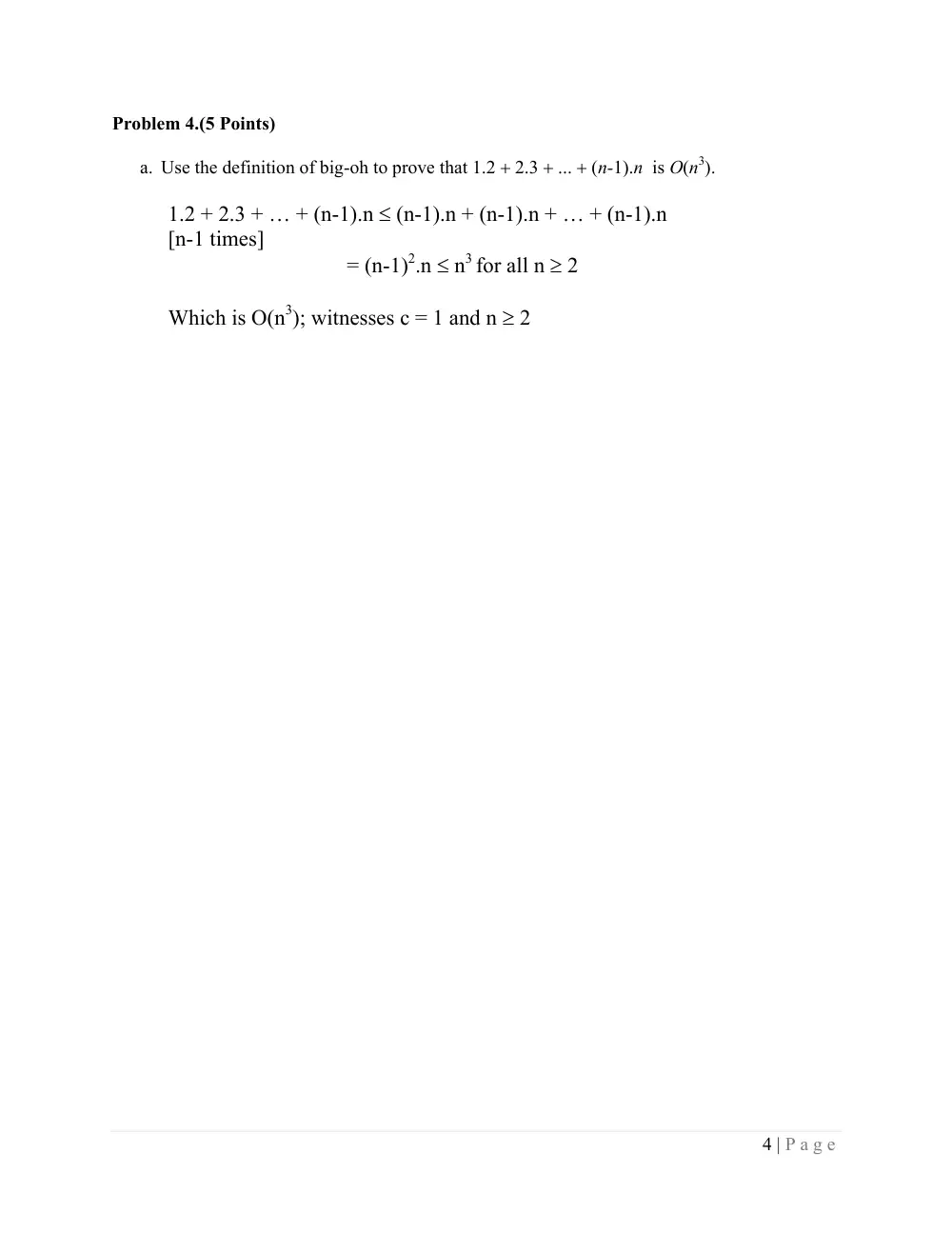
Problem 4.(5 Points)
a. Use the definition of big-oh to prove that 1.2 + 2.3 + ... + (n-1).n is O(n3).
1.2 + 2.3 + … + (n-1).n ≤ (n-1).n + (n-1).n + … + (n-1).n
[n-1 times]
= (n-1)2.n ≤ n3 for all n ≥ 2
Which is O(n3); witnesses c = 1 and n ≥ 2
5 | P a g e
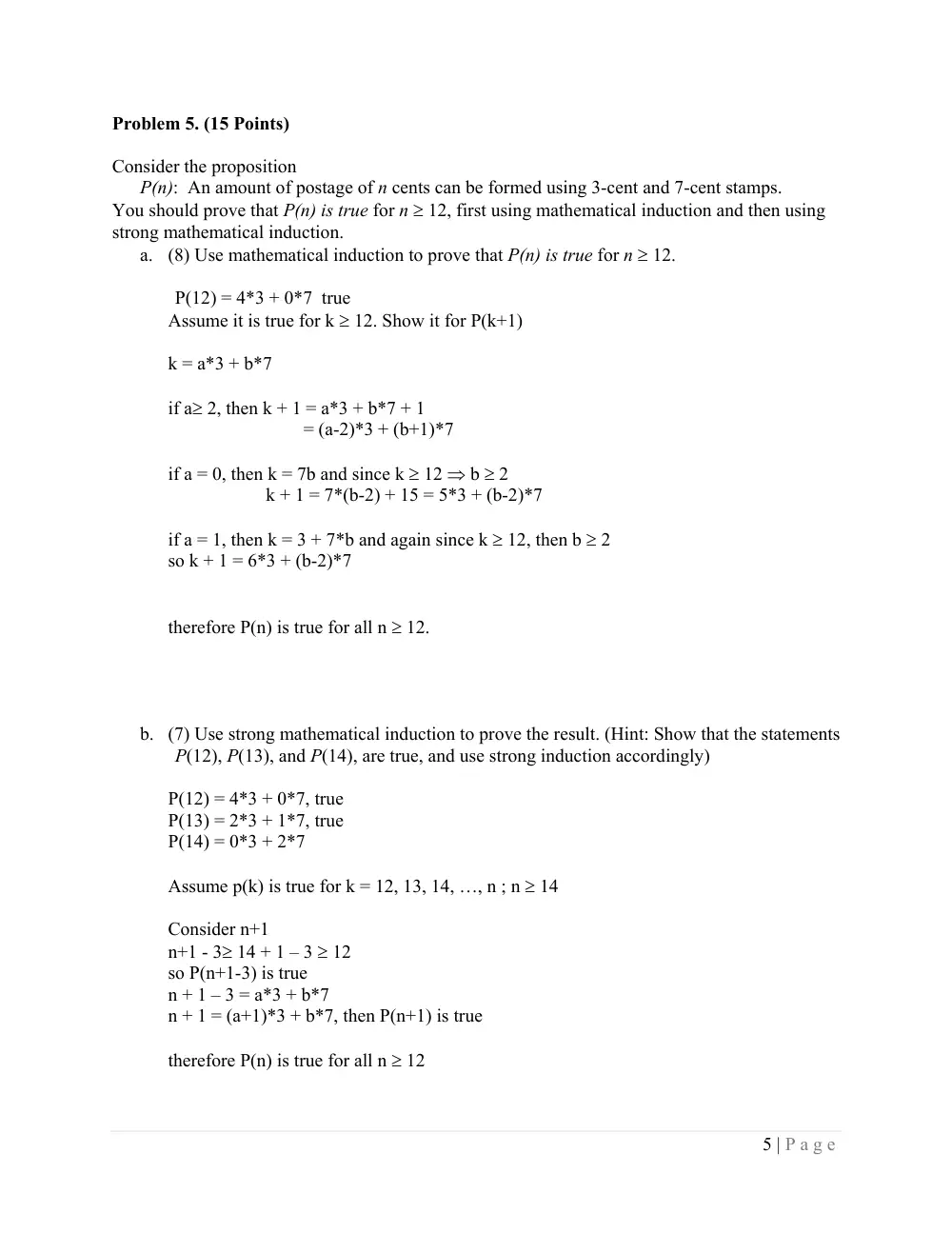
Problem 5. (15 Points)
Consider the proposition
P(n): An amount of postage of n cents can be formed using 3-cent and 7-cent stamps.
You should prove that P(n) is true for n ≥ 12, first using mathematical induction and then using
strong mathematical induction.
a. (8) Use mathematical induction to prove that P(n) is true for n ≥ 12.
P(12) = 4*3 + 0*7 true
Assume it is true for k ≥ 12. Show it for P(k+1)
k = a*3 + b*7
if a≥ 2, then k + 1 = a*3 + b*7 + 1
= (a-2)*3 + (b+1)*7
if a = 0, then k = 7b and since k ≥ 12 ⇒ b ≥ 2
k + 1 = 7*(b-2) + 15 = 5*3 + (b-2)*7
if a = 1, then k = 3 + 7*b and again since k ≥ 12, then b ≥ 2
so k + 1 = 6*3 + (b-2)*7
therefore P(n) is true for all n ≥ 12.
b. (7) Use strong mathematical induction to prove the result. (Hint: Show that the statements
P(12), P(13), and P(14), are true, and use strong induction accordingly)
P(12) = 4*3 + 0*7, true
P(13) = 2*3 + 1*7, true
P(14) = 0*3 + 2*7
Assume p(k) is true for k = 12, 13, 14, …, n ; n ≥ 14
Consider n+1
n+1 - 3≥ 14 + 1 – 3 ≥ 12
so P(n+1-3) is true
n + 1 – 3 = a*3 + b*7
n + 1 = (a+1)*3 + b*7, then P(n+1) is true
therefore P(n) is true for all n ≥ 12
6 | P a g e
Problem 6. (10 Points)
In the questions below give a recursive definition with initial condition(s).
a. (4) The function f (n) = 2n, n = 1, 2, 3, ....
Basis step: f (1 ) = 2
Recursive step: f (n) = 2*f(n-1), n ≥ 2
b. (3) The sequence a1 = 16, a2 = 13, a3 = 10, a4 = 7, ….
Basis step:
a1 = 16
Recursive step: an = an-1 – 3, n ≥ 2
c. (3) The set {0,3,6,9,…}.
Basis step:
0 ∈ S
Recursive step: x ∈ S → x + 3 ∈ S
7 | P a g e
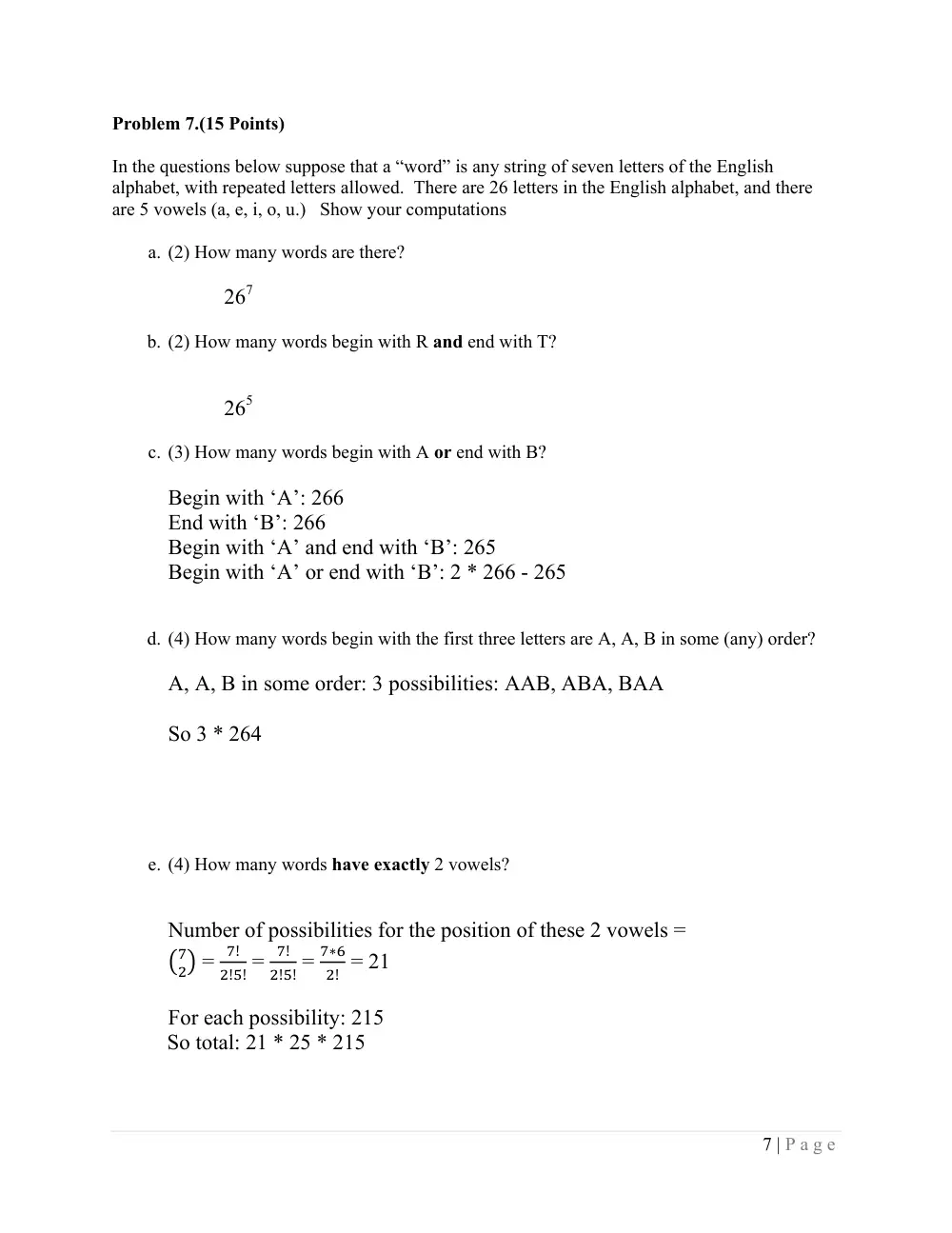
Problem 7.(15 Points)
In the questions below suppose that a “word” is any string of seven letters of the English
alphabet, with repeated letters allowed. There are 26 letters in the English alphabet, and there
are 5 vowels (a, e, i, o, u.) Show your computations
a. (2) How many words are there?
267
b. (2) How many words begin with R and end with T?
265
c. (3) How many words begin with A or end with B?
Begin with ‘A’: 266
End with ‘B’: 266
Begin with ‘A’ and end with ‘B’: 265
Begin with ‘A’ or end with ‘B’: 2 * 266 - 265
d. (4) How many words begin with the first three letters are A, A, B in some (any) order?
A, A, B in some order: 3 possibilities: AAB, ABA, BAA
So 3 * 264
e. (4) How many words have exactly 2 vowels?
Number of possibilities for the position of these 2 vowels =
��
�� =
�!
�!�! =
�!
�!�! =
���
�! = 21
For each possibility: 215
So total: 21 * 25 * 215
8 | P a g e
Problem 8 (15 Points)
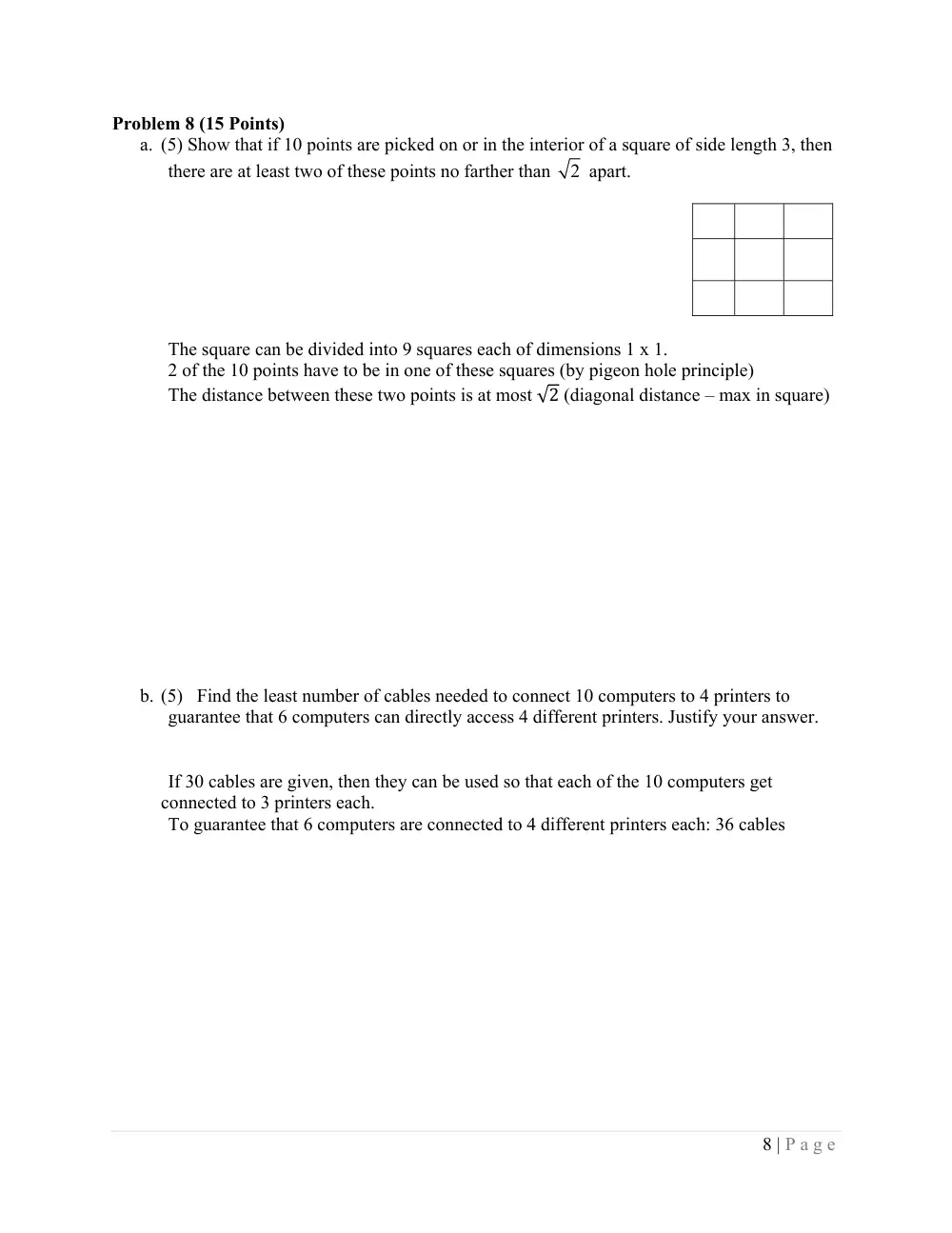
a. (5) Show that if 10 points are picked on or in the interior of a square of side length 3, then
there are at least two of these points no farther than
2 apart.
The square can be divided into 9 squares each of dimensions 1 x 1.
2 of the 10 points have to be in one of these squares (by pigeon hole principle)
The distance between these two points is at most √2 (diagonal distance – max in square)
b. (5) Find the least number of cables needed to connect 10 computers to 4 printers to
guarantee that 6 computers can directly access 4 different printers. Justify your answer.
If 30 cables are given, then they can be used so that each of the 10 computers get
connected to 3 printers each.
To guarantee that 6 computers are connected to 4 different printers each: 36 cables
9 | P a g e
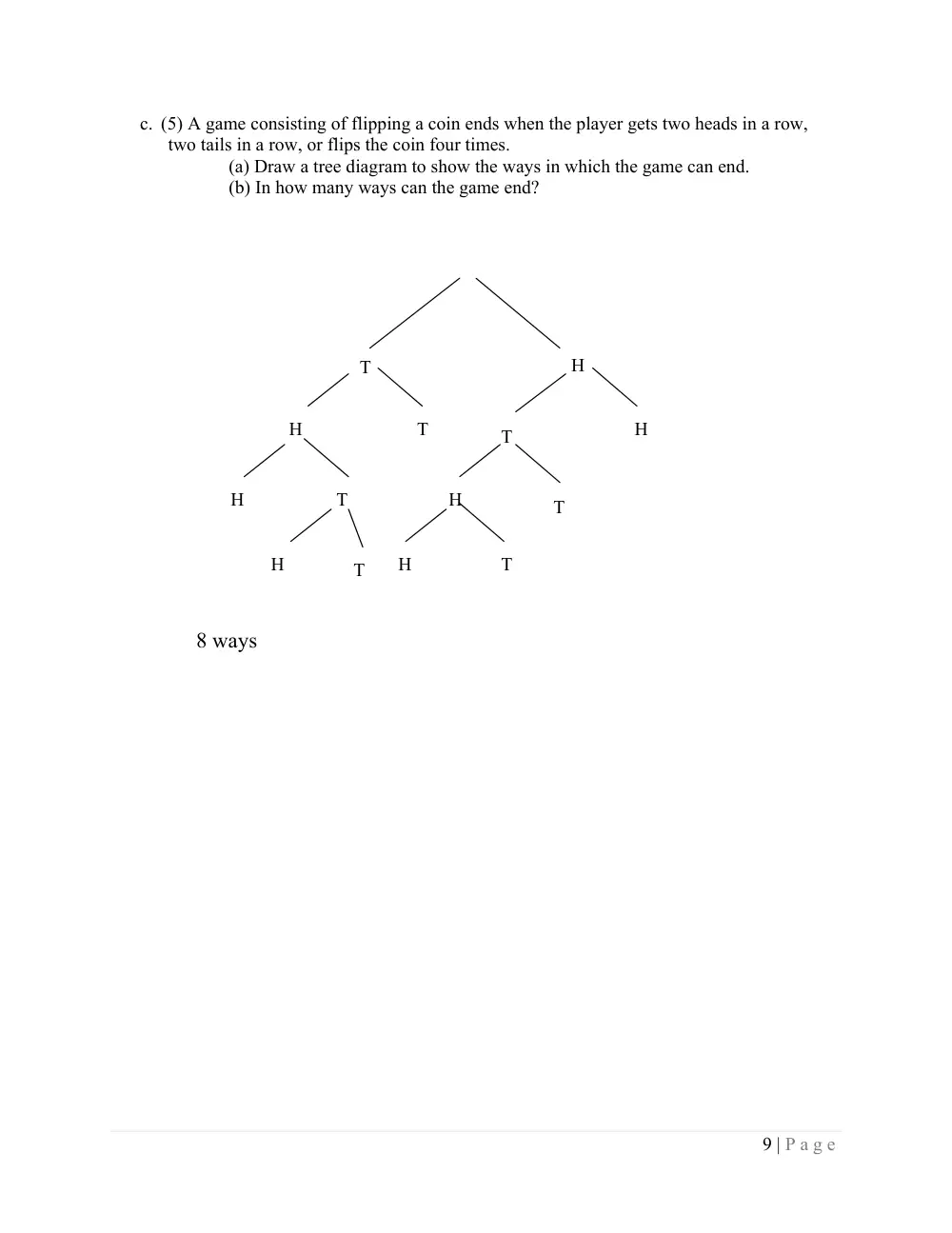
c. (5) A game consisting of flipping a coin ends when the player gets two heads in a row,
two tails in a row, or flips the coin four times.
(a) Draw a tree diagram to show the ways in which the game can end.
(b) In how many ways can the game end?
8 ways
H
T
T
T
H
H
H
H
T
T
H
H
T
T
10 | P a g e
Problem 9. (10 Points)
a. (5) How many functions are there from the set {1, 2, …, n} to the set {1, 2, 3}. Why?
For each of 1, 2, …, n there are 3 possible images ⇒ 3n
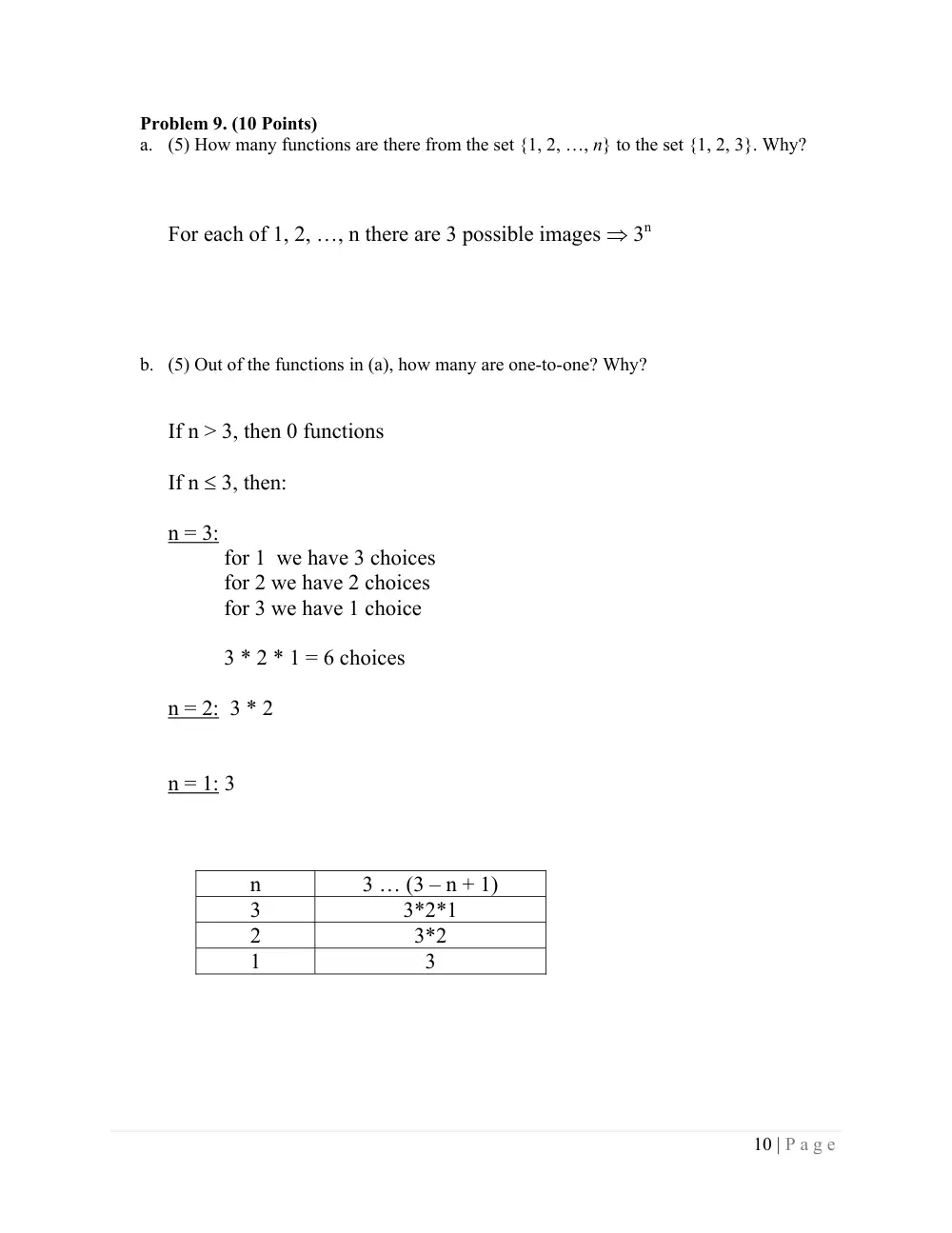
b. (5) Out of the functions in (a), how many are one-to-one? Why?
If n > 3, then 0 functions
If n ≤ 3, then:
n = 3:
for 1 we have 3 choices
for 2 we have 2 choices
for 3 we have 1 choice
3 * 2 * 1 = 6 choices
n = 2: 3 * 2
n = 1: 3
n
3 … (3 – n + 1)
3
3*2*1
2
3*2
1
3