
CMPS 211 Final, Spring 2010
American University of Beirut · Discrete Structures · 13 pages









Showing the first 10 of 13 pages. Download the PDF to see all of it.
More CMPS 211 files
- Final Sample · Fall 2010Final examView
- Lecture Chp 2 · Fall 2017LabView
- Exam 1 · Fall 2017ExamView
- Lecture Chp 1 · Fall 2017LabView
- Lecture Chp 3 · Fall 2017LabView
- Lecture Chp 4 · Fall 2017LabView
- Homework 5 with Solution · Spring 2016Homework · with solutionView
- Homework 4 with Solution · Spring 2016Homework · with solutionView
Show the text of this final exam
AUB-CMPS 211: Discrete Structures
June 3rd, 2009
Final Exam
Instructor: Fatima Abu Salem
Name:
Duration: 90 minutes
This exam is closed notes.
Question 1 (On Logic and Rules of inference) (10%)
Convert each of the following into a symbolic proof, and justify each step of the proof
leading up to the conclusion.
(a) (5%) For me to wear my summer clothes it is necessary that it be sunny. When it is
sunny I always wear my sunscreen. Today I did not wear my sunscreen. Therefore, it must
not be sunny, and so I am not wearing my summer clothes.
(b) (5%) For me to wear my summer clothes, it is sufficient that it be sunny. For me to
wear my sunscreen, it is necessary that it be sunny. I am wearing my sunscreen. Therefore,
it must be sunny, and so I must have been wearing my summer clothes.
Question 2 (On Iterative Algorithms) (18%)
In this question we examine a sorting algorithm known as Selection sort. Selection sort
works iteratively as follows. A list of n integers is initially given in an array A[0, . . . , n − 1].
In the first iteration, the minimum element in the list A[0, . . . , n−1] is found then swapped
with the element positioned in A[0]. In the second iteration, the second minimal element
in the list A[1, . . . , n − 1] is found then swapped with the element in A[1]. Generally, in the
i’th iteration, the i’th minimal element in the list A[i − 1, . . . , n − 1] is found then swapped
with the element in A[i − 1].
(a) (5%) Develop the pseudo-code for Selection Sort.
(b) (5%) Prove that Selection Sort is correct.
(c) (4%) Determine the asymptotic run-time of Selection Sort.
(d) (4%) Is Selection Sort asymptotically faster or slower than Merge Sort? Justify your
answer.
F-1
Question 3 (On Recursive Algorithms) (19%)
Given a list of n positive integers in an array A[0, . . . , n − 1], our goal is to find the greatest
common divisor of all integers in this list. Assume that n is a power of two.
(a) (5%) Suggest and develop the pseudo-code for a divide and conquer algorithm to
achieve this goal.
(a) (5%) Prove that your algorithm is correct.
(a) (5%) Write down the recurrence associated with the run-time of this algorithm.
(a) (4%) Use the Master Theorem to determine the run-time of this algorithm.
Question 4 (On Recurrences) (14%)
A string that contains only the characters 0, 1, and 2 is called a ternary string.
(a) (5%) Find a recurrence relation for the number of ternary strings that do not contain
two consecutive 2’s.
(b) (4%) What are the initial conditions for this recurrence?
(c) (5%) How many ternary strings of lenth five do not contain two consecutive 2’s?
Question 5 (On Counting) (29%)
In how many ways can an organiser of a tournament arrange six players in a row, including
the first prize winner and the second prize winner, if
(a) (5%) the first prize winner must be next to the second prize winner?
(b) (5%) the first prize winner is not next to the second prize winner?
(c) (5%) the first prize winner is standing somewhere to the right of the second prize
winner?
A computer programming class consists of 14 math students and 12 computer science
students.
The course instructor chooses students randomly to serve on a programming
contest.
(d) (5%) How many students must the course instructor select to be sure that at least two
students of the same major are participating in the contest?
(e) (4%) How many students must the course instructor select to be sure that at least two
computer science students are participating in the contest?
(f) (5%) Suppose there should be six students to participate in this contest. How many
ways are there to form a group of contestants if the group must have the same number of
math and computer science students?
F-2
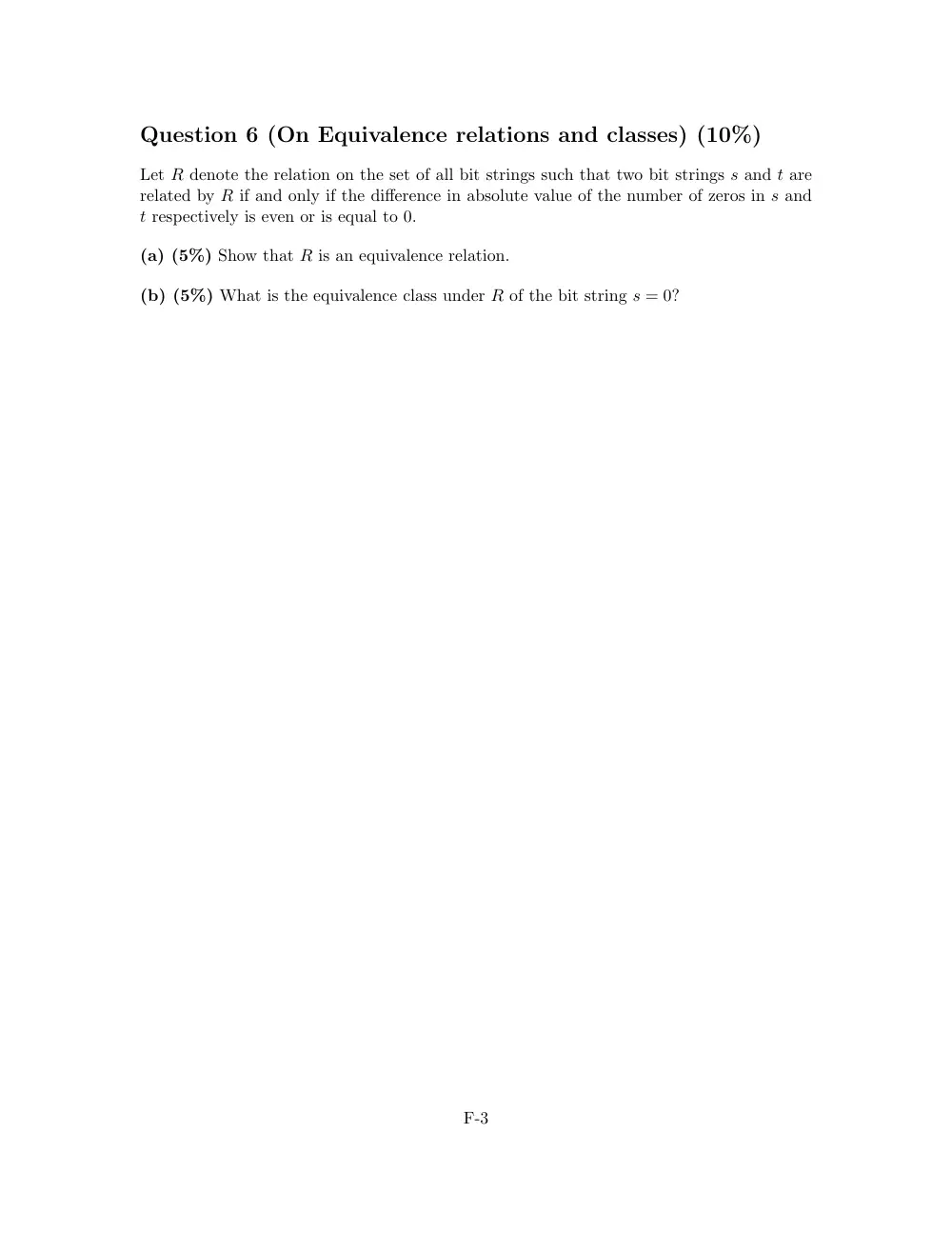
Question 6 (On Equivalence relations and classes) (10%)
Let R denote the relation on the set of all bit strings such that two bit strings s and t are
related by R if and only if the difference in absolute value of the number of zeros in s and
t respectively is even or is equal to 0.
(a) (5%) Show that R is an equivalence relation.
(b) (5%) What is the equivalence class under R of the bit string s = 0?
F-3
Answer Sheet 1
F-4
Answer Sheet 2
F-5
Answer Sheet 3
F-6
Answer Sheet 4
F-7
Answer Sheet 5
F-8
Answer Sheet 6
F-9
Answer Sheet 7
F-10
Answer Sheet 8
F-11
Answer Sheet 9
F-12
Answer Sheet 10
F-13