
CMPS 257 Final, Spring 2004
American University of Beirut · Theory of Computation · 12 pages



Showing the first 10 of 12 pages. Download the PDF to see all of it.
More CMPS 257 files
Show the text of this final exam
ent
CMeRICAN UNIVERSE
LIBRARY
oF BEIRUT
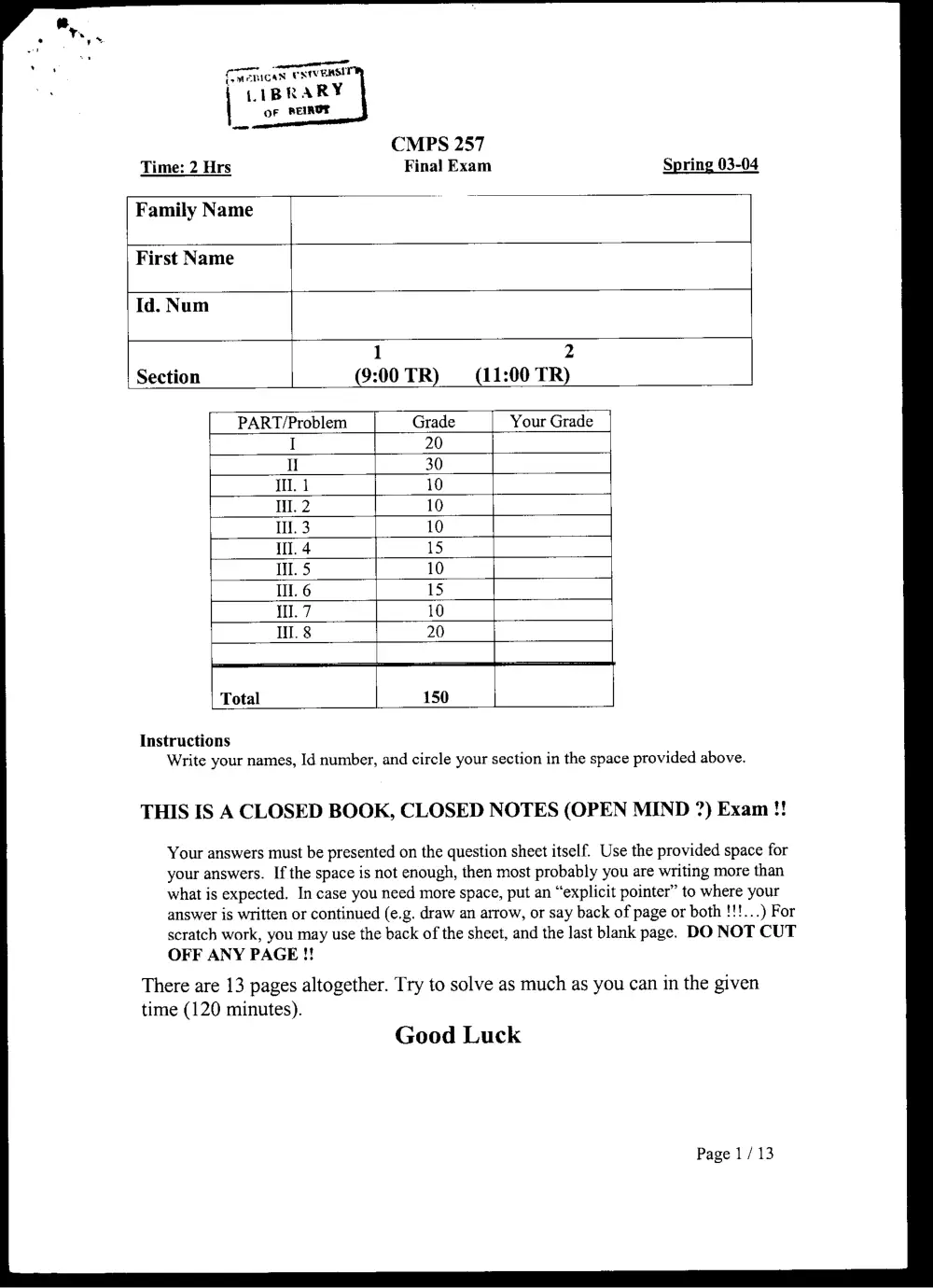
CMPS 257
Time: 2 Hrs Final Exam Spring 03-04
Family Name
First Name
Id. Num
1 2
Section (9:00 TR) —_((11:00 TR)
PART/Problem Grade Your Grade
I 20
II 30
Ill. 1 10
Ill. 2 10
Ill. 3 10
Il. 4 15
Il. 5 10
Ill. 6 15
III. 7 10
Ill. 8 20
EEE Dae A
Total
Instructions
Write your names, Id number, and circle your section in the space provided above.
THIS IS A CLOSED BOOK, CLOSED NOTES (OPEN MIND ?) Exam !!
Your answers must be presented on the question sheet itself. Use the provided space for
your answers. If the space is not enough, then most probably you are writing more than
what is expected. In case you need more space, put an “explicit pointer” to where your
) For
scratch work, you may use the back of the sheet, and the last blank page. DO NOT CUT
OFF ANY PAGE !!
There are 13 pages altogether. Try to solve as much as you can in the given
time (120 minutes).
Good Luck
Page 1/13
eee am nena ea
JeMEIUCAN ONTVERSIT
| LIBRARY |
OF BEIRUT
~
Part I. }(20 Points) True or False questions. Circle T or F [ Not Both ]
You might want to comment briefly, if you are not sure about your answer. But in case
your comment is not relevant, and you have the right answer, you might loose the points
for that part
If a language is regular, then there are infinitely many regular r/
expressions that represent it.
The complement of a decidable language is necessarily
decidable
Context free languages are closed under complementation
. Any subset of a decidable language is necessarily decidable
. Decidable languages are closed under intersection.
There is an uncountable number of languages that are not
Turing-recognizable
. Every string generated by a context free grammar has exactly
one left most derivation..
Push down automata cannot be simulated by Turing machines
A non-deterministic finite automaton might have an infinite
computation on a string w.
. For Turing machines, if the halting problem is decidable, then
the acceptance problem will be decidable
Page 2/13
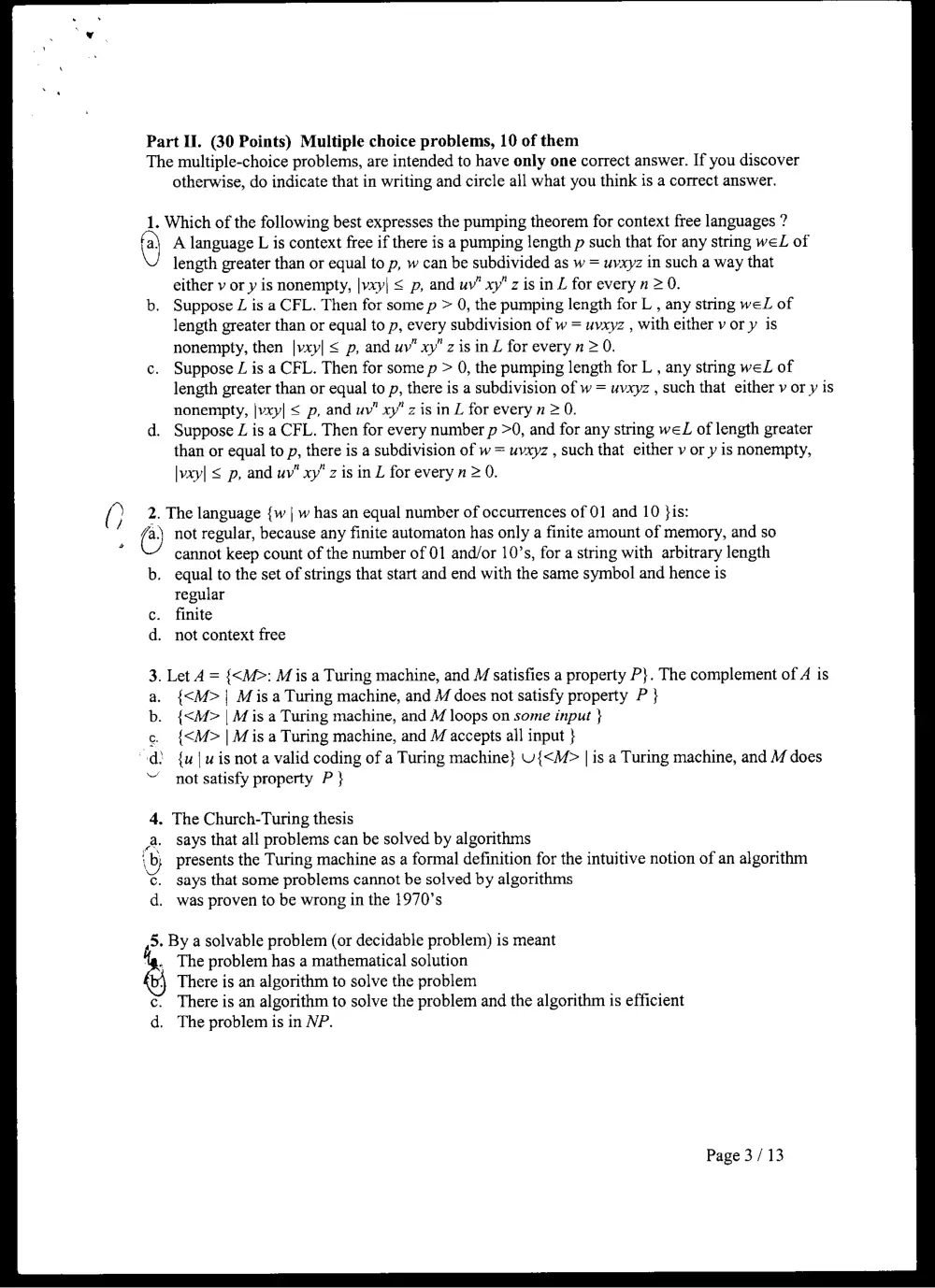
Part II. (30 Points) Multiple choice problems, 10 of them
The multiple-choice problems, are intended to have only one correct answer. If you discover
otherwise, do indicate that in writing and circle all what you think is a correct answer.
1. Which of the following best expresses the pumping theorem for context free languages ?
8 A language L is context free if there is a pumping length p such that for any string weZ of
length greater than or equal to p, w can be subdivided as w = uvxyz in such a way that
either v or y is nonempty, |vxy| < p, and uv” xy" z is in L for every n > 0.
b. Suppose L is a CFL. Then for some p > 0, the pumping length for L , any string wel of
length greater than or equal to p, every subdivision of w = uvxyz , with either v or y is
nonempty, then |vxy| < p, and uv" xy” z is in L for every n > 0.
Suppose L is a CFL. Then for some p > 0, the pumping length for L , any string weL of
length greater than or equal to p, there is a subdivision of w = uvxyz , such that either v or y is
nonempty, |vxy| < p, and uv" xy” z is in L for every n 2 0.
Suppose Z is a CFL. Then for every number p >0, and for any string we of length greater
than or equal to p, there is a subdivision of w = uvxyz , such that either v or y is nonempty,
|vxy| < p, and uv" xy" z is in L for every n = 0.
2. The language {w | w has an equal number of occurrences of 01 and 10 }is:
a not regular, because any finite automaton has only a finite amount of memory, and so
cannot keep count of the number of 01 and/or 10’s, for a string with arbitrary length
equal to the set of strings that start and end with the same symbol and hence is
regular
. finite
. hot context free
3. Let A = {<M>: Mis a Turing machine, and M satisfies a property P}. The complement of A is
a. {<M>| Misa Turing machine, and M does not satisfy property P }
b. {<M> | Mis a Turing machine, and M loops on some input }
¢. {<M> | Misa Turing machine, and M accepts all input }
d’ {u| wis not a valid coding of a Turing machine} U{<M> | is a Turing machine, and M does
“not satisfy property P }
4. The Church-Turing thesis
A. Says that all problems can be solved by algorithms
‘b presents the Turing machine as a formal definition for the intuitive notion of an algorithm
¢. says that some problems cannot be solved by algorithms
d. was proven to be wrong in the 1970’s
5. By a solvable problem (or decidable problem) is meant
. The problem has a mathematical solution
There is an algorithm to solve the problem
¢. There is an algorithm to solve the problem and the algorithm is efficient
d. The problem is in NP.
Page 3/13
» ILA is NP — cumplete , dic uicuibesship in dA van be
verified quickly and decided quickly
verified quickly and decided slowly
verified slowly and decided quickly
verified slowly and decided slowly
. The extended Tm model for which the one-tape simulating Turing machine is significantly
slower (exponential) running time is the
. the k-tape Turing machine
.. the non-deterministic Turing machine
The two-way infinite tape Turing machine
The enumerator
8. The language that expresses the emptiness problem for Turing machines Ey, is:
a. {<M w>| Misa Turing machine that does not halt on w}
b. {<M, w>| Misa Turing machine that rejects w}
c. {<M> | Misa Turing machine that halts on ¢}
( {<M> | Misa Turing machine, and L(M) = 6 }
9. The universal Turing machine is
a. the ultimate Turing machine, that simulates any variant (multi-tape, enumerators,
etc...)of the Turing machine model
b, a decider for Atm
Qc) capable of simulating any Turing machine on any input
d.
a decider for ALBA
. The acceptance problem for linear bounded automata, A: pa is decidable essentially because
an LBA has a finite amount of memory, so it runs out of memory in finite
time
for a given LBA B and a string w, there is a finite number of possible
configurations for the computation of B on w
a linear bounded automaton B must halt on any w
an LBA has the mechanism to guess whether it will halt on w or not
Page 4/13
PART III. Problems.
Problem 1.(10 Points)
Give an example for each of the following (No proof is required)
a. A language that is context free but not regular
ai
b. A language that is decidable but not context free
aA LS
cee
c. A language that is Turing-recognizable but not decidable
ol t YW
d. A language that is not Turing-recognizable
Ca re a
e. A language that is infP ;
Problem 2.(10 Points)
Let © = {0,1}, and consider the language L = {w €=* | the i symbol in w is 0, whenever i
iis odd } . aye’ ae
a. Show that Z is regular by giving the state diagram of a DFA that ‘yo .
recognizes L. v
b. Give a simple regular expression for describing L.
Page 5/13
Problem 3.(10 Points)
Consider the language L = {0" 1"| msn<2m}
a. Show that Z is context free by giving a PDA that recognizes L.
b. Give a simple CFG for L.
Page 6/13
Problem 4.(15 Points)
Let 2 = {0,1}, and consider the language L = {uu |uex* }
a. List in lexicographic order the first 8 strings in L .
b. Show that Z is not regular by using the pumping lemma for regular languages.
c. Consider the following incorrect “proof” that attempts to show that Z above is regular:
LetA={u|luexX*}.
1. A is obviously regular.
2. Now, L=AA
3. But regular languages are closed under concatenation.
4. Therefore, L is regular.
Which step in the “proof” is false, and why ?
d. If 2 = {0}, would the language L = { uu | ueX* } be not regular ? Why ?
Page 7 / 13
Problem 5 (10 Points)
Consider the acceptance problem for Turing machines represented by the language:
Arm = { <M, w>| Misa Turing machine that accepts string w}
a. Show that Arty is Turing-recognizable.
In showing that Arm is undecidable, we introduced a Turing machine D as
follows:
D=“On input <M>, where M is a Turing machine:
1. Run Hon input <™, < >>
2. IfH accepts, reject; if H reject, accept.”
What is H supposed to be, and what is the missing second component in Step 1 of
D?
c. Then a contradiction is arrived at by running D on some input. What is the input,
and what is the contradiction ?
Page 8 / 13
Problem 6.(15 Points)
Suppose that L is recognized by a DFA M with n states. Prove each of the following:
a. Lis nonempty if and only if M accepts a string of length less than 1. (Hint:
Take a string in Z of minimal length, and show that its length must be less
than n.)
b. Lis infinite if and only if M accepts some string w where n < |w| < 2n; i.e.
the length of w is between n and 2n.
Page 9/13
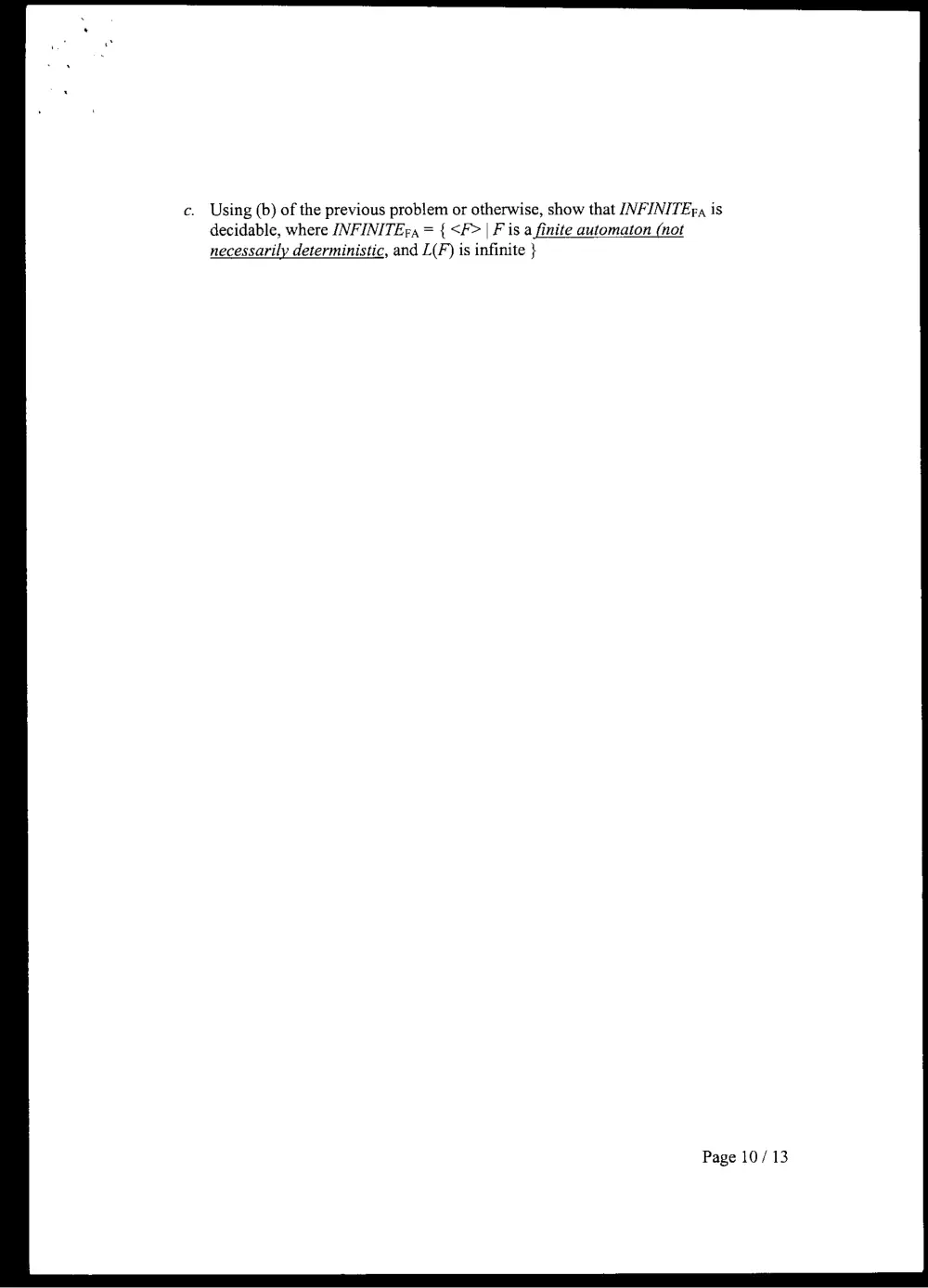
c. Using (b) of the previous problem or otherwise, show that INFINITE pa is
decidable, where INFINITEpas = { <F> | F is a finite automaton (not
necessarily deterministic, and L(F) is infinite }
Page 10/13