
CMPS 274 Final, Fall 1996
American University of Beirut · Compiler Construction · 5 pages
More CMPS 274 files
Show the text of this final exam
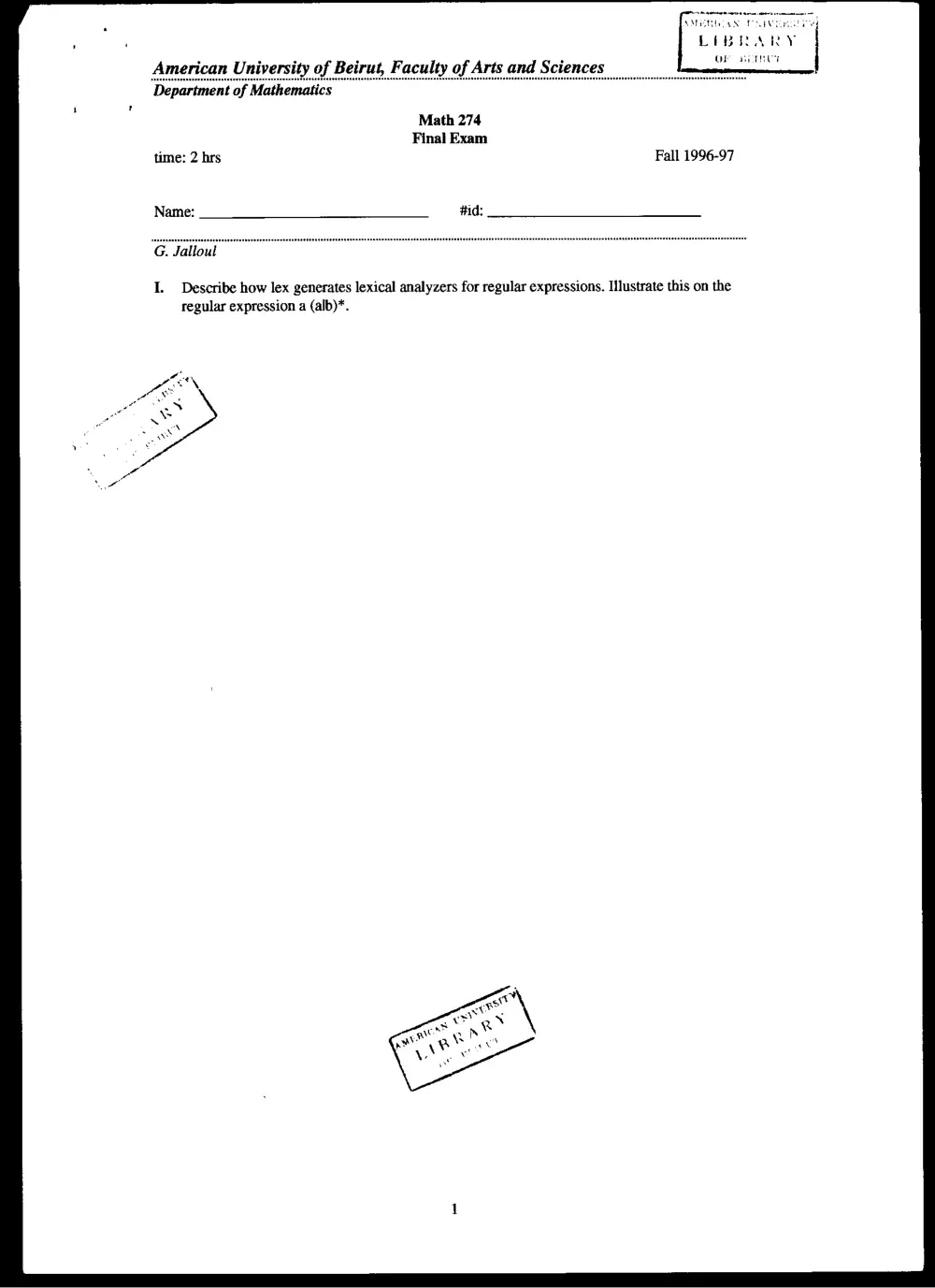
Math 274
Final Exam
AMENEAN PENT
LIBRARY
OF Betney
Fall 1996-97
G. Jalloul
IL
Describe how lex generates lexical analyzers for regular expressions. Illustrate this on the
regular expression a (alb)*.
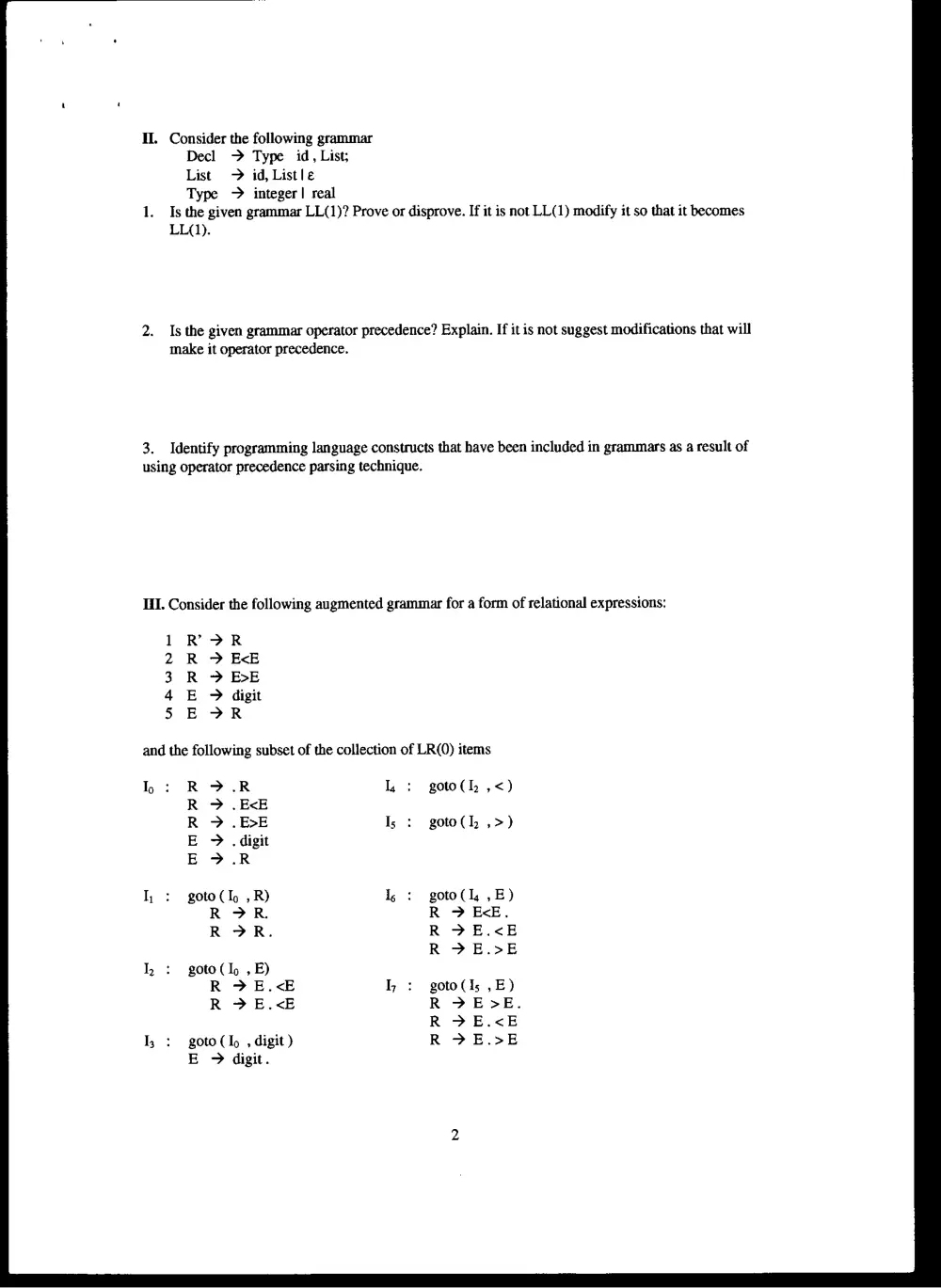
IL. Consider the following grammar
Decl ~> Type id, List;
List > id, Listle
Type ~> integer! real
1. Is the given grammar LL(1)? Prove or disprove. If it is not LL(1) modify it so that it becomes
LL(1).
2. Is the given grammar operator precedence? Explain. If it is not suggest modifications that will
make it operator precedence.
3. Identify programming language constructs that have been included in grammars as a result of
using operator precedence parsing technique.
III. Consider the following augmented grammar for a form of relational expressions:
Ubune
amMAADA
and the following subset of the collection of LR(0) items
lbh: RO.R lL : goto(h ,<)
R > .E<E
R > .E>DE Is : goto(], ,>)
E > . digit
E>.R
I, : goto(Ip ,R) Is : goto(l, ,E)
ROR. R > E<E.
ROR. R DE.<E
R DME.>E
I, : goto(lb ,E)
R DE.<E I, : goto(Is ,E)
R XE.<E R DME>E
R DE.<E
I, : goto(Ip , digit ) R DE.>E
E > digit.
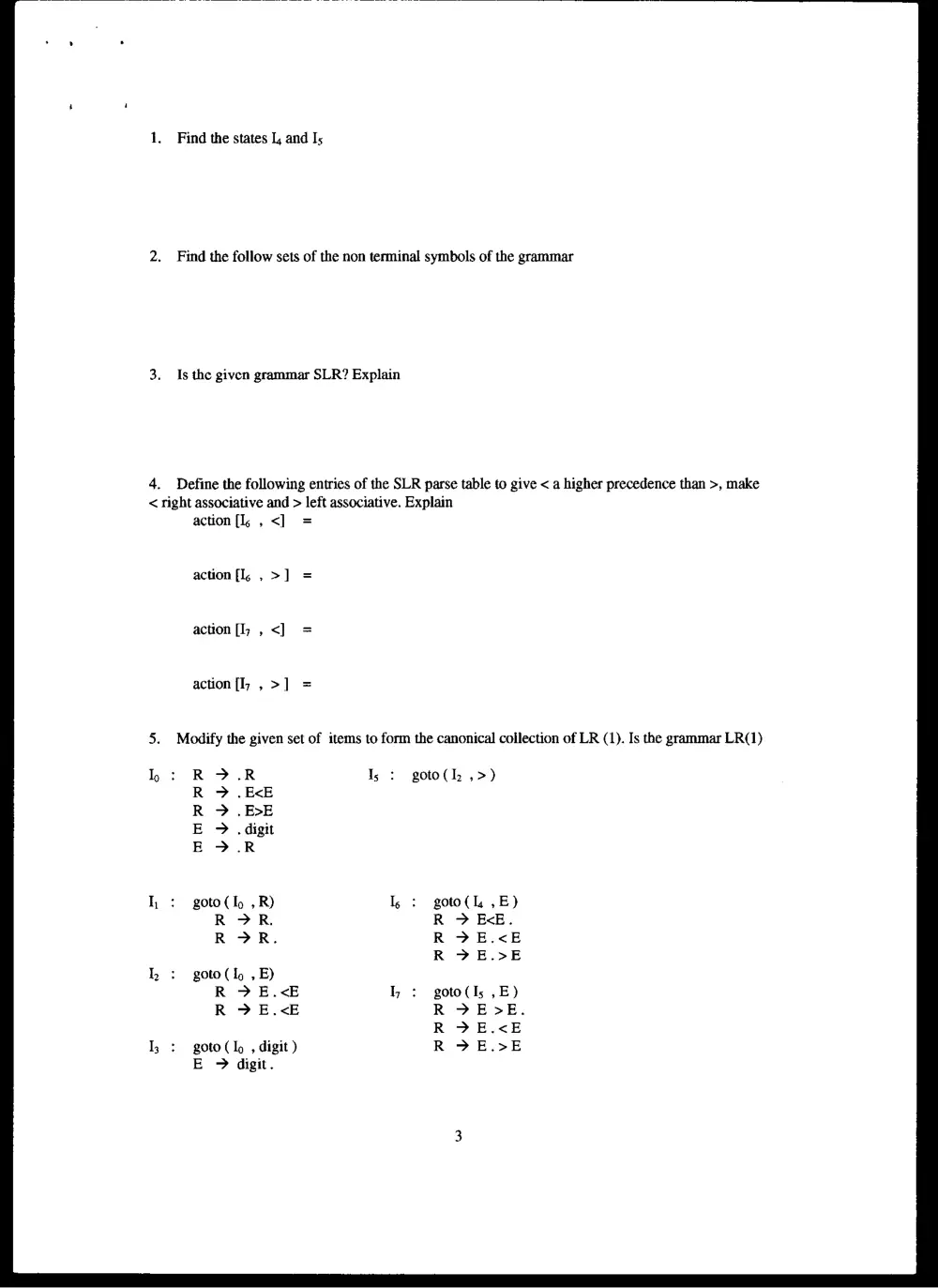
1. Find the states I, and I;
2. Find the follow sets of the non terminal symbols of the grammar
3. Is the given grammar SLR? Explain
4. Define the following entries of the SLR parse table to give < a higher precedence than >, make
< right associative and > left associative. Explain
action (I; , <]_ =
action [I; , >]
W
action [ , <]
action [I]; , >]
5. Modify the given set of items to form the canonical collection of LR (1). Is the grammar LR(1)
Ih: R>D.R Is: goto(], ,>)
R > .E<E
R > .E>E
E > . digit
E>.R
I, : goto(Ip ,R) I; : goto(l, ,E)
R OR. R > E<E.
ROR R DE.<E
R DE.>E
ary goto (Ip , E)
R DE.«<E L goto (I; ,E)
R XE.<E R DE>E.
R DE.<E
I; : goto (Ip , digit ) R DE.>E
E > digit.
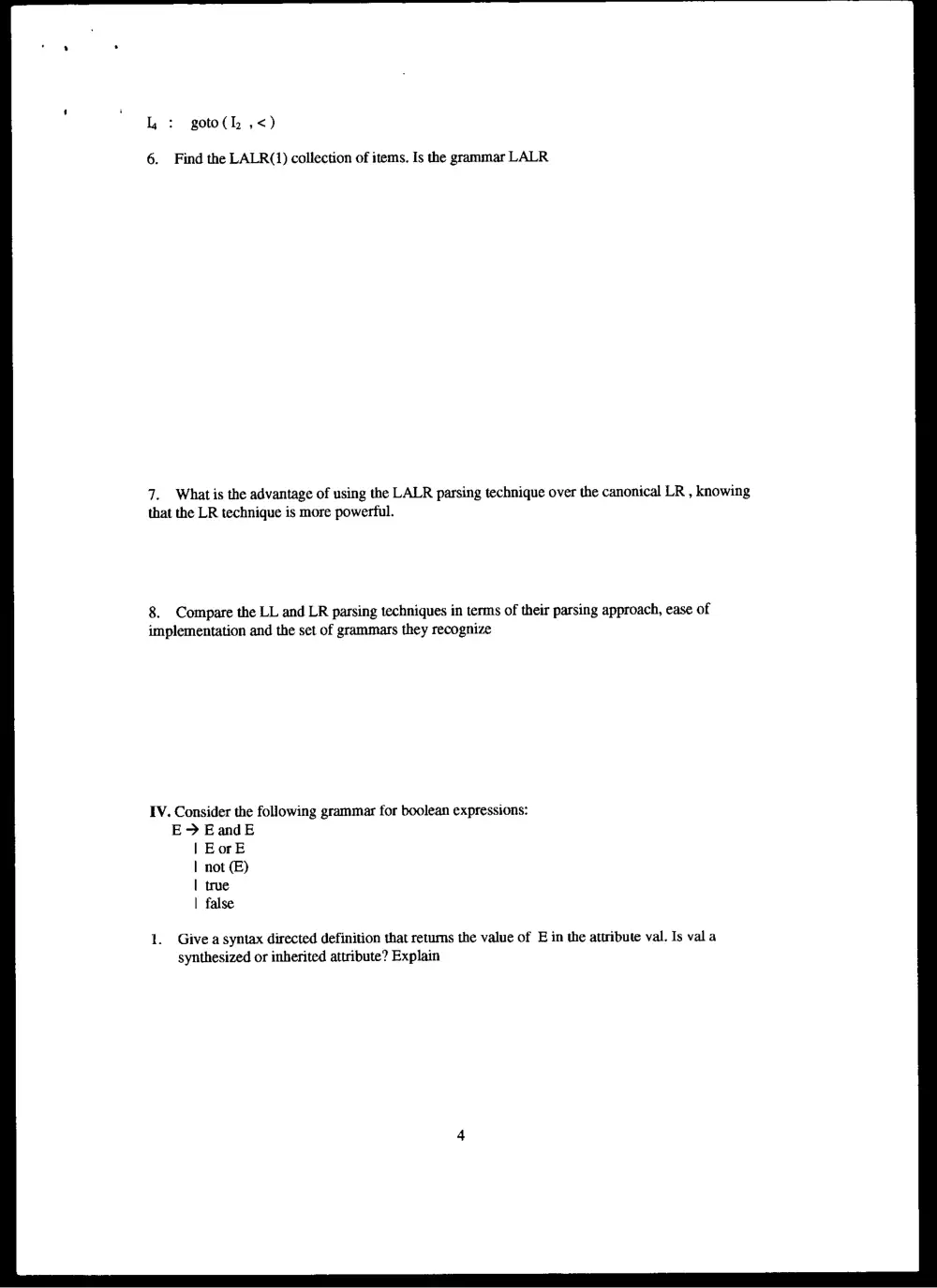
lL, : goto(h ,<)
6. Find the LALR(1) collection of items. Is the grammar LALR
7. What is the advantage of using the LALR parsing technique over the canonical LR , knowing
that the LR technique is more powerful.
8. Compare the LL and LR parsing techniques in terms of their parsing approach, ease of
implementation and the set of grammars they recognize
IV. Consider the following grammar for boolean expressions:
E> EandE
| EorE
| not (E)
| true
| false
1. Give a syntax directed definition that retums the value of E in the attribute val. Is val a
synthesized or inherited attribute? Explain
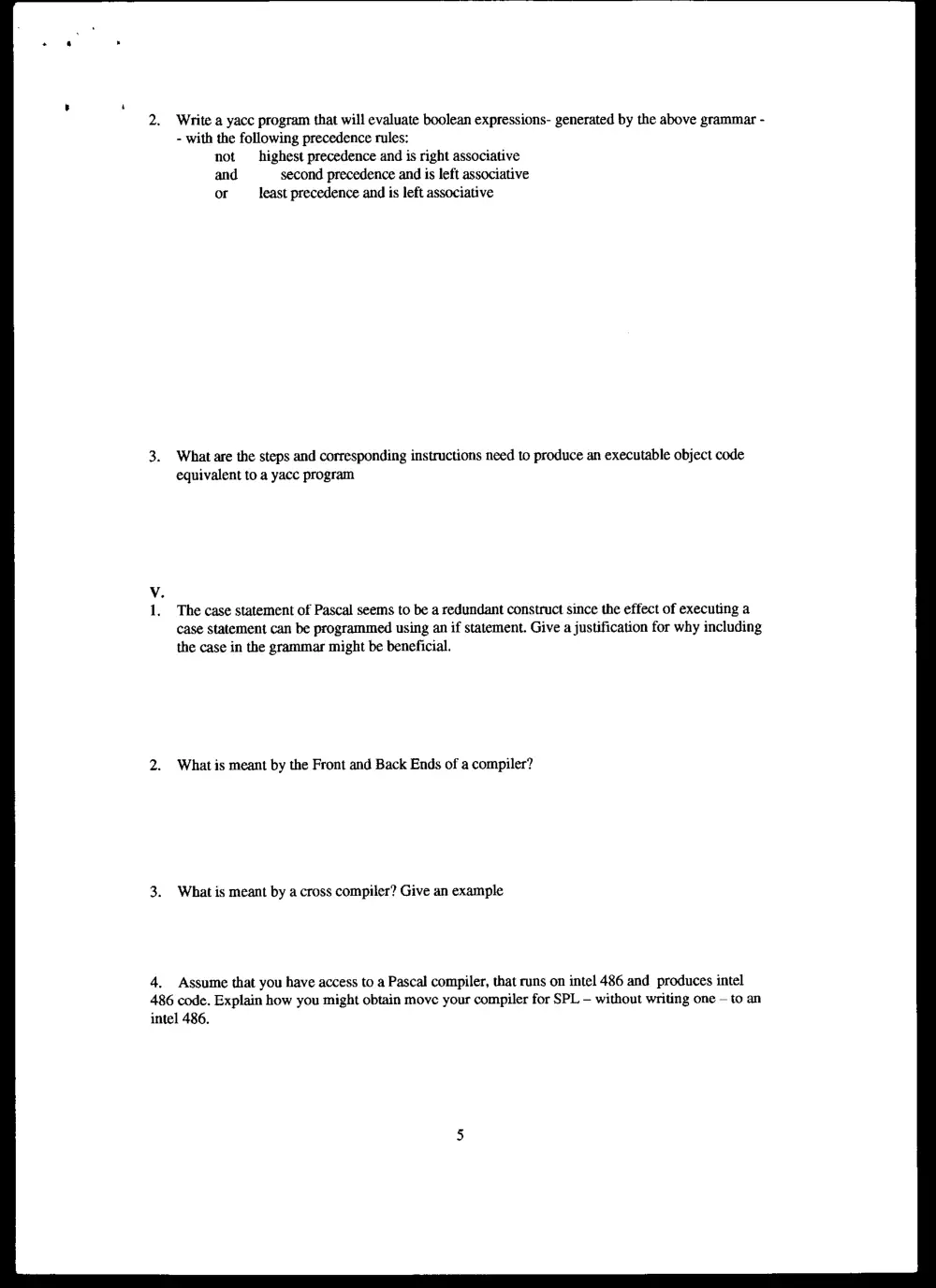
2. Write a yacc program that will evaluate boolean expressions- generated by the above grammar -
- with the following precedence rules:
not — highest precedence and is right associative
and second precedence and is left associative
or least precedence and is left associative
What are the steps and corresponding instructions need to produce an executable object code
equivalent to a yacc program
The case statement of Pascal seems to be a redundant construct since the effect of executing a
case statement can be programmed using an if statement. Give a justification for why including
the case in the grammar might be beneficial.
What is meant by the Front and Back Ends of a compiler?
What is meant by a cross compiler? Give an example
4. Assume that you have access to a Pascal compiler, that runs on intel 486 and produces intel
486 code. Explain how you might obtain move your compiler for SPL — without writing one — to an
intel 486.