
CMPS 356 Final, Fall 2005
American University of Beirut · Design and Analysis of Algorithms · 8 pages
More CMPS 356 files
Show the text of this final exam
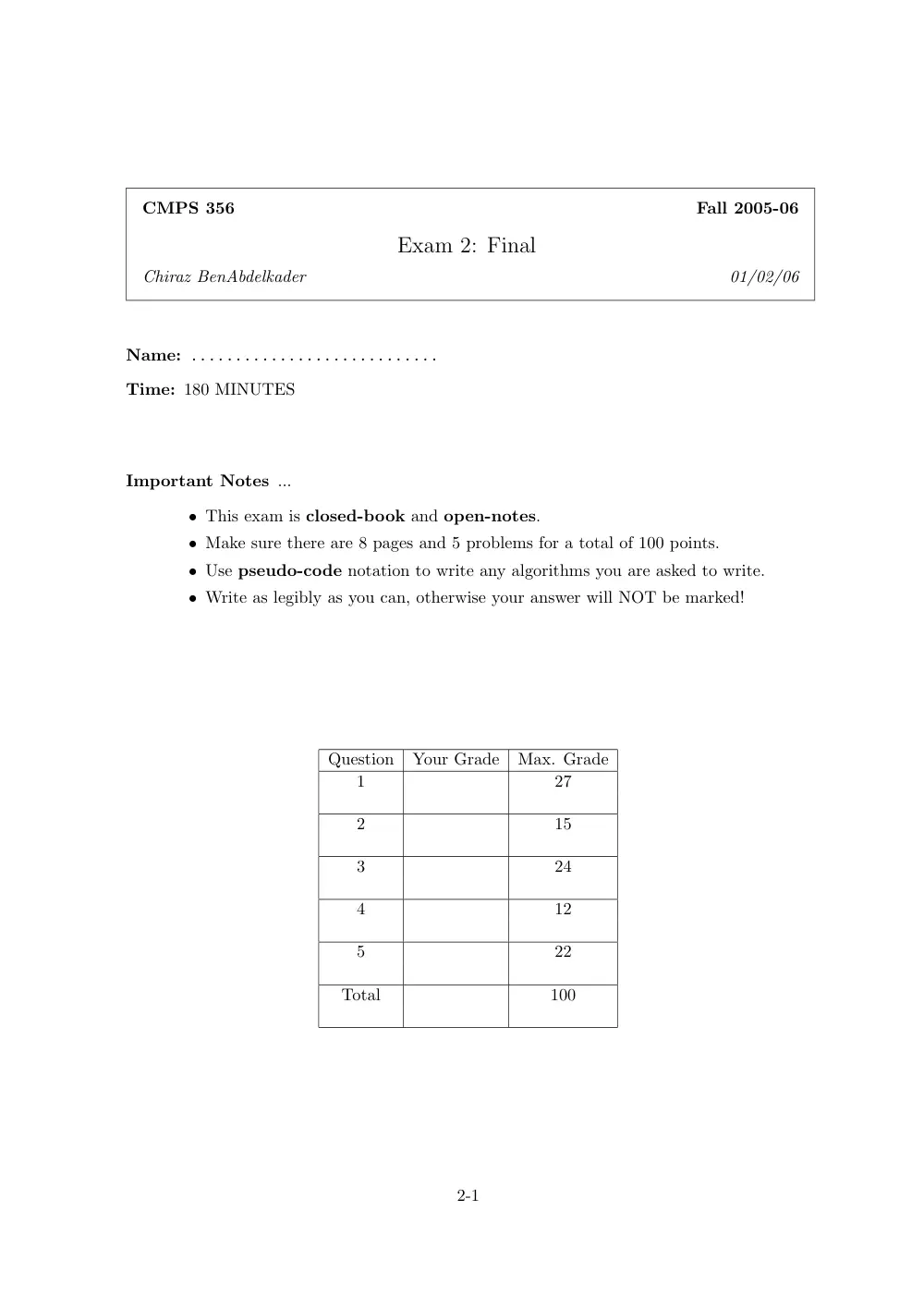
CMPS 356
Fall 2005-06
Exam 2: Final
Chiraz BenAbdelkader
01/02/06
Name: ............................
Time: 180 MINUTES
Important Notes ...
• This exam is closed-book and open-notes.
• Make sure there are 8 pages and 5 problems for a total of 100 points.
• Use pseudo-code notation to write any algorithms you are asked to write.
• Write as legibly as you can, otherwise your answer will NOT be marked!
Question
Your Grade
Max. Grade
1
27
2
15
3
24
4
12
5
22
Total
100
2-1
Exam 2: Final
2-2
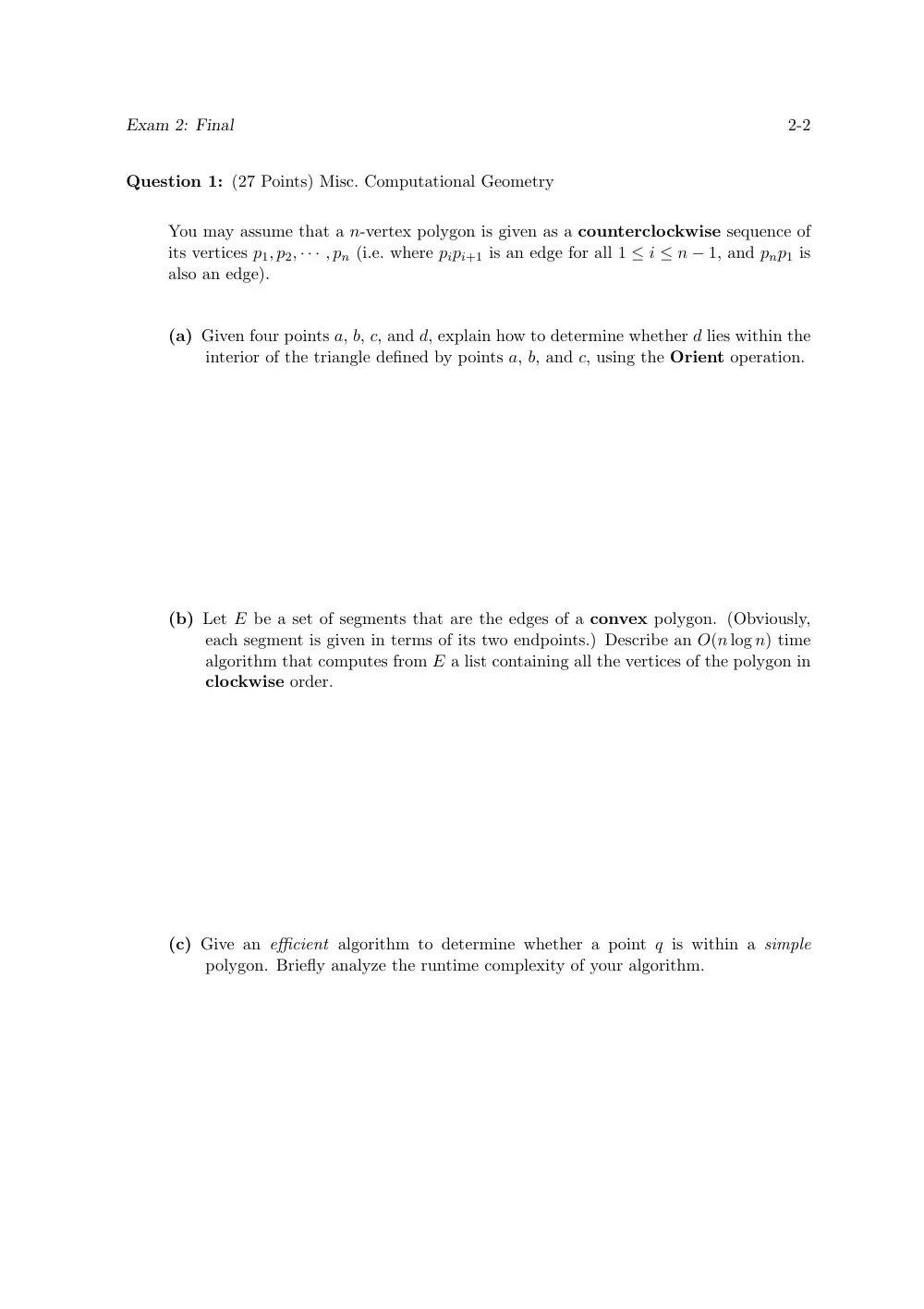
Question 1: (27 Points) Misc. Computational Geometry
You may assume that a n-vertex polygon is given as a counterclockwise sequence of
its vertices p1, p2, · · · , pn (i.e. where pipi+1 is an edge for all 1 ≤ i ≤ n − 1, and pnp1 is
also an edge).
(a) Given four points a, b, c, and d, explain how to determine whether d lies within the
interior of the triangle defined by points a, b, and c, using the Orient operation.
(b) Let E be a set of segments that are the edges of a convex polygon. (Obviously,
each segment is given in terms of its two endpoints.) Describe an O(n log n) time
algorithm that computes from E a list containing all the vertices of the polygon in
clockwise order.
(c) Give an efficient algorithm to determine whether a point q is within a simple
polygon. Briefly analyze the runtime complexity of your algorithm.
Exam 2: Final
2-3
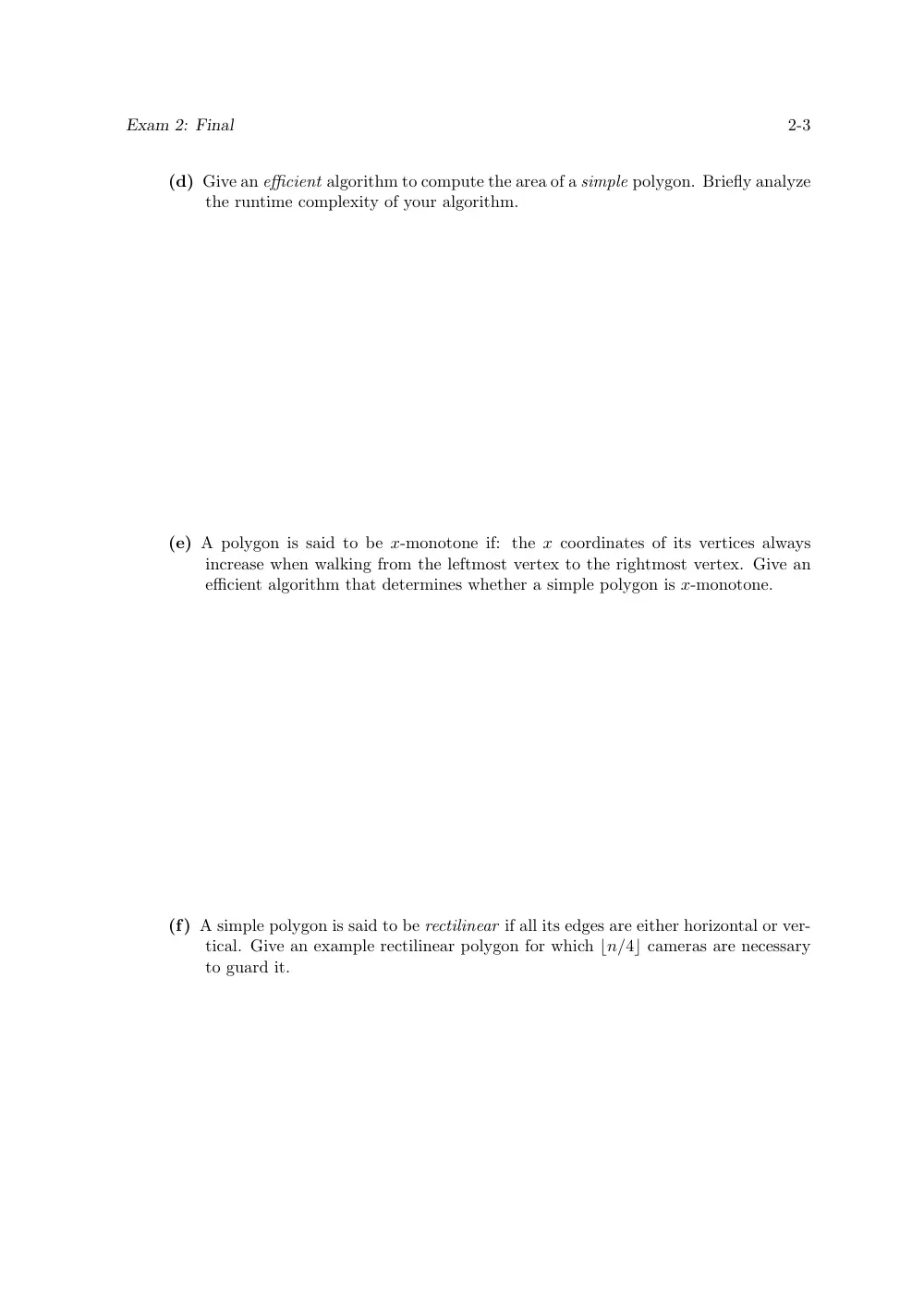
(d) Give an efficient algorithm to compute the area of a simple polygon. Briefly analyze
the runtime complexity of your algorithm.
(e) A polygon is said to be x-monotone if: the x coordinates of its vertices always
increase when walking from the leftmost vertex to the rightmost vertex. Give an
efficient algorithm that determines whether a simple polygon is x-monotone.
(f) A simple polygon is said to be rectilinear if all its edges are either horizontal or ver-
tical. Give an example rectilinear polygon for which ⌊n/4⌋ cameras are necessary
to guard it.
Exam 2: Final
2-4
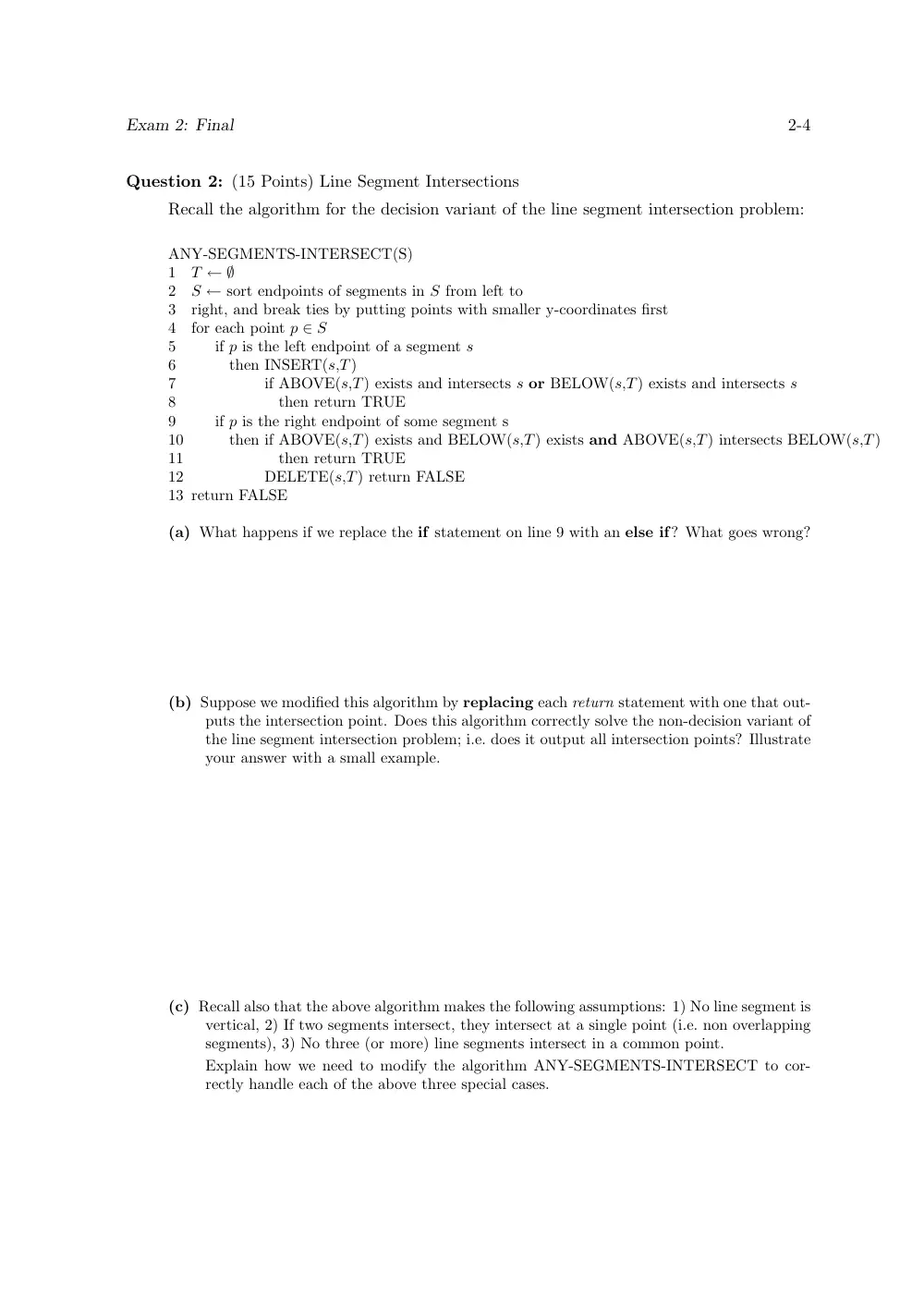
Question 2: (15 Points) Line Segment Intersections
Recall the algorithm for the decision variant of the line segment intersection problem:
ANY-SEGMENTS-INTERSECT(S)
1
T ← ∅
2
S ← sort endpoints of segments in S from left to
3
right, and break ties by putting points with smaller y-coordinates first
4
for each point p ∈ S
5
if p is the left endpoint of a segment s
6
then INSERT(s,T)
7
if ABOVE(s,T) exists and intersects s or BELOW(s,T) exists and intersects s
8
then return TRUE
9
if p is the right endpoint of some segment s
10
then if ABOVE(s,T) exists and BELOW(s,T) exists and ABOVE(s,T) intersects BELOW(s,T)
11
then return TRUE
12
DELETE(s,T) return FALSE
13 return FALSE
(a) What happens if we replace the if statement on line 9 with an else if? What goes wrong?
(b) Suppose we modified this algorithm by replacing each return statement with one that out-
puts the intersection point. Does this algorithm correctly solve the non-decision variant of
the line segment intersection problem; i.e. does it output all intersection points? Illustrate
your answer with a small example.
(c) Recall also that the above algorithm makes the following assumptions: 1) No line segment is
vertical, 2) If two segments intersect, they intersect at a single point (i.e. non overlapping
segments), 3) No three (or more) line segments intersect in a common point.
Explain how we need to modify the algorithm ANY-SEGMENTS-INTERSECT to cor-
rectly handle each of the above three special cases.
Exam 2: Final
2-5
Question 3: (24 Points) Linear Programming
(a) You are the project manager at a company.
Assume that you are given a list P of n
employees p1, p2, · · · , pn, and a list of m tasks t1, t2, · · · , tm. Each employee pa has a limit
La on the number of hours that they can work. Each task tb has a requirement Rb of the
total number of hours that must be devoted to this task in order for it to be finished. For
each employee pa and each task tb you are given an hourly salary ca,b that you must pay
pa to work at task tb. Your goal is to find the cheapest way to assign employees to tasks
so that all tasks are completed, and all the above constraints are satisfied. The cost of an
assignment is just the total amount of money you have to pay all of the employees. For
now, you need only be concerned about the total time devoted to each tasks. You need
not worry about scheduling when employees work on tasks; that will be handled later by
your graduate student intern.
Show that this problem can be cast as a linear program (and hence an efficient algorithm
exists for it, since efficient algorithms exist for LPs). Your final LP must be formulated in
standard form.
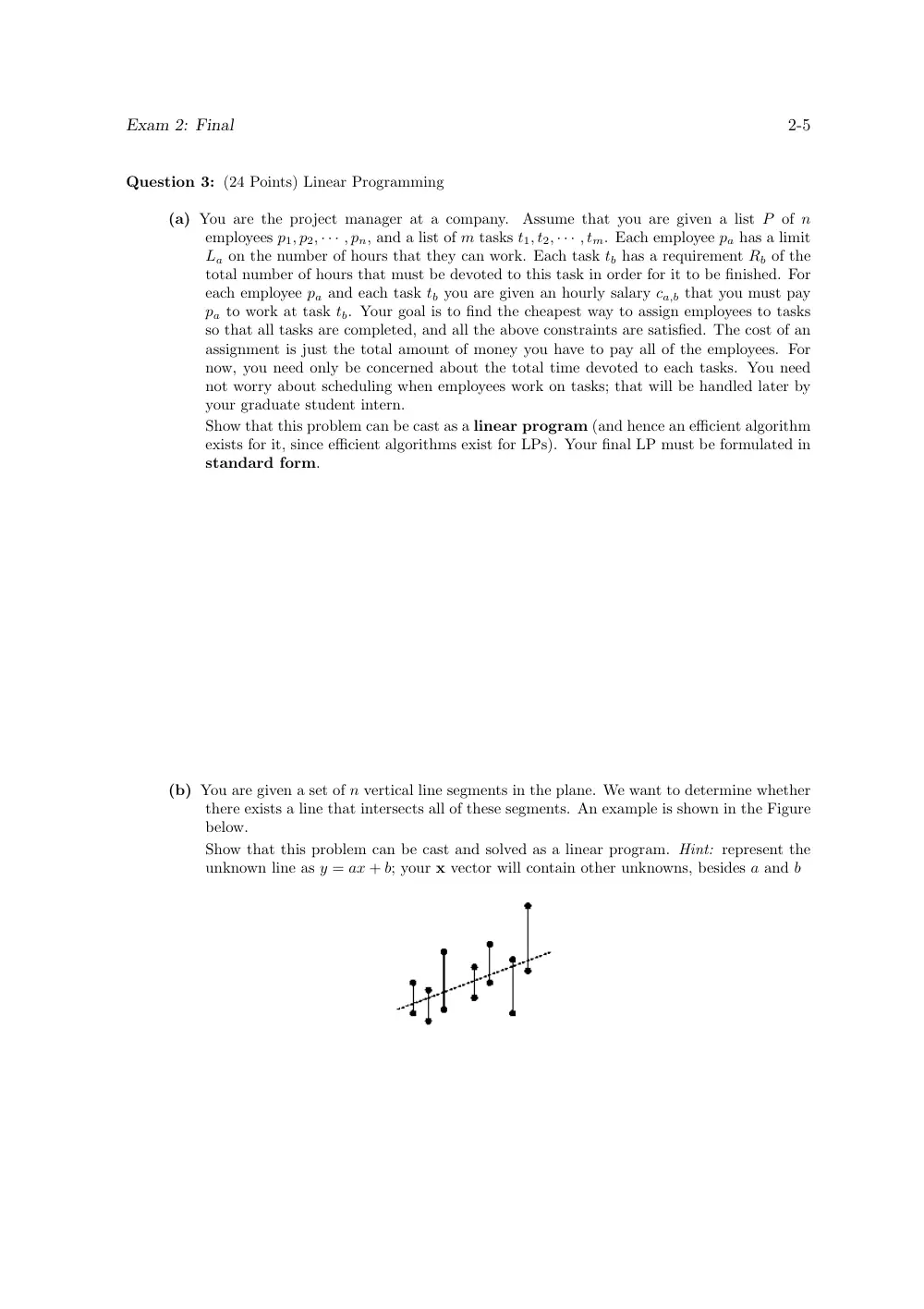
(b) You are given a set of n vertical line segments in the plane. We want to determine whether
there exists a line that intersects all of these segments. An example is shown in the Figure
below.
Show that this problem can be cast and solved as a linear program. Hint: represent the
unknown line as y = ax + b; your x vector will contain other unknowns, besides a and b
Exam 2: Final
2-6
(c) You are given two sets of points in the plane, the red set R contains nr points, and the blue
set B containing nb points. The total number of points in both sets is n = nr + nb. We
want to determine whether the convex hulls of the red set and the blue set intersect (i.e.
they are not disjoint).
Show that this problem can be cast and solved as a linear program. Hint: if the CH’s of
R and B do not intersect, then there exists a line that separates the sets of points. . .
Exam 2: Final
2-7
Question 4: (12 Points) Dynamic Programming
Given a sequence of n integers x, we say xi1, xi2, · · · , xik is an increasing subsequence of x, if
i1 < i2 < · · · < ik and xi1 ≤ xi2 ≤ · · · ≤ xik. For example, if x = {11, 14, −1, 2, 6, 25, 9} then
{11, 14, 25} is an increasing subsequence of x.
Give a dynamic programming algorithm that computes the longest increasing subsequence of
x. First derive the three basic DP components of the problem (optimal substructure, ...), then
give the iterative DP algorithm and briefly analyze its running time.
Exam 2: Final
2-8
Question 5: (22 Points) NP Completeness & Approximation Algorithms
(a) Consider the following two decision problems:
PARTITION: Given a set S of arbitrary numbers, decide whether it can be partitioned into
two subsets whose sums are equal. That is, if there exists C1 and C2 such that C1∪C2 = S
and �
x∈C1 = �
x∈C2.
SUBSET-SUM: Given a set S of arbitrary numbers and an arbitrary number t, decide
whether there exists a subset of S whose sum is equal to t. That is, if there exists C such
that C ⊆ S and �
x∈C = t.
(i) Show that PARTITION ≤P SUBSET-SUM.
(ii) Show that SUBSET-SUM ≤P PARTITION.
(b) Consider the following rectangle covering problem:
Input: a collection of rectangles I = {R1, R2, · · · , Rn} in the plane such that each rect-
angle is aligned with the x- and y- axes (all sides are horizontal and vertical). These
rectangles may overlap.
Output: a minimal set of points P = {p1, p2, · · · , pm} such that each rectangle in I
contains at least one point from P.
Give an efficient approximation algorithm for this problem.