
CMPS 373 Final, Spring 2005
American University of Beirut · Parallel Computing · 2 pages
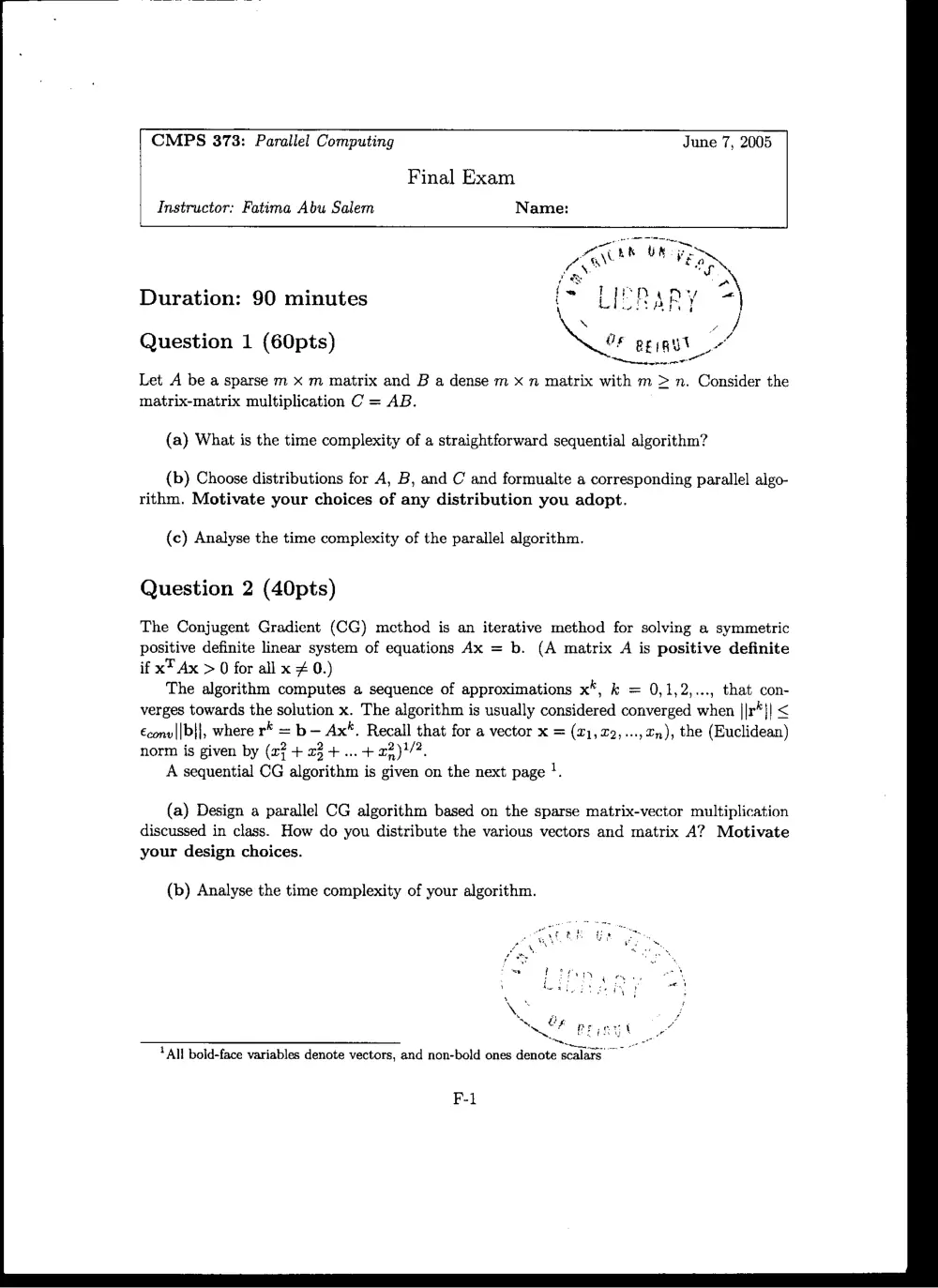

Show the text of this final exam
CMPS 373: Parallel Computing June 7, 2005
Final Exam
Instructor: Fatima Abu Salem Name:
Duration: 90 minutes
Question 1 (60pts)
Let A be a sparse m x m matrix and B a dense m x n matrix with m > n. Consider the
matrix-matrix multiplication C = AB.
(a) What is the time complexity of a straightforward sequential algorithm?
(b) Choose distributions for A, B, and C and formualte a corresponding parallel algo-
rithm. Motivate your choices of any distribution you adopt.
(c) Analyse the time complexity of the parallel algorithm.
Question 2 (40pts)
The Conjugent Gradient (CG) method is an iterative method for solving a symmetric
positive definite linear system of equations Ax = b. (A matrix A is positive definite
if x Ax > 0 for all x £ 0.)
The algorithm computes a sequence of approximations x*, k = 0,1,2,..., that con-
verges towards the solution x. The algorithm is usually considered converged when ||r*|| <
Econy||bj], where r®* = b— Ax*. Recall that for a vector x = (21, 29,...,Zn), the (Euclidean)
norm is given by (x? + 23+... + 22)1/2,
A sequential CG algorithm is given on the next page !.
(a) Design a parallel CG algorithm based on the sparse matrix-vector multiplication
discussed in class. How do you distribute the various vectors and matrix A? Motivate
your design choices.
(b) Analyse the time complexity of your algorithm.
eee
1 All bold-face variables denote vectors, and non-bold ones denote scalars
F-1
input: A: sparse n x n matrix,
b: dense vector of length n.
output: x: dense vector of length n, such that Ax ® b.
x := x®: { initial guess }
k := 0; { iteration number }
ri=b— Ax;
p= |[rll?s
while \/p > €cony||b||&&k < kmaz do
if k = 0 then
psy
else
8 := p/ potas
p:=r+t fp;
w= Ap;
y= ptw;
a= p/Y;
xX:=x+ ap;
r:=r—aw;
Pold *= P;
p= |r|);
k= k+l],