
CVSP 111 Final, Fall 2003
American University of Beirut · Youth and Rebellion · 2 pages

More CVSP 111 files
Show the text of this final exam
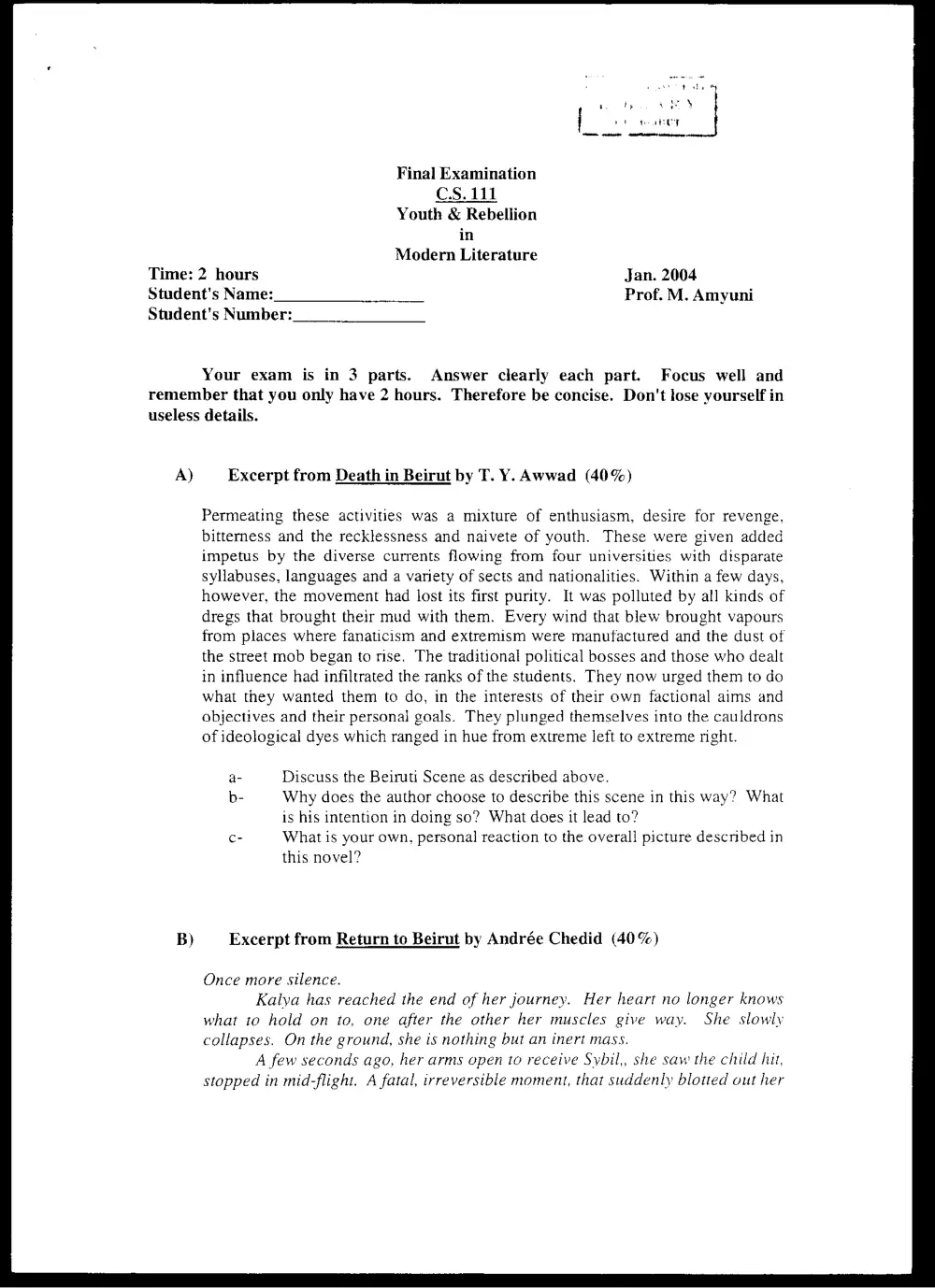
Final Examination
C.S.111
Youth & Rebellion
in
Modern Literature
Time: 2 hours Jan. 2004
Student's Name: Prof. M. Amyuni
Student's Number:
Your exam is in 3 parts. Answer clearly each part. Focus well and
remember that you only have 2 hours. Therefore be concise. Don't lose yourself in
useless details.
A) Excerpt from Death in Beirut by T. Y. Awwad (40%)
Permeating these activities was a mixture of enthusiasm, desire for revenge,
bitterness and the recklessness and naivete of youth. These were given added
impetus by the diverse currents flowing from four universities with disparate
syllabuses, languages and a variety of sects and nationalities. Within a few days,
however, the movement had lost its first purity. It was polluted by all kinds of
dregs that brought their mud with them. Every wind that blew brought vapours
from places where fanaticism and extremism were manufactured and the dust of
the street mob began to rise. The traditional political bosses and those who dealt
in influence had infiltrated the ranks of the students. They now urged them to do
what they wanted them to do, in the interests of their own factional aims and
objectives and their personal goals. They plunged themselves into the cauldrons
of ideological dyes which ranged in hue from extreme left to extreme right.
a- Discuss the Beiruti Scene as described above.
b- Why does the author choose to describe this scene in this way? What
is his intention in doing so? What does it lead to?
What is your own. personal reaction to the overall picture described in
this novel?
Excerpt from Return to Beirut by Andrée Chedid (40%)
Once more silence.
Kalya has reached the end of her journey. Her heart no longer knows
what to hold on to, one after the other her muscles give way. She slowly
collapses. On the ground, she is nothing but an inert mass.
A few seconds ago, her arms open to receive Sybil,, she saw the child hit,
stopped in mid-flight. A fatal, irreversible moment, that suddenly blotted out her
C)
own life. Her vigour and strength abandon her. She does not Struggle, no longer
wants this breath lingering on the edge of her lips.
Everything happens very quickly. Mario, he does not know how, suddenly
finds himself there kneeling at Kalya's side, trying to make himself heard: ‘I’ ve
found Georges. Everything's settled.'
He persists. He lies. He hopes his words will reach her:
‘Sybil will fly out tomorrow. Everything's settled. Everything's settled.’
‘Everything's settled’ echoes; rings incessantly in her ears. Kayla would
like to shake her head, but the words persist. They mingle with TU find you again
one day.' With other words spoken, with those of Slimane and Sybil, who sang
together: 'The water goes the water comes.’
Nouza's smile tries to break through the mists.
Men, women, rush into the square. Shutters open. Doors open. Cries, shouts
rise up all around; this indiscriminate violence cannot, will not last.
Tomorrow, the apocalypse, a sea of madness? Tomorrow, peace?
A little boy, who saw it all, looks at the square and the people there. In his
mind, things have begun to stir.
The yellow scarf, stained with blood, flaps in the breeze It retains in its folds the
tenacious brightness of the morning.
The piece of cloth rises, billows, fails, rises again, takes off, flutters; falls
once more then flies off, even higher...
1, Analyze the main ideas in this excerpt.
2. Interpret this ending, this conclusion to the novel.
3. What is your own personal reaction to the overall picture described in the
novel?
State briefly as a conclusion to the whole course, what kind of rebellion was
closest to your heart and for what reason(s)? (20%)