
CVSP 202 Notes, Spring 2011
American University of Beirut · Ancient, Medieval and Renaissance Culture · 4 pages
More CVSP 202 files
- Notes Monotheistic Traditions, Ten Commandments, Jesus, Koran,Greece and Plato, · Spring 2018NotesView
- Notes · Spring 2011NotesView
- Notes · Spring 2011NotesView
- Notes · Spring 2011NotesView
- Notes · Spring 2011NotesView
- Useful File Four Themes Have Been Compared Between Augustine, Ghazali, Aquinas a · Fall 2017FileView
- Useful File Comparison AlGhazali · Spring 2012FileView
- Final · Fall 2008Final examView
Show the text of this notes
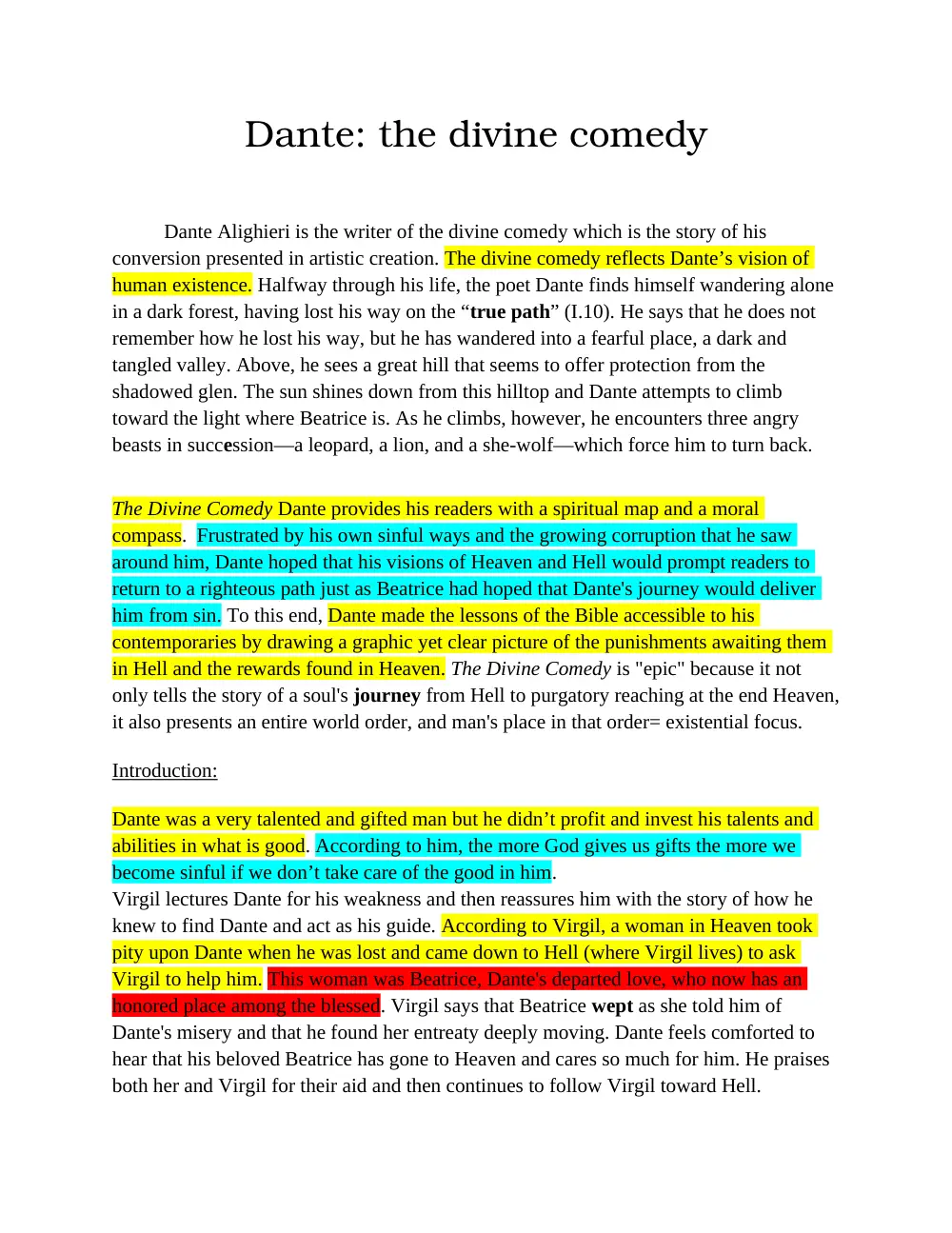
Dante: the divine comedy
Dante Alighieri is the writer of the divine comedy which is the story of his
conversion presented in artistic creation. The divine comedy reflects Dante’s vision of
human existence. Halfway through his life, the poet Dante finds himself wandering alone
in a dark forest, having lost his way on the “true path” (I.10). He says that he does not
remember how he lost his way, but he has wandered into a fearful place, a dark and
tangled valley. Above, he sees a great hill that seems to offer protection from the
shadowed glen. The sun shines down from this hilltop and Dante attempts to climb
toward the light where Beatrice is. As he climbs, however, he encounters three angry
beasts in succession—a leopard, a lion, and a she-wolf—which force him to turn back.
The Divine Comedy Dante provides his readers with a spiritual map and a moral
compass. Frustrated by his own sinful ways and the growing corruption that he saw
around him, Dante hoped that his visions of Heaven and Hell would prompt readers to
return to a righteous path just as Beatrice had hoped that Dante's journey would deliver
him from sin. To this end, Dante made the lessons of the Bible accessible to his
contemporaries by drawing a graphic yet clear picture of the punishments awaiting them
in Hell and the rewards found in Heaven. The Divine Comedy is "epic" because it not
only tells the story of a soul's journey from Hell to purgatory reaching at the end Heaven,
it also presents an entire world order, and man's place in that order= existential focus.
Introduction:
Dante was a very talented and gifted man but he didn’t profit and invest his talents and
abilities in what is good. According to him, the more God gives us gifts the more we
become sinful if we don’t take care of the good in him.
Virgil lectures Dante for his weakness and then reassures him with the story of how he
knew to find Dante and act as his guide. According to Virgil, a woman in Heaven took
pity upon Dante when he was lost and came down to Hell (where Virgil lives) to ask
Virgil to help him. This woman was Beatrice, Dante's departed love, who now has an
honored place among the blessed. Virgil says that Beatrice wept as she told him of
Dante's misery and that he found her entreaty deeply moving. Dante feels comforted to
hear that his beloved Beatrice has gone to Heaven and cares so much for him. He praises
both her and Virgil for their aid and then continues to follow Virgil toward Hell.
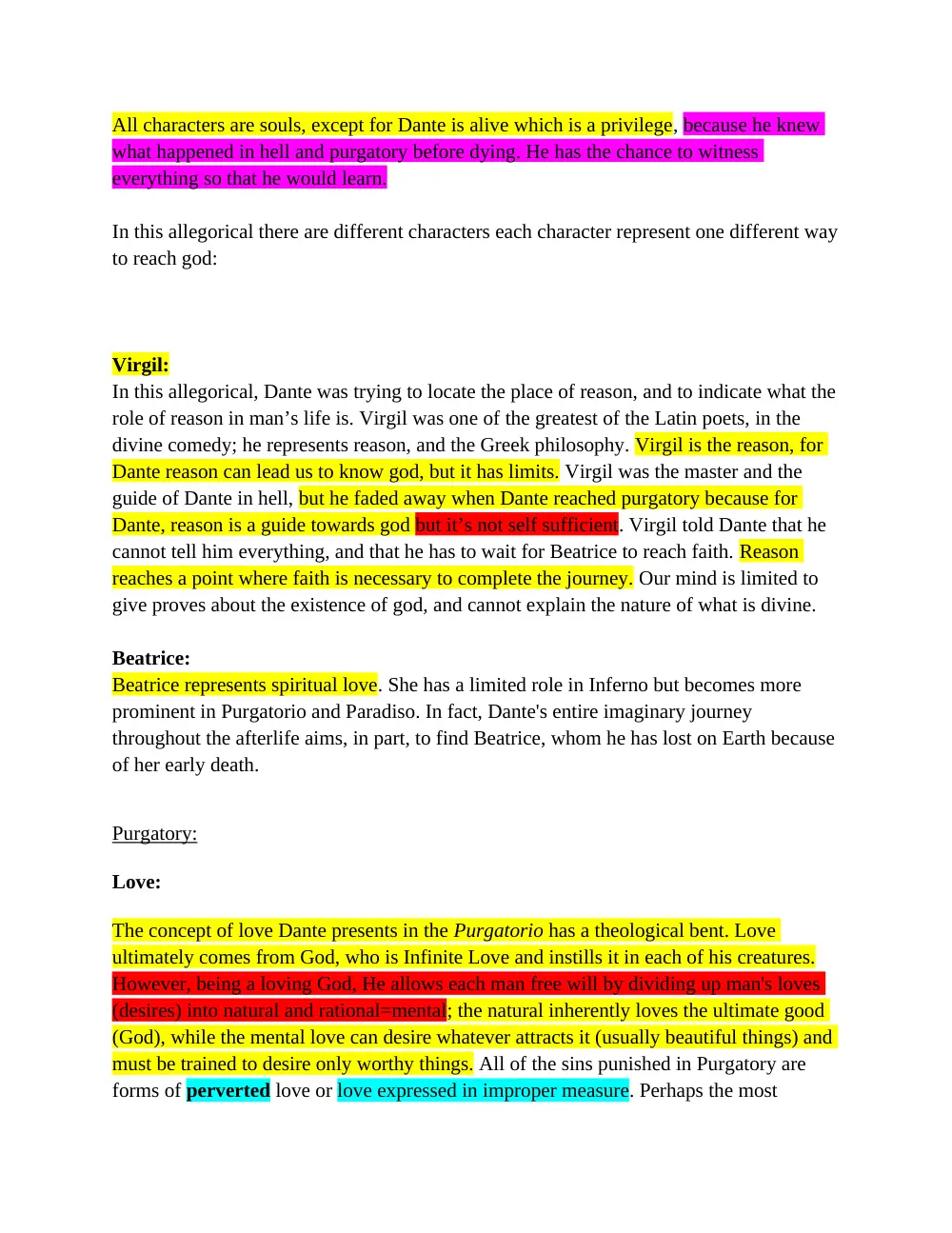
All characters are souls, except for Dante is alive which is a privilege, because he knew
what happened in hell and purgatory before dying. He has the chance to witness
everything so that he would learn.
In this allegorical there are different characters each character represent one different way
to reach god:
Virgil:
In this allegorical, Dante was trying to locate the place of reason, and to indicate what the
role of reason in man’s life is. Virgil was one of the greatest of the Latin poets, in the
divine comedy; he represents reason, and the Greek philosophy. Virgil is the reason, for
Dante reason can lead us to know god, but it has limits. Virgil was the master and the
guide of Dante in hell, but he faded away when Dante reached purgatory because for
Dante, reason is a guide towards god but it’s not self sufficient. Virgil told Dante that he
cannot tell him everything, and that he has to wait for Beatrice to reach faith. Reason
reaches a point where faith is necessary to complete the journey. Our mind is limited to
give proves about the existence of god, and cannot explain the nature of what is divine.
Beatrice:
Beatrice represents spiritual love. She has a limited role in Inferno but becomes more
prominent in Purgatorio and Paradiso. In fact, Dante's entire imaginary journey
throughout the afterlife aims, in part, to find Beatrice, whom he has lost on Earth because
of her early death.
Purgatory:
Love:
The concept of love Dante presents in the Purgatorio has a theological bent. Love
ultimately comes from God, who is Infinite Love and instills it in each of his creatures.
However, being a loving God, He allows each man free will by dividing up man's loves
(desires) into natural and rational=mental; the natural inherently loves the ultimate good
(God), while the mental love can desire whatever attracts it (usually beautiful things) and
must be trained to desire only worthy things. All of the sins punished in Purgatory are
forms of perverted love or love expressed in improper measure. Perhaps the most
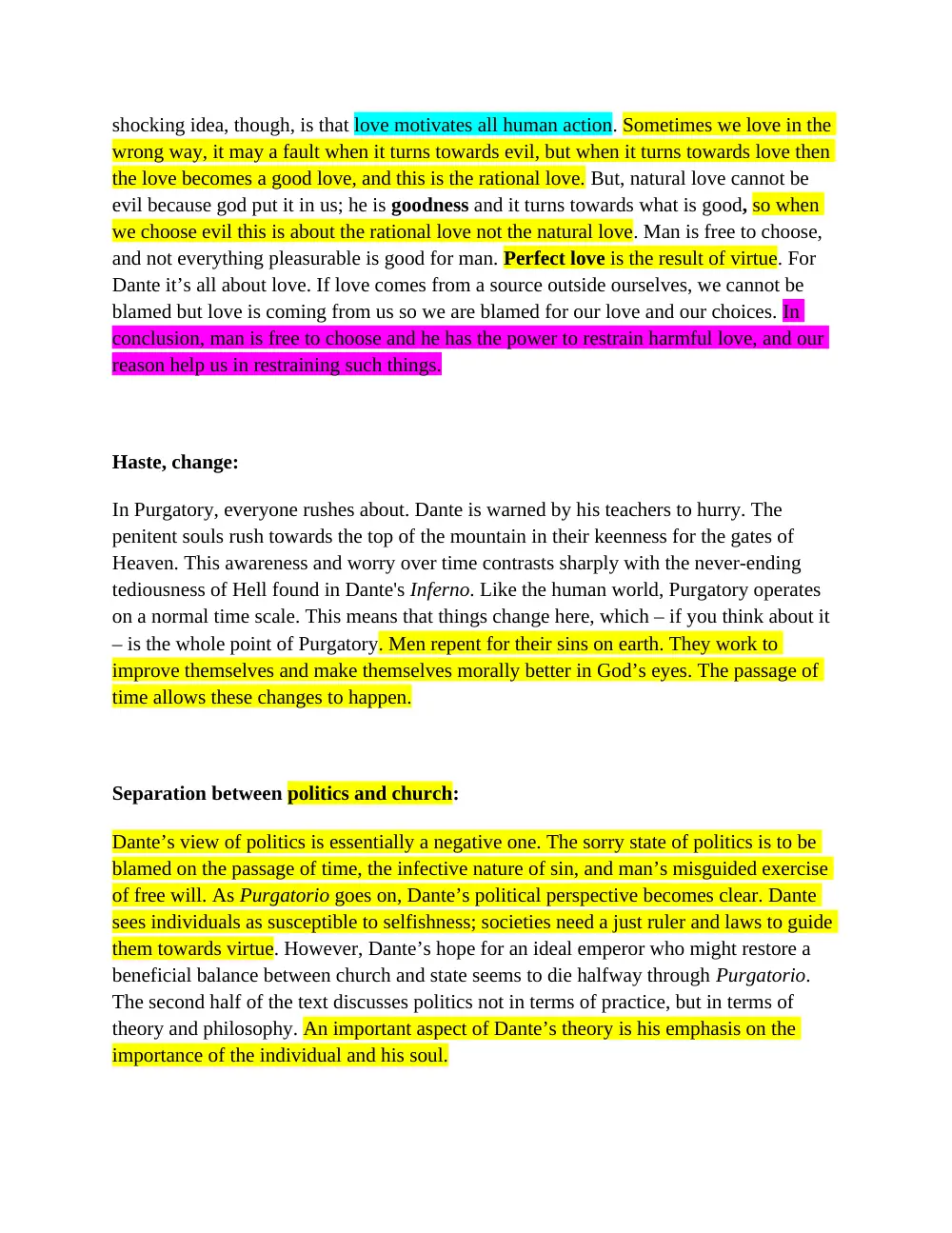
shocking idea, though, is that love motivates all human action. Sometimes we love in the
wrong way, it may a fault when it turns towards evil, but when it turns towards love then
the love becomes a good love, and this is the rational love. But, natural love cannot be
evil because god put it in us; he is goodness and it turns towards what is good, so when
we choose evil this is about the rational love not the natural love. Man is free to choose,
and not everything pleasurable is good for man. Perfect love is the result of virtue. For
Dante it’s all about love. If love comes from a source outside ourselves, we cannot be
blamed but love is coming from us so we are blamed for our love and our choices. In
conclusion, man is free to choose and he has the power to restrain harmful love, and our
reason help us in restraining such things.
Haste, change:
In Purgatory, everyone rushes about. Dante is warned by his teachers to hurry. The
penitent souls rush towards the top of the mountain in their keenness for the gates of
Heaven. This awareness and worry over time contrasts sharply with the never-ending
tediousness of Hell found in Dante's Inferno. Like the human world, Purgatory operates
on a normal time scale. This means that things change here, which – if you think about it
– is the whole point of Purgatory. Men repent for their sins on earth. They work to
improve themselves and make themselves morally better in God’s eyes. The passage of
time allows these changes to happen.
Separation between politics and church:
Dante’s view of politics is essentially a negative one. The sorry state of politics is to be
blamed on the passage of time, the infective nature of sin, and man’s misguided exercise
of free will. As Purgatorio goes on, Dante’s political perspective becomes clear. Dante
sees individuals as susceptible to selfishness; societies need a just ruler and laws to guide
them towards virtue. However, Dante’s hope for an ideal emperor who might restore a
beneficial balance between church and state seems to die halfway through Purgatorio.
The second half of the text discusses politics not in terms of practice, but in terms of
theory and philosophy. An important aspect of Dante’s theory is his emphasis on the
importance of the individual and his soul.
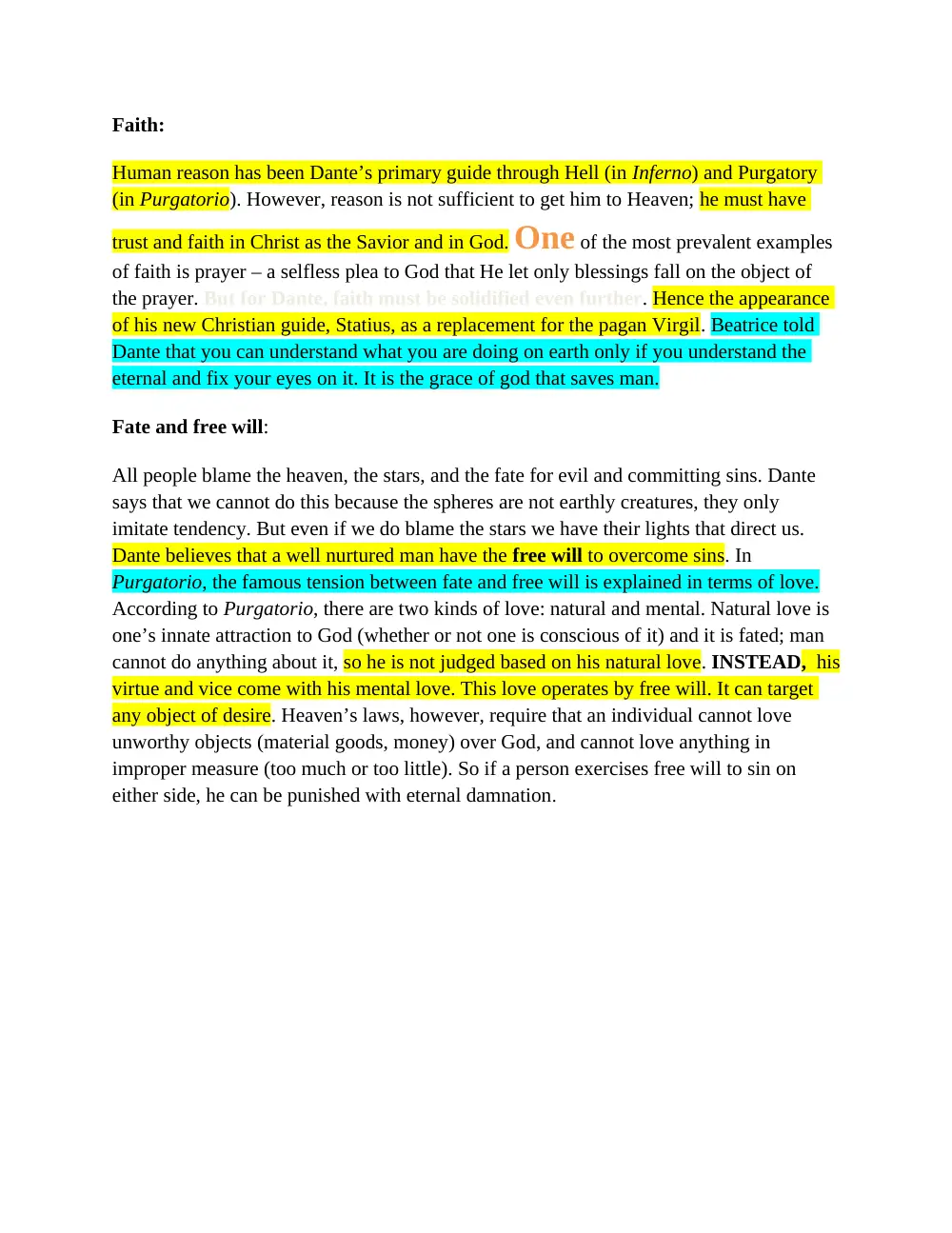
Faith:
Human reason has been Dante’s primary guide through Hell (in Inferno) and Purgatory
(in Purgatorio). However, reason is not sufficient to get him to Heaven; he must have
trust and faith in Christ as the Savior and in God. One of the most prevalent examples
of faith is prayer – a selfless plea to God that He let only blessings fall on the object of
the prayer. But for Dante, faith must be solidified even further. Hence the appearance
of his new Christian guide, Statius, as a replacement for the pagan Virgil. Beatrice told
Dante that you can understand what you are doing on earth only if you understand the
eternal and fix your eyes on it. It is the grace of god that saves man.
Fate and free will:
All people blame the heaven, the stars, and the fate for evil and committing sins. Dante
says that we cannot do this because the spheres are not earthly creatures, they only
imitate tendency. But even if we do blame the stars we have their lights that direct us.
Dante believes that a well nurtured man have the free will to overcome sins. In
Purgatorio, the famous tension between fate and free will is explained in terms of love.
According to Purgatorio, there are two kinds of love: natural and mental. Natural love is
one’s innate attraction to God (whether or not one is conscious of it) and it is fated; man
cannot do anything about it, so he is not judged based on his natural love. INSTEAD, his
virtue and vice come with his mental love. This love operates by free will. It can target
any object of desire. Heaven’s laws, however, require that an individual cannot love
unworthy objects (material goods, money) over God, and cannot love anything in
improper measure (too much or too little). So if a person exercises free will to sin on
either side, he can be punished with eternal damnation.