
CVSP 204 Final, Fall 2007
American University of Beirut · Modern and Contemporary Culture · 2 pages · Dr. Aida Arasoghli
More CVSP 204 files
Show the text of this final exam
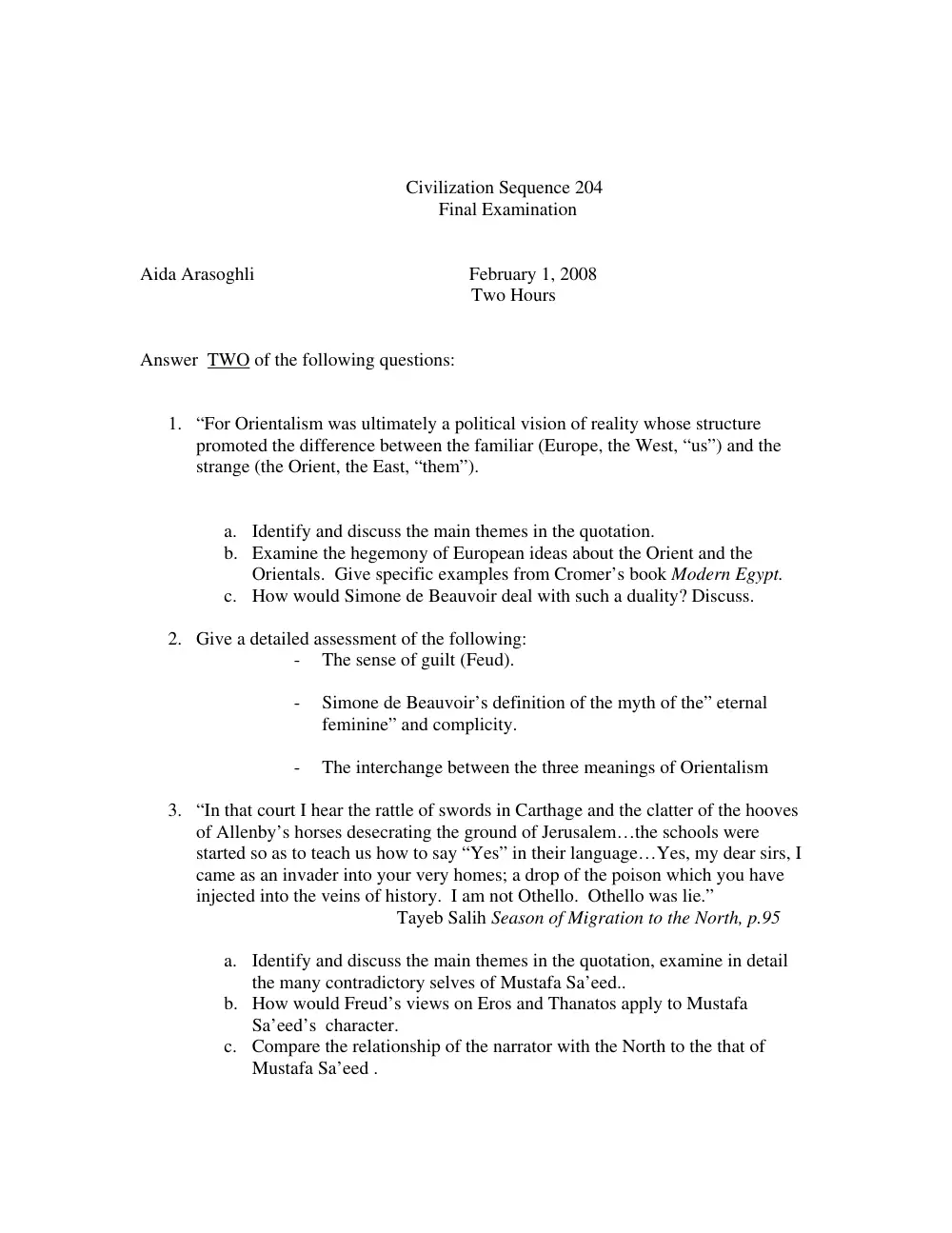
Civilization Sequence 204
Final Examination
Aida Arasoghli February 1, 2008
Two Hours
Answer TWO of the following questions:
1. “For Orientalism was ultimately a political vision of reality whose structure
promoted the difference between the familiar (Europe, the West, “us”) and the
strange (the Orient, the East, “them”).
a. Identify and discuss the main themes in the quotation.
b. Examine the hegemony of European ideas about the Orient and the
Orientals. Give specific examples from Cromer’s book Modern Egypt.
c. How would Simone de Beauvoir deal with such a duality? Discuss.
2. Give a detailed assessment of the following:
-
The sense of guilt (Feud).
-
Simone de Beauvoir’s definition of the myth of the” eternal
feminine” and complicity.
-
The interchange between the three meanings of Orientalism
3. “In that court I hear the rattle of swords in Carthage and the clatter of the hooves
of Allenby’s horses desecrating the ground of Jerusalem…the schools were
started so as to teach us how to say “Yes” in their language…Yes, my dear sirs, I
came as an invader into your very homes; a drop of the poison which you have
injected into the veins of history. I am not Othello. Othello was lie.”
Tayeb Salih Season of Migration to the North, p.95
a. Identify and discuss the main themes in the quotation, examine in detail
the many contradictory selves of Mustafa Sa’eed..
b. How would Freud’s views on Eros and Thanatos apply to Mustafa
Sa’eed’s character.
c. Compare the relationship of the narrator with the North to the that of
Mustafa Sa’eed .
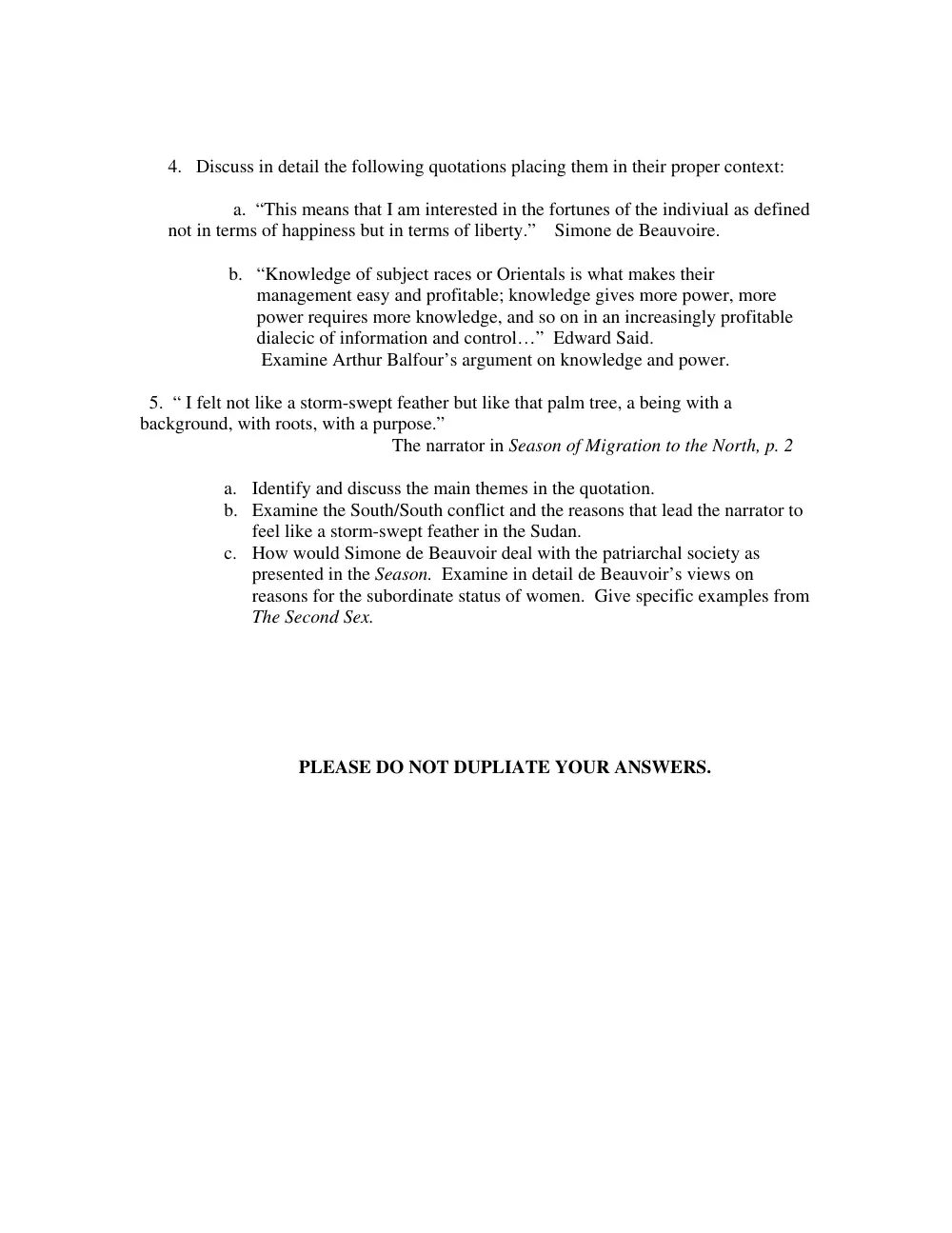
4. Discuss in detail the following quotations placing them in their proper context:
a. “This means that I am interested in the fortunes of the indiviual as defined
not in terms of happiness but in terms of liberty.” Simone de Beauvoire.
b. “Knowledge of subject races or Orientals is what makes their
management easy and profitable; knowledge gives more power, more
power requires more knowledge, and so on in an increasingly profitable
dialecic of information and control…” Edward Said.
Examine Arthur Balfour’s argument on knowledge and power.
5. “ I felt not like a storm-swept feather but like that palm tree, a being with a
background, with roots, with a purpose.”
The narrator in Season of Migration to the North, p. 2
a. Identify and discuss the main themes in the quotation.
b. Examine the South/South conflict and the reasons that lead the narrator to
feel like a storm-swept feather in the Sudan.
c. How would Simone de Beauvoir deal with the patriarchal society as
presented in the Season. Examine in detail de Beauvoir’s views on
reasons for the subordinate status of women. Give specific examples from
The Second Sex.
PLEASE DO NOT DUPLIATE YOUR ANSWERS.