
CVSP 207A Final, Fall 2003
American University of Beirut · Love Human and Divine · 2 pages
More CVSP 207A files
Show the text of this final exam
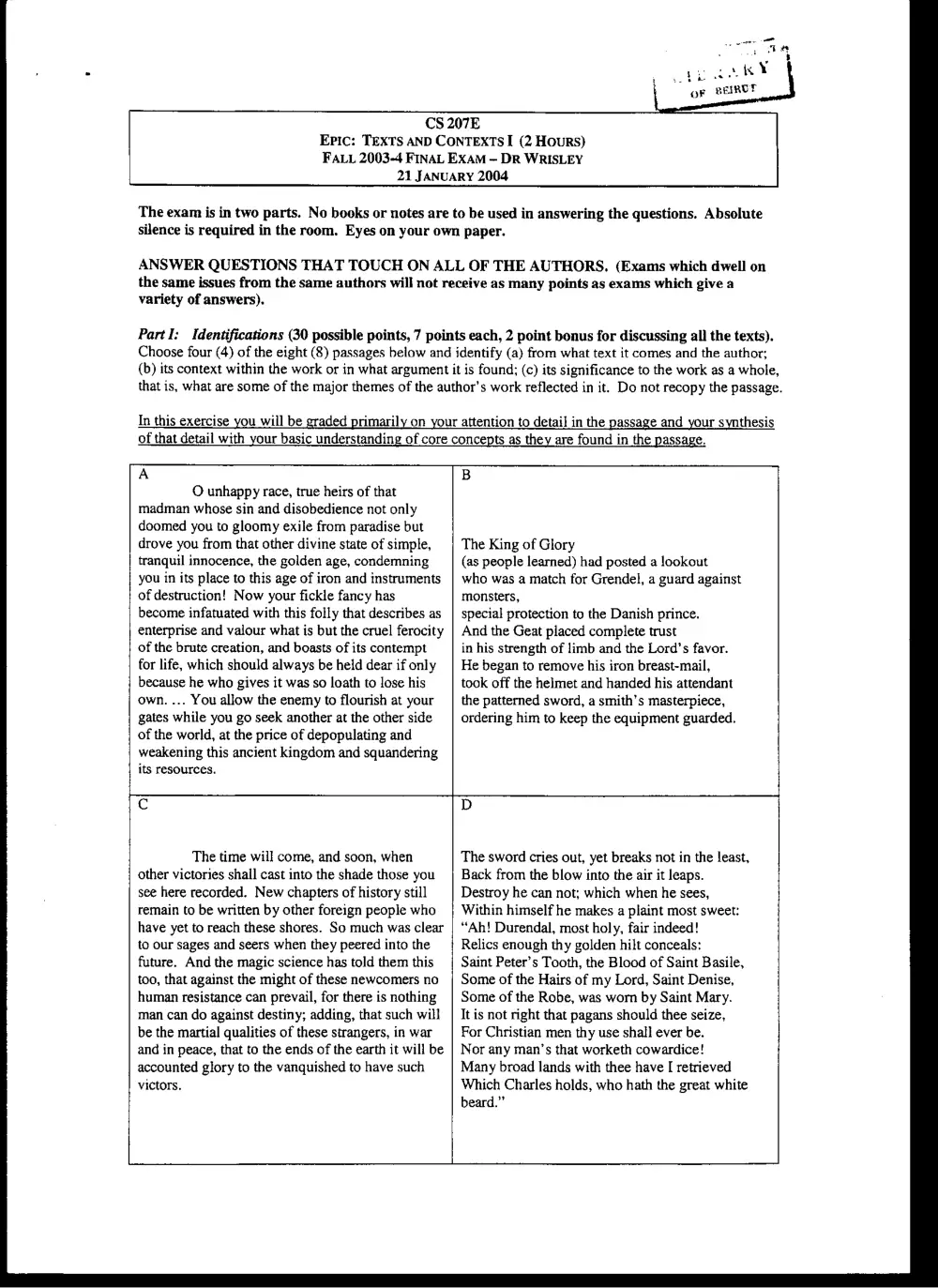
CS 207E
Epic: TEXTS AND CONTEXTS I (2 Hours)
FALL 2003-4 FINAL EXAM — DR WRISLEY
21 JANUARY 2004
The exam is in two parts. No books or notes are to be used in answering the questions. Absolute
silence is required in the room. Eyes on your own paper.
ANSWER QUESTIONS THAT TOUCH ON ALL OF THE AUTHORS, (Exams which dwell on
the same issues from the same authors will not receive as many points as exams which give a
variety of answers).
PartI: Identifications (30 possible points, 7 points each, 2 point bonus for discussing all the texts).
Choose four (4) of the eight (8) passages below and identify (a) from what text it comes and the author;
(b) its context within the work or in what argument it is found; (c) its significance to the work as a whole,
that is, what are some of the major themes of the author's work reflected in it. Do not recopy the passage.
In this exercise you will be graded primarily on your attention to detail in the passage and your synthesis
of that detail with your basic understanding of core concepts as they are found in the passage.
A
O unhappy race, true heirs of that
madman whose sin and disobedience not only
doomed you to gloomy exile from paradise but
drove you from that other divine state of simple,
tranquil innocence, the golden age, condemning
you in its place to this age of iron and instruments
of destruction! Now your fickle fancy has
become infatuated with this folly that describes as
enterprise and valour what is but the cruel ferocity
of the brute creation, and boasts of its contempt
for life, which should always be held dear if only
because he who gives it was so loath to lose his
own. ... You allow the enemy to flourish at your
gates while you go seek another at the other side
of the world, at the price of depopulating and
weakening this ancient kingdom and squandering
its resources.
B
The King of Glory
(as people learned) had posted a lookout
who was a match for Grendel, a guard against
monsters,
special protection to the Danish prince.
And the Geat placed complete trust
in his strength of limb and the Lord’s favor.
He began to remove his iron breast-mail,
took off the helmet and handed his attendant
the patterned sword, a smith’s masterpiece,
ordering him to keep the equipment guarded.
c
The time will come, and soon, when
other victories shall cast into the shade those you
see here recorded. New chapters of history still
remain to be written by other foreign people who
have yet to reach these shores. So much was clear
to our sages and seers when they peered into the
future. And the magic science has told them this
too, that against the might of these newcomers no
human resistance can prevail, for there is nothing
man can do against destiny; adding, that such will
be the martial qualities of these strangers, in war
and in peace, that to the ends of the earth it will be
accounted glory to the vanquished to have such
victors,
The sword cries out, yet breaks not in the least,
Back from the blow into the air it leaps.
Destroy he can not; which when he sees,
Within himself he makes a plaint most sweet:
“Ah! Durendal, most holy, fair indeed!
Relics enough thy golden hilt conceals:
Saint Peter’s Tooth, the Blood of Saint Basile,
Some of the Hairs of my Lord, Saint Denise,
Some of the Robe, was worn by Saint Mary.
It is not right that pagans should thee seize,
For Christian men thy use shall ever be.
Nor any man’s that worketh cowardice!
Many broad lands with thee have I retrieved
Which Charles holds, who hath the great white
beard.”
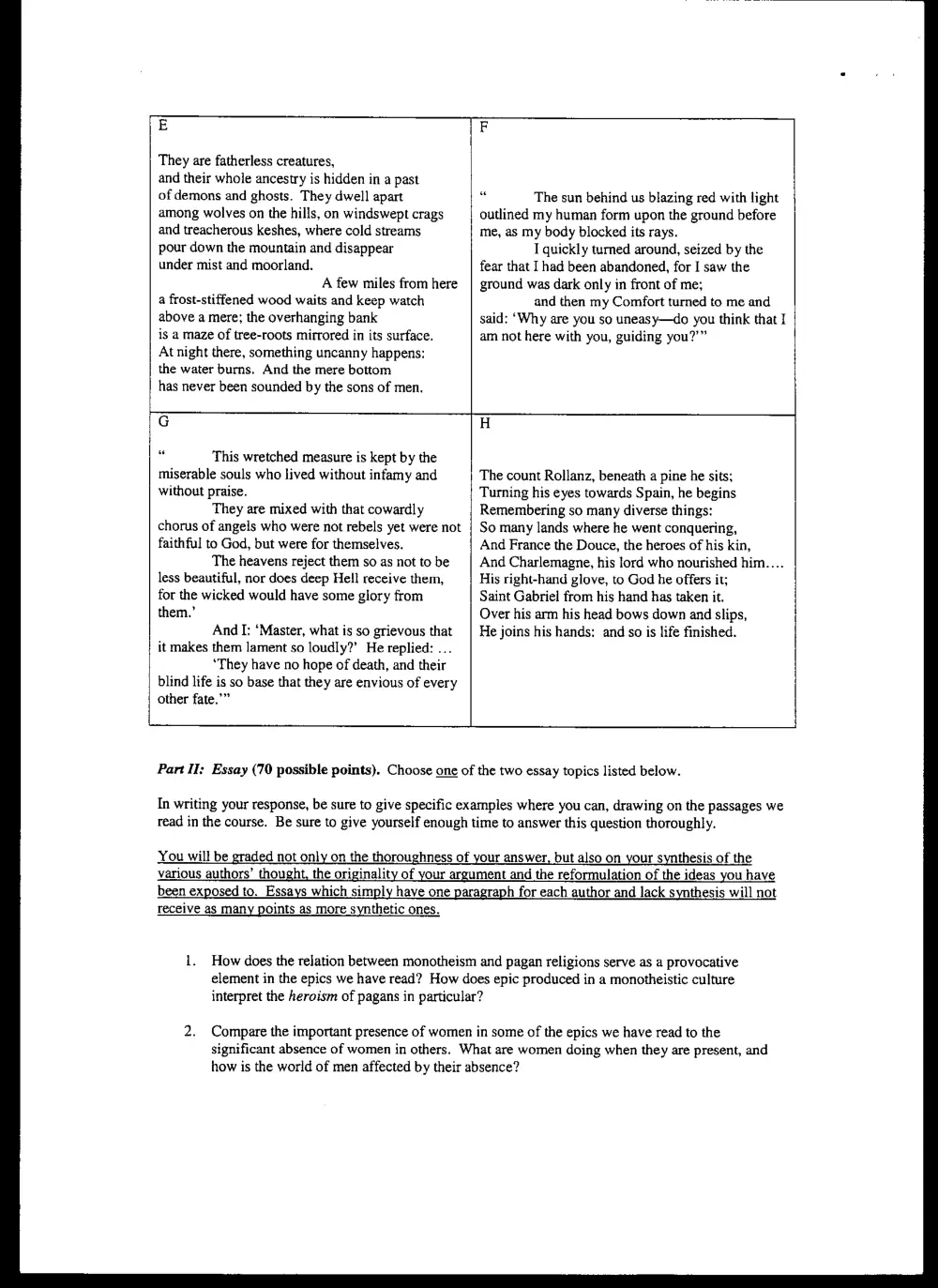
E
They are fatherless creatures,
and their whole ancestry is hidden in a past
of demons and ghosts. They dwell apart
among wolves on the hills, on windswept crags
and treacherous keshes, where cold streams
pour down the mountain and disappear
under mist and moorland.
A few miles from here
a frost-stiffened wood waits and keep watch
above a mere; the overhanging bank
is a maze of tree-roots mirrored in its surface.
At night there, something uncanny happens:
the water burns. And the mere bottom
has never been sounded by the sons of men.
“
The sun behind us blazing red with light
outlined my human form upon the ground before
me, as my body blocked its rays.
I quickly turned around, seized by the
fear that I had been abandoned, for I saw the
ground was dark only in front of me;
and then my Comfort turned to me and
said: ‘Why are you so uneasy—do you think that I
am not here with you, guiding you?’”
G
“ This wretched measure is kept by the
miserable souls who lived without infamy and
without praise.
They are mixed with that cowardly
chorus of angels who were not rebels yet were not
faithful to God, but were for themselves.
The heavens reject them so as not to be
less beautiful, nor does deep Hell receive them,
for the wicked would have some glory from
them.’
And I: ‘Master, what is so grievous that
it makes them lament so loudly?’ He replied: ...
‘They have no hope of death, and their
blind life is so base that they are envious of every
other fate.’”
The count Rollanz, beneath a pine he sits;
Turning his eyes towards Spain, he begins
Remembering so many diverse things:
So many lands where he went conquering,
And France the Douce, the heroes of his kin,
And Charlemagne, his lord who nourished him....
His right-hand glove, to God he offers it;
Saint Gabriel from his hand has taken it.
Over his arm his head bows down and slips,
He joins his hands: and so is life finished.
Part II: Essay (70 possible points). Choose one of the two essay topics listed below.
In writing your response, be sure to give specific examples where you can, drawing on the passages we
read in the course. Be sure to give yourself enough time to answer this question thoroughly.
You will be graded not only on the thoroughness of your answer, but also on your synthesis of the
yarious authors’ thought, the originality of your argument and the reformulation of the ideas you have
been exposed to. Essays which simply have one paragraph for each author and lack synthesis will not
receive as many points as more synthetic ones.
How does the relation between monotheism and pagan religions serve as a provocative
element in the epics we have read? How does epic produced in a monotheistic culture
interpret the heroism of pagans in particular?
Compare the important presence of women in some of the epics we have read to the
significant absence of women in others. What are women doing when they are present, and
how is the world of men affected by their absence?