
CVSP 208A Final, Spring 2004
American University of Beirut · Love in the Modern and Contemporary Worlds · 2 pages

More CVSP 208A files
Show the text of this final exam
CVSP 208E
EPIC: TEXTS AND CONTEXTS II
FINAL EXAM (2 Hours)
DRS MALLETTE AND WRISLEY
2 JUNE 2004
This exam is in two parts. No books or notes are to be used in answering the questions. Absolute
silence is required in the room. Eyes on your own paper. You will have two hours to complete the
exam.
Part I: Textual analysis (40 possible points). Choose one of the two questions below. Both of these
questions will appear on the exam. You will choose one of the two, and write an essay in response,
Please compare and contrast the two quotations.
© What is the point the author is making in this passage? What are the differences and
similarities between these two authors’ discussion of parallel topics?
What are some of the specific, relevant details in the text that illustrate the authors’ point?
How do these passages illustrate general themes in the authors’ texts?
What kinds of significant conclusions can you form by comparing the texts?
What can you say about the texts that we did not say in class?
in this exercise you will be graded primarily on your attention to detail in the passage and your synthesis of
that detail with your basic understanding of core concepts as they are found in the passage.
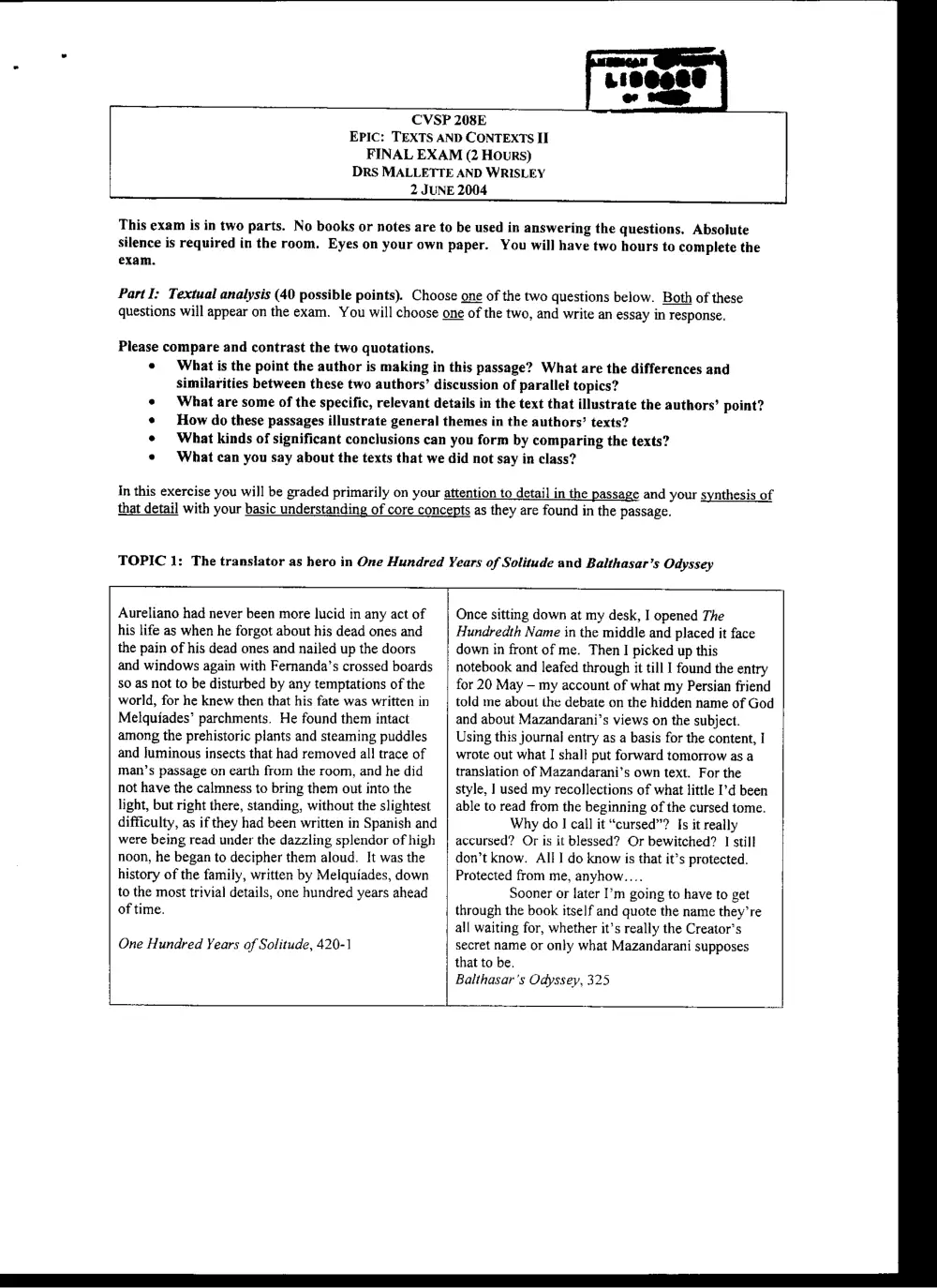
TOPIC 1: The translator as hero in One Hundred Years of Solitude and Balthasar’s Odyssey
Aureliano had never been more lucid in any act of
his life as when he forgot about his dead ones and
the pain of his dead ones and nailed up the doors
and windows again with Fernanda’s crossed boards
SO as not to be disturbed by any temptations of the
world, for he knew then that his fate was written in
Melquiades’ parchments. He found them intact
among the prehistoric plants and steaming puddles
and Juminous insects that had removed all trace of
man’s passage on earth from the room, and he did
not have the calmness to bring them out into the
light, but right there, standing, without the slightest
difficulty, as if they had been written in Spanish and
were being read under the dazzling splendor of high
noon, he began to decipher them aloud. It was the
history of the family, written by Melquiades, down
to the most trivial details, one hundred years ahead
of time.
One Hundred Years of Solitude, 420-1
Once sitting down at my desk, I opened The
Hundredth Name in the middle and placed it face
down in front of me. Then | picked up this
notebook and leafed through it till 1 found the entry
for 20 May — my account of what my Persian friend
told me about the debate on the hidden name of God
and about Mazandarani’s views on the subject.
Using this journal entry as a basis for the content, I
wrote out what I shall put forward tomorrow as a
translation of Mazandarani’s own text. For the
style, I used my recollections of what little I’d been
able to read from the beginning of the cursed tome.
Why do I call it “cursed”? Is it really
accursed? Or is it blessed? Or bewitched? | still
don’t know. All I do know is that it’s protected.
Protected from me, anyhow....
Sooner or later I’m going to have to get
through the book itself and quote the name they’re
all waiting for, whether it’s really the Creator’s
secret name or only what Mazandarani supposes
that to be.
Balthasar’s Odyssey, 325
swansd
Ota |
©
ee
TOPIC
? TheNers a3 outsider in One Hundred Years of Solitude and On the Road
The startling thing about her simplifying instinct
was that the more she did away with fashion in
search of a comfort and the more she passed over
conventions as she obeyed spontaneity, the more
disturbing her incredible beauty became and the
more provocative she became to men ,.. Everytime
she appeared in the dining room, against Ursula’s
orders, she cause a panic of exasperation among the
outsiders. It was all too evident that she was
completely naked underneath her crude nightshirt
and no one could understand that her shaved and
perfect skull was not some kind of a challenge ...
Men expert in the disturbances of love, experienced
all over the world, stated that they never suffered an
anxiety similar to the one produced by the natural
smell of Remedios the Beauty.
One Hundred Years of Solitude, 236-237
[T]hey all sat around looking at Dean with lowered
and hating eyes, and he stood on the carpet in the
middle of them and giggled — he just giggled. He
made a little dance. His bandage was getting dirtier
all the time; it began to flop and unroll. [ suddenly
realized that Dean, by virtue of his enormous series
of sins, was becoming the Idiot, the Imbecile, the
Saint of the lot... There were earlier days in Denver
when Dean has everybody sit in the dark with the
girls and just talked, and talked, and talked, with a
voice that was once hypnotic and strange and was
said to make the girls come across by sheer force of
persuasion and the content of what he said. This
was when he was fifteen, sixteen. Now his disciples
were married and the wives of his disciples had him
on the carpet for the sexuality and the Jife he had
helped bring into being.
On the Road, 176-77
Part I: Essay (60 possible points). There are three essay questions listed below. In the second section,
you will have to answer one essay question. Two of the questions given below will appear on the exam,
and you will choose one of them to answer.
In writing your response be sure to give specific examples where you can, drawn from the passages we read
in the course. Be sure to give yourself enough time to answer this question thoroughly.
You will be graded not only on the thoroughness of your answer, but also on your synthesis of the various
authors’ thought, the originality of your argument and the reformulation of the ideas you have been
exposed to. Essays which simply have one paragraph for each author and lack synthesis will not receive as
many points as more synthetic ones.
1 How does epic written by authors from developing nations, or from minority cultures within first
world nations, differ from traditional, classic epics? /s magic realism really epic?
2 How do the tensions between various peoples contribute to the character of epic in the modern
world? Take, for example, the Italians and the foreigners (Jacopo Ortis), blacks and whites (Beloved),
European Americans, Native Americans and Mexicans (Stagecoach). You may write about any of the texts.