
CVSP 241 Final, Spring 1998
American University of Beirut · Introduction to the Art of Music History II · 1 page
Stuck on a question? A tutor can walk you through it.
More CVSP 241 files
Show the text of this final exam
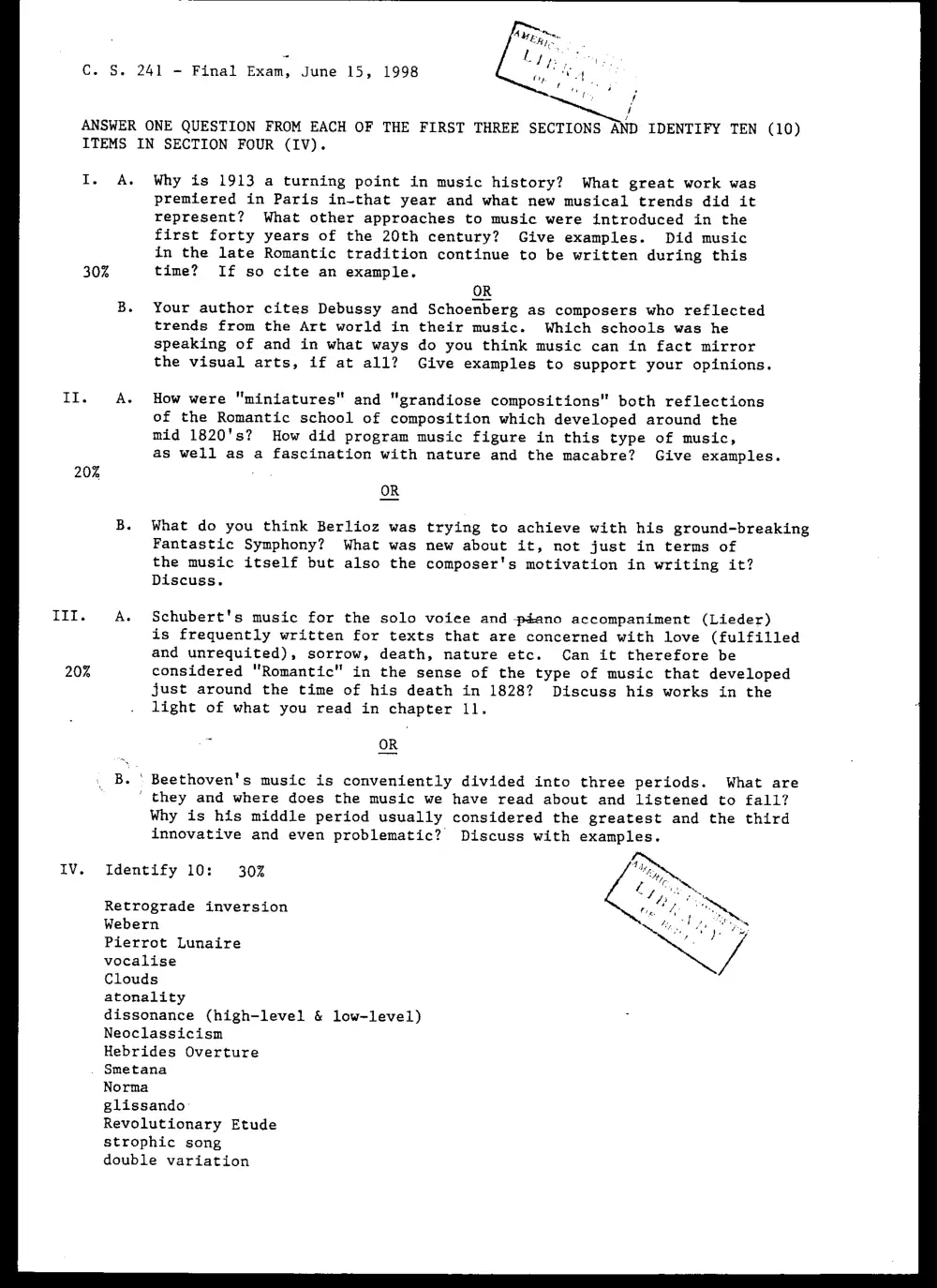
C. S. 241 - Final Exam, June 15, 1998
ANSWER ONE QUESTION FROM EACH OF THE FIRST THREE SECTIONS AND IDENTIFY TEN (10)
ITEMS IN SECTION FOUR (IV).
I. A. Why is 1913 a turning point in music history? What great work was
premiered in Paris in-that year and what new musical trends did it
represent? What other approaches to music were introduced in the
first forty years of the 20th century? Give examples. Did music
in the late Romantic tradition continue to be written during this
time? If so cite an example.
OR
Your author cites Debussy and Schoenberg as composers who reflected
trends from the Art world in their music. Which schools was he
speaking of and in what ways do you think music can in fact mirror
the visual arts, if at all? Give examples to support your opinions.
How were "miniatures" and "grandiose compositions" both reflections
of the Romantic school of composition which developed around the
mid 1820's? How did program music figure in this type of music,
as well as a fascination with nature and the macabre? Give examples.
OR
What do you think Berlioz was trying to achieve with his ground-breaking
Fantastic Symphony? What was new about it, not just in terms of
the music itself but also the composer's motivation in writing it?
Discuss.
Schubert's music for the solo voiee and piano accompaniment (Lieder)
is frequently written for texts that are concerned with love (fulfilled
and unrequited), sorrow, death, nature etc. Can it therefore be
considered "Romantic" in the sense of the type of music that developed
just around the time of his death in 1828? Discuss his works in the
light of what you read in chapter ll.
OR
B. ‘ Beethoven's music is conveniently divided into three periods. What are
: ‘ they and where does the music we have read about and listened to fall?
Why is his middle period usually considered the greatest and the third
innovative and even problematic? Discuss with examples.
Identify 10: 30%
Retrograde inversion
Webern
Pierrot Lunaire
vocalise
Clouds
atonality
dissonance (high-level & low-level)
Neoclassicism
Hebrides Overture
Smetana
Norma
glissando
Revolutionary Etude
strophic song
double variation