
ECON 203 Problems Solution Manual, Fall 2011
American University of Beirut · Survey of Economics · 1178 pages · with solution
Showing the first 10 of 1178 pages. Download the PDF to see all of it.
More ECON 203 files
Show the text of this problems
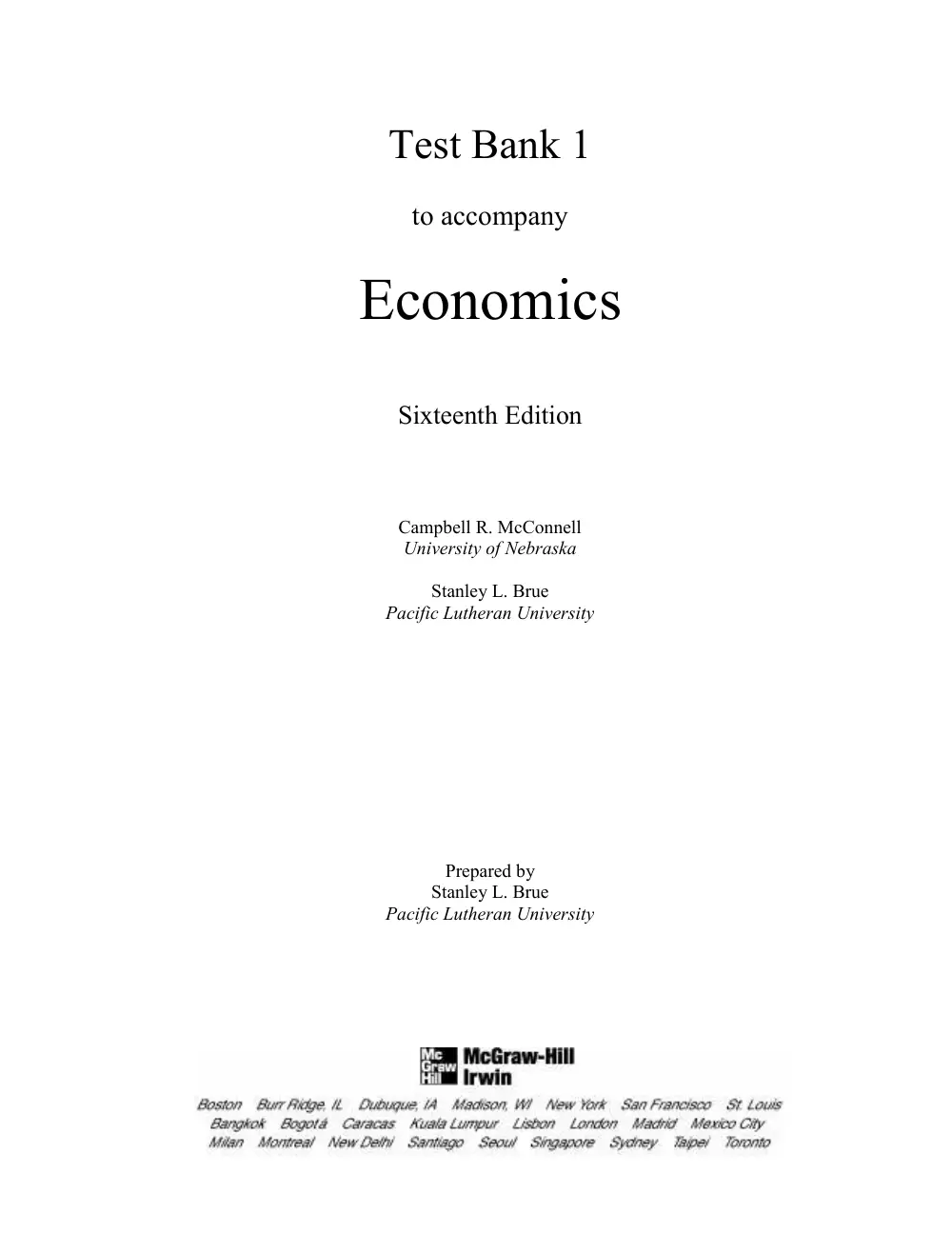
Test Bank 1
to accompany
Economics
Sixteenth Edition
Campbell R. McConnell
University of Nebraska
Stanley L. Brue
Pacific Lutheran University
Prepared by
Stanley L. Brue
Pacific Lutheran University
www.mhhe.com
Test Bank 1 to accompany
ECONOMICS
Campbell R. McConnell and Stanley L. Brue
Published by McGraw-Hill, an imprint of The McGraw-Hill Companies, Inc., 1221 Avenue of the Americas,
New York, NY 10020. Copyright 2005 by The McGraw-Hill Companies, Inc.
All rights reserved.
The contents, or parts thereof, may be reproduced in print form solely for classroom use with
ECONOMICS
provided such reproductions bear copyright notice, but may not be reproduced in any other form or for any
other purpose without the prior written consent of The McGraw-Hill Companies, Inc., including, but not limited
to, in any network or other electronic storage or transmission, or broadcast for distance learning.
1 2 3 4 5 6 7 8 9 0 Text printer code/Cover printer code 0 9 8 7 6 5 4
ISBN 0-07-288479-7
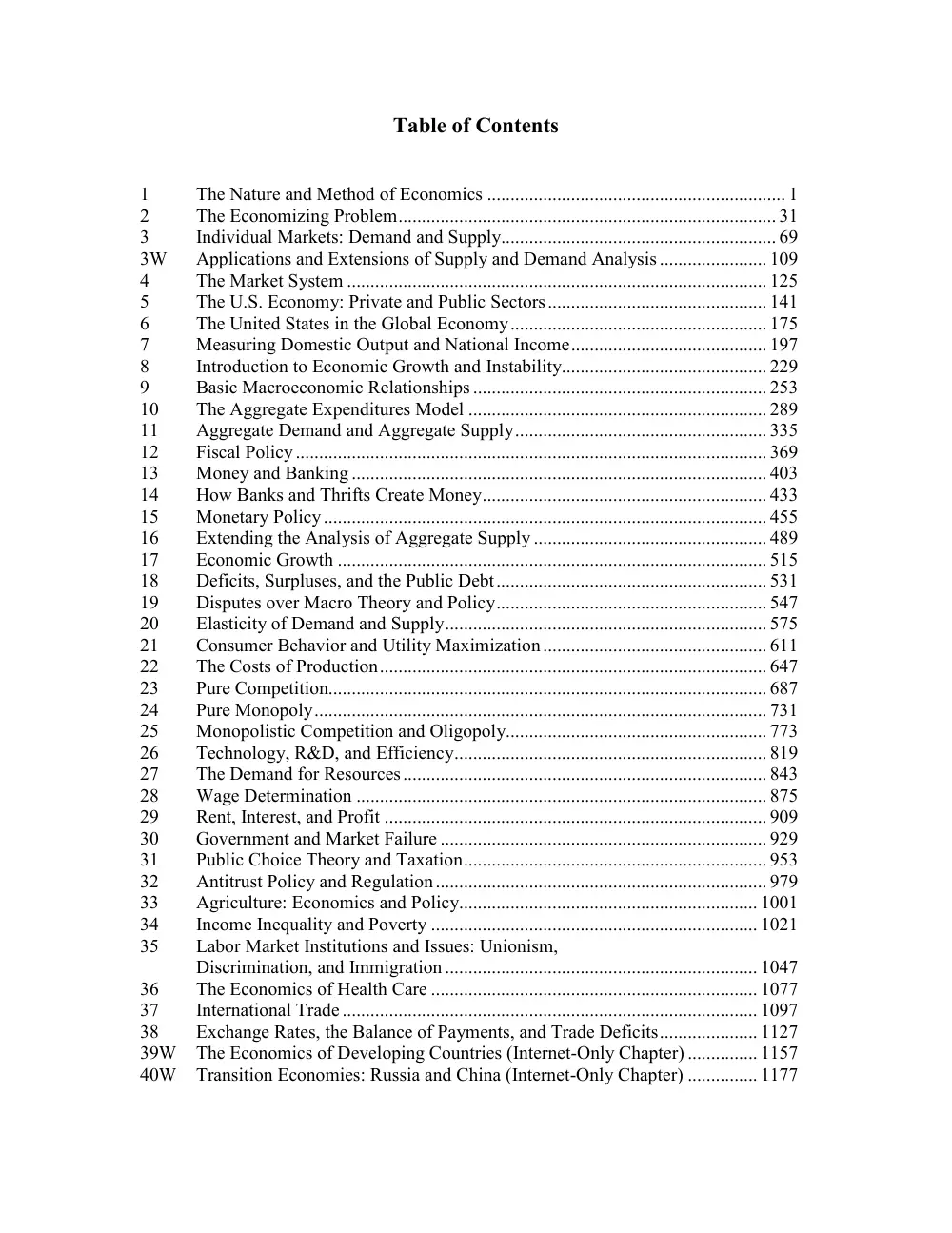
Table of Contents
1
The Nature and Method of Economics ................................................................ 1
2
The Economizing Problem................................................................................. 31
3
Individual Markets: Demand and Supply........................................................... 69
3W
Applications and Extensions of Supply and Demand Analysis ....................... 109
4
The Market System .......................................................................................... 125
5
The U.S. Economy: Private and Public Sectors............................................... 141
6
The United States in the Global Economy....................................................... 175
7
Measuring Domestic Output and National Income.......................................... 197
8
Introduction to Economic Growth and Instability............................................ 229
9
Basic Macroeconomic Relationships ............................................................... 253
10
The Aggregate Expenditures Model ................................................................ 289
11
Aggregate Demand and Aggregate Supply...................................................... 335
12
Fiscal Policy..................................................................................................... 369
13
Money and Banking ......................................................................................... 403
14
How Banks and Thrifts Create Money............................................................. 433
15
Monetary Policy............................................................................................... 455
16
Extending the Analysis of Aggregate Supply .................................................. 489
17
Economic Growth ............................................................................................ 515
18
Deficits, Surpluses, and the Public Debt.......................................................... 531
19
Disputes over Macro Theory and Policy.......................................................... 547
20
Elasticity of Demand and Supply..................................................................... 575
21
Consumer Behavior and Utility Maximization................................................ 611
22
The Costs of Production................................................................................... 647
23
Pure Competition.............................................................................................. 687
24
Pure Monopoly................................................................................................. 731
25
Monopolistic Competition and Oligopoly........................................................ 773
26
Technology, R&D, and Efficiency................................................................... 819
27
The Demand for Resources.............................................................................. 843
28
Wage Determination ........................................................................................ 875
29
Rent, Interest, and Profit .................................................................................. 909
30
Government and Market Failure ...................................................................... 929
31
Public Choice Theory and Taxation................................................................. 953
32
Antitrust Policy and Regulation....................................................................... 979
33
Agriculture: Economics and Policy................................................................ 1001
34
Income Inequality and Poverty ...................................................................... 1021
35
Labor Market Institutions and Issues: Unionism,
Discrimination, and Immigration ................................................................... 1047
36
The Economics of Health Care ...................................................................... 1077
37
International Trade......................................................................................... 1097
38
Exchange Rates, the Balance of Payments, and Trade Deficits..................... 1127
39W
The Economics of Developing Countries (Internet-Only Chapter) ............... 1157
40W
Transition Economies: Russia and China (Internet-Only Chapter) ............... 1177
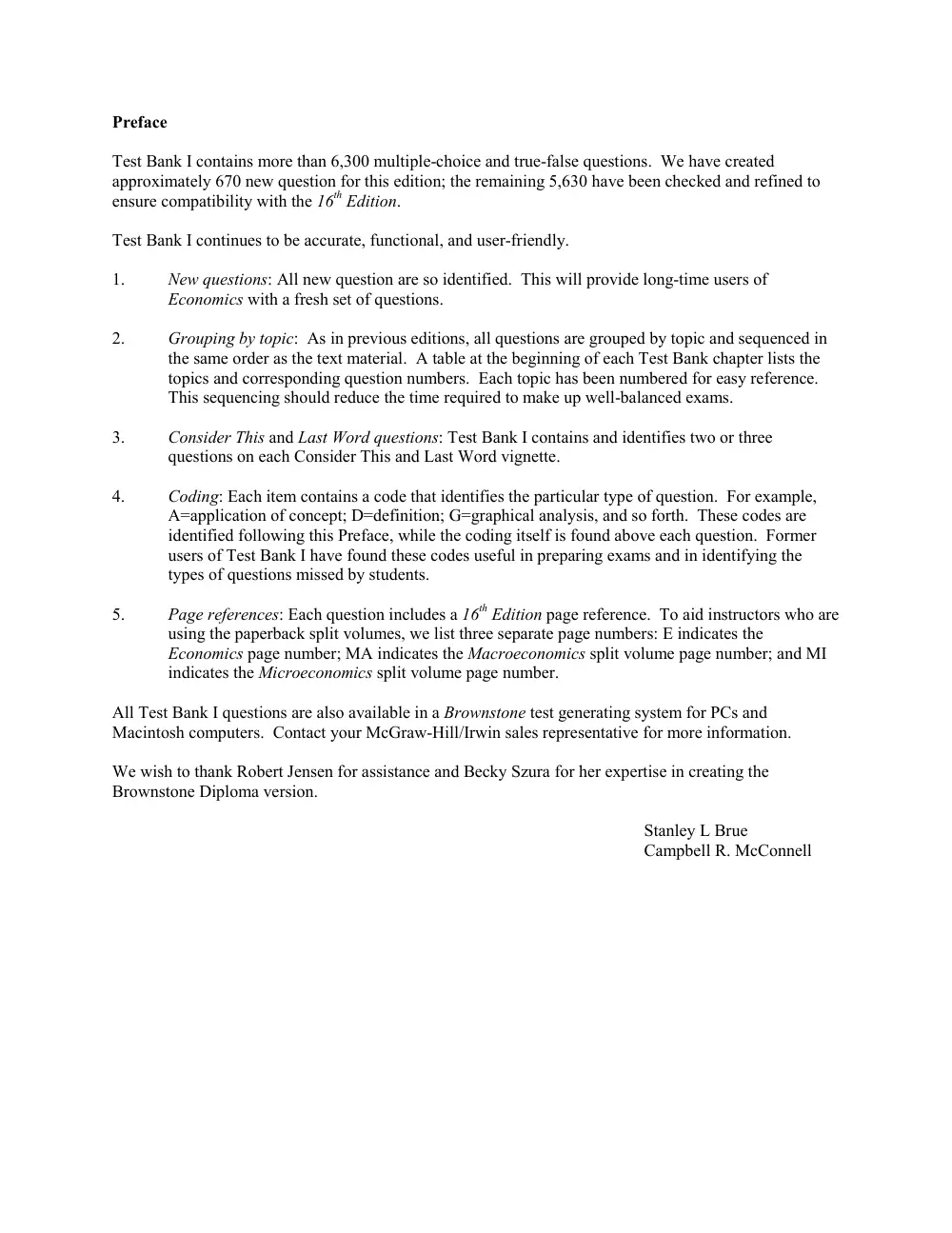
Preface
Test Bank I contains more than 6,300 multiple-choice and true-false questions. We have created
approximately 670 new question for this edition; the remaining 5,630 have been checked and refined to
ensure compatibility with the 16th Edition.
Test Bank I continues to be accurate, functional, and user-friendly.
1.
New questions: All new question are so identified. This will provide long-time users of
Economics with a fresh set of questions.
2.
Grouping by topic: As in previous editions, all questions are grouped by topic and sequenced in
the same order as the text material. A table at the beginning of each Test Bank chapter lists the
topics and corresponding question numbers. Each topic has been numbered for easy reference.
This sequencing should reduce the time required to make up well-balanced exams.
3.
Consider This and Last Word questions: Test Bank I contains and identifies two or three
questions on each Consider This and Last Word vignette.
4.
Coding: Each item contains a code that identifies the particular type of question. For example,
A=application of concept; D=definition; G=graphical analysis, and so forth. These codes are
identified following this Preface, while the coding itself is found above each question. Former
users of Test Bank I have found these codes useful in preparing exams and in identifying the
types of questions missed by students.
5.
Page references: Each question includes a 16th Edition page reference. To aid instructors who are
using the paperback split volumes, we list three separate page numbers: E indicates the
Economics page number; MA indicates the Macroeconomics split volume page number; and MI
indicates the Microeconomics split volume page number.
All Test Bank I questions are also available in a Brownstone test generating system for PCs and
Macintosh computers. Contact your McGraw-Hill/Irwin sales representative for more information.
We wish to thank Robert Jensen for assistance and Becky Szura for her expertise in creating the
Brownstone Diploma version.
Stanley L Brue
Campbell R. McConnell
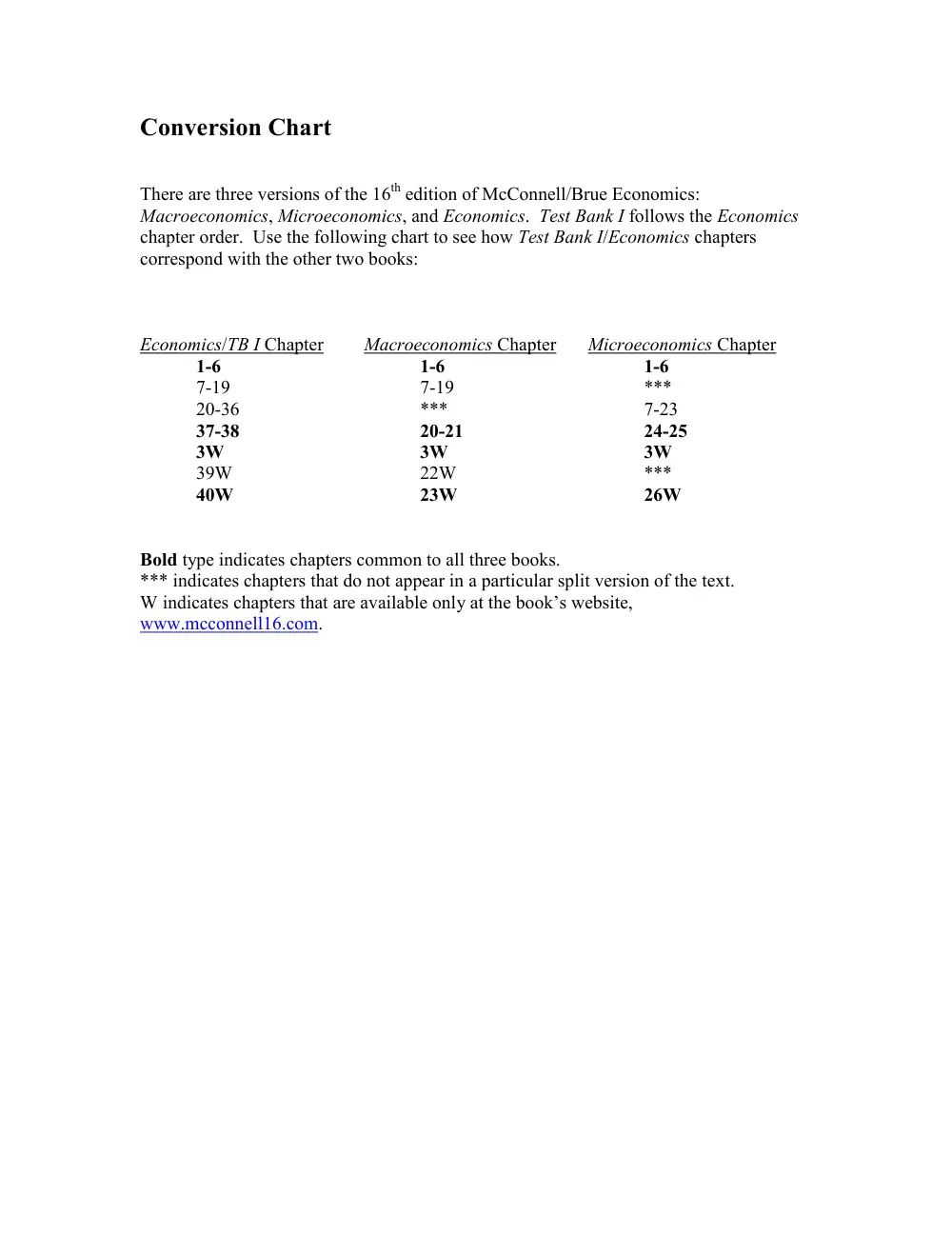
Conversion Chart
There are three versions of the 16th edition of McConnell/Brue Economics:
Macroeconomics, Microeconomics, and Economics. Test Bank I follows the Economics
chapter order. Use the following chart to see how Test Bank I/Economics chapters
correspond with the other two books:
Economics/TB I Chapter
Macroeconomics Chapter
Microeconomics Chapter
1-6
1-6
1-6
7-19
7-19
***
20-36
***
7-23
37-38
20-21
24-25
3W
3W
3W
39W
22W
***
40W
23W
26W
Bold type indicates chapters common to all three books.
*** indicates chapters that do not appear in a particular split version of the text.
W indicates chapters that are available only at the book’s website,
www.mcconnell16.com.
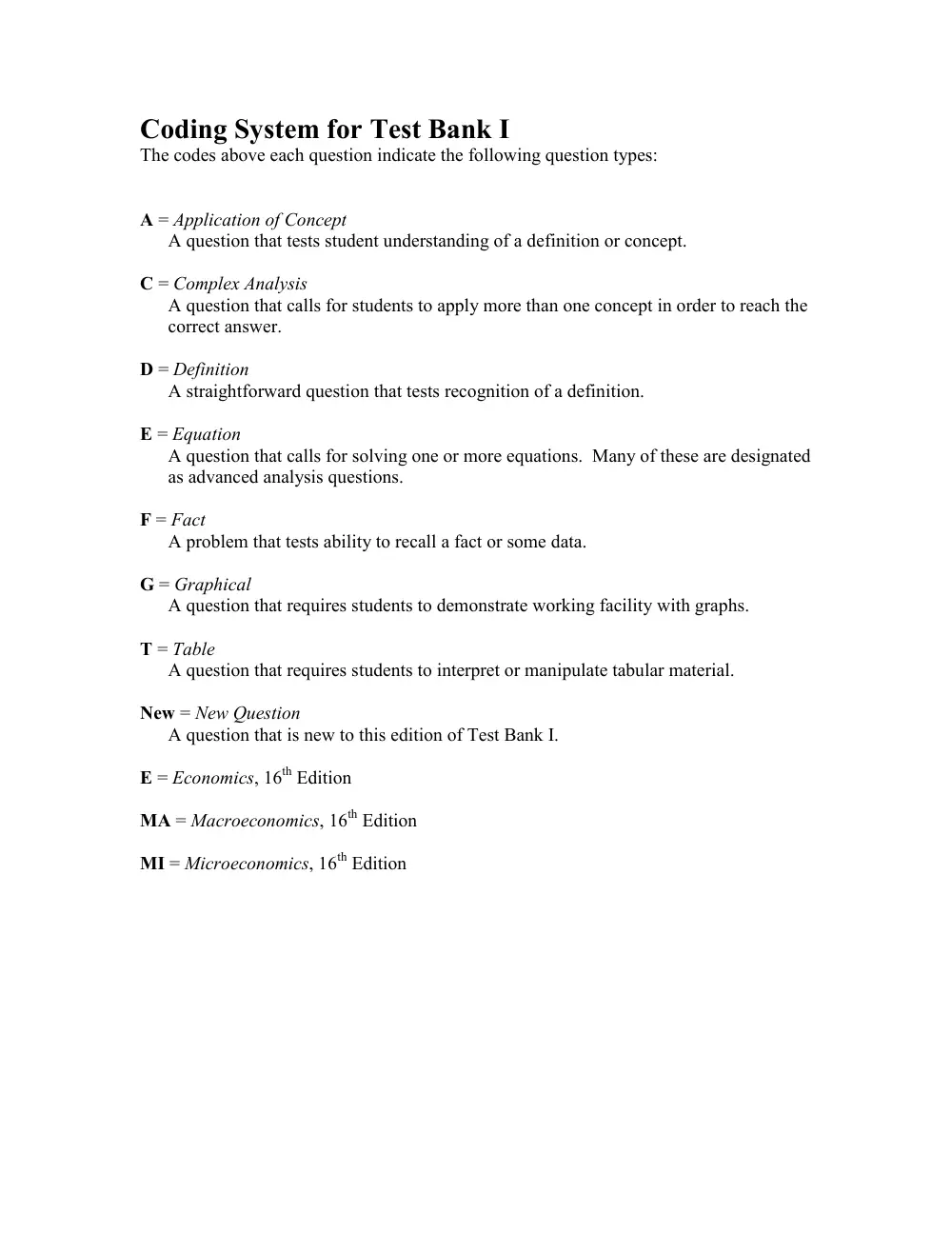
Coding System for Test Bank I
The codes above each question indicate the following question types:
A = Application of Concept
A question that tests student understanding of a definition or concept.
C = Complex Analysis
A question that calls for students to apply more than one concept in order to reach the
correct answer.
D = Definition
A straightforward question that tests recognition of a definition.
E = Equation
A question that calls for solving one or more equations. Many of these are designated
as advanced analysis questions.
F = Fact
A problem that tests ability to recall a fact or some data.
G = Graphical
A question that requires students to demonstrate working facility with graphs.
T = Table
A question that requires students to interpret or manipulate tabular material.
New = New Question
A question that is new to this edition of Test Bank I.
E = Economics, 16th Edition
MA = Macroeconomics, 16th Edition
MI = Microeconomics, 16th Edition
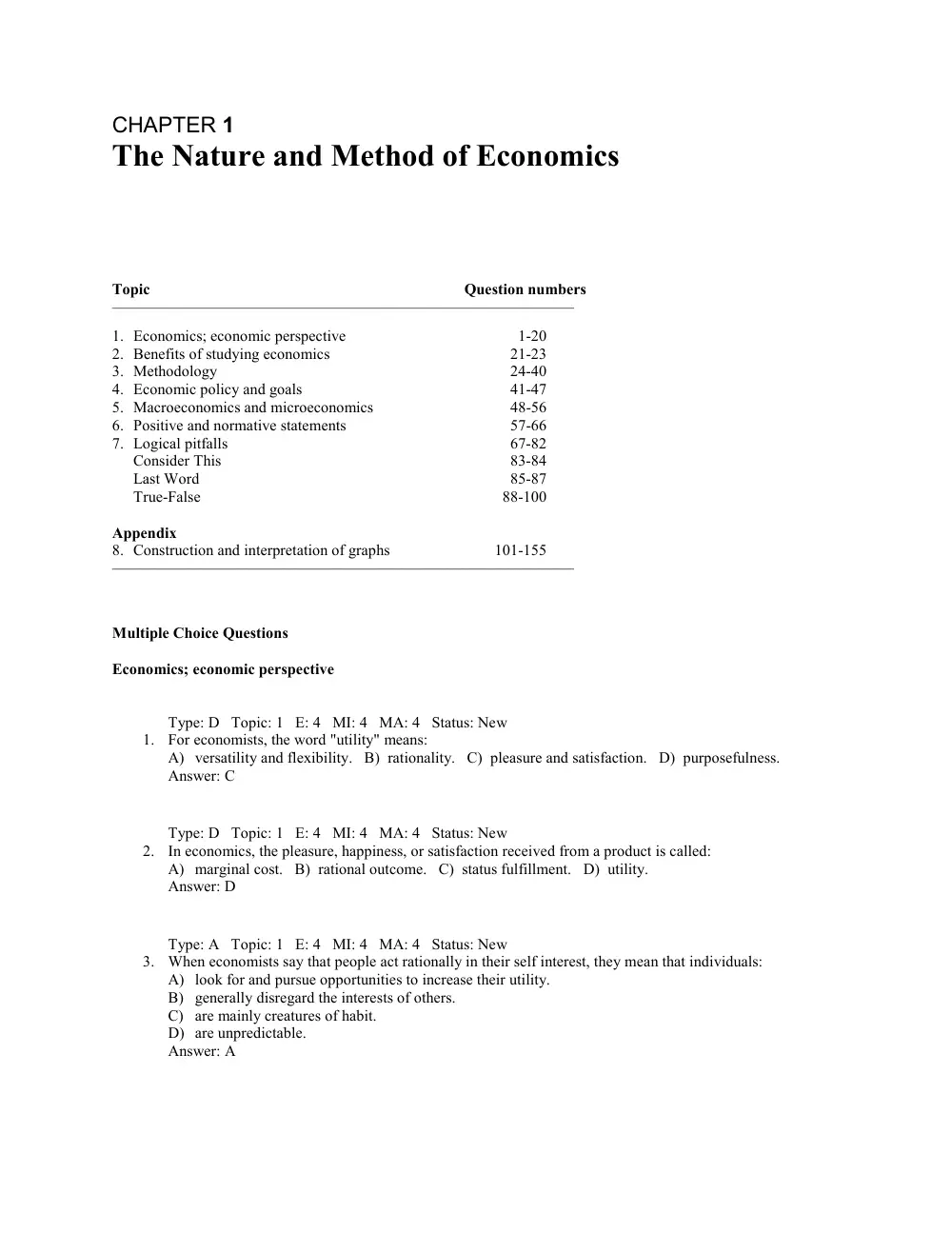
CHAPTER 1
The Nature and Method of Economics
Topic
Question numbers
___________________________________________________________________________________________________
1. Economics; economic perspective
1-20
2. Benefits of studying economics
21-23
3. Methodology
24-40
4. Economic policy and goals
41-47
5. Macroeconomics and microeconomics
48-56
6. Positive and normative statements
57-66
7. Logical pitfalls
67-82
Consider This
83-84
Last Word
85-87
True-False
88-100
Appendix
8. Construction and interpretation of graphs
101-155
___________________________________________________________________________________________________
Multiple Choice Questions
Economics; economic perspective
Type: D Topic: 1 E: 4 MI: 4 MA: 4 Status: New
1. For economists, the word "utility" means:
A) versatility and flexibility. B) rationality. C) pleasure and satisfaction. D) purposefulness.
Answer: C
Type: D Topic: 1 E: 4 MI: 4 MA: 4 Status: New
2. In economics, the pleasure, happiness, or satisfaction received from a product is called:
A) marginal cost. B) rational outcome. C) status fulfillment. D) utility.
Answer: D
Type: A Topic: 1 E: 4 MI: 4 MA: 4 Status: New
3. When economists say that people act rationally in their self interest, they mean that individuals:
A) look for and pursue opportunities to increase their utility.
B) generally disregard the interests of others.
C) are mainly creatures of habit.
D) are unpredictable.
Answer: A
Chapter 1: The Nature and Method of Economics
McConnell/Brue: Economics, 16/e Page 2
Type: A Topic: 1 E: 3 MI: 3 MA: 3
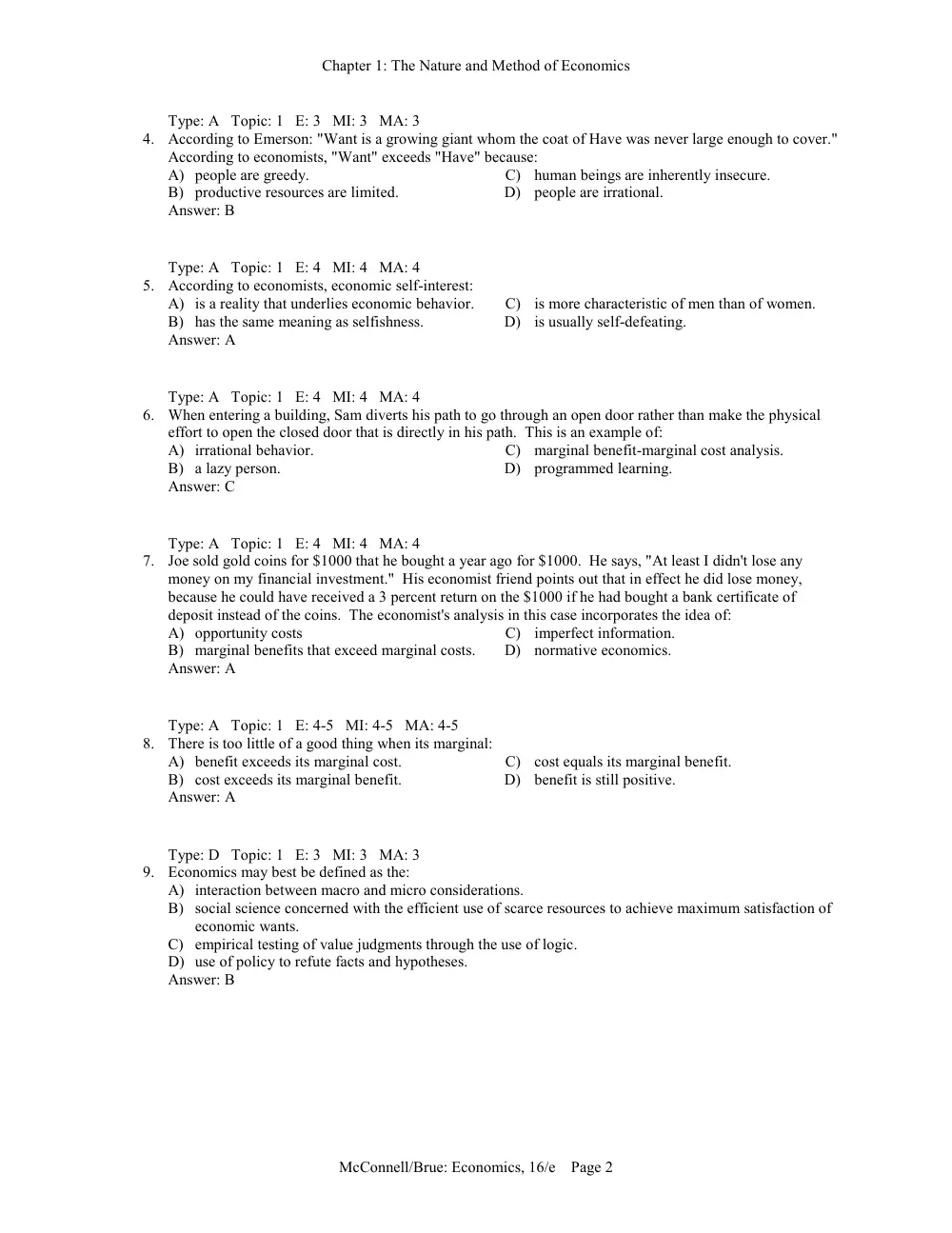
4. According to Emerson: "Want is a growing giant whom the coat of Have was never large enough to cover."
According to economists, "Want" exceeds "Have" because:
A) people are greedy.
C) human beings are inherently insecure.
B) productive resources are limited.
D) people are irrational.
Answer: B
Type: A Topic: 1 E: 4 MI: 4 MA: 4
5. According to economists, economic self-interest:
A) is a reality that underlies economic behavior.
C) is more characteristic of men than of women.
B) has the same meaning as selfishness.
D) is usually self-defeating.
Answer: A
Type: A Topic: 1 E: 4 MI: 4 MA: 4
6. When entering a building, Sam diverts his path to go through an open door rather than make the physical
effort to open the closed door that is directly in his path. This is an example of:
A) irrational behavior.
C) marginal benefit-marginal cost analysis.
B) a lazy person.
D) programmed learning.
Answer: C
Type: A Topic: 1 E: 4 MI: 4 MA: 4
7. Joe sold gold coins for $1000 that he bought a year ago for $1000. He says, "At least I didn't lose any
money on my financial investment." His economist friend points out that in effect he did lose money,
because he could have received a 3 percent return on the $1000 if he had bought a bank certificate of
deposit instead of the coins. The economist's analysis in this case incorporates the idea of:
A) opportunity costs
C) imperfect information.
B) marginal benefits that exceed marginal costs.
D) normative economics.
Answer: A
Type: A Topic: 1 E: 4-5 MI: 4-5 MA: 4-5
8. There is too little of a good thing when its marginal:
A) benefit exceeds its marginal cost.
C) cost equals its marginal benefit.
B) cost exceeds its marginal benefit.
D) benefit is still positive.
Answer: A
Type: D Topic: 1 E: 3 MI: 3 MA: 3
9. Economics may best be defined as the:
A) interaction between macro and micro considerations.
B) social science concerned with the efficient use of scarce resources to achieve maximum satisfaction of
economic wants.
C) empirical testing of value judgments through the use of logic.
D) use of policy to refute facts and hypotheses.
Answer: B
Chapter 1: The Nature and Method of Economics
McConnell/Brue: Economics, 16/e Page 3
Type: D Topic: 1 E: 3 MI: 3 MA: 3
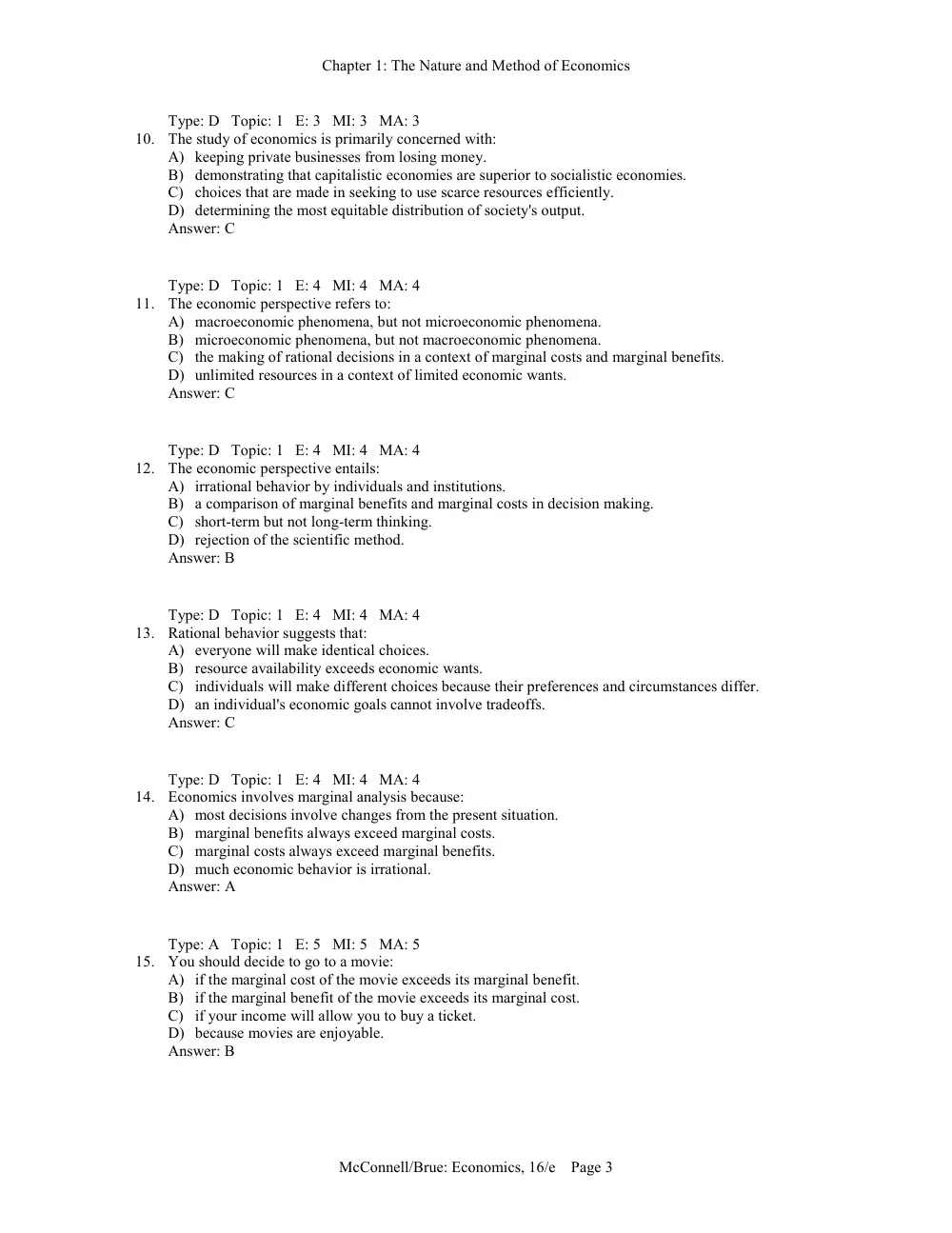
10. The study of economics is primarily concerned with:
A) keeping private businesses from losing money.
B) demonstrating that capitalistic economies are superior to socialistic economies.
C) choices that are made in seeking to use scarce resources efficiently.
D) determining the most equitable distribution of society's output.
Answer: C
Type: D Topic: 1 E: 4 MI: 4 MA: 4
11. The economic perspective refers to:
A) macroeconomic phenomena, but not microeconomic phenomena.
B) microeconomic phenomena, but not macroeconomic phenomena.
C) the making of rational decisions in a context of marginal costs and marginal benefits.
D) unlimited resources in a context of limited economic wants.
Answer: C
Type: D Topic: 1 E: 4 MI: 4 MA: 4
12. The economic perspective entails:
A) irrational behavior by individuals and institutions.
B) a comparison of marginal benefits and marginal costs in decision making.
C) short-term but not long-term thinking.
D) rejection of the scientific method.
Answer: B
Type: D Topic: 1 E: 4 MI: 4 MA: 4
13. Rational behavior suggests that:
A) everyone will make identical choices.
B) resource availability exceeds economic wants.
C) individuals will make different choices because their preferences and circumstances differ.
D) an individual's economic goals cannot involve tradeoffs.
Answer: C
Type: D Topic: 1 E: 4 MI: 4 MA: 4
14. Economics involves marginal analysis because:
A) most decisions involve changes from the present situation.
B) marginal benefits always exceed marginal costs.
C) marginal costs always exceed marginal benefits.
D) much economic behavior is irrational.
Answer: A
Type: A Topic: 1 E: 5 MI: 5 MA: 5
15. You should decide to go to a movie:
A) if the marginal cost of the movie exceeds its marginal benefit.
B) if the marginal benefit of the movie exceeds its marginal cost.
C) if your income will allow you to buy a ticket.
D) because movies are enjoyable.
Answer: B
Chapter 1: The Nature and Method of Economics
McConnell/Brue: Economics, 16/e Page 4
Type: D Topic: 1 E: 5 MI: 5 MA: 5
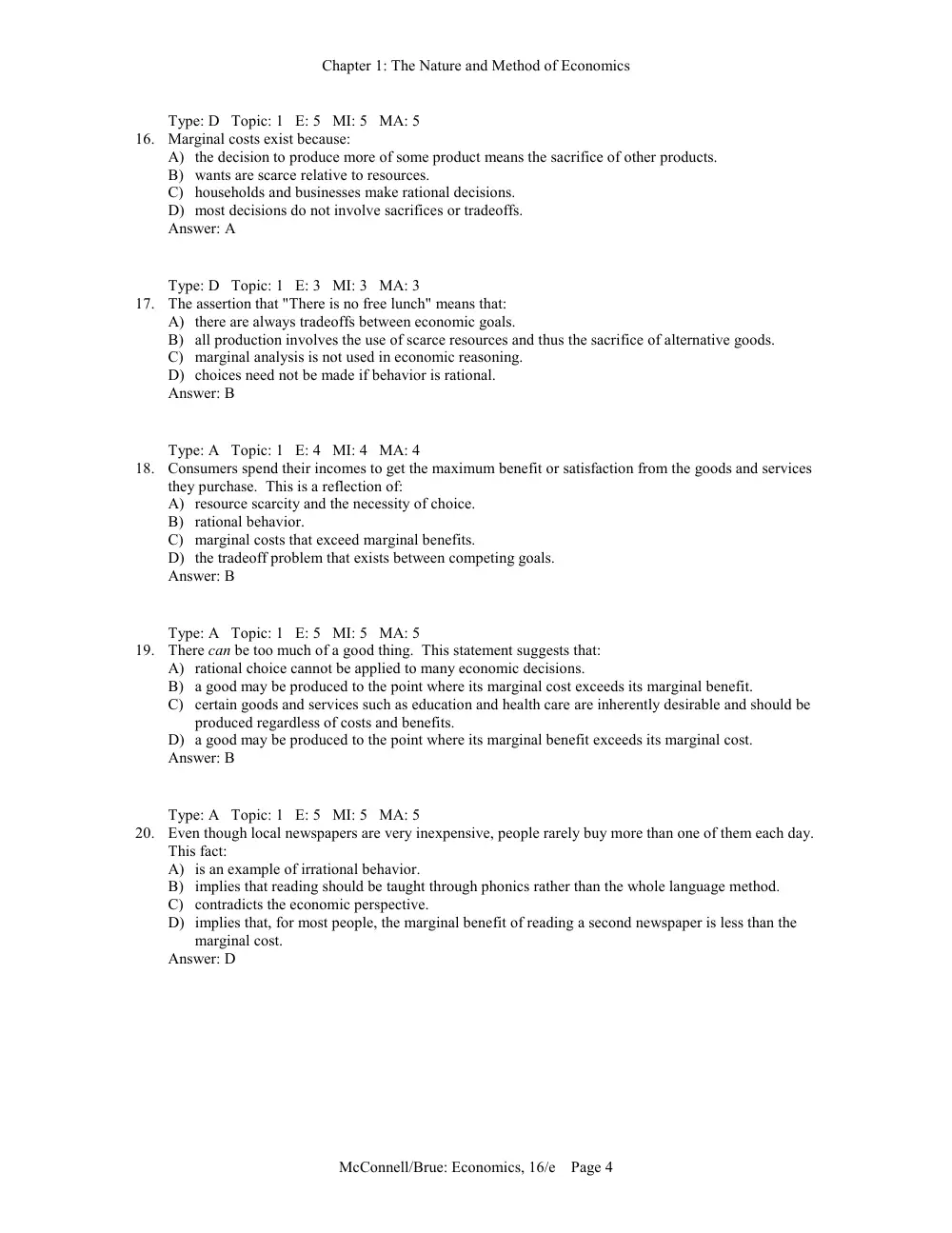
16. Marginal costs exist because:
A) the decision to produce more of some product means the sacrifice of other products.
B) wants are scarce relative to resources.
C) households and businesses make rational decisions.
D) most decisions do not involve sacrifices or tradeoffs.
Answer: A
Type: D Topic: 1 E: 3 MI: 3 MA: 3
17. The assertion that "There is no free lunch" means that:
A) there are always tradeoffs between economic goals.
B) all production involves the use of scarce resources and thus the sacrifice of alternative goods.
C) marginal analysis is not used in economic reasoning.
D) choices need not be made if behavior is rational.
Answer: B
Type: A Topic: 1 E: 4 MI: 4 MA: 4
18. Consumers spend their incomes to get the maximum benefit or satisfaction from the goods and services
they purchase. This is a reflection of:
A) resource scarcity and the necessity of choice.
B) rational behavior.
C) marginal costs that exceed marginal benefits.
D) the tradeoff problem that exists between competing goals.
Answer: B
Type: A Topic: 1 E: 5 MI: 5 MA: 5
19. There can be too much of a good thing. This statement suggests that:
A) rational choice cannot be applied to many economic decisions.
B) a good may be produced to the point where its marginal cost exceeds its marginal benefit.
C) certain goods and services such as education and health care are inherently desirable and should be
produced regardless of costs and benefits.
D) a good may be produced to the point where its marginal benefit exceeds its marginal cost.
Answer: B
Type: A Topic: 1 E: 5 MI: 5 MA: 5
20. Even though local newspapers are very inexpensive, people rarely buy more than one of them each day.
This fact:
A) is an example of irrational behavior.
B) implies that reading should be taught through phonics rather than the whole language method.
C) contradicts the economic perspective.
D) implies that, for most people, the marginal benefit of reading a second newspaper is less than the
marginal cost.
Answer: D
Chapter 1: The Nature and Method of Economics
McConnell/Brue: Economics, 16/e Page 5
Benefits of studying economics
Type: A Topic: 2 E: 5 MI: 5 MA: 5
21. Studying economics:
A) helps one become a better-informed citizen and voter.
B) is detrimental to good citizenship because economics emphasizes individualism.
C) is a waste of time since we all participate in the economy whether we understand it or not.
D) is important because economics is the science of earning money.
Answer: A
Type: A Topic: 2 E: 5 MI: 5 MA: 5
22. Learning economics:
A) is detrimental to good citizenship because economics emphasizes individualism.
B) is helpful to employers, but not to workers and consumers.
C) is important because economics is the science of earning money.
D) helps students improve analytical skills that are in great demand in the workplace.
Answer: D
Type: A Topic: 2 E: 6 MI: 6 MA: 6
23. The study of economics:
A) is similar to management, marketing, and finance since it emphasizes how to make money.
B) is helpful to businesses, but not particularly helpful in making personal buying decisions.
C) is mainly an academic, not a vocational subject.
D) looks at the economy from the viewpoint of one's own pocketbook, not from the standpoint of society's
interest.
Answer: C
Methodology
Type: D Topic: 3 E: 6 MI: 6 MA: 6
24. An economic hypothesis:
A) has the same meaning as an economic principal or economic law.
B) is usually a normative statement.
C) is a possible explanation of cause and effect.
D) is a stronger generalization than an economic law.
Answer: C
Type: A Topic: 3 E: 6 MI: 6 MA: 6
25. Which of the following terms implies the least degree of confidence in an economic generalization?
A) a hypothesis B) a theory C) a principle D) a law
Answer: A
Type: A Topic: 3 E: 7 MI: 7 MA: 7
26. Which of the following terms implies the greatest degree of confidence in an economic generalization?
A) a hypothesis B) a theory C) a principle D) an anomaly
Answer: C
Chapter 1: The Nature and Method of Economics
McConnell/Brue: Economics, 16/e Page 6
Type: D Topic: 3 E: 7 MI: 7 MA: 7
27. A well-tested economic theory is often called:
A) a hypothesis. B) a prototype. C) a principle. D) an anomaly.
Answer: C
Type: C Topic: 3 E: 7 MI: 7 MA: 7
28. Economists:
A) use both the economic perspective and the scientific method.
B) use the economic perspective but not the scientific method.
C) make positive economic statements, but not normative economic statements.
D) reject theorizing as being impractical.
Answer: A
Type: A Topic: 3 E: 6 MI: 6 MA: 6
29. The scientific method is:
A) not applicable to economics, because economics deals with human beings.
B) also known as the economic perspective.
C) analysis that moves from broad generalizations called laws to theories and then to hypotheses.
D) used by economists and other social scientists, as well as by physical scientists and life scientists.
Answer: D
Type: D Topic: 3 E: 7 MI: 7 MA: 7
30. The process by which economists test hypotheses against facts to develop theories, principles, and models
is called:
A) the economic perspective. B) the scientific method. C) policy economics. D) microeconomcis.
Answer: B
Type: D Topic: 3 E: 6 MI: 6 MA: 6
31. Economic theories:
A) are useless because they are not based on laboratory experimentation.
B) that are true for individual economic units are never true for the economy as a whole.
C) are generalizations based on a careful observation of facts.
D) are abstractions and therefore of no application to real situations.
Answer: C
Type: A Topic: 3 E: 6 MI: 6 MA: 6
32. Theoretical economics:
A) is also known as policy economics.
B) is the process of deriving principles of economics.
C) is highly impractical since it does not deal with the real world.
D) rejects the scientific method as being inappropriate for the social sciences.
Answer: B
Chapter 1: The Nature and Method of Economics
McConnell/Brue: Economics, 16/e Page 7
Type: D Topic: 3 E: 7 MI: 7 MA: 7
33. Which of the following is a correct statement?
A) Economic concepts or laws that are valid during depression are necessarily valid during prosperity.
B) Though not quantitatively exact, economic laws are useful because they allow us to predict and
therefore control or adjust to events.
C) Economics is as scientific as are physics and chemistry because economic laws are as quantitatively
precise as the laws of physics or chemistry.
D) Because economics is concerned with questions of "ought," it is a branch of applied ethics and not
scientific.
Answer: B
Type: D Topic: 3 E: 7 MI: 7 MA: 7
34. In constructing models, economists:
A) make simplifying assumptions.
C) must use mathematical equations.
B) include all available information.
D) attempt to duplicate the real world.
Answer: A
Type: D Topic: 3 E: 7 MI: 7 MA: 7
35. Economic models:
A) are of limited use because they cannot be tested empirically.
B) are limited to variables that are directly related to one another.
C) emphasize basic economic relationships by abstracting from the complexities of the real world.
D) are unrealistic and therefore of no practical consequence.
Answer: C
Type: D Topic: 3 E: 7 MI: 7 MA: 7
36. The term "ceteris paribus" means:
A) that if event A precedes event B, A has caused B.
B) that economics deals with facts, not values.
C) other things equal.
D) prosperity inevitably follows recession.
Answer: C
Type: D Topic: 3 E: 7 MI: 7 MA: 7
37. The basic purpose of the other-things-equal assumption is to:
A) allow one to reason about the relationship between variables X and Y without the intrusion of variable
Z.
B) allow one to focus upon micro variables by ignoring macro variables.
C) allow one to focus upon macro variables by ignoring micro variables.
D) determine whether X causes Y or vice versa.
Answer: A
Chapter 1: The Nature and Method of Economics
McConnell/Brue: Economics, 16/e Page 8
Type: A Topic: 3 E: 7 MI: 7 MA: 7
38. Suppose an economist says that "Other things equal, the lower the price of bananas, the greater the amount
of bananas purchased." This statement indicates that:
A) the quantity of bananas purchased determines the price of bananas.
B) all factors other than the price of bananas (for example, consumer tastes and incomes) are assumed to
be constant.
C) economists can conduct controlled laboratory experiments.
D) one cannot generalize about the relationship between the price of bananas and the quantity purchased.
Answer: B
Type: D Topic: 3 E: 6 MI: 6 MA: 6
39. An hypothesis is:
A) a fundamental truth that all economists accept.
B) a tentative, untested statement of possible cause and effect.
C) the same as a normative statement.
D) also known as a principle or law.
Answer: B
Type: D Topic: 3 E: 8 MI: 8 MA: 8
40. The term "other things equal" means that:
A) the associated statement is normative.
B) many variables affect the variable under consideration.
C) a number of relevant variables are assumed to be constant.
D) when variable X increases so does related variable Y.
Answer: C
Economic policy and goals
Type: F Topic: 4 E: 8 MI: 8 MA: 8 Status: New
41. Which of the following statements is true?
A) The process of deriving economic theories and principles is known as policy economics.
B) Full employment, price-level stability, and economic growth are widely accepted macroeconomics
goals in the United States.
C) Normative economics deals with "what is," whereas positive economics deals with "what ought to be."
D) There can be too little of a good thing, but never too much of a good thing.
Answer: B
Type: A Topic: 4 E: 8 MI: 8 MA: 8
42. In formulating economic policy it is important to:
A) use only positive economics, not normative economics.
B) consider the benefits and costs of the various policy options for reaching desired goals.
C) avoid outcomes for which marginal benefits exceed marginal costs.
D) use only normative economics, not positive economics.
Answer: B
Chapter 1: The Nature and Method of Economics
McConnell/Brue: Economics, 16/e Page 9
Type: D Topic: 4 E: 9 MI: 9 MA: 9
43. If there is a tradeoff between goals A and B:
A) greater fulfillment of A means lesser fulfillment of B.
B) goals A and B are positively correlated.
C) causation exists between the two goals.
D) greater fulfillment of A means greater fulfillment of B.
Answer: A
Type: A Topic: 4 E: 9 MI: 9 MA: 9
44. The achieving of complete economic freedom is most likely to conflict with the goal of:
A) price-level stability.
C) an equitable distribution of income.
B) economic growth.
D) economic efficiency.
Answer: C
Type: A Topic: 4 E: 9 MI: 9 MA: 9
45. If a reduction in the unemployment rate is always accompanied by a reduction in income inequality, then:
A) full employment and greater income equality are conflicting goals.
B) full employment and greater income equality are compatible goals.
C) reduced income inequality is a more important goal than is achieving full employment.
D) achieving full employment is a more important goal than reducing income inequality.
Answer: B
Type: A Topic: 4 E: 10 MI: 10 MA: 10
46. Most of the disagreement among economists involves:
A) the use of statistics. B) the gathering of facts. C) generalizing upon facts. D) policy economics.
Answer: D
Type: A Topic: 4 E: 9 MI: 9 MA: 9
47. With respect to the basic economic goals of society, for example, economic growth, full employment,
economic efficiency, price level stability, economic freedom, distributional equity, and economic security,
it can be said that:
A) all are accepted and assigned similar priorities in every industrialized society.
B) all are precisely measurable.
C) some goals are complementary and others are conflicting.
D) all are conflicting goals.
Answer: C
Macroeconomics and microeconomics
Type: D Topic: 5 E: 9 MI: 9 MA: 9
48. Macroeconomics approaches the study of economics from the viewpoint of:
A) the entire economy.
B) governmental units.
C) the operation of specific product and resource markets.
D) individual firms.
Answer: A
Chapter 1: The Nature and Method of Economics
McConnell/Brue: Economics, 16/e Page 10
Type: A Topic: 5 E: 9 MI: 9 MA: 9
49. Which of the following is associated with macroeconomics?
A) an examination of the incomes of Harvard Business School graduates
B) an empirical investigation of the general price level and unemployment rates since 1990
C) a study of the trend of pecan prices since the Second World War
D) a case study of pricing and production in the textbook industry
Answer: B
Type: A Topic: 5 E: 9 MI: 9 MA: 9
50. The problems of aggregate inflation and unemployment are:
A) major topics of macroeconomics.
C) major topics of microeconomics.
B) not relevant to the U.S. economy.
D) peculiar to command economies.
Answer: A
Type: A Topic: 5 E: 9 MI: 9 MA: 9
51. Which of the following statements pertains to macroeconomics?
A) Because the minimum wage was raised, Mrs. Olsen decided to enter the labor force.
B) A decline in the price of soybeans caused farmer Wanek to plant more land in wheat.
C) The national productivity rate grew by 2.7 percent last year.
D) The Pumpkin Center State Bank increased its interest rate on consumer loans by 1 percentage point.
Answer: C
Type: D Topic: 5 E: 9 MI: 9 MA: 9
52. Macroeconomics can best be described as the:
A) analysis of how a consumer tries to spend income.
B) study of the large aggregates of the economy or the economy as a whole.
C) analysis of how firms attempt to maximize their profits.
D) study of how supply and demand determine prices in individual markets.
Answer: B
Type: D Topic: 5 E: 9 MI: 9 MA: 9
53. Microeconomics is concerned with:
A) the aggregate or total levels of income, employment, and output.
B) a detailed examination of specific economic units that make up the economic system.
C) positive economics, but not normative economics.
D) the establishing of an overall view of the operation of the economic system.
Answer: B
Type: D Topic: 5 E: 9 MI: 9 MA: 9
54. Microeconomics:
A) is the basis for the "after this, therefore because of this" fallacy.
B) is not concerned with details, but only with the overall big picture of the economy.
C) is concerned with individual economic units and specific markets.
D) describes the aggregate flows of output and income.
Answer: C
Chapter 1: The Nature and Method of Economics
McConnell/Brue: Economics, 16/e Page 11
Type: A Topic: 5 E: 9 MI: 9 MA: 9
55. Which of the following is a macroeconomic statement?
A) The gross profits of all U.S. businesses were $182 billion last year.
B) The price of beef declined by 3 percent last year.
C) General Motors' profits increased last year.
D) The productivity of steelworkers increased by 1 percent last year.
Answer: A
Type: A Topic: 5 E: 9 M