
ECON 212 Problems, Spring 2008
American University of Beirut · Elementary Macroeconomics Theory · 5 pages

More ECON 212 files
- Questions 20 · Fall 2012ProblemsView
- Problems Macroeconomics Bank Questions-Answers Chap.14 · Fall 2011Problems · with solutionView
- Questions Selected Problems Answers · Spring 2011Problems · with solutionView
- Problems Sample Questions 2 with Key · Summer 2010Problems · with solutionView
- Syllabus · Spring 2019LabView
- Syllabus Test Bank · Fall 2018LabView
- Useful File Test Bank · Fall 2017FileView
- Useful File Summary · Fall 2017FileView
Show the text of this problems
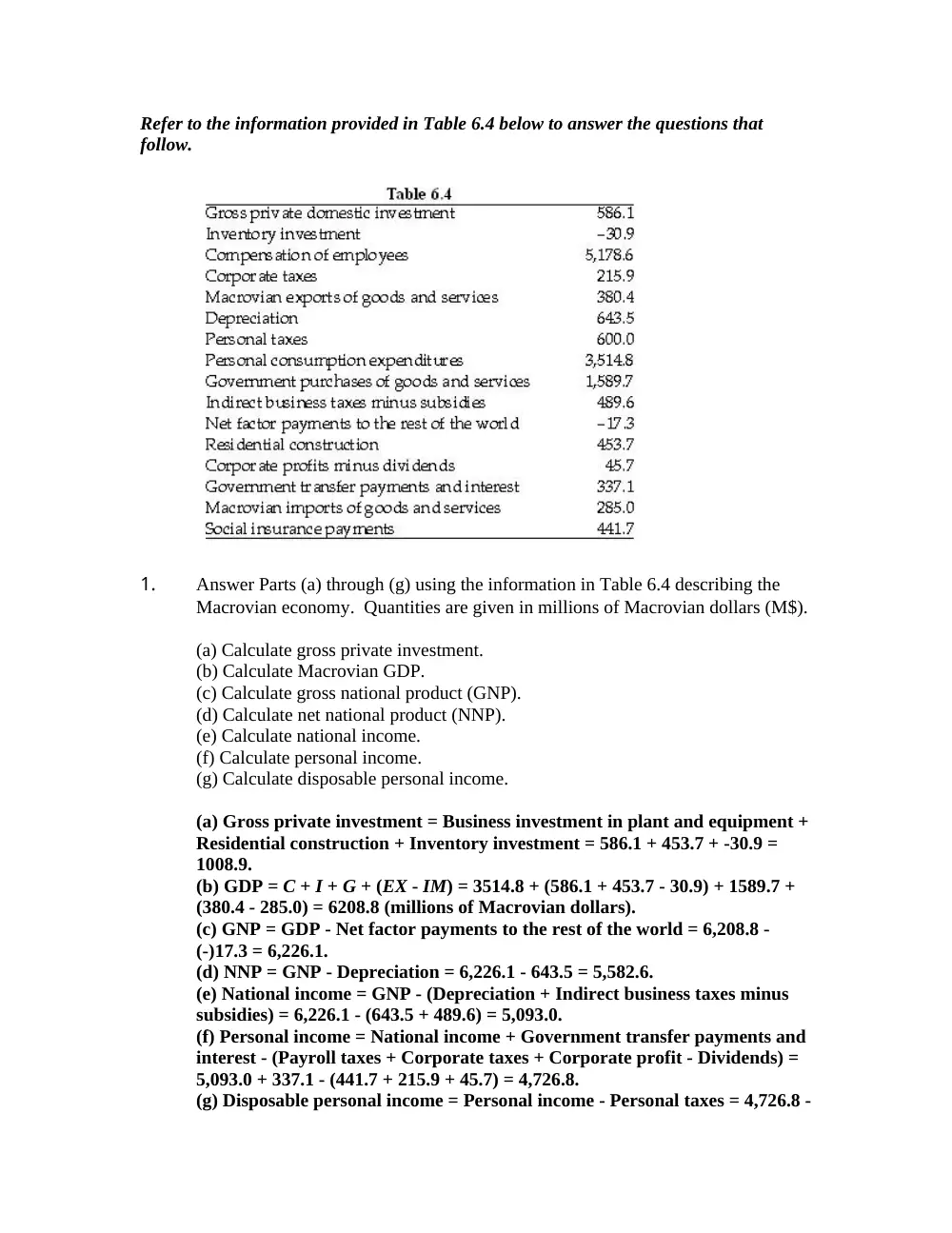
Refer to the information provided in Table 6.4 below to answer the questions that
follow.
1.
Answer Parts (a) through (g) using the information in Table 6.4 describing the
Macrovian economy. Quantities are given in millions of Macrovian dollars (M$).
(a) Calculate gross private investment.
(b) Calculate Macrovian GDP.
(c) Calculate gross national product (GNP).
(d) Calculate net national product (NNP).
(e) Calculate national income.
(f) Calculate personal income.
(g) Calculate disposable personal income.
(a) Gross private investment = Business investment in plant and equipment +
Residential construction + Inventory investment = 586.1 + 453.7 + -30.9 =
1008.9.
(b) GDP = C + I + G + (EX - IM) = 3514.8 + (586.1 + 453.7 - 30.9) + 1589.7 +
(380.4 - 285.0) = 6208.8 (millions of Macrovian dollars).
(c) GNP = GDP - Net factor payments to the rest of the world = 6,208.8 -
(-)17.3 = 6,226.1.
(d) NNP = GNP - Depreciation = 6,226.1 - 643.5 = 5,582.6.
(e) National income = GNP - (Depreciation + Indirect business taxes minus
subsidies) = 6,226.1 - (643.5 + 489.6) = 5,093.0.
(f) Personal income = National income + Government transfer payments and
interest - (Payroll taxes + Corporate taxes + Corporate profit - Dividends) =
5,093.0 + 337.1 - (441.7 + 215.9 + 45.7) = 4,726.8.
(g) Disposable personal income = Personal income - Personal taxes = 4,726.8 -
600.0 = 4,126.8.
2.
Compare and contrast the terms nominal GDP and real GDP.
Nominal GDP measures gross domestic product in current dollars. Real GDP
measures gross domestic product by adjusting Nominal GDP for price
changes.
Difficulty: E
Type: C
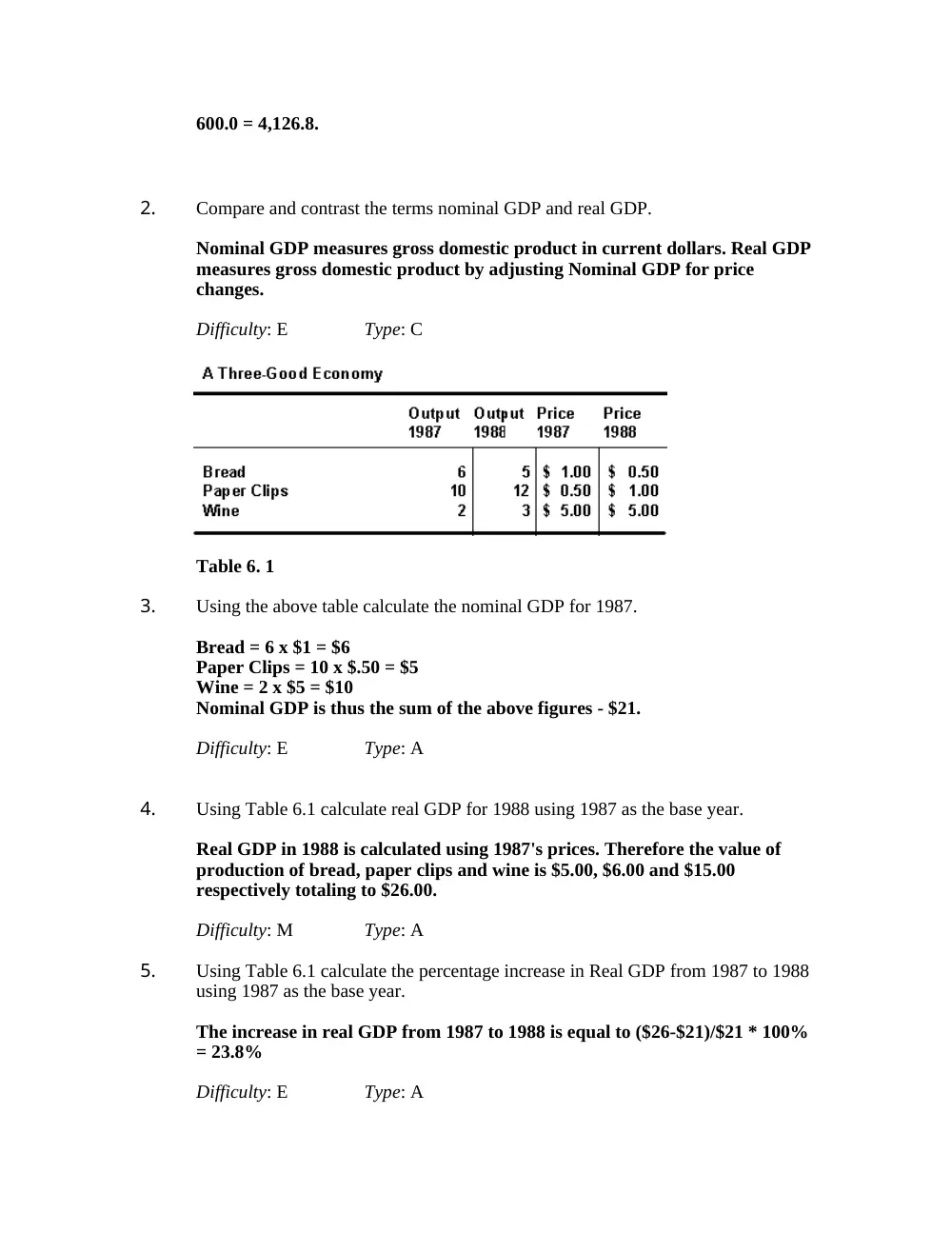
Table 6. 1
3.
Using the above table calculate the nominal GDP for 1987.
Bread = 6 x $1 = $6
Paper Clips = 10 x $.50 = $5
Wine = 2 x $5 = $10
Nominal GDP is thus the sum of the above figures - $21.
Difficulty: E
Type: A
4.
Using Table 6.1 calculate real GDP for 1988 using 1987 as the base year.
Real GDP in 1988 is calculated using 1987's prices. Therefore the value of
production of bread, paper clips and wine is $5.00, $6.00 and $15.00
respectively totaling to $26.00.
Difficulty: M
Type: A
5.
Using Table 6.1 calculate the percentage increase in Real GDP from 1987 to 1988
using 1987 as the base year.
The increase in real GDP from 1987 to 1988 is equal to ($26-$21)/$21 * 100%
= 23.8%
Difficulty: E
Type: A
6.
If nominal GDP is $8 trillion and real GDP is $5 trillion, calculate the value of the
GDP deflator.
Real GDP = Nominal GDP
-----------------
GDP Deflator / 100
Therefore the GDP Deflator = Nominal GDP / Real GDP x 100 = $8 trillion /
$5 trillion x 100 = 160.
Difficulty: E
Type: A
Table 7-1
7.
Using Table 7.1 above, calculate the unemployment rate.
The total amount of people who are unemployed and looking for work are
400 + 200 + 100 = 700. The labor force equals this number plus the employed
- 700 + 8000. The unemployment rate is equal to 700/8700 x 100% = 8.04%
Difficulty: E
Type: A
8.
Assume that the CPI for year 3 is 120 and the CPI for year 4 is 130. Compute the
inflation rate for year 4.
The inflation rate = (130 - 120)/120 * 100% = 8.33%
Difficulty: E
Type: A
9.
Suppose you want to earn a 7% rate of return on a one-year loan you are about to
make and the expected inflation rate for the duration of the loan is 5%. How much
interest should be charged? Secondly, suppose that your forecasts are 2% below
the actual level. What would happen to your real rate of return? What if you
overestimated inflation by 2%.
You would need to assess an interest rate of 12% to earn 7%. The 5% is
simply an inflation premium. However, if you underestimate inflation by 2%
your real rate of return will only be 5% not 7%. Likewise, if you
overestimate the inflation rate you will be in the happy circumstance of
earning a 9% rate of return (12% - 3%).
10.
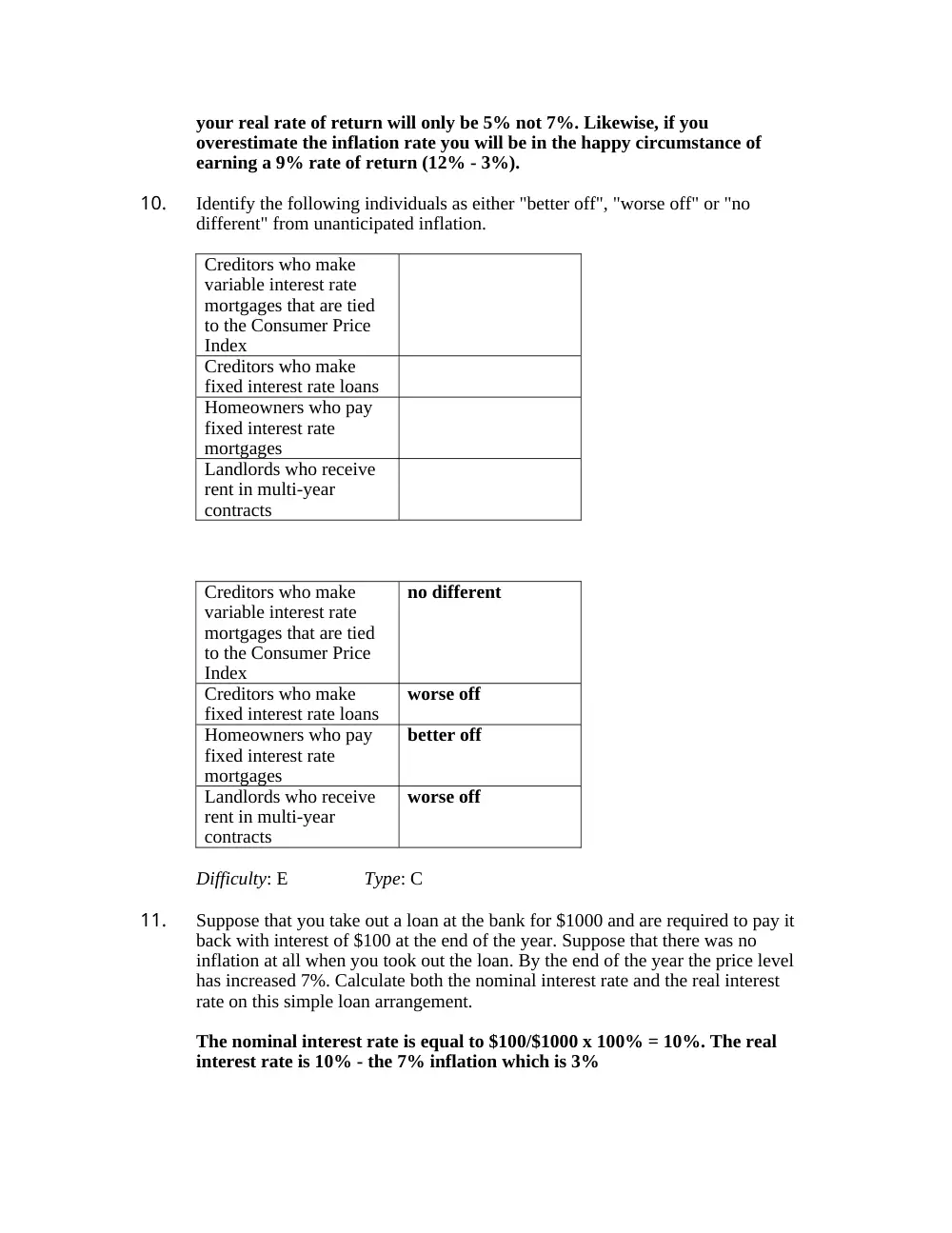
Identify the following individuals as either "better off", "worse off" or "no
different" from unanticipated inflation.
Creditors who make
variable interest rate
mortgages that are tied
to the Consumer Price
Index
Creditors who make
fixed interest rate loans
Homeowners who pay
fixed interest rate
mortgages
Landlords who receive
rent in multi-year
contracts
Creditors who make
variable interest rate
mortgages that are tied
to the Consumer Price
Index
no different
Creditors who make
fixed interest rate loans
worse off
Homeowners who pay
fixed interest rate
mortgages
better off
Landlords who receive
rent in multi-year
contracts
worse off
Difficulty: E
Type: C
11.
Suppose that you take out a loan at the bank for $1000 and are required to pay it
back with interest of $100 at the end of the year. Suppose that there was no
inflation at all when you took out the loan. By the end of the year the price level
has increased 7%. Calculate both the nominal interest rate and the real interest
rate on this simple loan arrangement.
The nominal interest rate is equal to $100/$1000 x 100% = 10%. The real
interest rate is 10% - the 7% inflation which is 3%
12.
Lenders and borrowers expect the inflation rate to equal the actual inflation rate.
The consumer price index is 110 in year 1 and 126.5 in year 2. If the interest rate
charged by Richie Rich in year 2 is 40%, what is Rich's real interest rate?
Rich's real interest rate is 25%. The inflation rate in year 2 is (change in
CPI/initial CPI) × 100, or 15%. The real interest rate (25%) is the difference
between the market interest rate (40%) and the expected inflation rate
(15%).
13.
If year 1 is the base year and the price index for year 2 is 105 and the price index
for year 3 is 103, what is the inflation rate in years 2 and 3? Explain what has
happened between years 1 and 2, years 2 and 3, and years 1 and 3 to the cost of
living.
The inflation rate in year 2 is 5%. The inflation rate in year 3 is -1.9%. The
cost of living increased between years 1 and 2 and years 1 and 3, but
decreased between years 2 and 3.