
ECON 227 Midterm, Spring 2011
American University of Beirut · Intermediate Macroeconomics · 6 pages


More ECON 227 files
- Midterm with Solutions · Fall 2002Exam · with solutionView
- Useful File Book 8th Edition · Summer 2018FileView
- Final · Spring 2011Final examView
- Problems 1 Answers · Spring 2011Problems · with solutionView
- Problems 1 · Spring 2011ProblemsView
- Problems 2 Answers · Spring 2011Problems · with solutionView
- Problems 2 · Spring 2011ProblemsView
- Problems 3 Answers · Spring 2011Problems · with solutionView
Show the text of this exam
Economics 227: Intermediate Macroeconomics
Practice Midterm Exam
Spring 2011
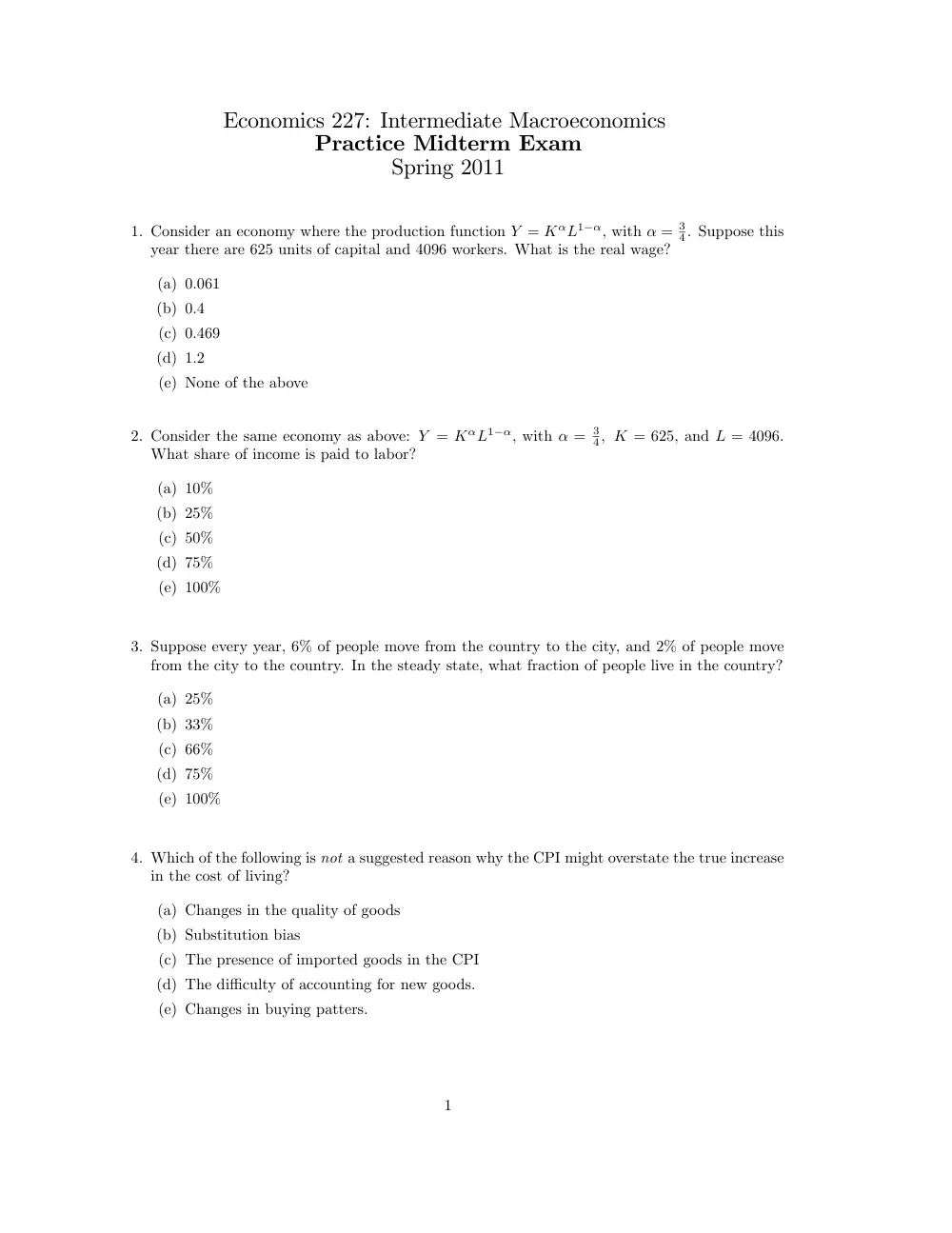
1. Consider an economy where the production function Y = KαL1−α, with α = 3
4. Suppose this
year there are 625 units of capital and 4096 workers. What is the real wage?
(a) 0.061
(b) 0.4
(c) 0.469
(d) 1.2
(e) None of the above
2. Consider the same economy as above: Y = KαL1−α, with α = 3
4, K = 625, and L = 4096.
What share of income is paid to labor?
(a) 10%
(b) 25%
(c) 50%
(d) 75%
(e) 100%
3. Suppose every year, 6% of people move from the country to the city, and 2% of people move
from the city to the country. In the steady state, what fraction of people live in the country?
(a) 25%
(b) 33%
(c) 66%
(d) 75%
(e) 100%
4. Which of the following is not a suggested reason why the CPI might overstate the true increase
in the cost of living?
(a) Changes in the quality of goods
(b) Substitution bias
(c) The presence of imported goods in the CPI
(d) The difficulty of accounting for new goods.
(e) Changes in buying patters.
1
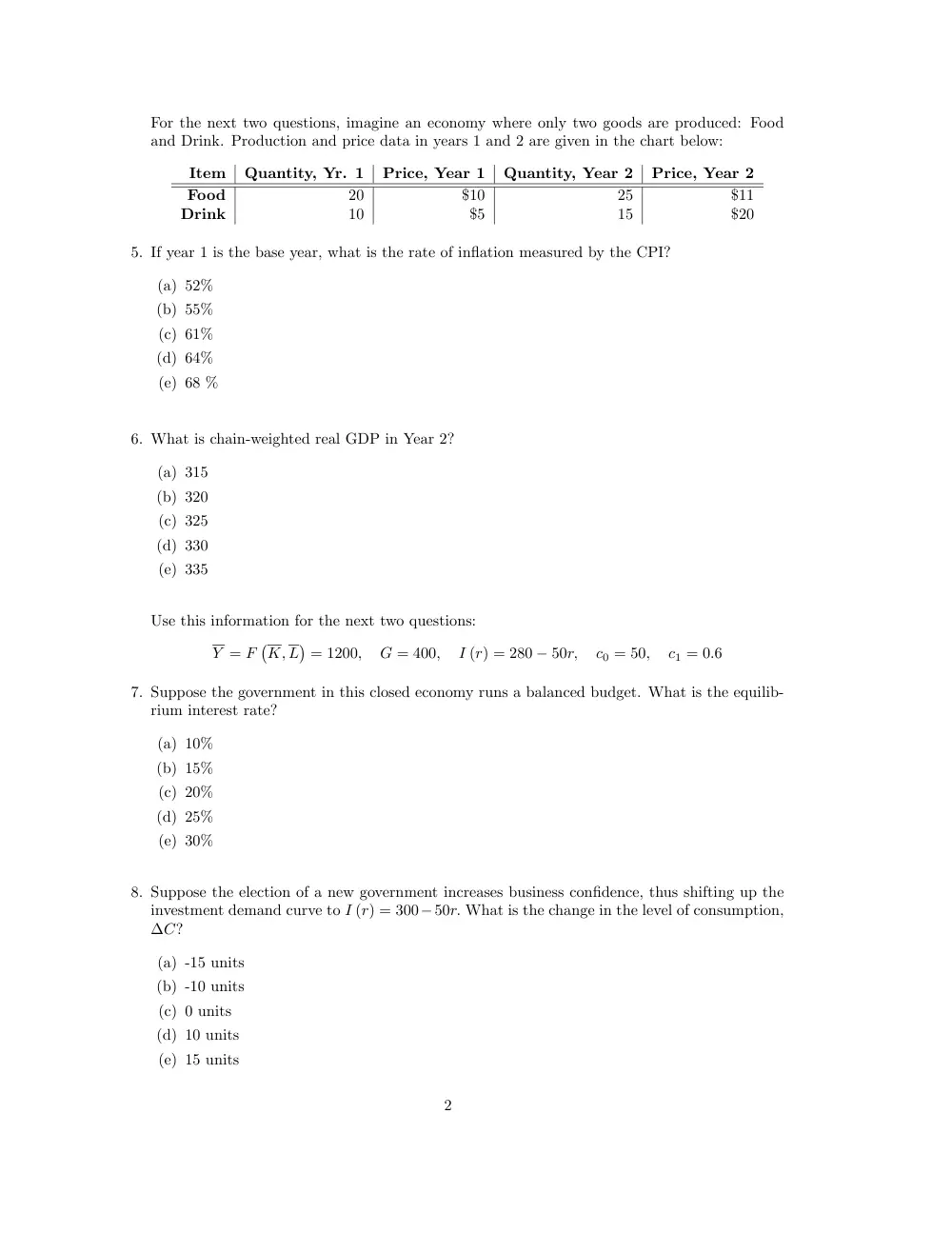
For the next two questions, imagine an economy where only two goods are produced: Food
and Drink. Production and price data in years 1 and 2 are given in the chart below:
Item
Quantity, Yr. 1
Price, Year 1
Quantity, Year 2
Price, Year 2
Food
20
$10
25
$11
Drink
10
$5
15
$20
5. If year 1 is the base year, what is the rate of inflation measured by the CPI?
(a) 52%
(b) 55%
(c) 61%
(d) 64%
(e) 68 %
6. What is chain-weighted real GDP in Year 2?
(a) 315
(b) 320
(c) 325
(d) 330
(e) 335
Use this information for the next two questions:
Y = F
�
K, L
�
= 1200,
G = 400,
I (r) = 280 − 50r,
c0 = 50,
c1 = 0.6
7. Suppose the government in this closed economy runs a balanced budget. What is the equilib-
rium interest rate?
(a) 10%
(b) 15%
(c) 20%
(d) 25%
(e) 30%
8. Suppose the election of a new government increases business confidence, thus shifting up the
investment demand curve to I (r) = 300−50r. What is the change in the level of consumption,
∆C?
(a) -15 units
(b) -10 units
(c) 0 units
(d) 10 units
(e) 15 units
2
9. Which of the following would likely reduce the economy’s total level of frictional unemploy-
ment?
(a) An increase in the minimum wage
(b) A increase in the generosity of unemployment insurance.
(c) A decrease in the proportion of the labor force that is unionized.
(d) A rise in the rate of job finding.
(e) None of the above.
10. Svalbard is a small open economy with perfect capital mobility. The investment function is
I (r) = 100000 − 100r, and net exports are given by the function NX (ε) = 2500 − 10ε. The
marginal propensity to consume out of disposable income is 0.9. Assume both government
purchases and taxes rise by 100 units. What is the change in the real exchange rate?
(a) It falls by 1 unit
(b) It falls by 0.1 units
(c) It doesn’t change
(d) It rises by 0.1 units
(e) It rises by 1 unit
11. Suppose in 2000, £1 cost LL. 3000, and in 2010 £1 costs LL. 2000. Over the same period,
inflation totaled 20% in the U.K., and 33% in Lebanon. How much more expensive has it
become for British residents to travel in Lebanon?
(a) 13%
(b) 35%
(c) 50%
(d) 61%
(e) 66%
12. The Faroe Islands are a small open economy with a trade deficit. If the Faroese government
increases government spending, what happens to the exchange rate and the size of the trade
deficit?
(a) The trade deficit and exchange rate both fall
(b) The trade deficit falls and the exchange rate increases
(c) The trade deficit increases and the exchange rate falls
(d) The trade deficit and exchange rate both increase
(e) We don’t have enough information to answer this question.
3
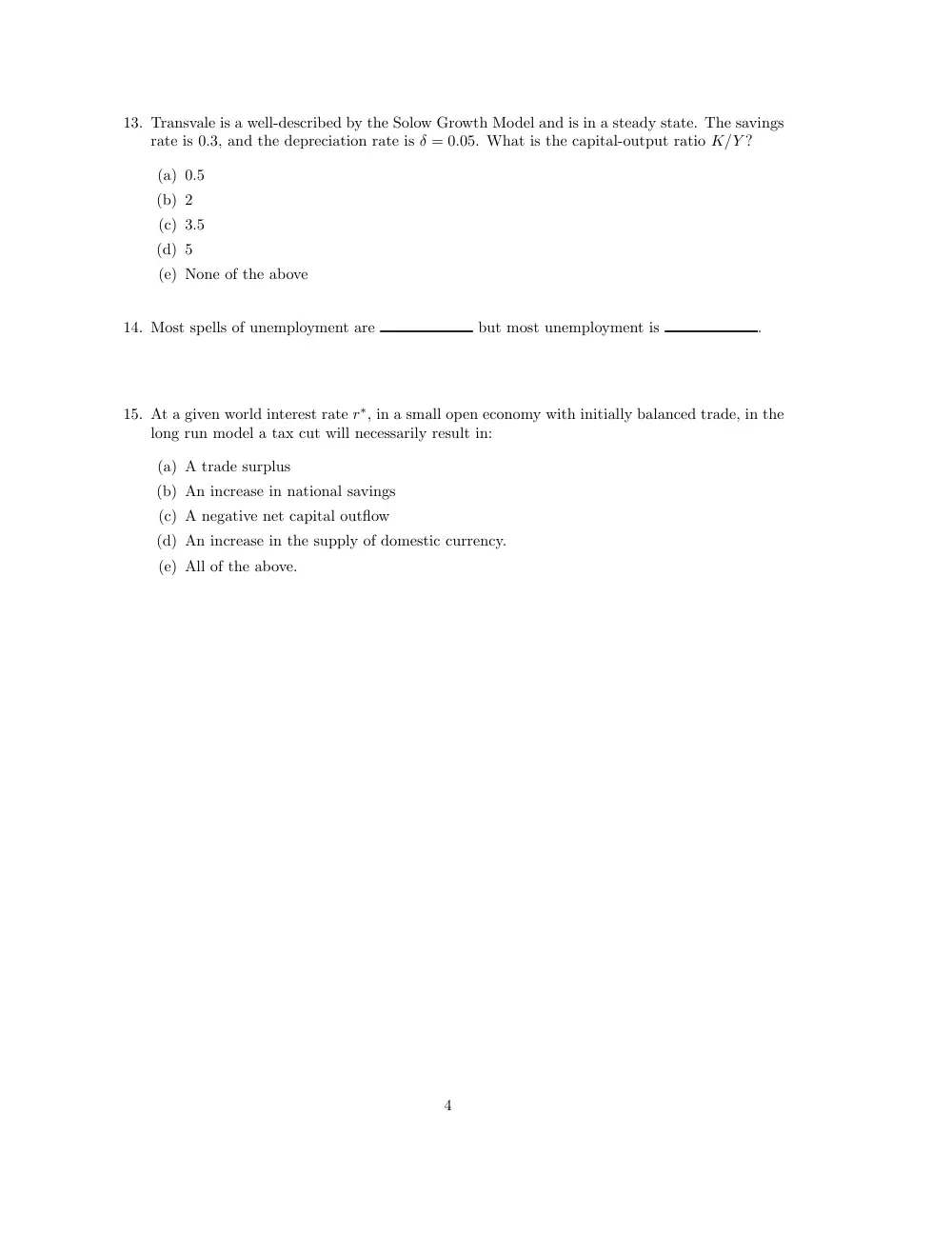
13. Transvale is a well-described by the Solow Growth Model and is in a steady state. The savings
rate is 0.3, and the depreciation rate is δ = 0.05. What is the capital-output ratio K/Y ?
(a) 0.5
(b) 2
(c) 3.5
(d) 5
(e) None of the above
14. Most spells of unemployment are
but most unemployment is
.
15. At a given world interest rate r∗, in a small open economy with initially balanced trade, in the
long run model a tax cut will necessarily result in:
(a) A trade surplus
(b) An increase in national savings
(c) A negative net capital outflow
(d) An increase in the supply of domestic currency.
(e) All of the above.
4
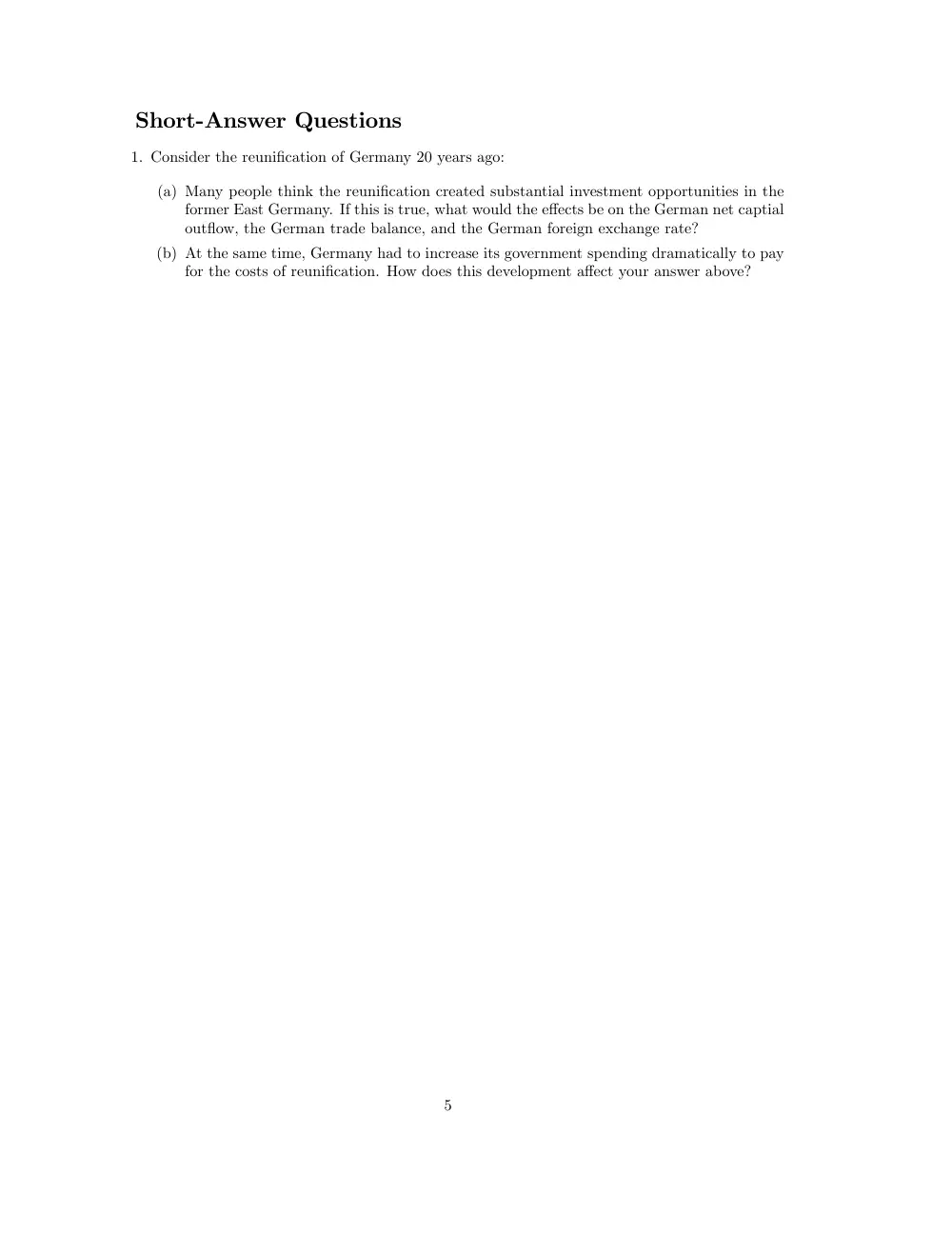
Short-Answer Questions
1. Consider the reunification of Germany 20 years ago:
(a) Many people think the reunification created substantial investment opportunities in the
former East Germany. If this is true, what would the effects be on the German net captial
outflow, the German trade balance, and the German foreign exchange rate?
(b) At the same time, Germany had to increase its government spending dramatically to pay
for the costs of reunification. How does this development affect your answer above?
5
2. Consider the following economy with a petroleum refiner, an equipment factory, a government,
and many consumers. The petroleum refiner produces 10 million liters of refined petroleum
products, which sell for $5 per liter. The factory produces 40 pieces of equipment, which sell
for $500,000. Of the 10 million liters of refined petroleum, 6 million are sold to consumers, 2
million are sold to the factory to power their equipment, and 2 million are unsold at the end of
the year. Of the 40 units of equipment, the refiner buys 10 to expand capacity, the government
buys 20 to upgrade their surveillance technology, consumers buy 5, and the equpment manu-
facturer retains the rest. The government also spends $5 million in wages for the surveillance
professionals who conduct surveillance. This is financed by $1 million in taxes from the refiner,
$2 million from the factory, and $1 million from consumers. The factory and the refiner pay
$6 million and $40 million in wages respectively, and the refiner pays $5 million to consumers
in interest on a loan. Calculate GDP by production, expenditures, and income.
6