
ECON 228 Midterm, Fall 2001
American University of Beirut · Intermediate Monetary Economics · 2 pages
More ECON 228 files
Show the text of this exam
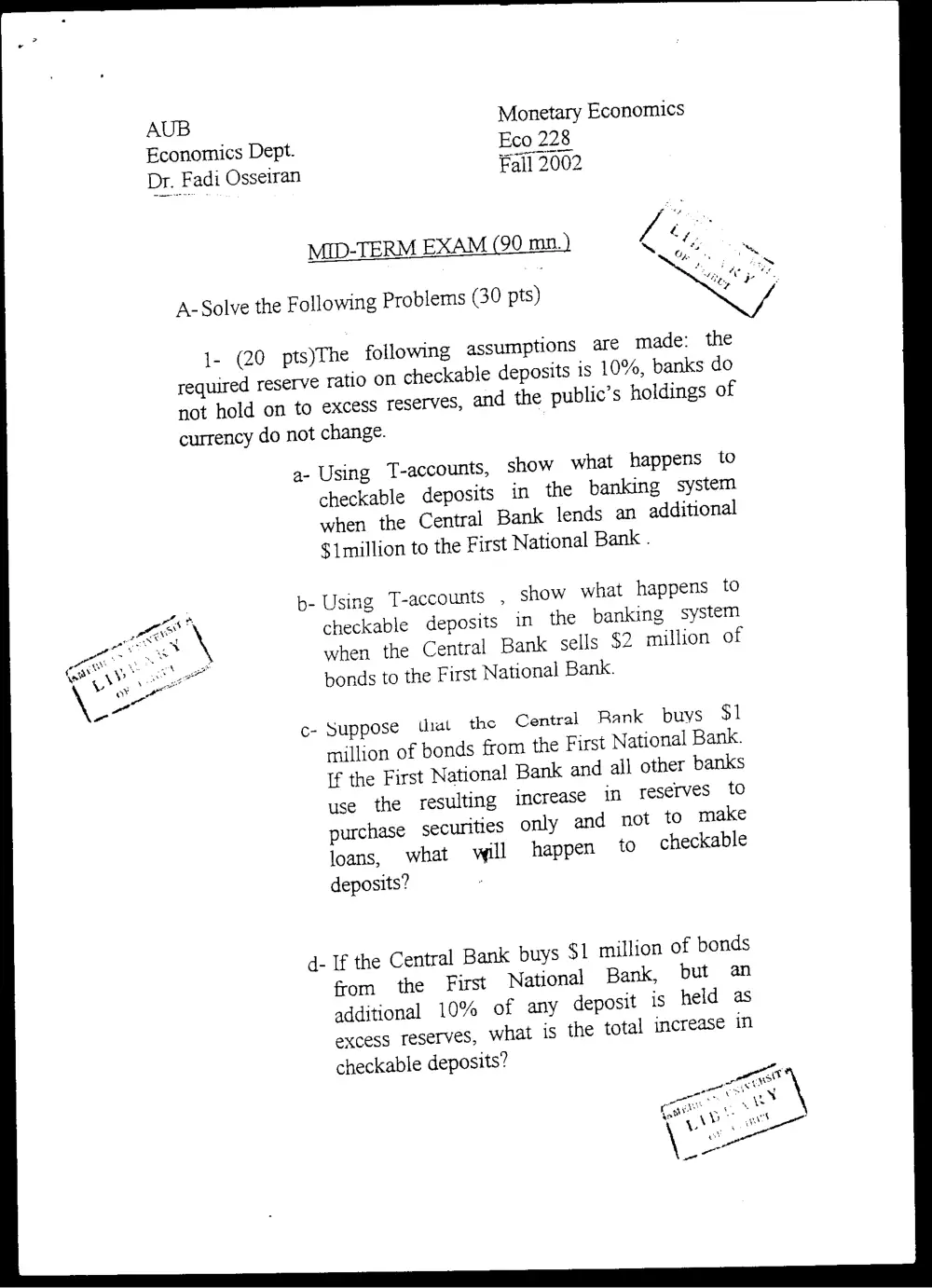
AUB Monetary Economics
Economics Dept. Eco 22 8
Dr. Fadi Osseiran Fall 2002
MID-TERM EXAM (90 mn.)
A-Solve the Following Problems (30 pts)
1- (20 pts)The following assumptions are made: the
required reserve ratio on checkable deposits is 10%, banks do
not hold on to excess reserves, and the public’s holdings of
currency do not change.
a- Using T-accounts, show what happens to
checkable deposits in the banking system
when the Central Bank lends an additional
$1million to the First National Bank .
Using T-accounts , show what happens to
checkable deposits in the banking system
when the Central Bank sells $2 million of
bonds to the First National Bank.
Suppose Unat the Central Rank buys $1
million of bonds from the First National Bank.
If the First National Bank and all other banks
use the resulting increase in reserves to
purchase securities only and not to make
loans, what will happen to checkable
deposits?
If the Central Bank buys $1 million of bonds
from the First National Bank, but an
additional 10% of any deposit is held as
excess reserves, what is the total mecrease in
checkable deposits?
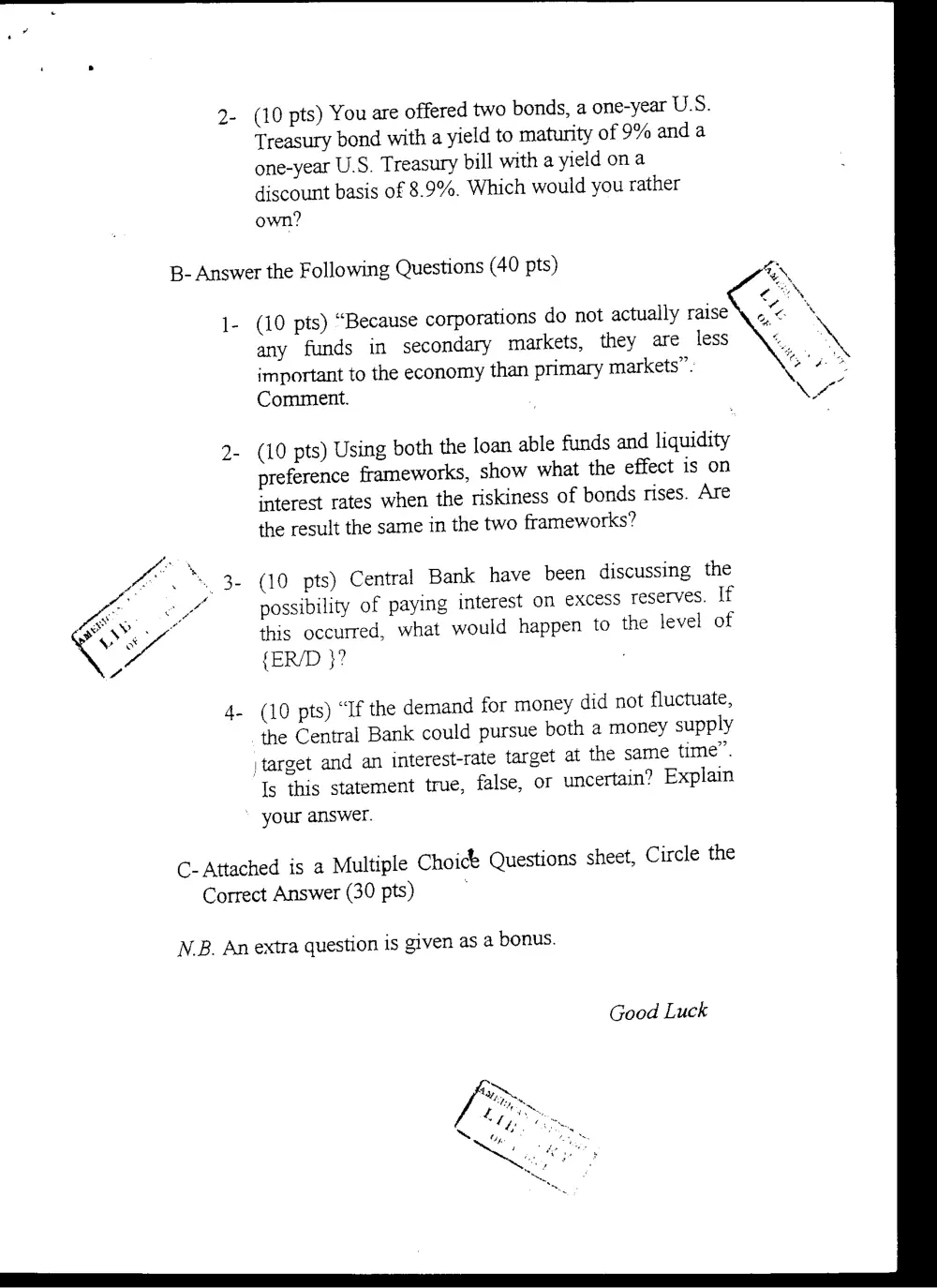
2- (10 pts) You are offered two bonds, a one-year U.S.
Treasury bond with a yield to maturity of 9% and a
one-year U.S. Treasury bill with a yield on a
discount basis of 8.9%. Which would you rather
own?
B- Answer the Following Questions (40 pts)
1- (10 pts) “Because corporations do not actually raise
any funds in secondary markets, they are less
important to the economy than primary markets”.
Comment. \7
2- (10 pts) Using both the loan able funds and liquidity
preference frameworks, show what the effect is on
interest rates when the riskiness of bonds rises. Are
the result the same in the two frameworks?
a . *s 3. (10 pts) Central Bank have been discussing the
va oe 4 possibility of paying interest on excess reserves. If
O47 this occurred, what would happen to the level of
X\ {ER/D }? ;
4- (10 pts) “If the demand for money did not fluctuate,
the Central Bank could pursue both a money supply
jtarget and an interest-rate target at the same time”.
Is this statement true, false, or uncertain? Explain
~ your answer.
C- Attached is a Multiple Choice Questions sheet, Circle the
Correct Answer (30 pts)
NB. An extra question is given as a bonus.
Good Luck