
ECON 296 Final, Fall 2005
American University of Beirut · Senior Seminar in Economics · 1 page
Stuck on a question? A tutor can walk you through it.
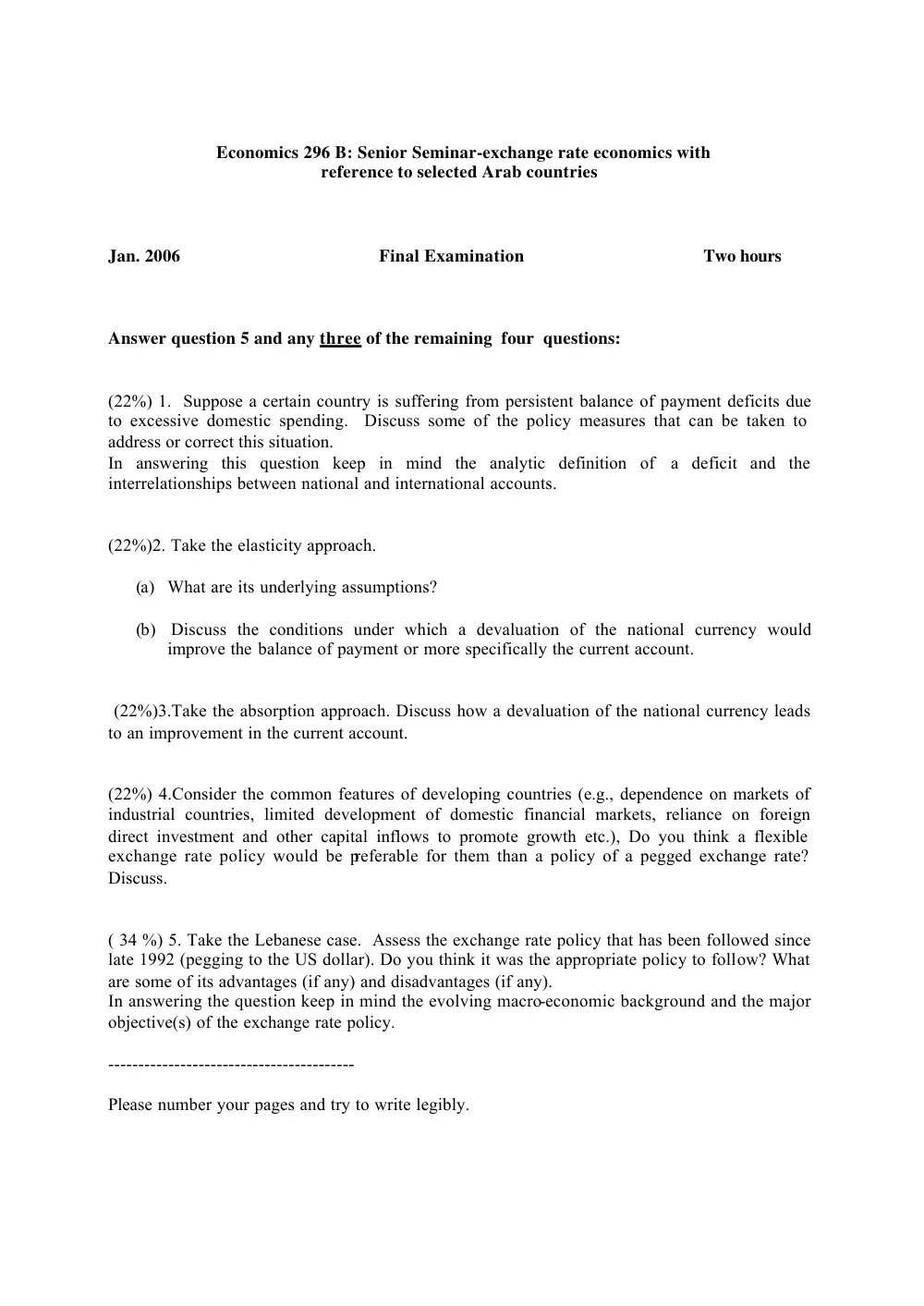
Show the text of this final exam
Economics 296 B: Senior Seminar-exchange rate economics with
reference to selected Arab countries
Jan. 2006
Final Examination
Two hours
Answer question 5 and any three of the remaining four questions:
(22%) 1. Suppose a certain country is suffering from persistent balance of payment deficits due
to excessive domestic spending. Discuss some of the policy measures that can be taken to
address or correct this situation.
In answering this question keep in mind the analytic definition of a deficit and the
interrelationships between national and international accounts.
(22%)2. Take the elasticity approach.
(a) What are its underlying assumptions?
(b) Discuss the conditions under which a devaluation of the national currency would
improve the balance of payment or more specifically the current account.
(22%)3.Take the absorption approach. Discuss how a devaluation of the national currency leads
to an improvement in the current account.
(22%) 4.Consider the common features of developing countries (e.g., dependence on markets of
industrial countries, limited development of domestic financial markets, reliance on foreign
direct investment and other capital inflows to promote growth etc.), Do you think a flexible
exchange rate policy would be preferable for them than a policy of a pegged exchange rate?
Discuss.
( 34 %) 5. Take the Lebanese case. Assess the exchange rate policy that has been followed since
late 1992 (pegging to the US dollar). Do you think it was the appropriate policy to follow? What
are some of its advantages (if any) and disadvantages (if any).
In answering the question keep in mind the evolving macro-economic background and the major
objective(s) of the exchange rate policy.
-----------------------------------------
Please number your pages and try to write legibly.