
EDUC 211 Final, Fall 2005
American University of Beirut · The School and the Social Order · 2 pages
More EDUC 211 files
Show the text of this final exam
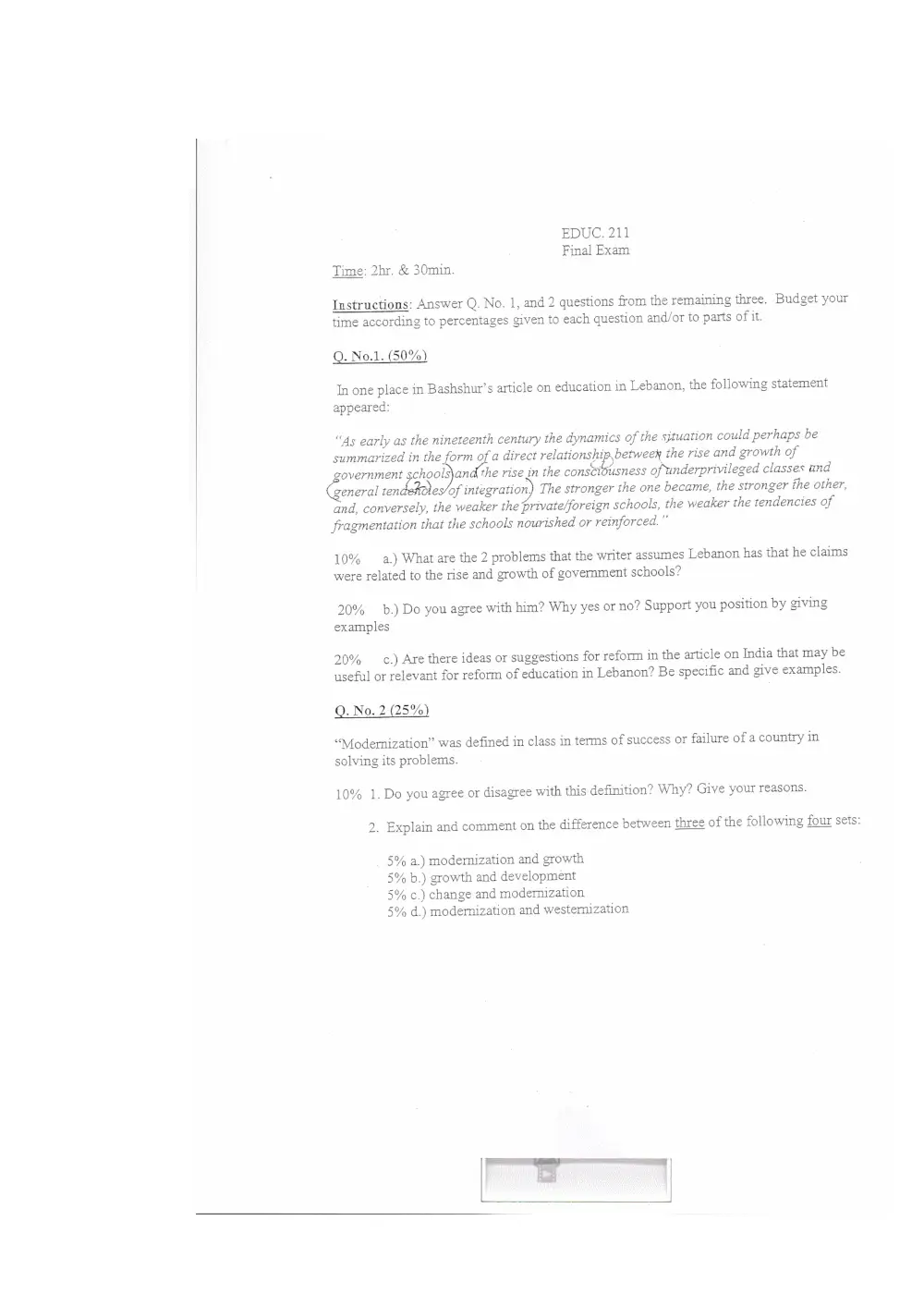
EDUC. 211
Final Exam
Time: 2hr. & 30min.
Instructions: Answer Q. No. 1, and 2 questions from the remaining three. Budget your
time according to percentages given to each question and/or to parts of it.
Q. No.1. (50%)
In one place in Bashshur’s article on education in Lebanon, the following statement
appeared:
“4s early as the nineteenth century the dynamics of the sjtuation could perhaps be
summarized in the form of a direct relationship, betweex the rise and growth of
government sgl the rise in the conscibusness of underprivileged classes und
General tendehohe of integration) The stronger the one became, the stronger the other,
and, conversely, the weaker the private/foreign schools, the weaker the tendencies of
fragmentation that the schools nourished or reinforced.”
10% a.) What are the 2 problems that the writer assumes Lebanon has that he claims
were related to the rise and growth of government schools?
20% b.) Do you agree with him? Why yes or no? Support you position by giving
examples
20% c.) Are there ideas or suggestions for reform in the article on India that may be
useful or relevant for reform of education in Lebanon? Be specific and give examples.
Q. No. 2 (25%
“Modernization” was defined in class in terms of success or failure of a country in
solving its problems.
10% 1. Do you agree or disagree with this definition? Why? Give your reasons.
2. Explain and comment on the difference between three of the following four sets:
5% a.) modernization and growth
5% b.) growth and development
5% c.) change and modemization
5% d.) modemization and westernization
————
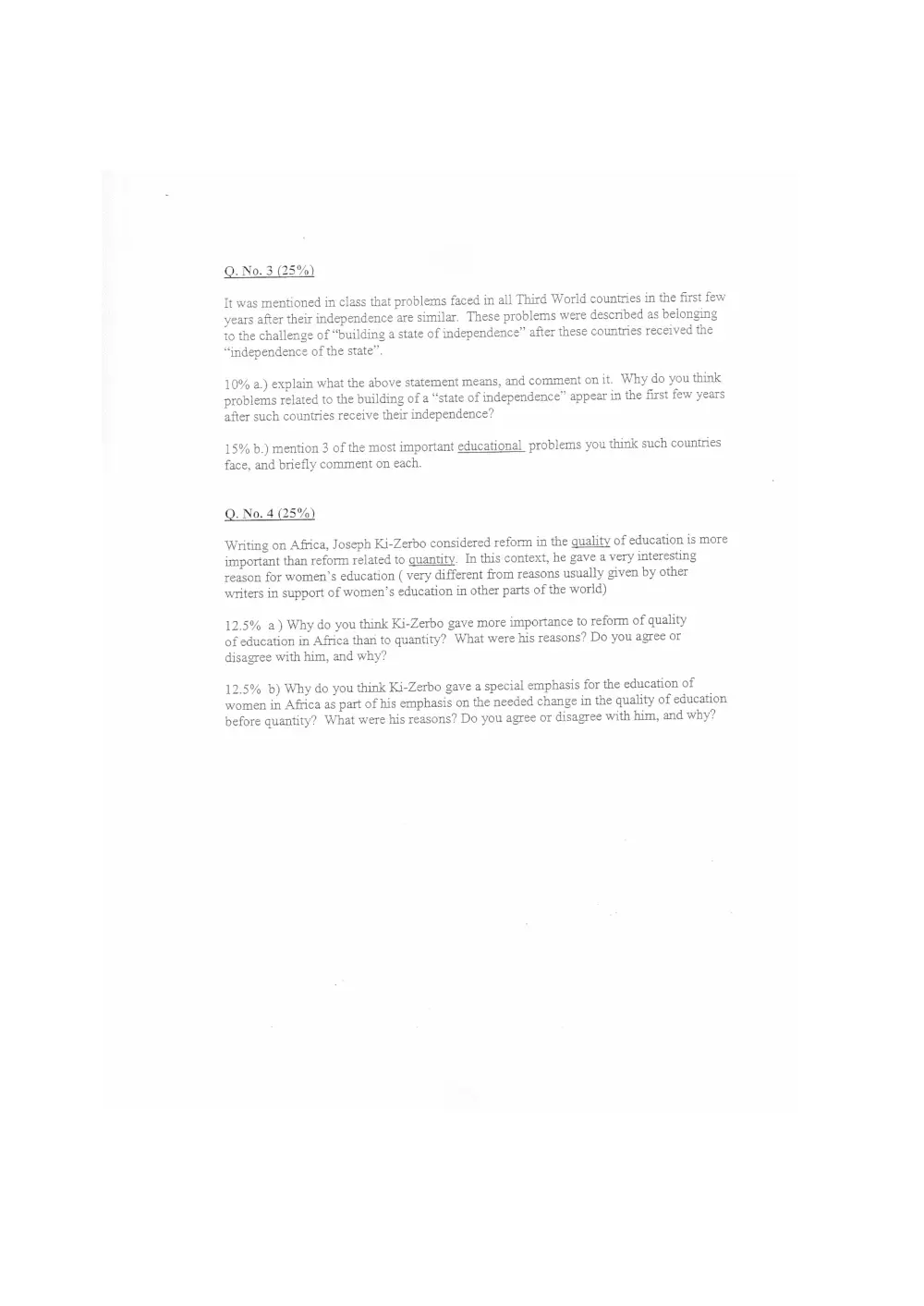
Q. No. 3 (25%)
It was mentioned in class that problems faced in all Third World countries in the first few
years after their independence are similar. These problems were described as belonging
to the challenge of “building a state of independence” after these countries received the
“independence of the state”.
10% a.) explain what the above statement means, and comment on it. Why do you think
problems related to the building of a “state of independence” appear in the first few years
after such countries receive their independence?
15% b.) mention 3 of the most important educational problems you think such countries
face, and briefly comment on each.
Q. No. 4 (25%)
Writing on Africa, Joseph Ki-Zerbo considered reform in the quality of education is more
important than reform related to quantity. In this context, he gave a very interesting
reason for women’s education ( very different from reasons usually given by other
writers in support of women’s education in other parts of the world)
12.5% a) Why do you think Ki-Zerbo gave more importance to reform of quality
of education in Africa than to quantity? What were his reasons? Do you agree or
disagree with him, and why?
12.5% b) Why do you think Ki-Zerbo gave a special emphasis for the education of
women in Africa as part of his emphasis on the needed change in the quality of education
before quantity? What were his reasons? Do you agree or disagree with him, and why?