
EDUC 216 Final, Fall 2005
American University of Beirut · Philosophy of Education · 6 pages

More EDUC 216 files
Show the text of this final exam
1
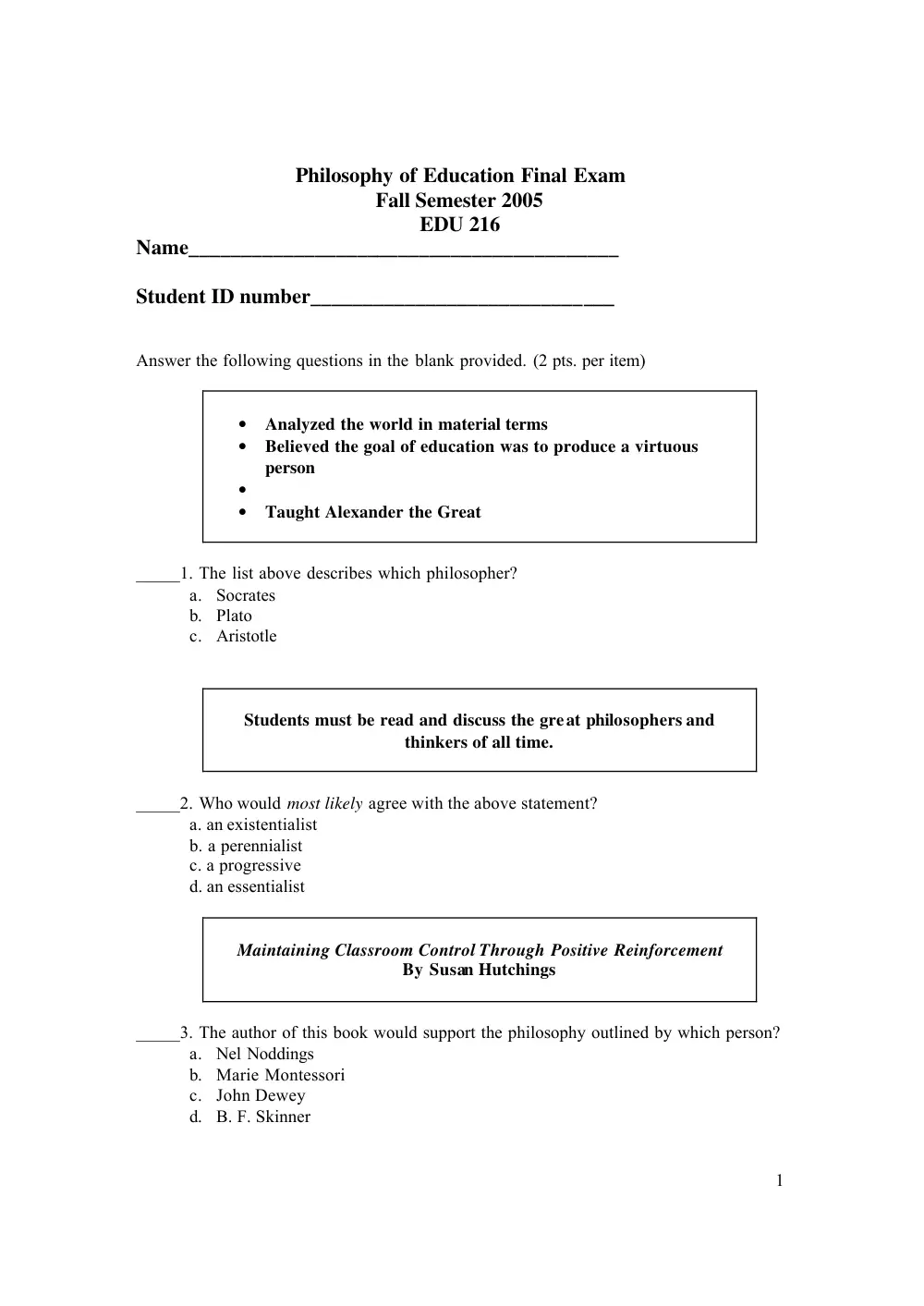
Philosophy of Education Final Exam
Fall Semester 2005
EDU 216
Name_________________________________________
Student ID number_____________________________
Answer the following questions in the blank provided. (2 pts. per item)
•
Analyzed the world in material terms
•
Believed the goal of education was to produce a virtuous
person
•
•
Taught Alexander the Great
_____1. The list above describes which philosopher?
a. Socrates
b. Plato
c. Aristotle
Students must be read and discuss the great philosophers and
thinkers of all time.
_____2. Who would most likely agree with the above statement?
a. an existentialist
b. a perennialist
c. a progressive
d. an essentialist
Maintaining Classroom Control Through Positive Reinforcement
By Susan Hutchings
_____3. The author of this book would support the philosophy outlined by which person?
a. Nel Noddings
b. Marie Montessori
c. John Dewey
d. B. F. Skinner
2
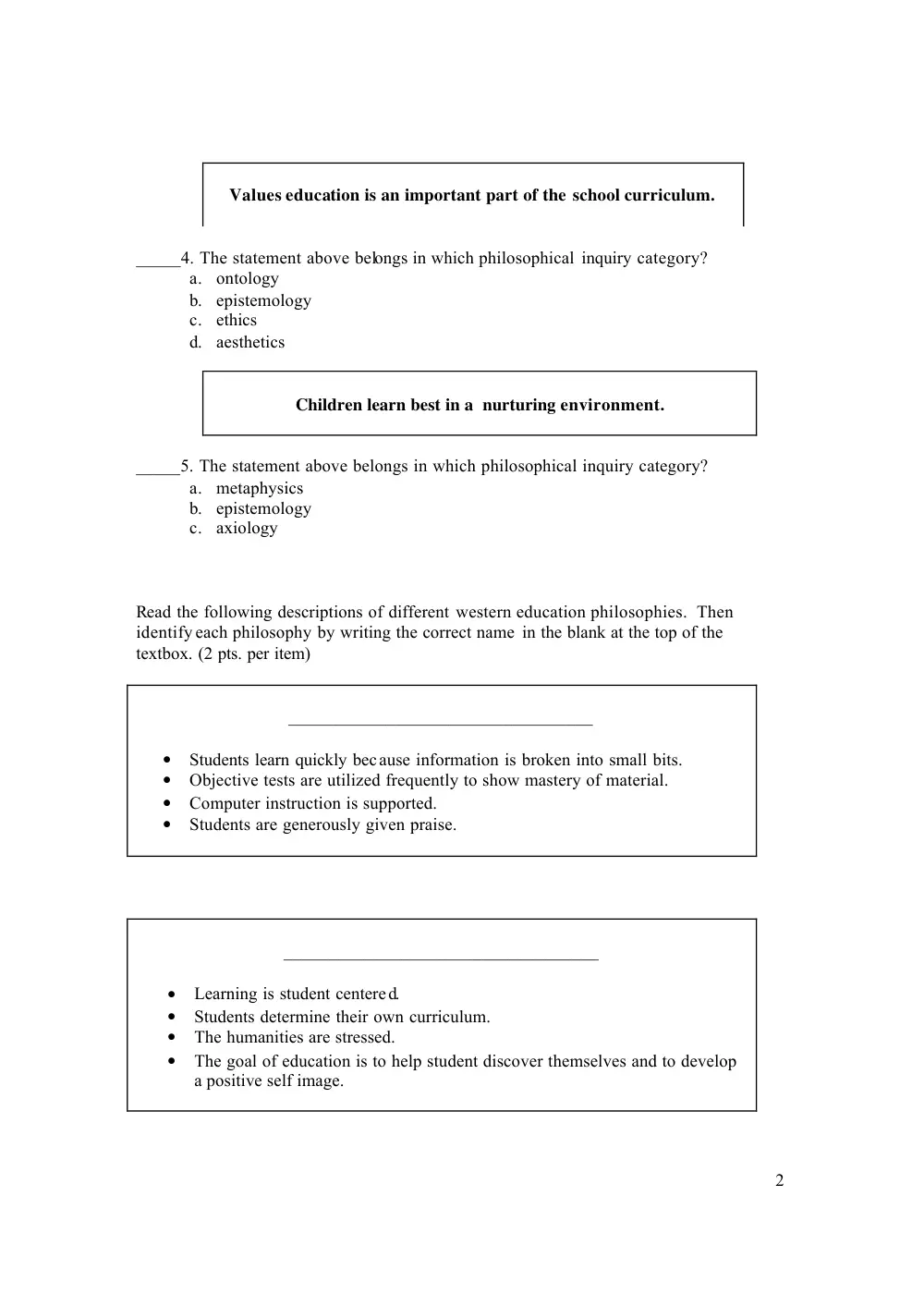
Values education is an important part of the school curriculum.
_____4. The statement above belongs in which philosophical inquiry category?
a. ontology
b. epistemology
c. ethics
d. aesthetics
Children learn best in a nurturing environment.
_____5. The statement above belongs in which philosophical inquiry category?
a. metaphysics
b. epistemology
c. axiology
Read the following descriptions of different western education philosophies. Then
identify each philosophy by writing the correct name in the blank at the top of the
textbox. (2 pts. per item)
__________________________________
• Students learn quickly because information is broken into small bits.
• Objective tests are utilized frequently to show mastery of material.
• Computer instruction is supported.
• Students are generously given praise.
___________________________________
•
Learning is student centered.
•
Students determine their own curriculum.
•
The humanities are stressed.
•
The goal of education is to help student discover themselves and to develop
a positive self image.
3
______________________________________
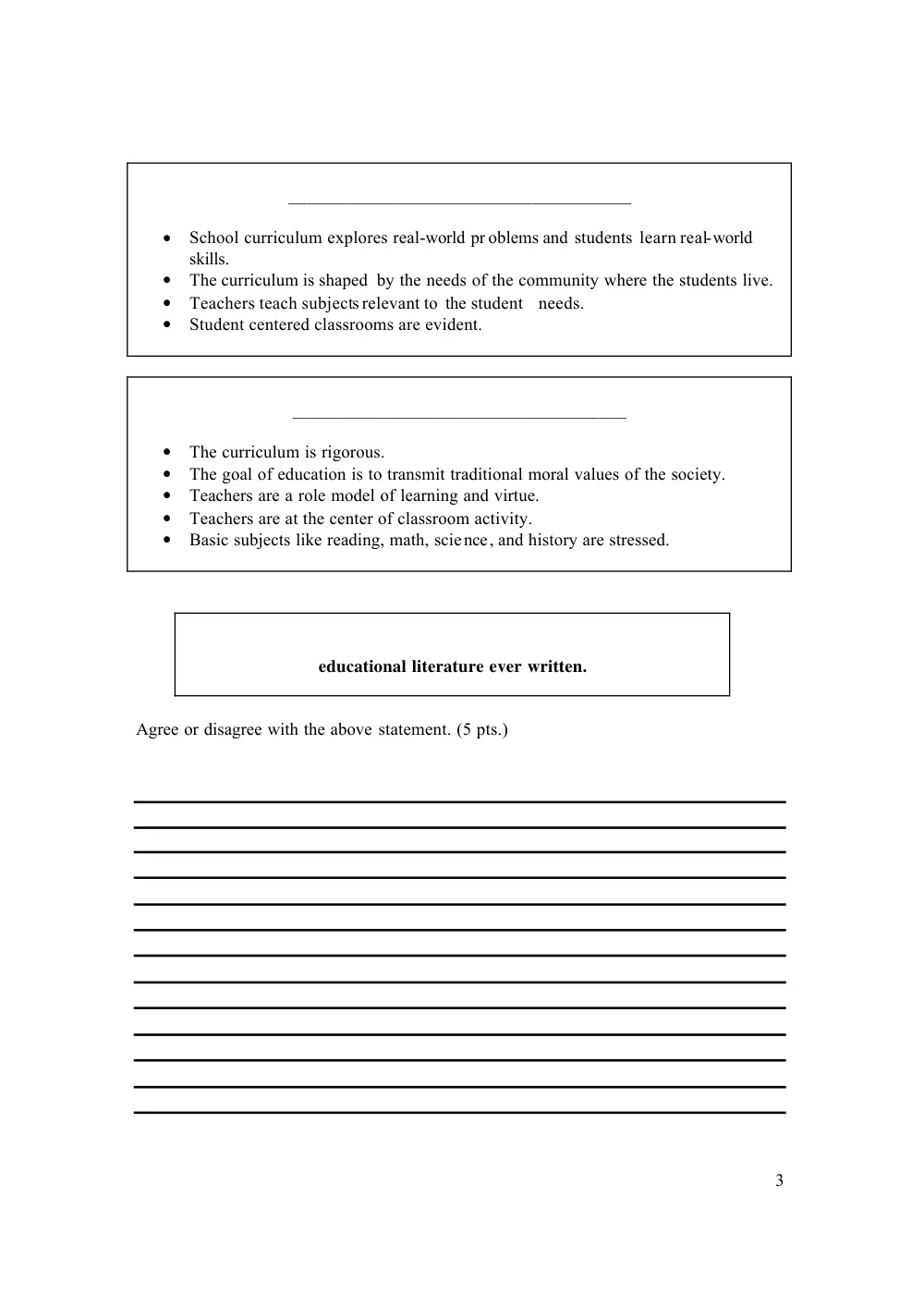
• School curriculum explores real-world pr oblems and students learn real-world
skills.
• The curriculum is shaped by the needs of the community where the students live.
• Teachers teach subjects relevant to the student needs.
• Student centered classrooms are evident.
_____________________________________
• The curriculum is rigorous.
• The goal of education is to transmit traditional moral values of the society.
• Teachers are a role model of learning and virtue.
• Teachers are at the center of classroom activity.
• Basic subjects like reading, math, science, and history are stressed.
educational literature ever written.
Agree or disagree with the above statement. (5 pts.)
4
Answer the following questions on the space provided below. (8 pts.)
As a teacher, why is it important to know your philosophy of education?
List 5 of the most important questions that you may ask to discover your
philosophy. Explain why you chose these questions. (8 pts.)
5
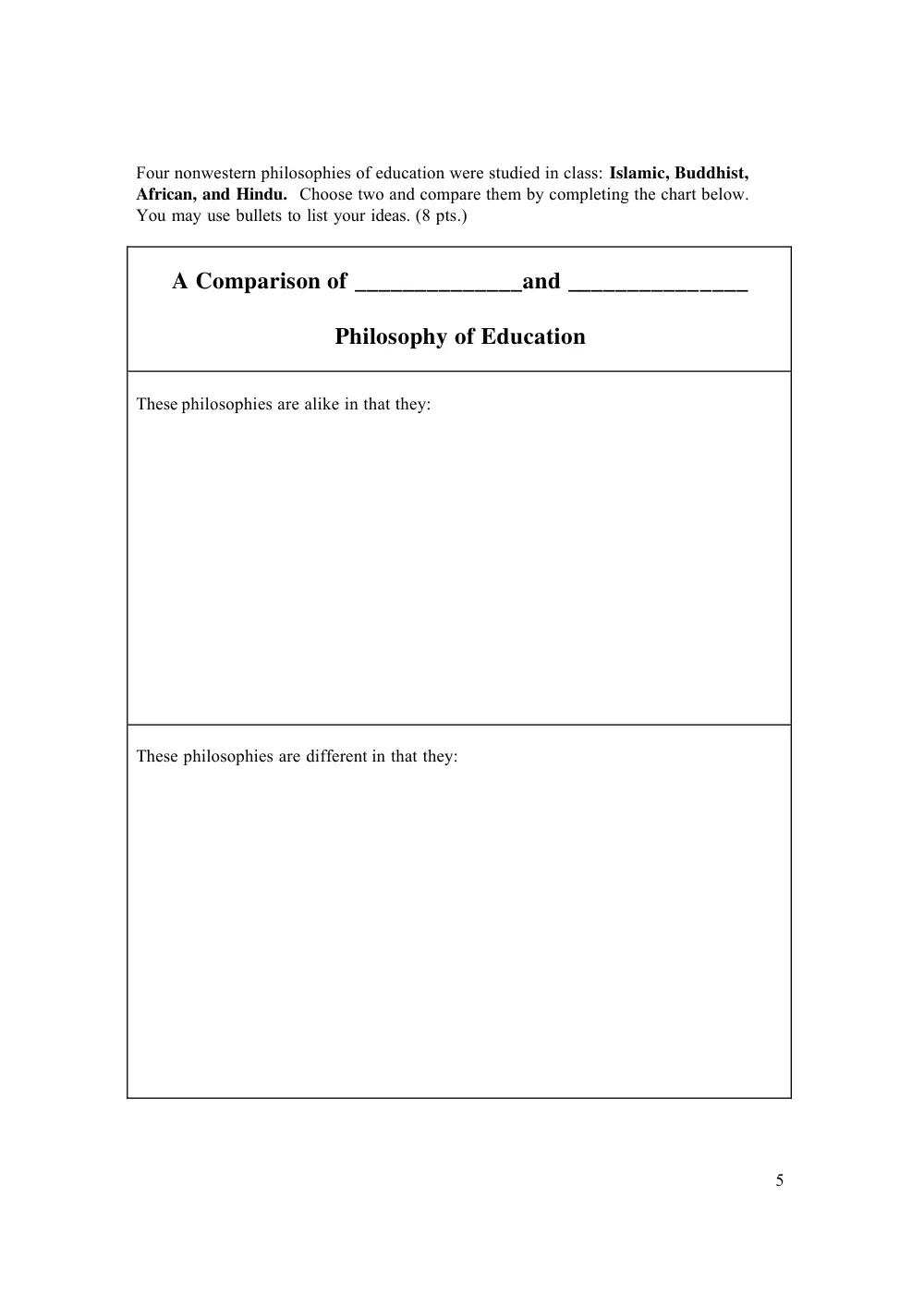
Four nonwestern philosophies of education were studied in class: Islamic, Buddhist,
African, and Hindu. Choose two and compare them by completing the chart below.
You may use bullets to list your ideas. (8 pts.)
A Comparison of ______________and _______________
Philosophy of Education
These philosophies are alike in that they:
These philosophies are different in that they:
6
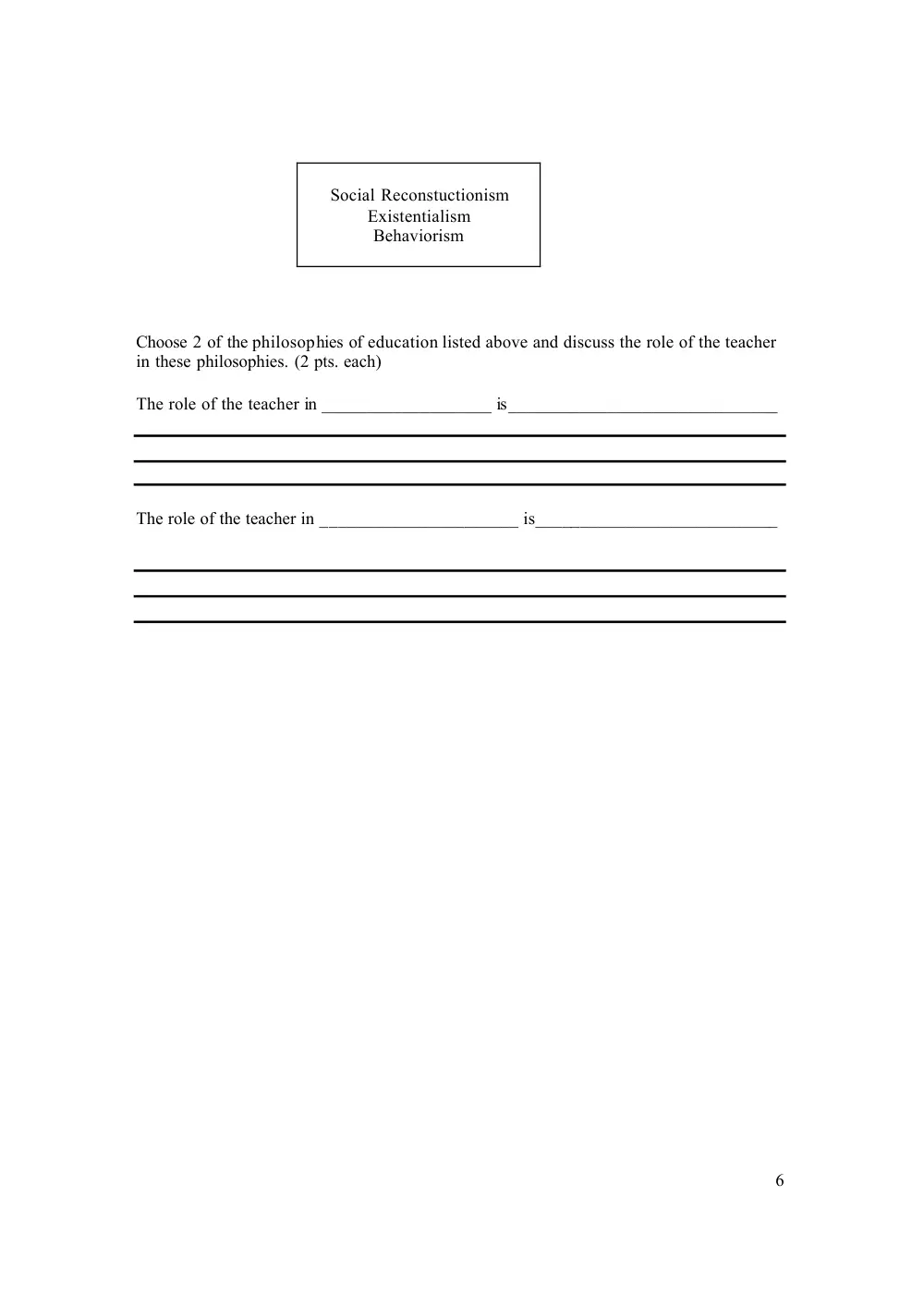
Social Reconstuctionism
Existentialism
Behaviorism
Choose 2 of the philosophies of education listed above and discuss the role of the teacher
in these philosophies. (2 pts. each)
The role of the teacher in ___________________ is______________________________
The role of the teacher in ______________________ is___________________________