
EDUC 217 Final, Fall 2005
American University of Beirut · Measurement and Evaluation for the Classroom Teachers · 7 pages

Show the text of this final exam
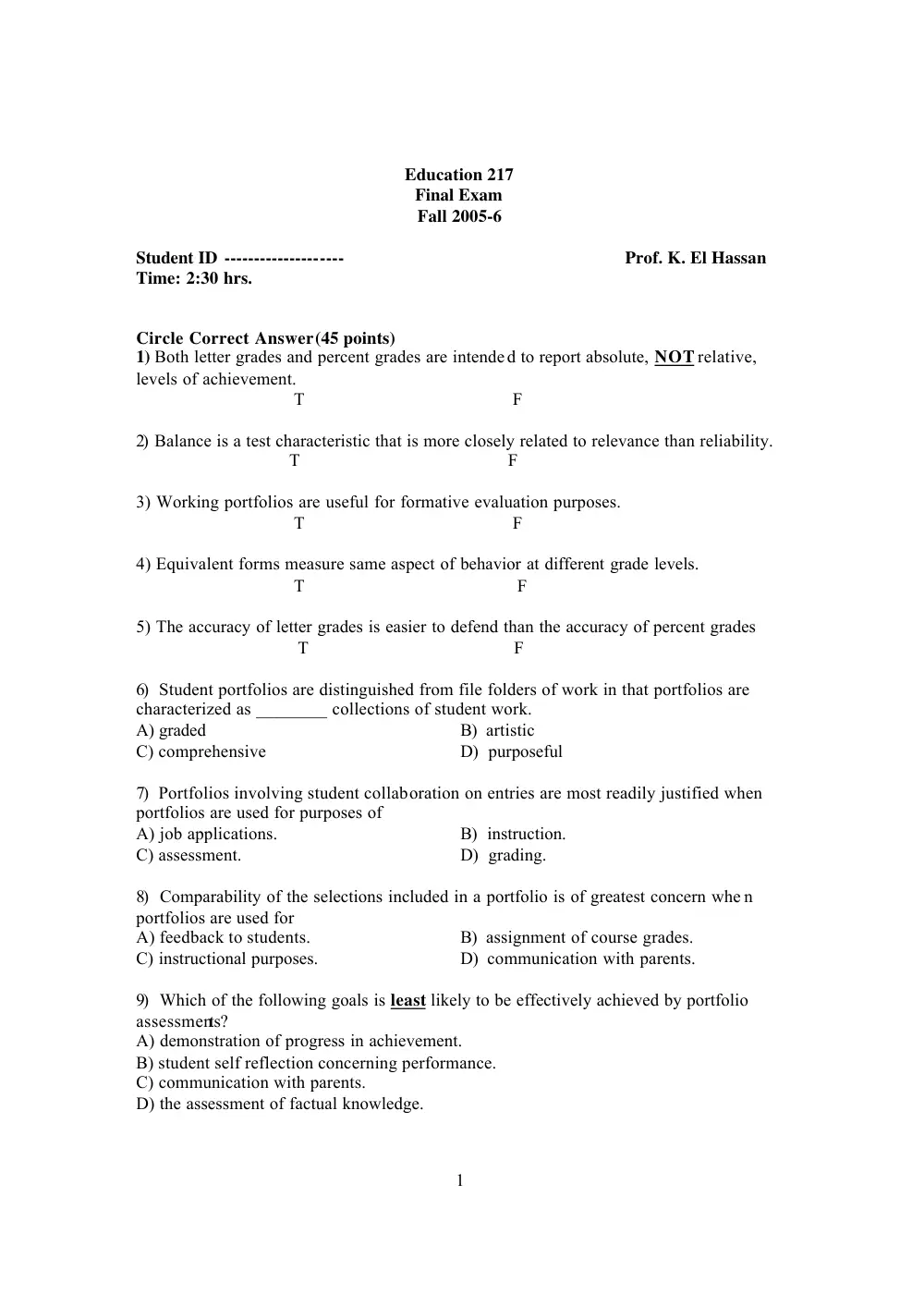
1
Education 217
Final Exam
Fall 2005-6
Student ID -------------------- Prof. K. El Hassan
Time: 2:30 hrs.
Circle Correct Answer (45 points)
1) Both letter grades and percent grades are intended to report absolute, NOT relative,
levels of achievement.
T F
2) Balance is a test characteristic that is more closely related to relevance than reliability.
T F
3) Working portfolios are useful for formative evaluation purposes.
T F
4) Equivalent forms measure same aspect of behavior at different grade levels.
T F
5) The accuracy of letter grades is easier to defend than the accuracy of percent grades
T
F
6) Student portfolios are distinguished from file folders of work in that portfolios are
characterized as ________ collections of student work.
A) graded
B) artistic
C) comprehensive
D) purposeful
7) Portfolios involving student collaboration on entries are most readily justified when
portfolios are used for purposes of
A) job applications.
B) instruction.
C) assessment.
D) grading.
8) Comparability of the selections included in a portfolio is of greatest concern whe n
portfolios are used for
A) feedback to students.
B) assignment of course grades.
C) instructional purposes.
D) communication with parents.
9) Which of the following goals is least likely to be effectively achieved by portfolio
assessments?
A) demonstration of progress in achievement.
B) student self reflection concerning performance.
C) communication with parents.
D) the assessment of factual knowledge.
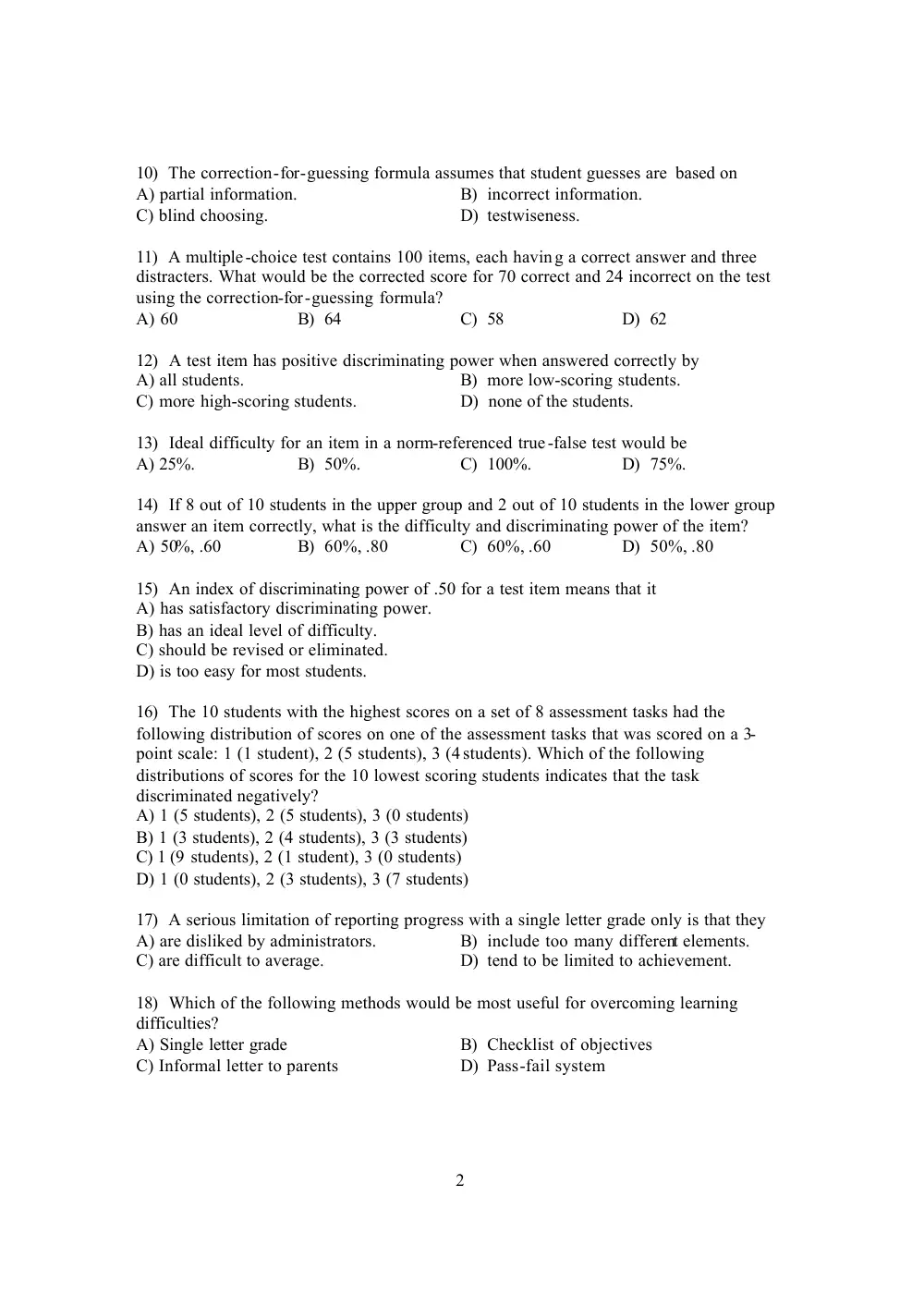
2
10) The correction-for-guessing formula assumes that student guesses are based on
A) partial information.
B) incorrect information.
C) blind choosing.
D) testwiseness.
11) A multiple-choice test contains 100 items, each having a correct answer and three
distracters. What would be the corrected score for 70 correct and 24 incorrect on the test
using the correction-for-guessing formula?
A) 60
B) 64
C) 58
D) 62
12) A test item has positive discriminating power when answered correctly by
A) all students.
B) more low-scoring students.
C) more high-scoring students.
D) none of the students.
13) Ideal difficulty for an item in a norm-referenced true-false test would be
A) 25%.
B) 50%.
C) 100%.
D) 75%.
14) If 8 out of 10 students in the upper group and 2 out of 10 students in the lower group
answer an item correctly, what is the difficulty and discriminating power of the item?
A) 50%, .60
B) 60%, .80
C) 60%, .60
D) 50%, .80
15) An index of discriminating power of .50 for a test item means that it
A) has satisfactory discriminating power.
B) has an ideal level of difficulty.
C) should be revised or eliminated.
D) is too easy for most students.
16) The 10 students with the highest scores on a set of 8 assessment tasks had the
following distribution of scores on one of the assessment tasks that was scored on a 3-
point scale: 1 (1 student), 2 (5 students), 3 (4 students). Which of the following
distributions of scores for the 10 lowest scoring students indicates that the task
discriminated negatively?
A) 1 (5 students), 2 (5 students), 3 (0 students)
B) 1 (3 students), 2 (4 students), 3 (3 students)
C) 1 (9 students), 2 (1 student), 3 (0 students)
D) 1 (0 students), 2 (3 students), 3 (7 students)
17) A serious limitation of reporting progress with a single letter grade only is that they
A) are disliked by administrators.
B) include too many different elements.
C) are difficult to average.
D) tend to be limited to achievement.
18) Which of the following methods would be most useful for overcoming learning
difficulties?
A) Single letter grade
B) Checklist of objectives
C) Informal letter to parents
D) Pass-fail system
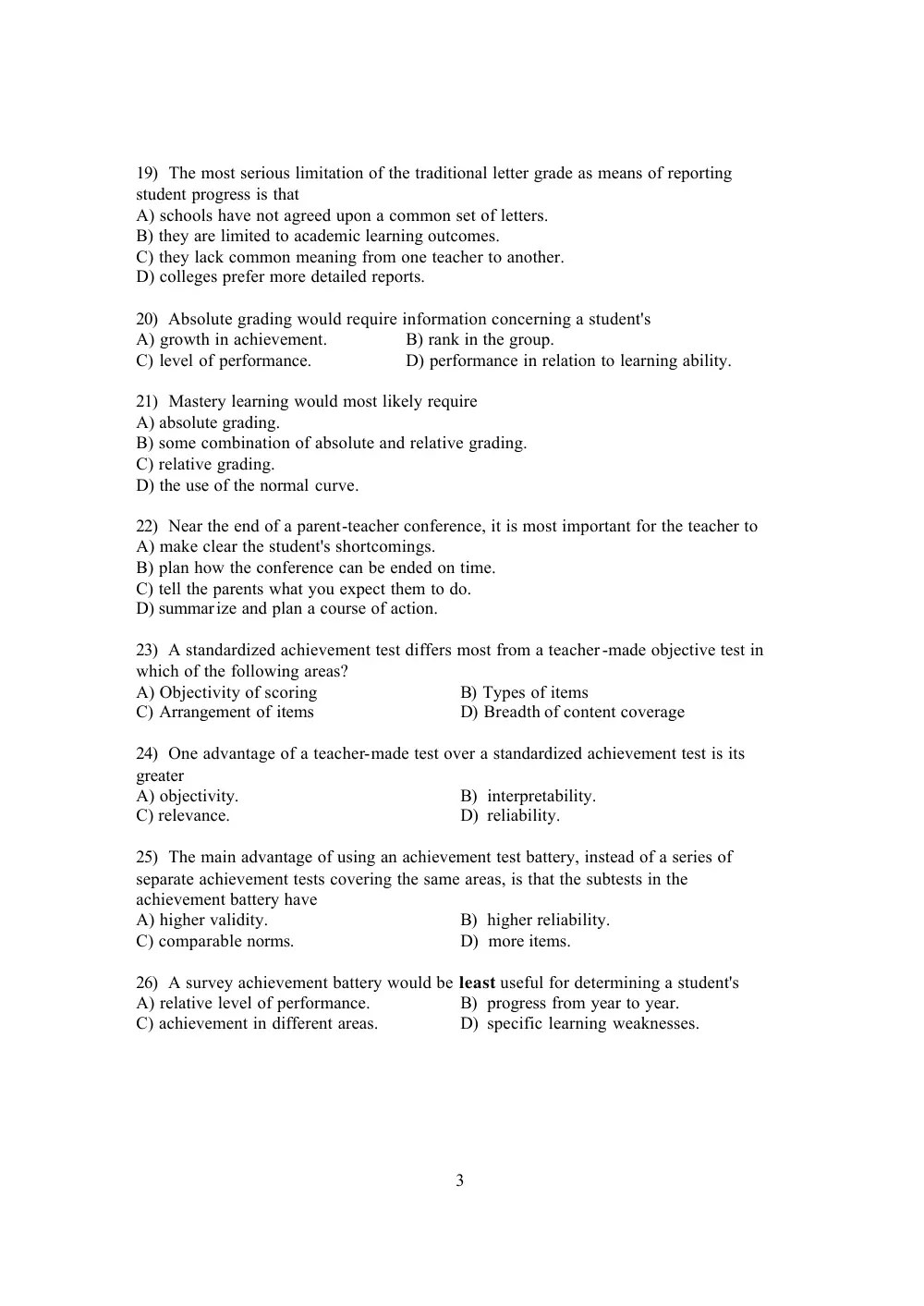
3
19) The most serious limitation of the traditional letter grade as means of reporting
student progress is that
A) schools have not agreed upon a common set of letters.
B) they are limited to academic learning outcomes.
C) they lack common meaning from one teacher to another.
D) colleges prefer more detailed reports.
20) Absolute grading would require information concerning a student's
A) growth in achievement.
B) rank in the group.
C) level of performance.
D) performance in relation to learning ability.
21) Mastery learning would most likely require
A) absolute grading.
B) some combination of absolute and relative grading.
C) relative grading.
D) the use of the normal curve.
22) Near the end of a parent-teacher conference, it is most important for the teacher to
A) make clear the student's shortcomings.
B) plan how the conference can be ended on time.
C) tell the parents what you expect them to do.
D) summarize and plan a course of action.
23) A standardized achievement test differs most from a teacher-made objective test in
which of the following areas?
A) Objectivity of scoring
B) Types of items
C) Arrangement of items
D) Breadth of content coverage
24) One advantage of a teacher-made test over a standardized achievement test is its
greater
A) objectivity.
B) interpretability.
C) relevance.
D) reliability.
25) The main advantage of using an achievement test battery, instead of a series of
separate achievement tests covering the same areas, is that the subtests in the
achievement battery have
A) higher validity.
B) higher reliability.
C) comparable norms.
D) more items.
26) A survey achievement battery would be least useful for determining a student's
A) relative level of performance.
B) progress from year to year.
C) achievement in different areas.
D) specific learning weaknesses.
4
27) Tests of learning ability differ from published achievement tests in that they
A) provide norms for score interpretation.
B) measure school objectives more effectively.
C) depend less on specific school learning.
D) are useful in predicting future achievement.
28) In the spectrum of ability tests, which test type would be farthest from the content-
oriented achievement test?
A) Tests of general educational development
B) Nonverbal test
C) School-oriented aptitude test
D) Verbal ability test
29) Which of the following tests provides highest number of subtest scores?
A) Otis-Lennon Ability Test
B) School and College Ability Tests
C) Cognitive Abilities Test
D) Differential Abilities Tests
30) Given the information below for an item on a test, where is the best distracter?
a. b c d e*
U 1 2 3 4 15
L 0 16 3 5 1
a. a
b. b
c. c
d. d
31) Which of the following statements is NOT true of achievement tests?
a. They require more time than intelligence tests.
b. They measure knowledge resulting from formal education.
c. They are a valid measure of potential.
d. They are fairer to people from culturally deprived areas.
32) Which of the following tests is used for measuring achievement?
a. DAT
b. ITED
c. CogAT
d. OLSAT
5
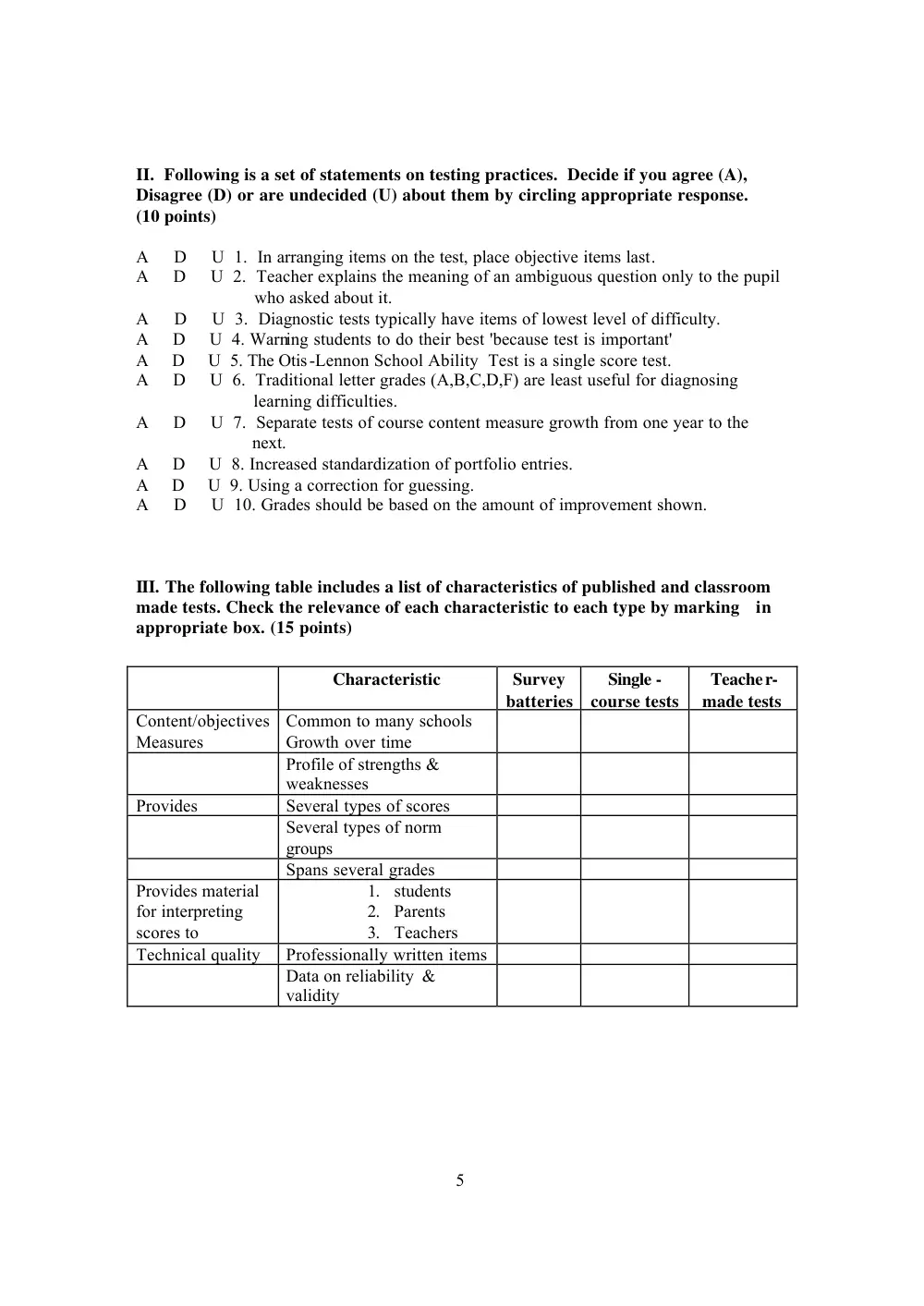
II. Following is a set of statements on testing practices. Decide if you agree (A),
Disagree (D) or are undecided (U) about them by circling appropriate response.
(10 points)
A D U 1. In arranging items on the test, place objective items last.
A D U 2. Teacher explains the meaning of an ambiguous question only to the pupil
who asked about it.
A D U 3. Diagnostic tests typically have items of lowest level of difficulty.
A D U 4. Warning students to do their best 'because test is important'
A D U 5. The Otis-Lennon School Ability Test is a single score test.
A D U 6. Traditional letter grades (A,B,C,D,F) are least useful for diagnosing
learning difficulties.
A D U 7. Separate tests of course content measure growth from one year to the
next.
A D U 8. Increased standardization of portfolio entries.
A D U 9. Using a correction for guessing.
A D U 10. Grades should be based on the amount of improvement shown.
III. The following table includes a list of characteristics of published and classroom
made tests. Check the relevance of each characteristic to each type by marking in
appropriate box. (15 points)
Characteristic
Survey
batteries
Single -
course tests
Teacher-
made tests
Content/objectives Common to many schools
Measures
Growth over time
Profile of strengths &
weaknesses
Provides
Several types of scores
Several types of norm
groups
Spans several grades
Provides material
for interpreting
scores to
1. students
2. Parents
3. Teachers
Technical quality
Professionally written items
Data on reliability &
validity
6
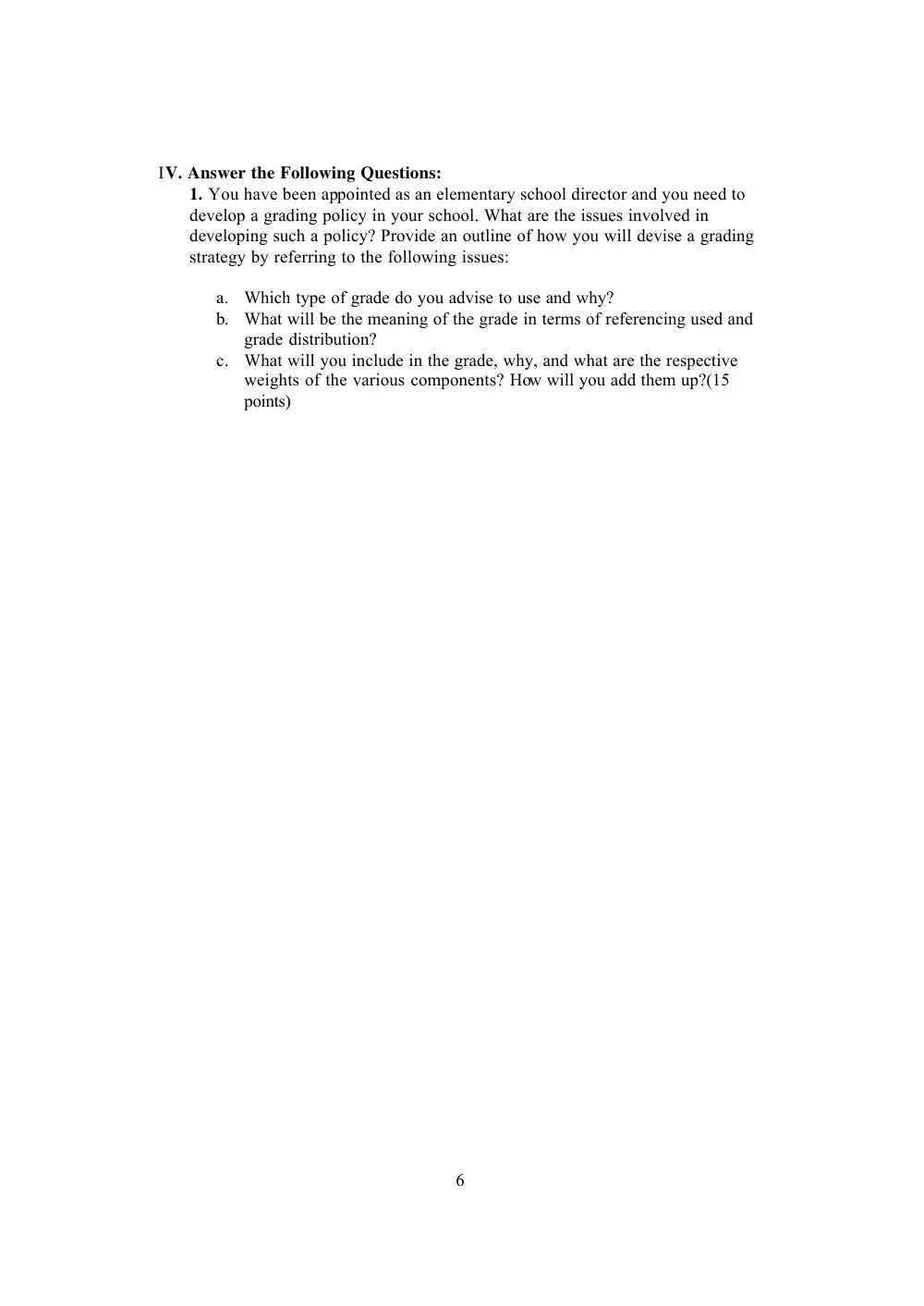
IV. Answer the Following Questions:
1. You have been appointed as an elementary school director and you need to
develop a grading policy in your school. What are the issues involved in
developing such a policy? Provide an outline of how you will devise a grading
strategy by referring to the following issues:
a. Which type of grade do you advise to use and why?
b. What will be the meaning of the grade in terms of referencing used and
grade distribution?
c. What will you include in the grade, why, and what are the respective
weights of the various components? How will you add them up?(15
points)
7
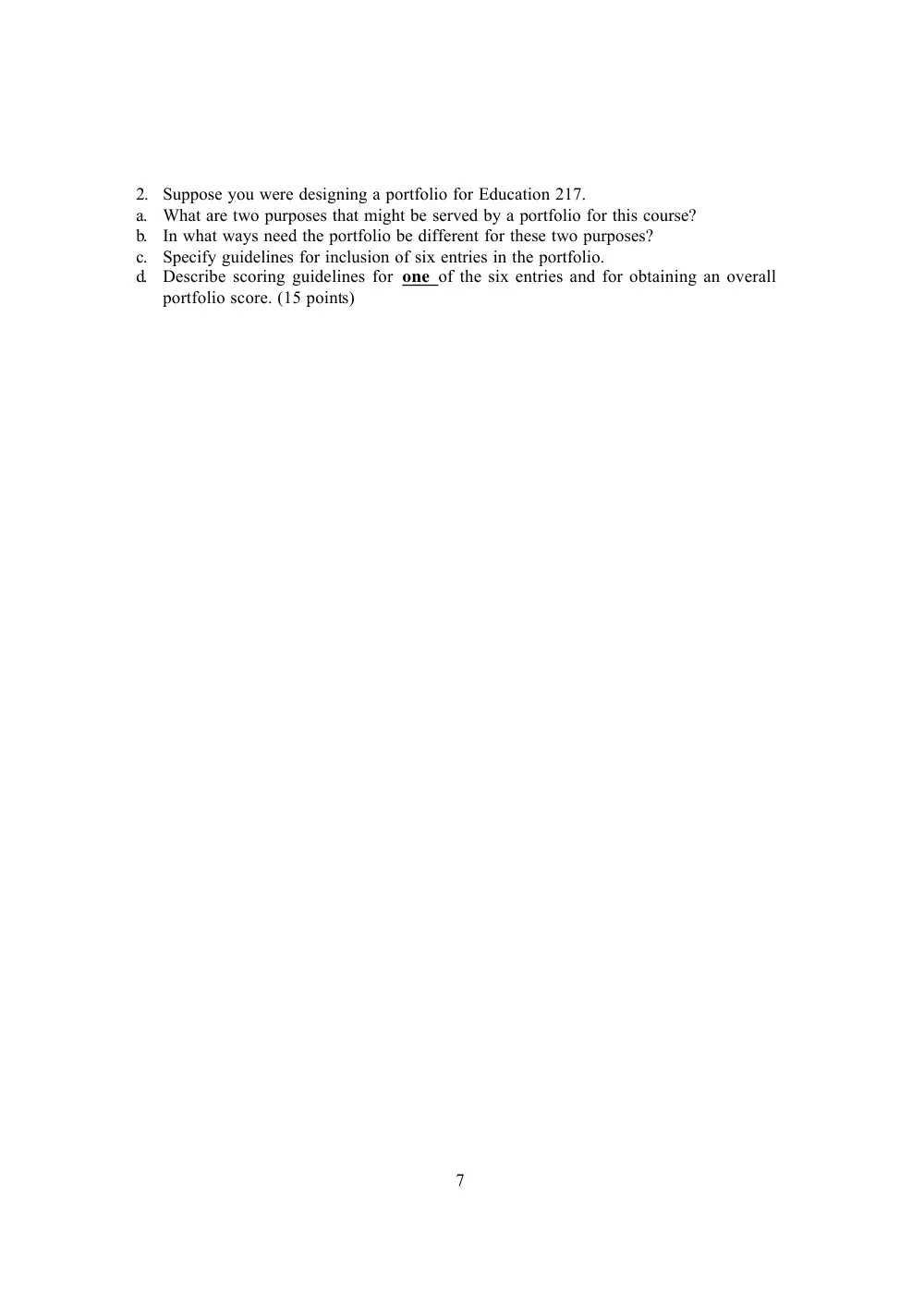
2. Suppose you were designing a portfolio for Education 217.
a. What are two purposes that might be served by a portfolio for this course?
b. In what ways need the portfolio be different for these two purposes?
c. Specify guidelines for inclusion of six entries in the portfolio.
d. Describe scoring guidelines for one of the six entries and for obtaining an overall
portfolio score. (15 points)