
EDUC 222 Final, Fall 2005
American University of Beirut · Introduction to Assessment in Special Education · 8 pages


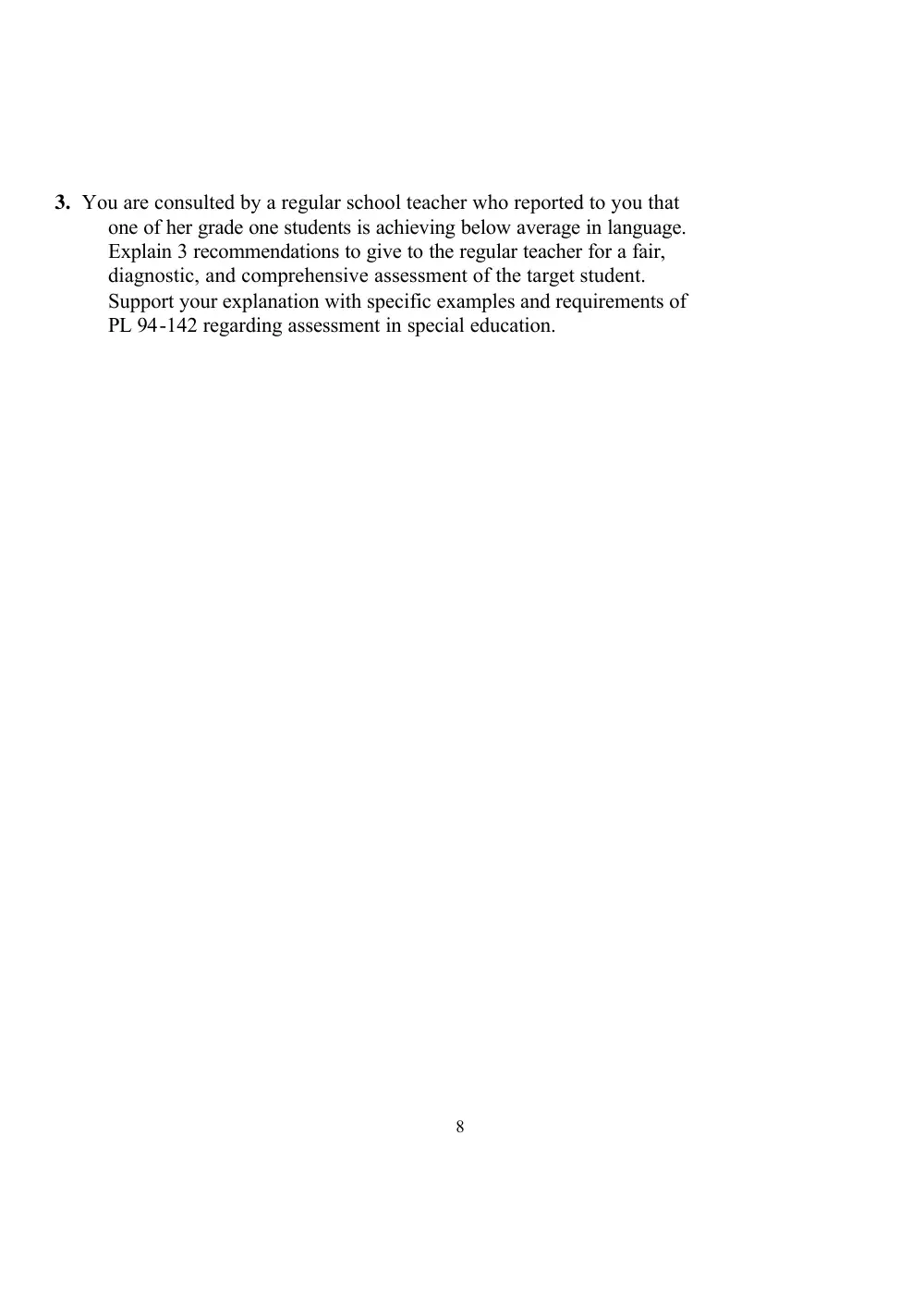
Show the text of this final exam
1
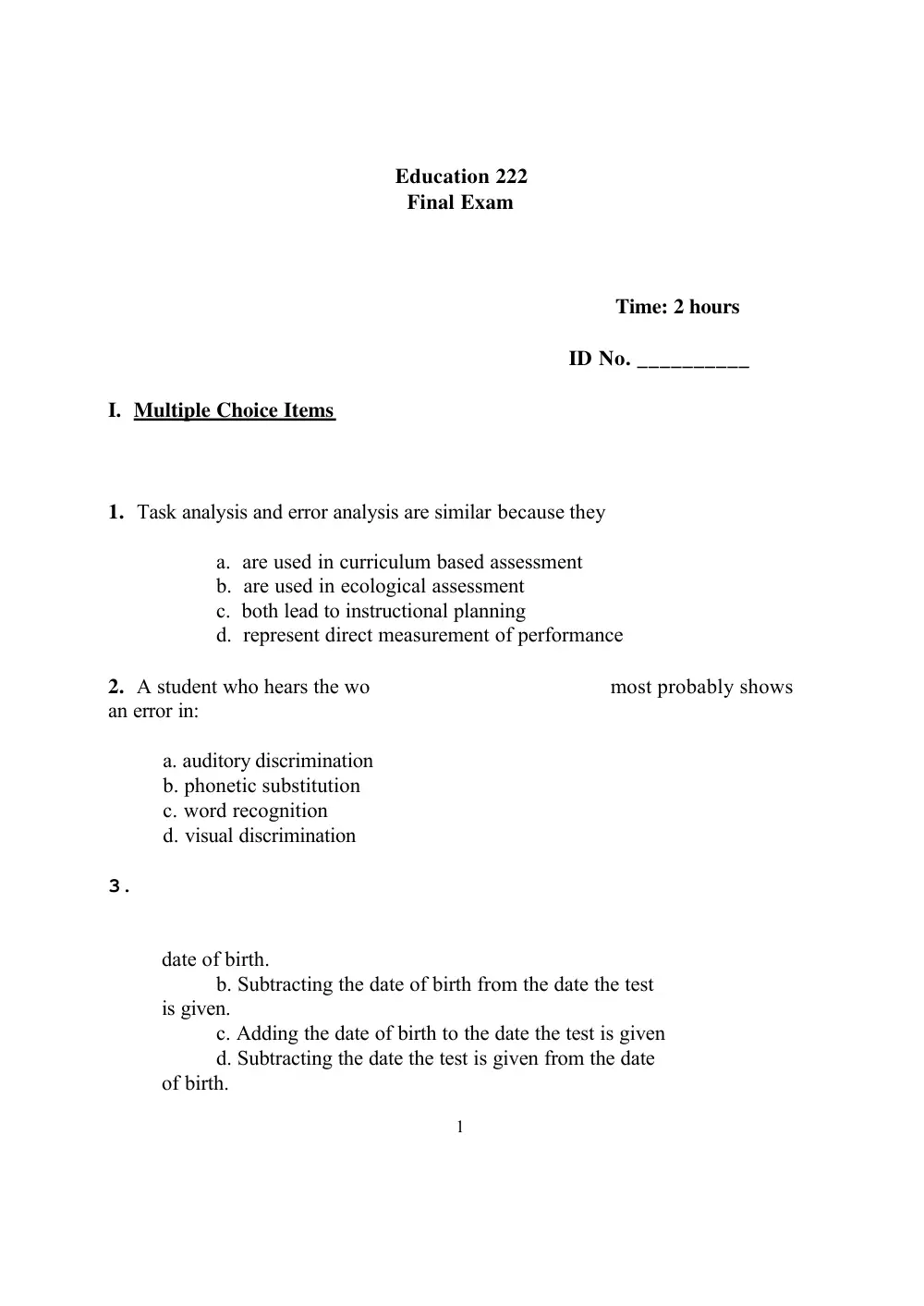
Education 222
Final Exam
Time: 2 hours
ID No. __________
I. Multiple Choice Items
1. Task analysis and error analysis are similar because they
a. are used in curriculum based assessment
b. are used in ecological assessment
c. both lead to instructional planning
d. represent direct measurement of performance
2. A student who hears the wo
most probably shows
an error in:
a. auditory discrimination
b. phonetic substitution
c. word recognition
d. visual discrimination
3.
date of birth.
b. Subtracting the date of birth from the date the test
is given.
c. Adding the date of birth to the date the test is given
d. Subtracting the date the test is given from the date
of birth.
2
4. A student who hears the word "house" and writes "home" requires
an informal assessment of
a. linguistic substitution error
b. receptive language error
c. phonetic sequencing error
d. none of the above
5. A subtest on the Developmental Test of Visual Perception 2 where
performance is influenced by short-term visual memory is:
a. form constancy
b. spatial relations
c. both a & b
d. none of the above
6. Which of the following represents an example of derived scores
that are often reported for standardized tests because they are
relatively easier to understand:
a. scaled scores
b. raw scores
c. percentile ranks
d. standard deviations
7. An advantage of the Woodcock Johnson Psycho -educational Battery
over the Wechsler Scales is that the Woodcock Johnson:
a. is used as an informal measure of cognitive abilities.
b. assesses intra and interindividual processes which are
not represented on the Wechsler
c. has norm tables for minority and social need
populations
d. all of the above
3
8. All of following instruments measure perceptual-motor abilities
except the:
a. Bender-Visual Gestalt test
b. Draw A Man Test
c. DIAL-R
d. None of the above
9. The purpose of conducting assessment of skills such as memory and
attention is:
a. to identify learner aptitudes that, with instruction,
contribute to raised performance levels.
b. to determine the degree to which memory or attention
skills diminish achievement test results.
c. to extend the range of standardized tests administered
for a complete learner profile.
d. to establish the discrepancy between memory and
attention for adaptive behavior scores.
10. The primary purpose of the reading subtest on the Woodcock
Johnson Psycho-educational Battery is:
a.
b. identifying specific strengths and weaknes ses in
reading.
c. identifying students who need special instruction.
d. none of the above.
11. Assessing fine motor ability involves evaluating movement skills in
all of the following areas except:
a. drawing
b. grasping
c. cutting with scissors
d. catching a ball
4
12. Deficits in visual memory may:
a. Not be measured adequately on perceptual tests
b. Be more common than auditory memory deficits
c. Be developmental
d. Be linked with difficulty in retaining what is read.
13. A quick measure of visual perceptual deficits is the:
a. Goodenough - Harris Drawing Test
b. Draw-A-Person
c. Motor-Free Visual perception System
d. Watkins Bender-Gestalt Scoring System
14. A test that yield a single measure of receptive vocabulary is:
a. The Test for Auditory Comprehension of Language - R
b. Test of Word Finding
c. The Preschool Language Scale-3
d. None of the above
15. The language skills used in speaking or writing are:
a. Receptive language skills
b. speech skills
c. Expressive language skills
d. Developmental language skills
5
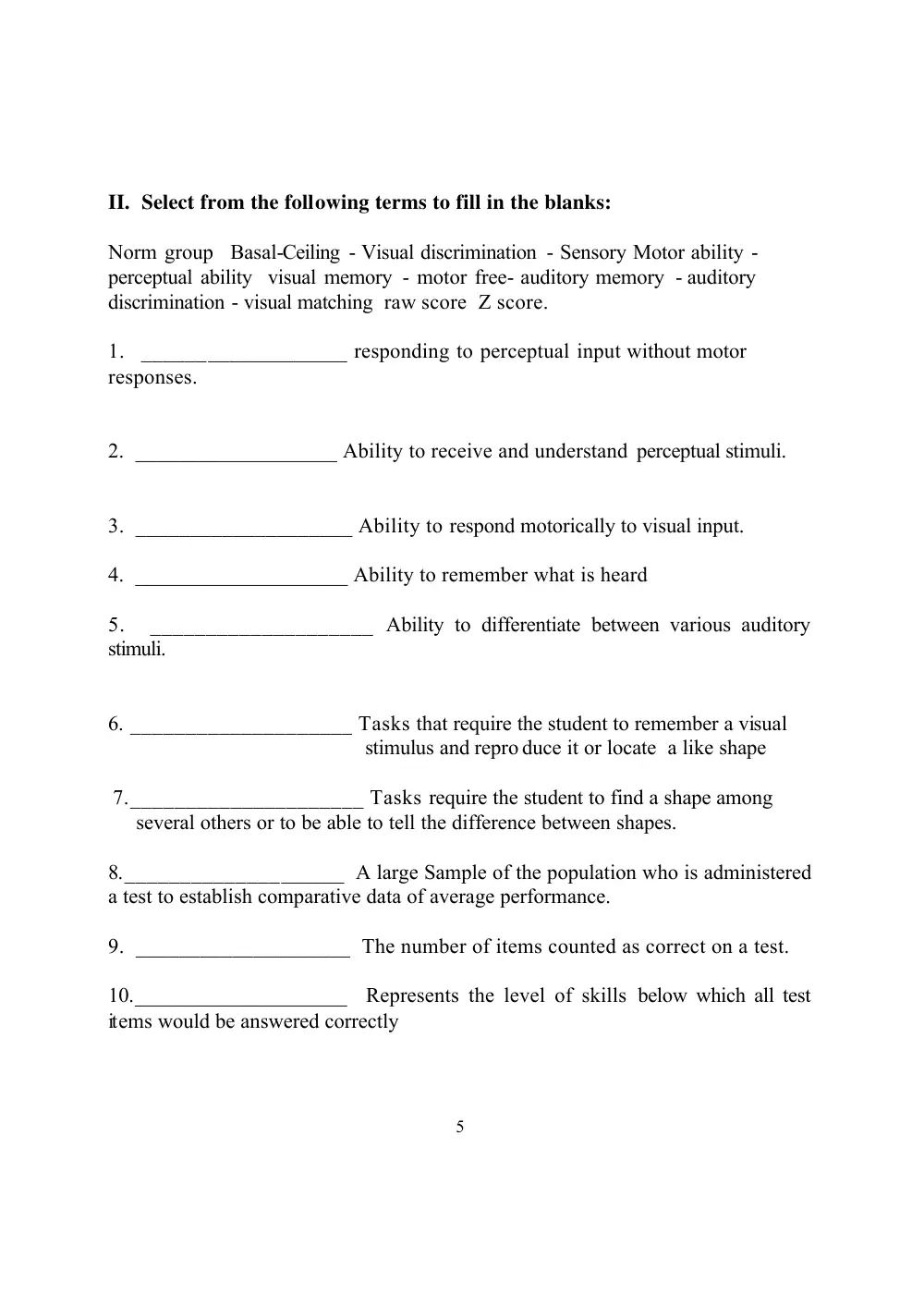
II. Select from the following terms to fill in the blanks:
Norm group Basal-Ceiling - Visual discrimination - Sensory Motor ability -
perceptual ability visual memory - motor free- auditory memory - auditory
discrimination - visual matching raw score Z score.
1. ___________________ responding to perceptual input without motor
responses.
2. ___________________ Ability to receive and understand perceptual stimuli.
3. ____________________ Ability to respond motorically to visual input.
4. ____________________ Ability to remember what is heard
5. ____________________ Ability to differentiate between various auditory
stimuli.
6. ____________________ Tasks that require the student to remember a visual
stimulus and repro duce it or locate a like shape
7._____________________ Tasks require the student to find a shape among
several others or to be able to tell the difference between shapes.
8.____________________ A large Sample of the population who is administered
a test to establish comparative data of average performance.
9. ____________________ The number of items counted as correct on a test.
10.____________________ Represents the level of skills below which all test
items would be answered correctly
6
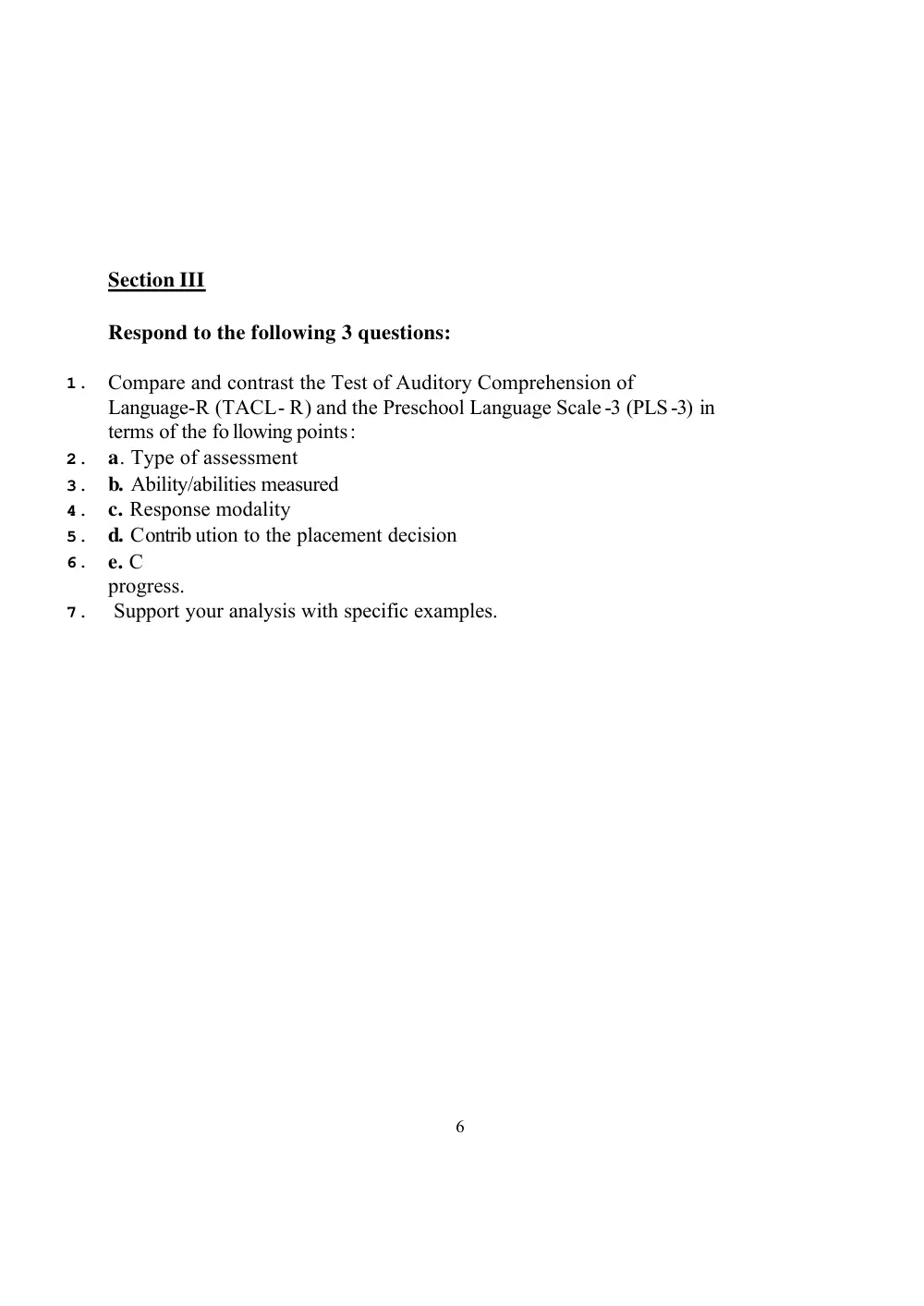
Section III
Respond to the following 3 questions:
1. Compare and contrast the Test of Auditory Comprehension of
Language-R (TACL- R) and the Preschool Language Scale -3 (PLS-3) in
terms of the fo llowing points:
2. a. Type of assessment
3. b. Ability/abilities measured
4. c. Response modality
5. d. Contrib ution to the placement decision
6. e. C
progress.
7. Support your analysis with specific examples.
7
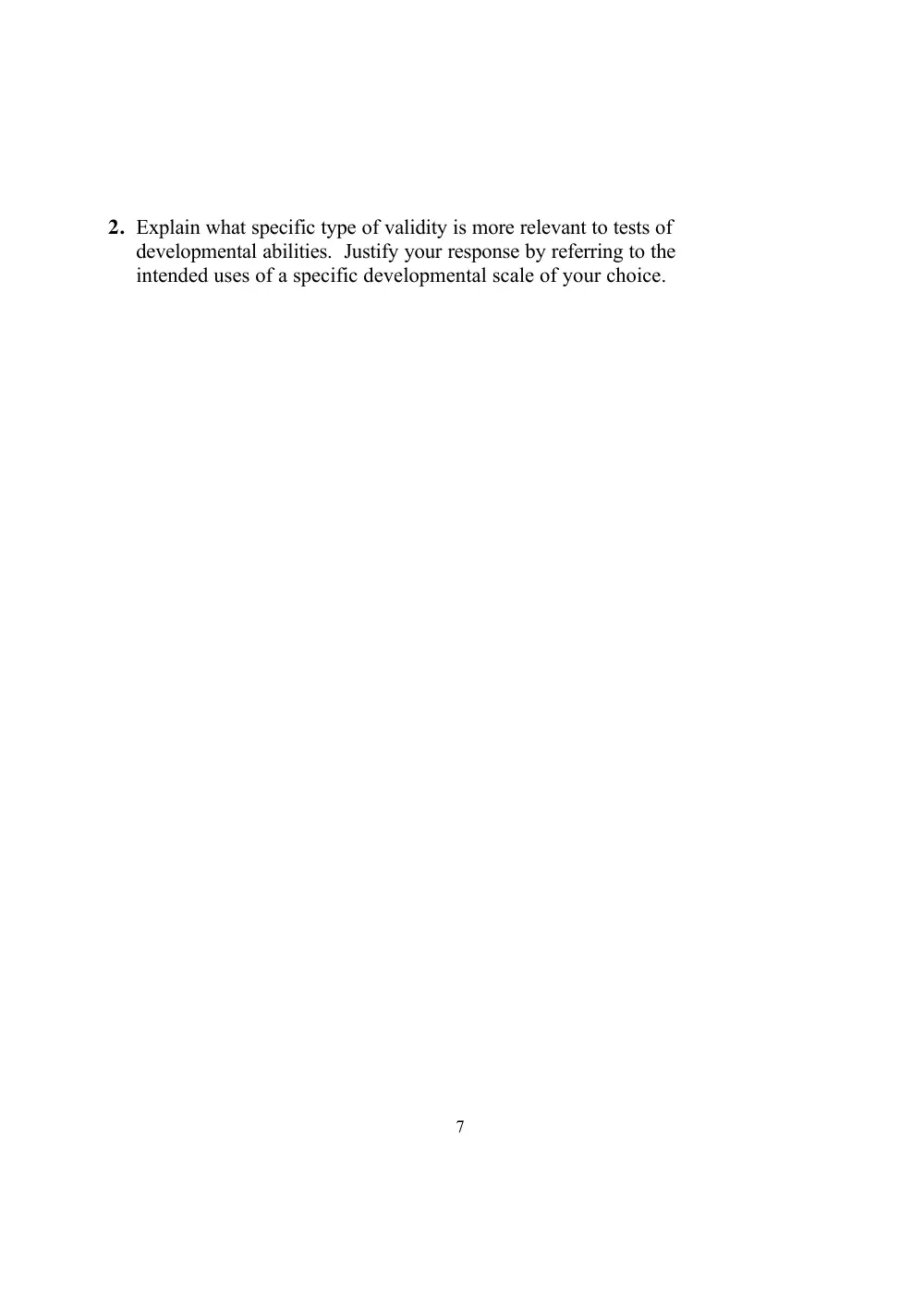
2. Explain what specific type of validity is more relevant to tests of
developmental abilities. Justify your response by referring to the
intended uses of a specific developmental scale of your choice.
8
3. You are consulted by a regular school teacher who reported to you that
one of her grade one students is achieving below average in language.
Explain 3 recommendations to give to the regular teacher for a fair,
diagnostic, and comprehensive assessment of the target student.
Support your explanation with specific examples and requirements of
PL 94-142 regarding assessment in special education.